
Package 18: Ajanta Ellora Caves Tour India
Mumbai – Aurangabad – Ajanta – Ellora – Mumbai
Duration: 5 Days / 4 Nights
Price: Request For Price (Rates based on twin sharing accommodation)
Private AC Car | Fast AC Train | Morning Breakfast
Best for: UNESCO heritage lovers, history explorers, culture travellers, photographers, architecture fans, International tourists, offbeat India explorers
The Caves That Rewrote What Human Hands Are Capable Of
There are heritage sites that impress you. There are heritage sites that educate you. And then, very rarely, there are heritage sites that do something more fundamental that stop you in your tracks, that make you question your assumptions about what ancient civilisations were capable of, that produce in the most seasoned traveller a silence of genuine, unperformed awe.
Ajanta and Ellora are in that final, rarest category.
Together, these two UNESCO World Heritage Sites in the Marathwada region of Maharashtra represent perhaps the single greatest concentration of ancient rock-cut architecture and art in the world. Not in India, in the world. The cave temples of Ajanta, with their extraordinary Buddhist paintings preserved in vivid colour across walls carved from sheer cliff face nearly two thousand years ago. The cave temples of Ellora, where Hindu, Buddhist, and Jain craftsmen worked side by side across five centuries to create a complex of thirty-four caves of extraordinary ambition, including the Kailasa Temple, a structure so improbable, so magnificent, so far beyond what the designation "cave temple" prepares you for, that scholars and architects and engineers who come to study it often leave having revised their entire understanding of what is architecturally possible.
These are not tourist attractions in any ordinary sense. They are among the great achievements of human civilisation, on the same level, in their own way, as the Parthenon, the Colosseum, or the Pyramids. And unlike many of the world's great heritage sites, they remain, even now, genuinely accessible, genuinely uncrowded by international standards, and genuinely capable of delivering the kind of direct, unmediated encounter with ancient greatness that the most significant sites often frustratingly withhold.
The Ajanta & Ellora Cave Discovery Tour, brings you here from Mumbai in complete comfort, using the Fast AC Train to cover the distance to Aurangabad efficiently and pleasantly, and a private car for all local travel. In five days and four nights, it delivers two of the greatest heritage experiences available anywhere on Earth, paced correctly, planned carefully, and delivered without the confusion or rush that can reduce even the finest monuments to a blur of photographs and exhaustion.
This is the tour for travellers who understand that some things deserve to be seen properly.
Day by Day Itinerary
Day 1: Arrival in Mumbai - First Evening in India's Most Electric City
At Chhatrapati Shivaji Maharaj International Airport, our private representative will be waiting to welcome you and transfer you to your hotel in a private, air-conditioned vehicle. Mumbai greets every arrival with the same tremendous energy, the scale of the city, the harbour light, the traffic, the smell of the sea and the street and even a short transfer from the airport carries a charge of arrival that is entirely its own.
The first evening is intentionally relaxed. After a long international flight, rest is the priority — but if time and energy permit, Mumbai offers the perfect gentle introduction:
Marine Drive & Gateway of India - A coastal drive along Marine Drive as the sun sets over the Arabian Sea, followed by a stop at the Gateway of India on the harbour front, gives you the two most iconic images of Mumbai in a single, unhurried hour. The Gateway lit against the dark harbour, the Taj Mahal Palace Hotel behind it, the fishing boats and tourist launches on the water, it is a first encounter with India that is simultaneously overwhelming and completely welcoming.
Nearby Markets - A wander through the lanes near your hotel, wherever in the city you are staying, delivers the specific pleasure of a Mumbai neighbourhood at dusk: street food stalls operating at full capacity, the smell of vada-pav frying and chai brewing, the relentless, cheerful commerce of a city that does not stop.
Rest well tonight. Tomorrow is a travel day, and the caves are waiting beyond it.
Day 2: Mumbai → Aurangabad by Fast AC Train - The Journey to the Gateway of the Caves
After a relaxed morning in Mumbai, a good breakfast, a final cup of chai, perhaps a last walk in the neighbourhood, your private car takes you to the railway station for the afternoon Fast AC Train to Aurangabad.
This is one of the specific design decisions that makes Package 18 work so well, and it is worth explaining. The distance from Mumbai to Aurangabad is approximately 335 kilometres - a journey of five to six hours by road through traffic that can be unpredictable and tiring. By Fast AC Train, the same distance is covered in a comfortable, air-conditioned carriage with complimentary snacks, meals, and mineral water served during the journey. You arrive in Aurangabad rested, fed, and ready rather than stiff from a long car journey and too tired to appreciate where you've arrived.
As the train leaves Mumbai's urban sprawl behind and moves into the Maharashtra interior, the landscape changes noticeably. The coastal density of the city gives way to the Deccan Plateau, a high, flat tableland of volcanic basalt, its red-brown soil broken by fields of cotton and sugarcane, its horizon interrupted by the occasional volcanic hill formation known as a dyke or butte, rising abruptly from the flat land around it. This is ancient geological India, the landscape shaped by volcanic forces sixty-five million years ago, the same volcanic activity that created the basalt from which the caves of Ajanta and Ellora were carved.
Aurangabad - your base for the next three nights, is a city of considerable historical depth in its own right. Founded in the seventeenth century by Malik Ambar and later named after the Mughal Emperor Aurangzeb, who made it his capital for a period, it carries its Mughal heritage in its monuments: the Bibi Ka Maqbara, built by Aurangzeb's son as a tribute to his mother and often called the "Taj of the Deccan" for its resemblance to the great Agra monument; the Aurangabad Caves, a smaller but genuinely beautiful set of Buddhist rock-cut caves within the city limits; and the Panchakki watermill complex, a seventeenth-century garden and mill of considerable elegance. These city monuments are available as optional additions for travellers with specific interest in Mughal heritage, ask us to incorporate them into your plan.
Arrive in Aurangabad in the late evening. Transfer to your hotel by private car. Dinner at leisure - Aurangabad has a good range of restaurants serving Mughlai and Maharashtrian cuisine and an early night in preparation for one of the most extraordinary heritage days of your life.
Day 3: Ajanta Caves - An Ancient Art Gallery Carved into Stone
After breakfast, we drive to the Ajanta Caves, approximately 100 kilometres from Aurangabad, a journey of two to two-and-a-half hours through the Deccan countryside. The drive itself is pleasant, crossing the plateau landscape with its volcanic hill formations and its occasional river valleys cutting through the basalt. Then the road drops into a horseshoe-shaped gorge carved by the Waghora River, and on the inner curve of the gorge, carved into the sheer basalt cliff face rising 76 metres above the river, are the thirty cave temples of Ajanta.
The Ajanta Caves - What They Are - The Ajanta Caves were created in two distinct periods of construction: the earliest caves date from approximately the 2nd century BCE, the later ones from around 460–480 CE. They are Buddhist religious monuments, sanctuaries and monasteries (viharas) and prayer halls (chaityas) carved by monks and craftsmen into the living rock of the cliff, over generations, as places of worship, meditation, and monastic life. They were in active use for approximately nine centuries before being abandoned, probably as Buddhism declined in the region and then forgotten entirely, their location known only to local villagers, until a British army officer named John Smith came across them by accident while tiger-hunting in 1819.
When Smith entered the cave complex, what he found had been sealed by the jungle for over a thousand years. And what the jungle had preserved was extraordinary.
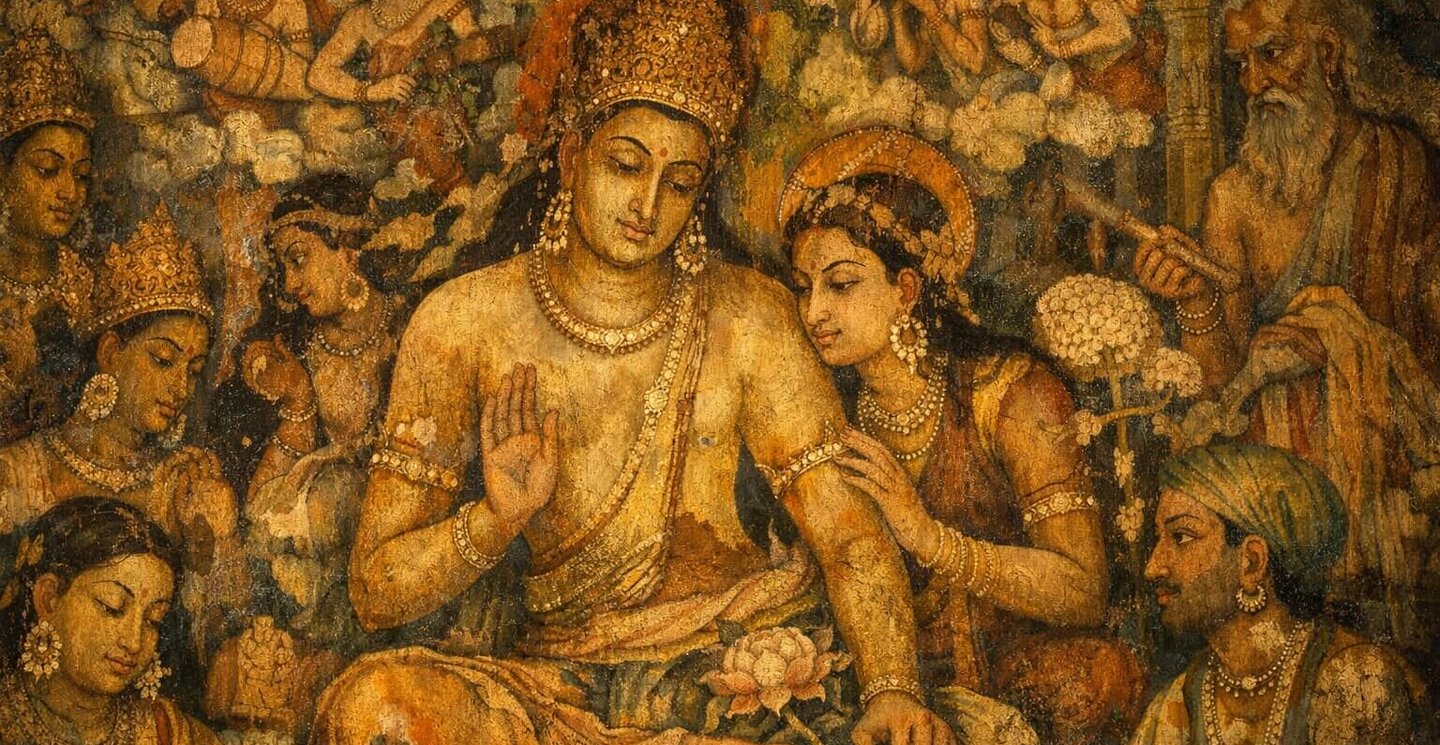
The Paintings - The Ajanta Caves are most celebrated for their paintings, the largest and best-preserved collection of ancient Indian painting in existence, covering the walls and ceilings of the cave interiors in scenes of Buddhist narrative, royal court life, nature, and devotion that were executed with a confidence and sophistication of technique that places them among the finest examples of pre-modern painting anywhere in the world.
The Ajanta Caves hold:
The largest surviving body of ancient Indian paintings
Dating roughly from 2nd century BCE to 6th century CE
Created using a technique similar to fresco (tempera on dry plaster)
The paintings depict scenes from the Jataka Tales, stories of the previous lives of the Buddha with a richness of human observation, a sensitivity to individual expression, and a mastery of composition that have been compared by art historians to the great fresco traditions of Renaissance Italy. Figures turn in space. Faces carry specific, readable emotions. Animals move with anatomical accuracy. Crowds of figures are organised with compositional intelligence that seems entirely beyond the conventional understanding of what ancient Indian art was capable of.
The most celebrated single image in Ajanta is the Bodhisattva Padmapani in Cave 1 - a figure of such grace, such delicacy, such melancholy beauty that it has become one of the iconic images of Indian artistic heritage. Standing before it in the dim interior of the cave, the painted eyes looking down with an expression of infinite, compassionate sadness, is an encounter with human artistic achievement that very few visits to any heritage site in the world quite match.
Beyond the paintings, the sculptural programs of the caves, the carved figures of Buddhas, Bodhisattvas, guardians, and celestial beings that populate the doorways, niches, and interiors, are of equally extraordinary quality. The façade carvings of Cave 19 and Cave 26, in particular, represent some of the finest decorative stone carving in ancient India.
A full and unhurried visit to Ajanta takes four to five hours. We build this time in deliberately, because rushing through Ajanta is not merely a missed opportunity. It is a failure of respect for something that deserves the full attention it has spent fifteen hundred years earning.
Return to Aurangabad in the late afternoon. Rest, dinner, and a quiet evening, the caves will stay with you through the night.
Day 4: Ellora Caves - The Kailasa Temple & the Greatest Rock-Cut Achievement on Earth
After breakfast, we drive to the Ellora Caves, approximately 30 kilometres from Aurangabad, a journey of less than an hour. And if yesterday was extraordinary, today is, in a specific and irreplaceable way, even more so.
The Ellora Caves - What They Are - The Ellora Caves are a complex of 34 rock-cut monuments carved into the escarpment of the Charanandri Hills between approximately the 6th and 11th centuries CE. Unlike Ajanta, which is exclusively Buddhist, Ellora is a remarkable demonstration of religious pluralism: 12 Buddhist caves at the southern end of the complex, 17 Hindu caves in the centre, and 5 Jain caves at the northern end, all created during the same broad historical period, all reflecting the remarkable artistic tradition of the Deccan, and all demonstrating that the craftsmen of different religious traditions worked in close proximity and apparently in productive artistic dialogue with each other.
The result is a complex of extraordinary diversity and quality, each cave a world in itself, each reflecting the specific artistic and theological priorities of its tradition, together forming the most comprehensive single statement of India's ancient religious art available anywhere on Earth.
But before anything else before the Buddhist viharas with their carved monks' cells, before the Hindu cave temples with their fierce, dynamic sculptural programs, before the serene Jain halls with their exquisitely detailed carvings, there is the Kailasa Temple.
The Kailasa Temple (Cave 16) - Nothing prepares you for it. Not the photographs. Not the descriptions. Not the fact that you have been told, before arrival, that it is remarkable. When you stand at the rim of the excavation and look down at what the craftsmen of the Rashtrakuta dynasty created here in the 8th century CE, the mind genuinely struggles to process what it is seeing.
The Kailasa Temple is not a cave. It is a freestanding temple, a complete, three-dimensional temple complex of extraordinary architectural ambition, carved from the living basalt of the hillside by removing the rock from the top downward, leaving the temple standing in an open courtyard excavated around it. The numbers involved are staggering: approximately 200,000 tonnes of rock were removed to create the courtyard and expose the temple. The temple itself rises 33 metres above the courtyard floor, its tower carved to represent Mount Kailash, the Himalayan home of Lord Shiva. Its length is 83 metres. Its width is 47 metres. Every surface, every wall, every pillar, every doorframe, every cornice, is covered in sculptural carving of extraordinary density and quality.
The Kailasa Temple was carved by chiselling downward through the basalt from the top of the hill, working entirely by hand, entirely by eye, with no structural engineering safety net because a mistake in the wrong place, a miscalculation of proportion or depth, could not be corrected. The craftsmen who built it over an estimated 18 years, under the patronage of Rashtrakuta king Krishna I - were producing, in real time, without the ability to step back and review the whole, one of the most complex three-dimensional architectural compositions in the history of human construction.
The sculptural panels that cover the temple's exterior walls are as remarkable as the architecture. The Ravana shaking Mount Kailash panel, depicting the demon king attempting to uproot the mountain, Shiva pressing it back down with his toe, Parvati clinging to her husband in terror, is a narrative sculpture of such drama, such compositional sophistication, and such physical energy that it seems almost to move. The Shiva Nataraja panels, the Vishnu Anantashayana (reclining on the cosmic serpent), the Durga Mahishasuramardini (the goddess slaying the buffalo demon), each is a masterwork of Indian sculptural tradition at its absolute height.
To stand in the courtyard of the Kailasa Temple, looking up at the carved tower and the galleries and the sculptural program covering every surface, is to understand, perhaps for the first time with full physical force that the ancient world was not artistically limited, was not technically primitive, was not working with any less ambition or any less intelligence than the builders of the great monuments of any civilisation. It was simply working with different materials, different traditions, and different gods.
It is one of the most affecting experiences available to any traveller anywhere in the world.
After the Kailasa Temple, time permitting, we explore selected caves from the Buddhist and Jain sections of the Ellora complex, the Vishvakarma Cave (Cave 10), a Buddhist prayer hall whose interior soars to a cathedral-like height with a carved stupa at its centre; the Indra Sabha (Cave 32), a Jain cave of two storeys whose upper chamber is covered in carving of almost hallucinatory delicacy.
Return to Aurangabad in the late afternoon. A final dinner in the city, there is time this evening, if you wish, for a visit to the Bibi Ka Maqbara, the seventeenth-century Mughal tomb that stands in the city as a quieter, more intimate echo of the monument it was built to evoke. In the evening light, its white marble glowing against the Deccan sky, it is a beautiful and moving sight.
Day 5: Aurangabad → Mumbai by Fast AC Train → Airport - The Journey Home
An early start this morning, your private car takes you to Aurangabad Railway Station for the Fast AC Train departing at approximately 5:00 AM for Mumbai. The very early departure is the one logistical demand this package makes, and it is entirely worth accommodating. With complimentary snacks and meals served on board, the train arrives in Mumbai by early afternoon, giving you comfortable time for your international departure.
We recommend packing some additional snacks the evening before for the early morning journey, as platform food options at this hour are limited.
The train journey back across the Deccan, watching the plateau landscape brighten as the sun rises over the basalt hills, the volcanic formations emerging from the morning mist, the fields coming to life below, is a beautiful reverse of the outward journey, and a peaceful way to begin the process of integrating what you have seen over the past two days.
Arrive in Mumbai in the early afternoon. Your private car takes you directly to Chhatrapati Shivaji Maharaj International Airport in time for your flight home.
Your Ajanta & Ellora Cave Discovery Tour ends here at a departure gate, with the sounds of an airport around you. But the caves themselves do not end quite so cleanly. The painted eyes of the Bodhisattva Padmapani. The impossible verticality of the Kailasa Tower rising from its excavated courtyard. The twenty-thousand-tonne fact of what two hundred years of determined, brilliant craftsmen accomplished with nothing but chisels and faith and an understanding of beauty that still, fifteen centuries later, stops people in their tracks.
These things stay. They become part of the furniture of the imagination. They make the world feel, in the best possible way, larger and older and more astonishing than it seemed before you saw them.
✅ Inclusions
✅ 4 Nights Accommodation: Quality 3-star / 4-star properties ( as available ) in Mumbai (1 night) and Aurangabad (3 nights), selected for comfort, cleanliness, and location.
✅ Daily Breakfast: A proper breakfast at your accommodation every morning.
✅ Fast AC Train Travel: Comfortable reserved seating on the Mumbai - Aurangabad and Aurangabad - Mumbai services, with complimentary snacks, meals, and mineral water included on both journeys.
✅ Private AC Car: Dedicated vehicle for all Aurangabad local travel: hotel to Ajanta and return (Day 3), hotel to Ellora and return (Day 4), and all station transfers in Mumbai and Aurangabad.
✅ All Sightseeing as per Itinerary: Both cave complexes visited on separate days for the best possible experience.
✅ All Tolls, Parking & Driver Allowances: No hidden road costs.
❌ Exclusions
❌ International flights and airfare ❌ Lunch, dinner, and personal expenses ❌ Travel insurance and visa charges ❌ Optional city monuments in Aurangabad (Bibi Ka Maqbara).
Best Time to Visit
October - March: is the ideal season for this tour - comfortable temperatures on the Deccan Plateau, clear skies for photography, and the best conditions for extended cave exploration.
October - November: Post-monsoon Deccan is green and fresh. Excellent cave conditions and comfortable temperatures. Highly recommended.
December - February: Peak season. Cool, bright days perfect for the long walks through both cave complexes. The light inside the caves is best in the mid-morning hours of the winter months.
March: Warming but still manageable. The last comfortable month before the Deccan heat makes extended outdoor sightseeing more demanding.
April to June brings significant heat on the Deccan Plateau. July to September (monsoon) brings rain that can make the cave paths slippery and the drive to Ajanta through the gorge atmospheric but slower.
Frequently Asked Questions
Q: Why visit Ajanta and Ellora on separate days rather than combining them? This is one of the most important design decisions in Package 18. Ajanta and Ellora are each a half-day minimum to see adequately and both reward considerably more time than that. Visiting both in a single day produces exhaustion and inevitably means rushing through one or both, which is the single worst thing you can do at either site. Separate days allow genuine, unhurried engagement with each complex, the only way to do them justice.
Q: Are the caves accessible for senior travellers or those with limited mobility? Both cave complexes involve walking on uneven rock surfaces and, at Ajanta in particular, some uphill sections. Ajanta offers shuttle buses from the main entrance to reduce walking distance. Ellora's caves are generally more accessible, with most of the major monuments reachable on relatively flat paths. We recommend comfortable, sturdy walking shoes and building in rest time. For travellers with specific mobility requirements, please advise us when booking and we will plan accordingly.
Q: Can we upgrade to luxury hotels in Aurangabad? Yes, Aurangabad has several excellent luxury properties, and the upgrade is well worth considering for travellers who want premium comfort after long heritage days. Revised pricing is shared in advance of booking.
Q: Is the 5:00 AM departure on Day 5 really necessary? The early departure is necessary to ensure comfortable arrival in Mumbai in time for afternoon or evening international flights. The train journey is comfortable and catered, and the early morning departure from a quiet station is far less stressful than it might appear. We recommend going to bed early on Day 4 to make the early start as easy as possible.
Why Book This with UK India Tourism?
Ajanta and Ellora are sites of genuine world significance and sites that, if visited badly, can leave travellers feeling curiously unmoved. Too rushed, and the paintings at Ajanta become a blur. Too crowded, and the Kailasa Temple courtyard loses the quality of awe that defines it. Too tired from a long road journey, and the capacity to absorb what you are looking at is simply not there.
Getting these caves right requires the specific combination that Package 18 delivers: the right transport to arrive rested, the right pacing to give each site the time it needs, and the right guidance to ensure that what you encounter in those ancient interiors lands with its full force.
✅ Separate days for each cave complex - the correct approach ✅ Fast AC Train travel - arrive rested, not road-weary ✅ Private car throughout Aurangabad - your schedule, your pace ✅ Correct sightseeing timing - morning visits for best light and smallest crowds ✅ Full comfort and support for international travellers throughout.

Ready to step beyond stone and into stories?
Let the timeless wonders of the Ajanta Caves and Ellora Caves awaken a journey you’ll never forget.
UK India Tourism
UK : +44 7345 191205
India: +91 9958 480873
Email: sales@ukindiatourism.co.uk
Travel Specialists for UK, USA, Canada, Australia, France, Poland, Singapore, Japan & Beyond
UK: +44 7345191205
UK India Tourism© 2026, all rights reserved
India: +91 9958480873
⭐⭐⭐⭐⭐ 4.9/5 | 2,600+ Travelers | 18 Years | 98% Recommend