
Book India tours from London to Delhi
Where history breathes in marble, culture sparkles in colour, and modern India glows with confidence - Delhi unfolds like a grand storybook waiting to be explored. For travellers seeking unforgettable India tours from London, this vibrant capital offers the perfect blend of heritage, flavour, and contemporary charm. From UNESCO treasures and majestic Mughal architecture to lively bazaars, soulful temples, and world-class experiences, Delhi stands as a gateway to an extraordinary India holiday package from UK - welcoming you with warmth, wonder, and timeless beauty.
Delhi Travel Guide — Discover India's Extraordinary Capital City
India's Capital City · 3 UNESCO World Heritage Sites · Golden Triangle Gateway · Old Delhi & New Delhi
Where seven centuries of dynasties, Mughal grandeur, colonial history, and modern India collide in one breath taking metropolis
Why Delhi is the Perfect Starting Point for Every India Journey
Delhi is not merely India's capital - it is India in miniature. Across its vast, sprawling terrain, thirty million stories unfold simultaneously: ancient mosques and Mughal fortresses rise beside glass-fronted corporate towers, colonial-era bungalows and avenues give way to labyrinthine Old City bazaars, and sacred temples of a dozen faiths stand within minutes of designer restaurants and rooftop bars. No other city on earth packs so many centuries of history, so many layers of culture, and so much sensory richness into a single urban landscape.
For international visitors arriving in India for the first time, Delhi is both the natural gateway and the ideal introduction. As one of the world's largest and most historically significant capital cities, it serves as the anchor for India's legendary Golden Triangle travel circuit - connecting Delhi, Agra, and Jaipur in the most visited travel route on the subcontinent. Three UNESCO World Heritage Sites, a food culture of extraordinary depth, world-class museums, vibrant bazaars, serene spiritual sanctuaries, and some of the finest hotels in Asia all await within this single remarkable city.
Delhi rewards every kind of traveller. History enthusiasts will be overwhelmed with riches. Food lovers will find themselves in paradise. Architecture admirers will discover layers of Indo-Islamic, Mughal, colonial, and contemporary design that span eight hundred years. And those simply seeking to feel the pulse of the real India will find it here — raw, dazzling, humbling, and unforgettable — in every lane of Old Delhi.
Delhi at a Glance - Essential Facts for International Visitors
— Official name: National Capital Territory (NCT) of Delhi
— Population: Approximately 30 million - one of the most populous urban areas on earth
— Language: Hindi is the primary language; English is widely spoken across hotels, restaurants, tourist sites, and transport hubs
— Currency: Indian Rupee (INR) - ATMs and currency exchange widely available; major cards accepted at hotels and restaurants
— Time zone: India Standard Time (IST) - UTC +5:30 (no seasonal time change)
— International airport: Indira Gandhi International Airport (IATA: DEL) - one of South Asia's principal aviation hubs
— UNESCO World Heritage Sites in Delhi: Red Fort, Qutub Minar, and Humayun's Tomb
— Golden Triangle position: Delhi is the starting and ending point of the Delhi-Agra-Jaipur circuit
Top Tourist Attractions in Delhi - UNESCO Heritage Sites, Monuments & Landmarks
Delhi's historical canvas stretches across seven successive cities, each built by a different dynasty over seven centuries. The monuments, mosques, tombs, and fortresses left behind by the Sultans, the Mughals, and the British together form one of the most extraordinary concentrations of historical architecture in the world. Below are the essential attractions for every international visitor to Delhi.
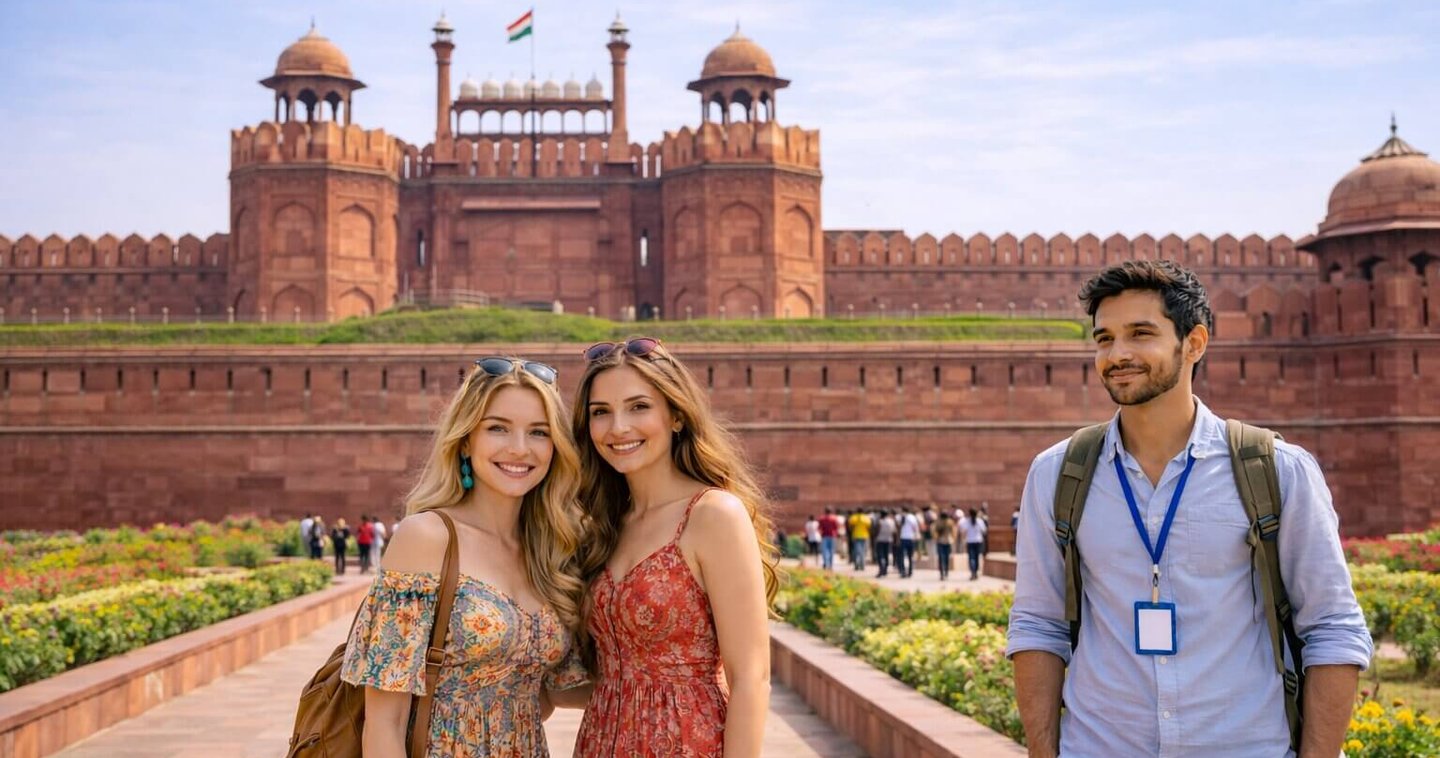
1. Red Fort (Lal Qila) - UNESCO World Heritage Site · Symbol of Mughal Imperial Power
Old Delhi · UNESCO Heritage · Must Visit · Iconic Landmark
The crown of Old Delhi — built by Emperor Shah Jahan in 1639
The Red Fort - Lal Qila in Hindi - is one of the most iconic monuments in India and the undisputed centrepiece of Old Delhi. Built by the great Mughal Emperor Shah Jahan between 1638 and 1648, this vast red sandstone fortress served as the principal residence of the Mughal emperors of India for nearly two hundred years, from its completion until 1857. Declared a UNESCO World Heritage Site in 2007, the fort is today one of the most visited historical monuments in the country and carries enormous symbolic importance as the site from which India's Prime Minister addresses the nation each Independence Day on the 15th of August.
Entering through the great Lahori Gate, visitors discover a self-contained imperial city within the walls: the Diwan-i-Aam (the Hall of Public Audience, where the emperor received petitions from ordinary citizens), the Diwan-i-Khas (the spectacular Hall of Private Audience, home of the legendary Peacock Throne), the marble Rang Mahal (Palace of Colours), the Mumtaz Mahal, the Nahr-i-Behisht water channel that once ran through the palace apartments, the Moti Masjid (Pearl Mosque), and the Hayat Bakhsh Bagh (Life-Bestowing Garden). Several excellent museums inside the fort explore the history of the Mughal court, Indian archaeology, and the 1857 First War of Independence.
What to See at the Red Fort
— Lahori Gate - the grand main entrance gateway inscribed with Quranic verses
— Diwan-i-Aam - where the emperor held public court seated on the marble throne
— Diwan-i-Khas - the most richly decorated hall; once housed the legendary Peacock Throne studded with rubies, emeralds, and sapphires
— Rang Mahal (Palace of Colours) - the principal royal residence, with a marble lotus fountain at its centre
— Moti Masjid (Pearl Mosque) - an intimate private mosque of perfectly polished white marble
— Hayat Bakhsh Bagh (Life-Bestowing Garden) - a formal Mughal garden with pavilions and water channels
— Museums within the fort - covering Mughal history, archaeology, Indian art, and the 1857 uprising
Essential Visitor Information — Red Fort
— Entry ticket for foreign nationals: Approximately INR 600
— Opening hours: Sunrise to sunset, Tuesday to Sunday - CLOSED on Mondays
— Sound and Light Show: Evening show available - check current scheduling
— Location: Old Delhi, accessible from Chandni Chowk metro station (Yellow Line).
2. Jama Masjid — India's Largest Mosque · Masterpiece of Mughal Architecture
Old Delhi · Spiritual Landmark · Architectural Wonder · Built by Shah Jahan
One of the grandest places of worship in the Islamic world
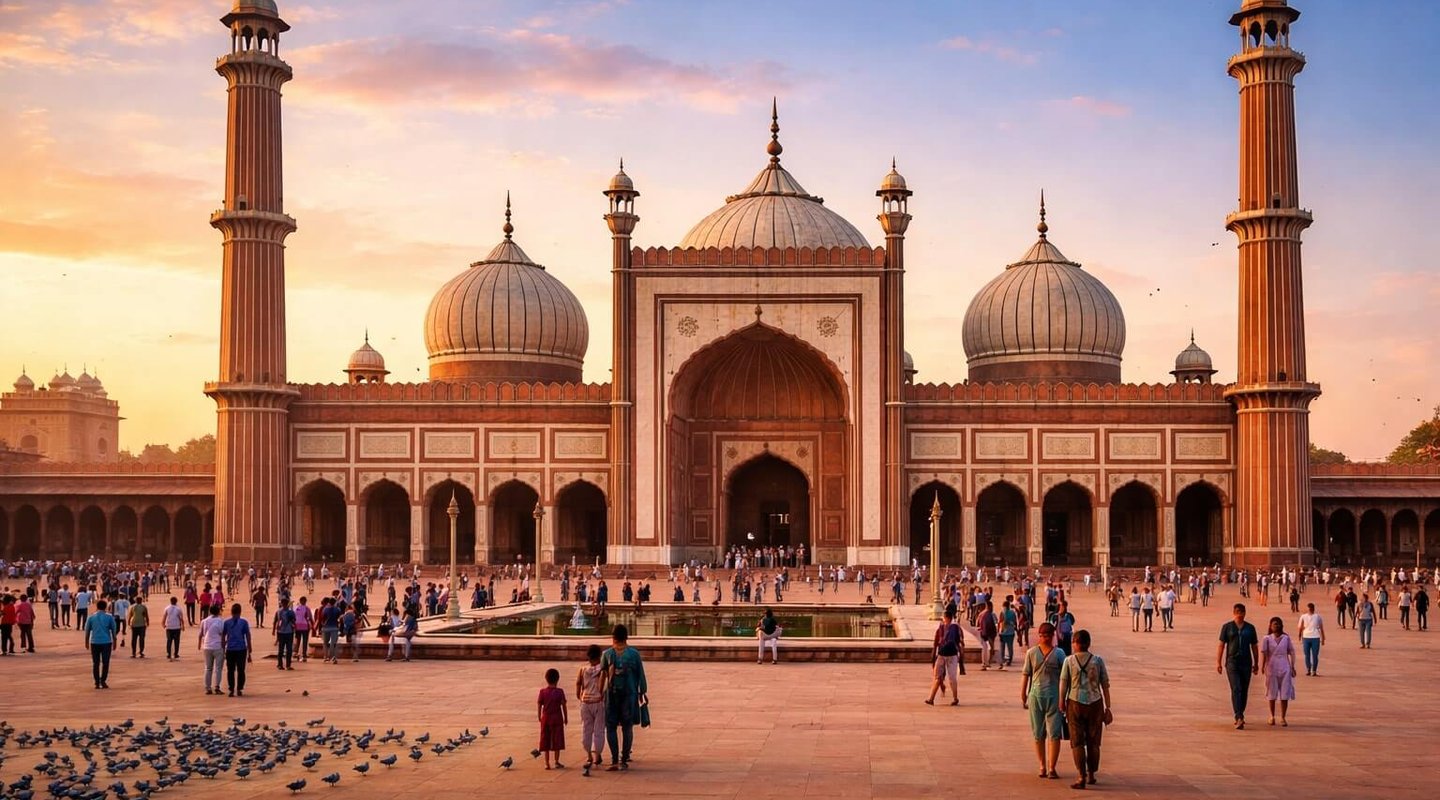
Rising majestically above the rooftops of Old Delhi, the Jama Masjid is one of the largest and most magnificent mosques in India, capable of accommodating up to twenty-five thousand worshippers in its vast sandstone and marble courtyard. Built by Emperor Shah Jahan between 1644 and 1656 - the same emperor who created both the Taj Mahal and the Red Fort - the mosque represents the pinnacle of Mughal religious architecture. Its three grand gateways, four towers, two forty-metre-high minarets, and the three great bulbous marble domes that crown the prayer hall are among the most photographed skylines in all of northern India.
The mosque welcomes visitors of all faiths outside prayer times, providing modest dress coverings at the entrance. Climbing to the top of the southern minaret offers breath taking panoramic views across the rooftops of Old Delhi, with the Red Fort visible to the north and the dense maze of Chandni Chowk's lanes spreading in every direction below. For international visitors, the Jama Masjid provides one of the most authentic and deeply atmospheric encounters with India's living Islamic heritage.
Essential Visitor Information - Jama Masjid
— Entry: Free for worshippers and visitors; a small camera fee applies for photography
— Minaret climb: Additional small fee; access to the southern minaret for panoramic views
— Dress code: Modest dress required - coverings are provided free of charge at the entrance gate
— Visiting hours: Open from approximately 7am to 12pm and 1:30pm to 6:30pm; closed to tourists during prayer times (approx. 12pm–1:30pm)
— Location: Old Delhi - a short walk from the Red Fort and Chandni Chowk.
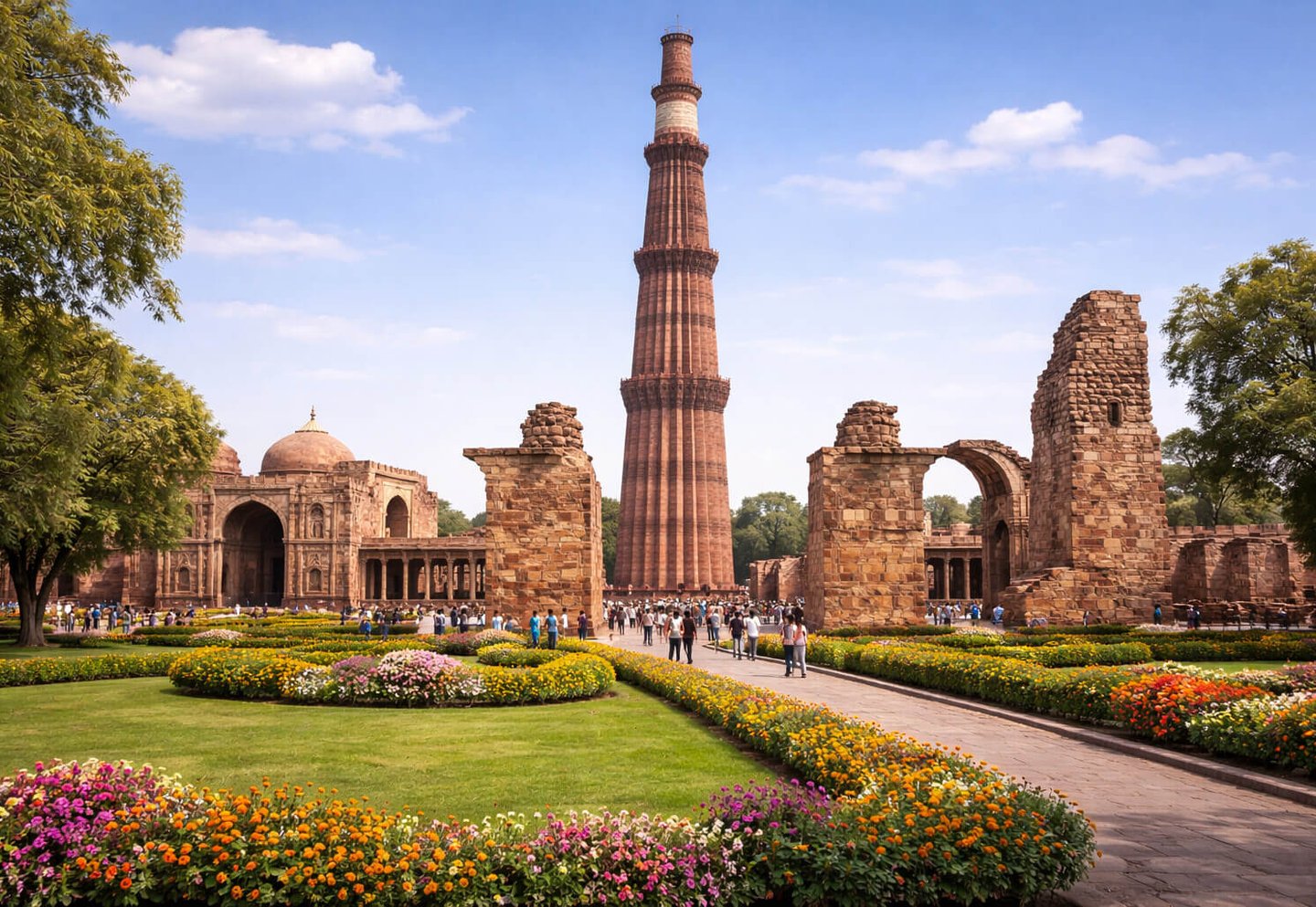
3. Qutub Minar Complex — UNESCO World Heritage Site · The World's Tallest Brick Minaret
South Delhi · UNESCO Heritage · 800-Year-Old Monument · Indo-Islamic Architecture
Standing tall for over eight centuries - the oldest surviving monument of the Delhi Sultanate
At 72.5 metres, the Qutub Minar is the tallest brick minaret in the world and one of the finest examples of early Indo-Islamic architecture anywhere on earth. Begun by Qutb ud-Din Aibak in 1193 — just three years after his defeat of the last Hindu king of Delhi — and completed by his successor Iltutmish, the minaret served as a tower from which the faithful were called to prayer at the adjacent Quwwat-ul-Islam Mosque (the Power of Islam Mosque), the first mosque built in India after the Islamic conquest of the subcontinent.
The UNESCO-listed Qutub Minar complex is a remarkable archaeological treasure that encompasses over a millennium of Delhi's history in a single site. Alongside the great minaret, visitors can explore the remains of the mosque, the mysterious Iron Pillar of Delhi — a 7-metre column forged in the 4th century CE that has stood outdoors for over 1,600 years without rusting — the Alai Darwaza gateway built in 1311 by Alauddin Khalji, and the tomb of Iltutmish. For international visitors, the complex offers an extraordinary and visually dramatic encounter with the very earliest chapter of Delhi's Islamic heritage.
What to See at the Qutub Minar Complex
— Qutub Minar - the 72.5-metre minaret of red sandstone and marble with intricate calligraphic and geometric carvings
— Quwwat-ul-Islam Mosque - ruins of the first mosque built in India after the Islamic conquest
— Iron Pillar of Delhi - a 4th-century CE iron column that has never rusted, inscribed in Sanskrit
— Alai Darwaza - a magnificent 1311 gateway considered one of the finest examples of early Islamic architecture in India
— Tomb of Iltutmish - intricate carved geometric decoration in red sandstone
— Alai Minar - the base of an unfinished minaret intended to be twice the height of Qutub Minar
Essential Visitor Information - Qutub Minar
— Entry ticket for foreign nationals: Approximately INR 600
— Opening hours: Sunrise to sunset, seven days a week
— Location: Mehrauli, South Delhi - approximately 14 km from Connaught Place.
4. Humayun's Tomb - UNESCO World Heritage Site · The Architectural Precursor to the Taj Mahal
Central Delhi · UNESCO Heritage · Mughal Garden Tomb · Must Visit
The monument that inspired the Taj Mahal - serene, symmetrical, and breathtakingly beautiful
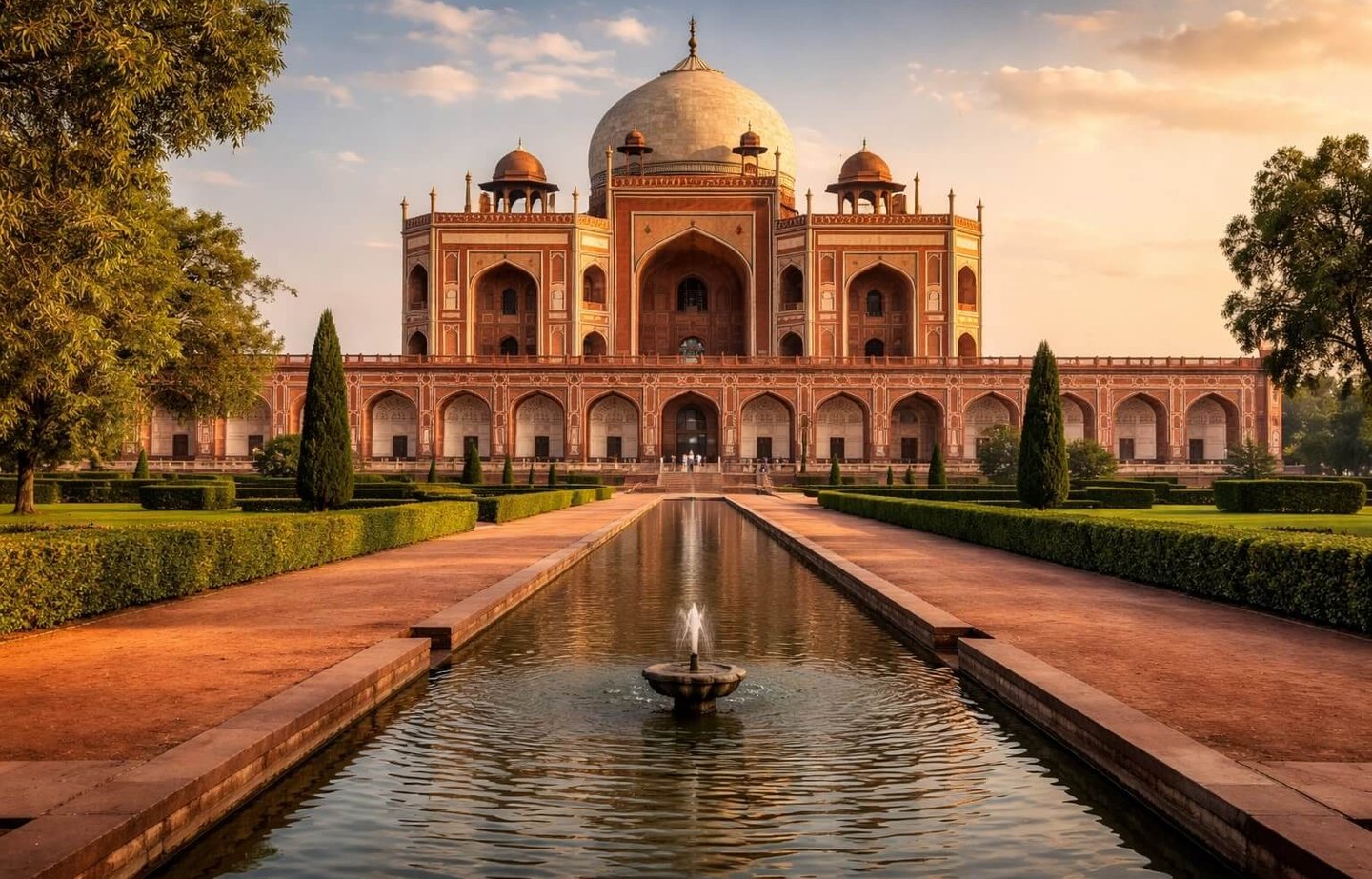
Completed in 1572, Humayun's Tomb is one of the greatest and most historically significant monuments of the Mughal era - and a UNESCO World Heritage Site of exceptional architectural importance. Built by the empress Bega Begum for her husband, the Mughal Emperor Humayun, it was the first garden-tomb built in India - establishing the architectural language of the charbagh (four-part garden), the elevated platform, the double dome, and the symmetrical chamber layout that would find its ultimate expression, eighty years later, in the Taj Mahal at Agra.
The tomb sits at the centre of a vast, beautifully restored Persian-style garden divided by water channels and pathways. The main mausoleum is built of red sandstone with white marble inlay detailing, and its double dome - one of the first of its kind in the subcontinent - rises to a height of nearly 47 metres. The complex also contains the tombs of several other Mughal rulers and nobles, and the Isa Khan Garden Tomb, a beautifully preserved 16th-century complex that predates the main monument. Unlike the Taj Mahal, Humayun's Tomb is rarely overcrowded, making it one of the most peaceful and deeply rewarding heritage experiences in Delhi.
What to See at Humayun's Tomb
— The main mausoleum - red sandstone and white marble; double dome; octagonal chambers with carved screens (jalis)
— Charbagh garden - a vast Persian-style four-part garden restored to its original Mughal design
— Isa Khan Garden Tomb - a perfectly preserved 1547 garden-tomb complex within the grounds
— Barber's Tomb - a charming small domed structure, possibly for the royal barber
— Arab Serai - a large enclosure that once housed craftsmen working on the tomb construction
Essential Visitor Information — Humayun's Tomb
— Entry ticket for foreign nationals: Approximately INR 600
— Opening hours: Sunrise to sunset, seven days a week
— Location: Nizamuddin East, Central Delhi - approximately 6 km from India Gate.
5. India Gate & Kartavya Path - New Delhi's Grand Imperial Boulevard
New Delhi · War Memorial · Colonial Architecture · Evening Destination
The heart of New Delhi - where history, pride, and the capital's grandeur converge
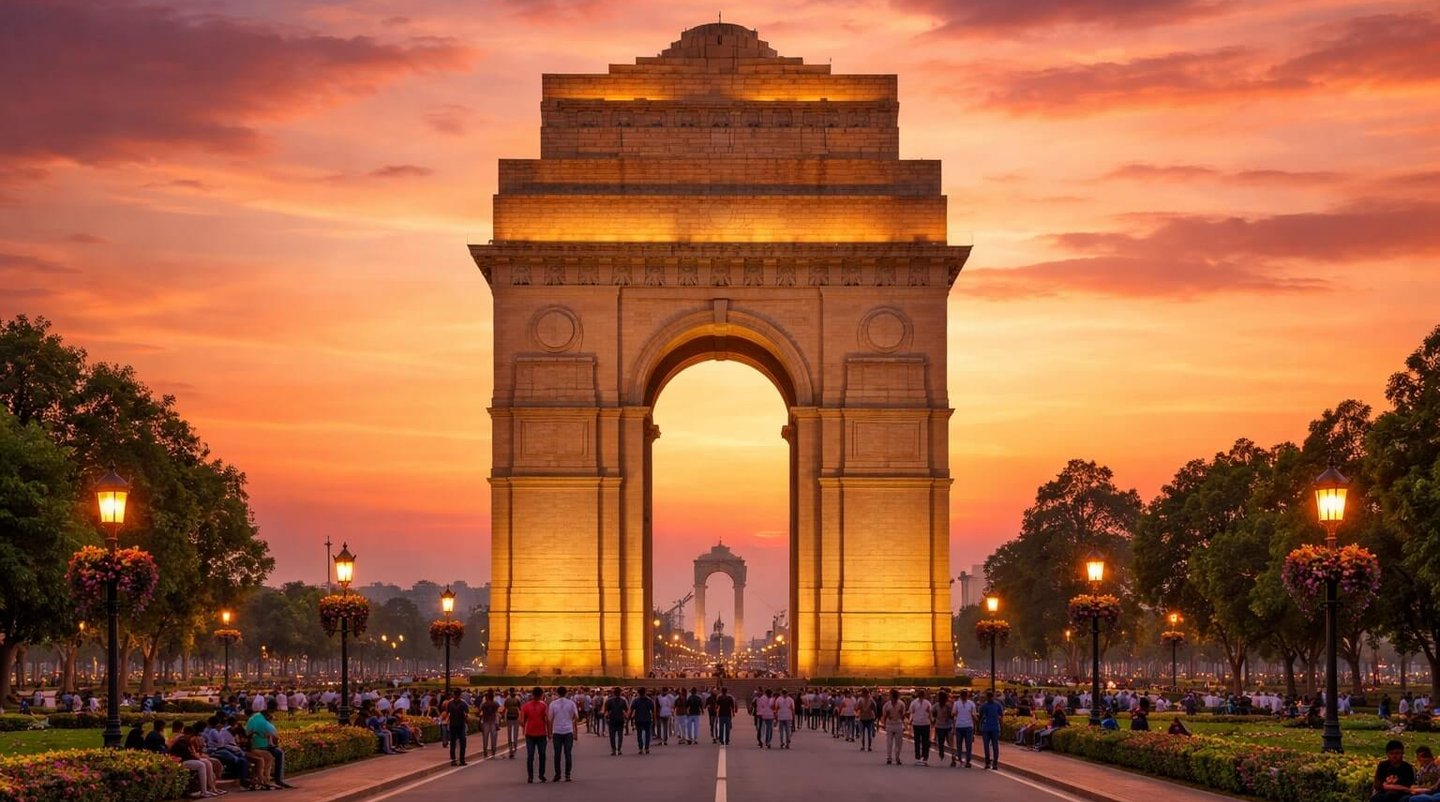
India Gate is New Delhi's most recognisable landmark and one of the most visited public monuments in India. A 42-metre triumphal arch in the style of the Arc de Triomphe in Paris, it was designed by the celebrated British architect Edwin Lutyens and completed in 1931. The arch commemorates the 70,000 soldiers of the British Indian Army who lost their lives in the First World War and the Third Anglo-Afghan War. At its base burns the Amar Jawan Jyoti (Flame of the Immortal Soldier), a flame of remembrance that has burned continuously since 1972, honouring Indian soldiers who died in the 1971 Indo-Pakistan War.
The grand ceremonial boulevard that leads to India Gate - now renamed Kartavya Path (Path of Duty) - extends over three kilometres to the Rashtrapati Bhavan (the Presidential Palace), with the North and South Secretariat buildings and the Indian Parliament flanking its course. This breath taking ensemble of colonial-era buildings and wide manicured lawns, designed to project imperial power and national pride, is best experienced in the early morning or at dusk when the monuments are illuminated and families, visitors, and locals gather on the lawns in one of Delhi's most beloved and democratic public spaces.
Essential Visitor Information — India Gate
— Entry: Free - open to the public at all hours
— Best time to visit: Early morning or after sunset, when the monument is illuminated
— Combined with: Rashtrapati Bhavan (Presidential Palace), Parliament House, and the National Museum on Kartavya Path
— Location: Kartavya Path, New Delhi - central location accessible from most parts of the city.
6. Swaminarayan Akshardham Temple - World's Largest Culturally-Rich Temple
East Delhi · Spiritual Experience · Architectural Marvel · Evening Show
A breath taking monument to ten thousand years of Indian civilisation
The Swaminarayan Akshardham Temple, which opened in 2005, is a monument of extraordinary ambition and breath taking scale. Certified by the Guinness Book of World Records as the world's largest culturally-rich temple, Akshardham is built entirely of Rajasthani pink sandstone and white Italian marble, without the use of any steel and elaborately carved by over eleven thousand sculptors and craftspeople. The central monument stands 43 metres tall and is decorated with thousands of carved figures of deities, dancers, musicians, flora, and fauna drawn from India's ten-thousand-year cultural heritage.
For international visitors, the highlight of an Akshardham visit is the evening Sahaj Anand Water Show, a breath taking multimedia extravaganza combining fountain choreography, laser projection, fire effects, and narration that brings ancient Indian philosophical stories to life. The complex also includes boat rides through a dramatized journey of India's 10,000 years of civilisation, a film theatre, and the world's largest step well within a temple complex. Photography of the main temple monument is not permitted, but the experience of the complex itself is deeply moving and unlike anything else in Delhi.
Essential Visitor Information - Akshardham
— Entry to complex: Free; separate charges for exhibitions, boat ride, and film show
— Evening Water Show: Approximately INR 220 per person; timings vary by season
— Photography: NOT permitted inside or near the main temple monument
— Opening hours: Tuesday to Sunday, 9:30am to 8pm (exhibitions), Water Show in the evening; CLOSED on Mondays
— Dress code: Modest clothing required; remove shoes before entering the temple precinct
— Location: NH-24, East Delhi - accessible from Akshardham metro station.
7. Lotus Temple - Architectural Icon & Baha'i House of Worship
South Delhi · Spiritual Sanctuary · Architectural Masterpiece · All Faiths Welcome
One of the most photographed buildings in the world - a symbol of peace and unity
The Lotus Temple is among the most photographed buildings in India and one of the most architecturally distinctive structures in Asia. Completed in 1986 to a design by Canadian architect Fariborz Sahba, the building takes the form of a half-open lotus flower, nine pools of water surrounding twenty seven free-standing marble petals arranged in groups of three to form the lotus bloom. The interior is a single vast hall of breath taking simplicity and light, seating over 2,500 people, where visitors of any faith or no faith, are welcome to sit in silence and reflection.
The Lotus Temple receives over four million visitors annually, making it one of the most visited religious buildings on earth. For international visitors, it offers a rare moment of calm and beauty within the sensory richness of Delhi — a place of pure, unhurried serenity that provides a deeply memorable counterpoint to the city's extraordinary energy.
Essential Visitor Information - Lotus Temple
— Entry: Free
— Opening hours: Tuesday to Sunday, approximately 9am to 7pm (summer) and 9:30am to 5:30pm (winter); CLOSED on Mondays
— Silence is maintained inside the temple - no talking, photography, or religious ceremonies
— Location: Bahapur, South Delhi - accessible from Kalkaji Mandir metro station.
8. Raj Ghat - Memorial to Mahatma Gandhi
Old Delhi · Memorial · Historical Significance · Garden of Remembrance
The sacred site where the Father of the Nation was cremated in 1948
Raj Ghat is the serene riverside memorial that marks the cremation site of Mahatma Gandhi, the father of independent India, who was assassinated on 30 January 1948. A simple yet profoundly moving black marble platform bears a perpetually burning flame. The surrounding gardens are beautifully maintained, and the atmosphere of quiet dignity and national reverence makes Raj Ghat one of the most emotionally significant sites in Delhi. The adjacent Gandhi Smriti, the museum housed in the bungalow where Gandhi spent his final 144 days, provides a deeply moving account of his life and assassination.
Essential Visitor Information - Raj Ghat
— Entry: Free
— Opening hours: Daily, sunrise to sunset
— Gandhi Smriti Museum: Tuesday to Sunday, 10am to 5:30pm; entry free
— Location: Mahatma Gandhi Road, near the Red Fort and the Yamuna River bank
Old Delhi - The Soul of the City: Chandni Chowk, Bazaars & Street Food
If the monuments of Delhi represent the city's grandeur, then Old Delhi - Shahjahanabad, the walled city built by Emperor Shah Jahan in the 17th century, represents its soul. Exploring Old Delhi is one of the most immersive, exhilarating, and unforgettable experiences available to any international traveller visiting India. Nothing prepares you for it, nothing compares to it, and nothing after it seems quite as vivid.
The lanes of Old Delhi are a living museum of sensory richness and historical depth. Narrow streets lined with centuries-old havelis (merchant mansions) and family-run shops lead to hidden courtyards, ancient mosques, bustling spice markets, the fragrant lanes of flower sellers, and food stalls that have been serving the same recipes for generations. Here, the past and present coexist in a remarkable, seamless continuum that is uniquely and quintessentially Indian.
Chandni Chowk - Old Delhi's Historic Bazaar · Asia's Oldest Market Street
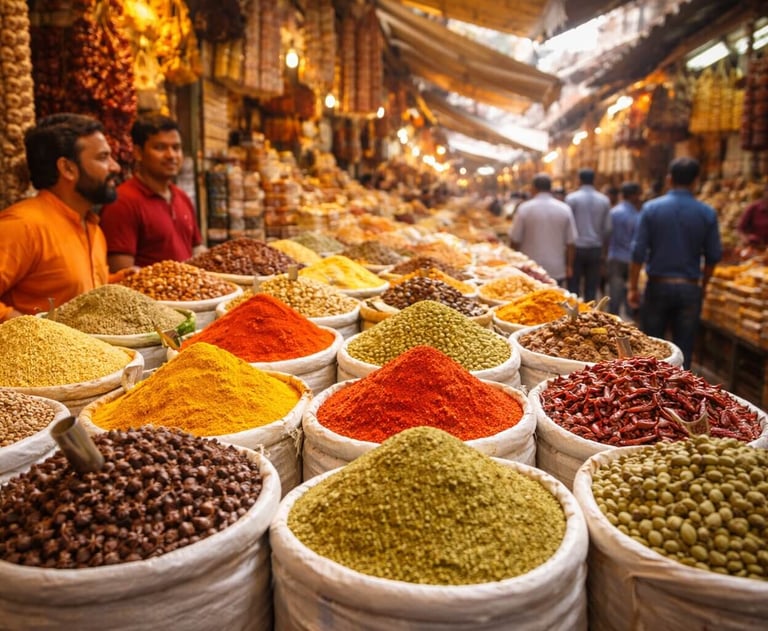
Chandni Chowk - Moonlight Square, is one of the oldest, busiest, and most celebrated market streets in Asia. Originally designed in the 17th century by Princess Jahanara, the daughter of Emperor Shah Jahan, the street was once graced by a canal that reflected moonlight and lined with the grandest shops in the Mughal empire. Today it remains the pulsating commercial and culinary heart of Old Delhi, a dense, exhilarating labyrinth of lanes, each one specialising in a different trade: silver jewellery, wedding dress fabrics, wholesale spices, religious items, electronics, and every conceivable kind of street food.
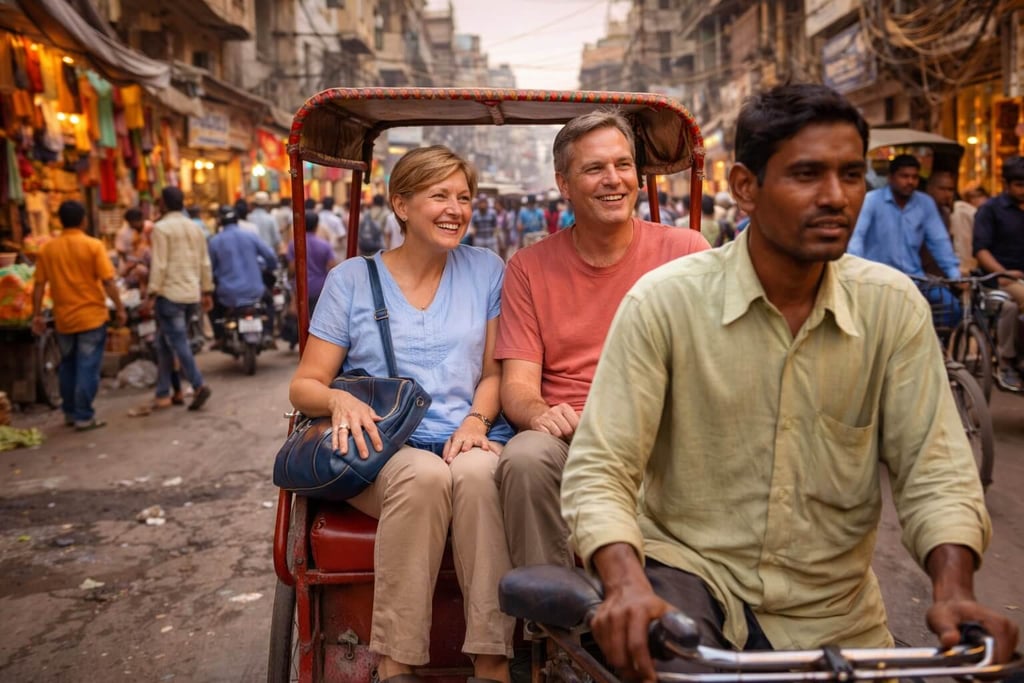
A rickshaw ride through Chandni Chowk and its adjoining lanes is one of the most memorable experiences in all of Delhi. Passing through the narrow alleys of Kinari Bazaar (wedding accessories and trimmings), the Dariba Kalan silver market, the fragrant lanes of the flower market, and the ancient Paranthe Wali Gali (the lane of stuffed flatbreads), visitors encounter a way of life that has continued largely unchanged for centuries.
Must Experience Stops in and around Chandni Chowk
— Chandni Chowk Main Street - iconic rickshaw ride through the heart of Old Delhi
— Khari Baoli - Asia's largest wholesale spice market; a photographer's dream of colour, fragrance, and texture
— Kinari Bazaar - a glittering lane of wedding accessories, tinsel, and decorative trimmings
— Dariba Kalan - Old Delhi's famous silver jewellery market, selling traditional and contemporary designs
— Paranthe Wali Gali - the legendary lane of deep-fried stuffed flatbreads; the most famous street food destination in Old Delhi
— Meena Bazaar - a market of religious items, incense, and offerings adjacent to the Jama Masjid
— Gurudwara Sis Ganj Sahib - a historically significant Sikh shrine on Chandni Chowk; open to all visitors
Old Delhi Street Food - A Culinary Heritage Recognised Across the World
The street food culture of Old Delhi is one of the most celebrated and diverse in the world. The cuisines that evolved in these lanes over four centuries, shaped by Mughal royal kitchens, Central Asian influences, local Hindu and Jain vegetarian traditions, and the merchant communities of the old city, have created a food heritage that is both extraordinarily complex and deeply satisfying. Old Delhi street food is not a tourist gimmick; it is a living culinary tradition eaten daily by millions.
Essential Old Delhi Street Food Experiences
— Paranthe Wali Gali - deep-fried stuffed parathas (flatbreads) with potato, paneer, cauliflower, or mixed fillings; the most famous lane-food experience in Old Delhi
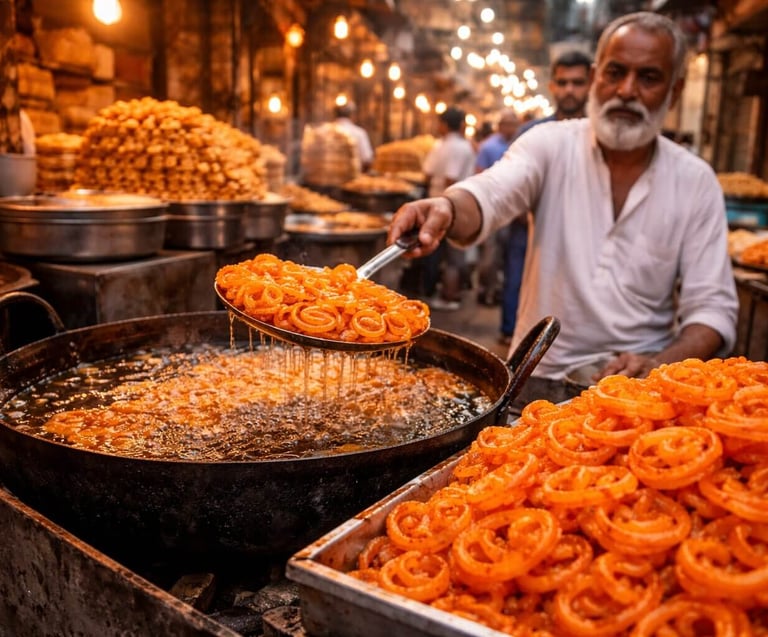
— Jalebi from Old Famous Jalebi Wala - hot, freshly fried spiral sweets in sugary syrup; a Delhi institution since 1884
— Nihari from Al-Jawahar and Kallu Nihari - slow-cooked lamb or beef stew, a traditional Mughal-era breakfast dish
— Daulat ki Chaat - a uniquely Old Delhi confection of whipped cream, saffron, and dried fruits; only available in the winter months
— Kachori from Natraj Dahi Bhalle - crispy fried pastry puffs with spiced filling, yoghurt, and chutneys
— Choley Bhature from Sita Ram Diwan Chand - a classic Delhi breakfast; spiced chickpea curry with deep-fried leavened bread
— Mutton Seekh Kebabs from Aslam Chicken - charcoal-grilled kebabs in a hidden lane near the Jama Masjid
— Kheer and Firni - slow-cooked rice pudding and ground rice dessert; perfected in Old Delhi's traditional sweet shops
UK India Tourism arranges immersive guided Old Delhi food walks for international visitors - a curated evening or morning journey through the lanes with an expert local guide, tasting eight to ten of the most celebrated street food items while learning about the history, culture, and families behind each dish.
New Delhi - Colonial Grandeur, Modern Culture & the Contemporary Capital
While Old Delhi plunges visitors into a dense, sensory immersion in the past, New Delhi - the planned capital designed by British architects Edwin Lutyens and Herbert Baker and inaugurated in 1931, presents an entirely different face of the city. Wide, tree-lined boulevards, monumental government buildings, beautifully manicured roundabouts, embassies and high commissions, luxury hotels, sophisticated restaurants, contemporary art galleries, and the most elegant shopping districts in India all define the experience of New Delhi.
But New Delhi is not simply a colonial relic reimagined as a modern capital. It is also home to extraordinary Mughal-era heritage, ancient archaeological sites, and some of the most vibrant, creative, and cosmopolitan neighbourhoods in India. From the diplomatic enclave of Chanakyapuri to the fashionable boutiques and restaurants of Khan Market and Hauz Khas, New Delhi rewards exploration at every turn.
Connaught Place - The Heart of New Delhi
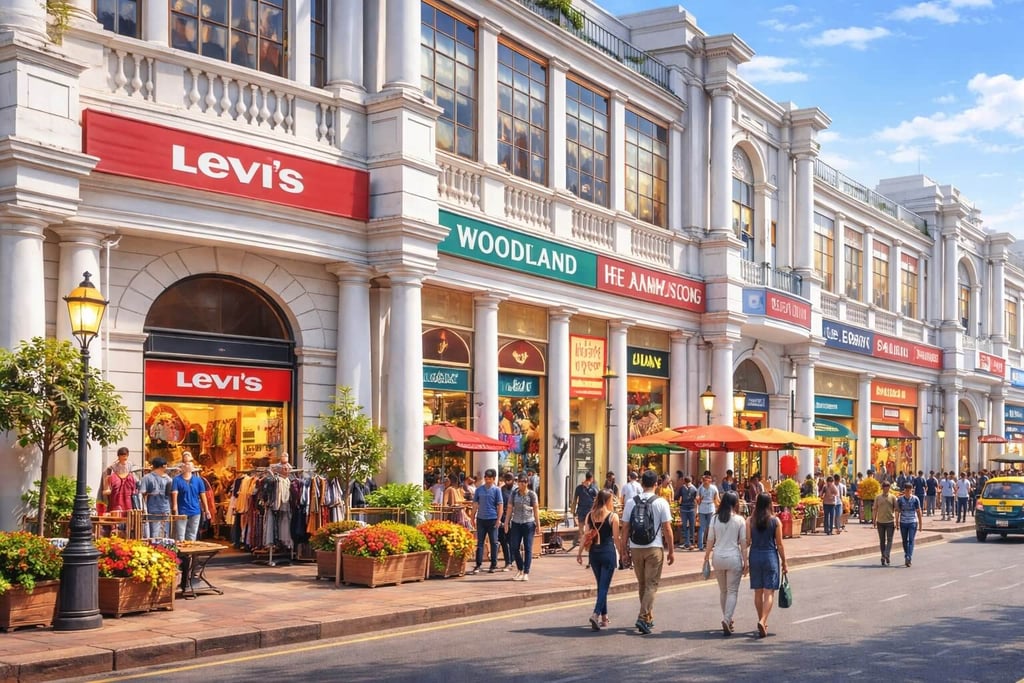
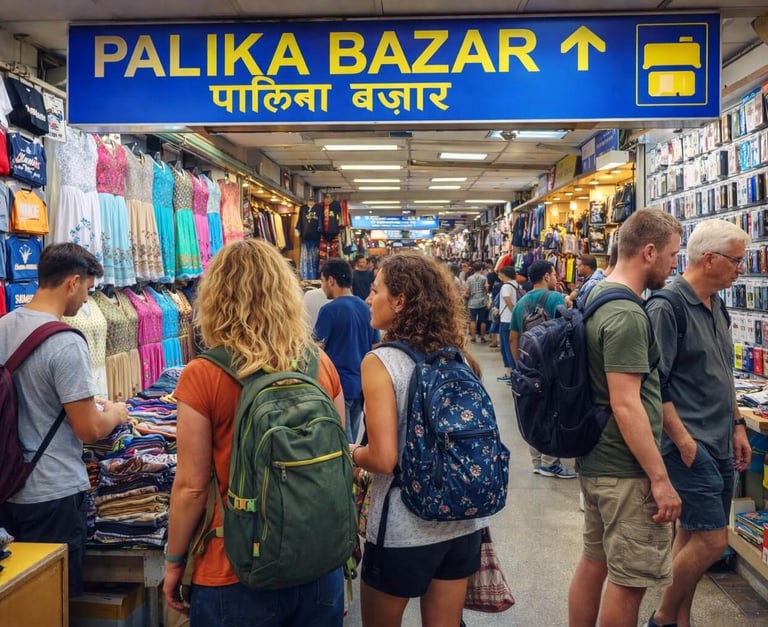
Connaught Place, locally known simply as CP, is the grand circular commercial centre of New Delhi, designed in the style of the Royal Crescent in Bath and completed in 1933. Its sweeping colonnaded facades house international brands, restaurants, bookshops, and cafes across two concentric rings of Georgian-style arcade. The iconic underground Palika Bazaar beneath Connaught Place offers a completely different experience: a busy underground market selling clothing, electronics, accessories, and souvenirs. The nearby Janpath Market is famous for handmade crafts, silver jewellery, block-printed textiles, and ethnic clothing from across India — essential browsing for international visitors.
Shopping & Experiences near Connaught Place
— Connaught Place (CP) - branded stores, restaurants, and heritage cafes in a grand colonial arcade
— Janpath Market - handicrafts, textiles, silver jewellery, and souvenirs from across India
— Palika Bazaar - an underground market for clothing, electronics, and accessories
— Delhi Haat - a permanent crafts market near INA Market, featuring artisans from every Indian state
— Khan Market - one of Asia's most expensive retail strips; home to fine bookshops, designer boutiques, and excellent restaurants.
Hauz Khas Village - Medieval Ruins, Art, Restaurants & Delhi's Most Stylish Neighbourhood
Hauz Khas Village is one of the most unexpected and rewarding neighbourhoods in Delhi - a place where a medieval 14th-century reservoir, royal tombs, and the ruins of a Sultanate-era madrasa sit within a few metres of independent boutiques, contemporary art galleries, design studios, acclaimed restaurants, and some of the city's most popular bars and cafes. The village takes its name from the Hauz-i-Khas (Royal Tank) reservoir constructed by Sultan Alauddin Khalji in 1295 to supply water to his new city of Siri.
By day, Hauz Khas Village is a relaxed neighbourhood for gallery-hopping, boutique shopping, and leisurely lunches. By evening, it transforms into one of Delhi's most vibrant social destinations, with rooftop bars, artisanal coffee shops, and innovative restaurants that draw the city's creative and cosmopolitan crowd. For international visitors seeking a thoroughly contemporary Delhi experience alongside genuine medieval heritage, Hauz Khas is essential.
What to See and Do in Hauz Khas Village
— Hauz Khas Complex - 14th-century ruins of a royal reservoir, mosque, and madrasa amid parkland
— Deer Park adjacent to the complex - a peaceful green space popular with morning walkers and families
— Art galleries and design studios - concentrated in the village lanes above the complex
— Boutique fashion and jewellery shops - independent Indian designers alongside vintage and handcraft stores
— Restaurants and cafes - among the most inventive dining in Delhi, from modern Indian to European and Japanese cuisine
Lutyens' Delhi - The Grand Presidential and Parliamentary Quarter
The central ceremonial quarter of New Delhi - designed by Edwin Lutyens and Herbert Baker for the British Raj and inaugurated in 1931, is one of the finest planned capital environments in the world, and a deeply revealing lens through which to understand both the history of the British Empire in India and the post-independence nation that reimagined and reclaimed it. A guided drive along Kartavya Path (formerly Rajpath) from India Gate to the Rashtrapati Bhavan offers visitors a sweeping encounter with some of the most architecturally significant buildings in Asia.
Key Landmarks on the Lutyens' Delhi Drive
— Rashtrapati Bhavan (Presidential Palace) - completed in 1929; one of the largest residences of any head of state in the world; open for public tours by prior booking
— Sansad Bhavan (Parliament House) - the circular building housing the Lok Sabha and Rajya Sabha; the new Parliament building, completed in 2023, stands adjacent
— North and South Secretariat buildings - twin symmetrical blocks housing the principal ministries of the Government of India
— India Gate - war memorial arch; the focal point of the ceremonial boulevard
— National Museum - one of India's finest collections of art, archaeology, and cultural heritage, covering five thousand years of Indian civilisation
Top Museums in Delhi - World Class Collections for International Visitors
Delhi is the museum capital of India. As the seat of national government and the repository of the subcontinent's collected historical and cultural heritage, Delhi hosts a concentration of exceptional museums that few capital cities can match. The following are the most important and rewarding for international visitors.
National Museum - India's Premier Archaeological and Cultural Collection
The National Museum of India, located on Kartavya Path in the heart of New Delhi, houses one of the most comprehensive and significant collections of Indian art and archaeology in the world. Its galleries span over five thousand years of Indian civilisation - from the extraordinary terracotta figures of the Harappan (Indus Valley) Civilisation of 2500 BCE, through Buddhist stupas, Gupta-period sculpture, Mughal miniature paintings, Chola bronzes, jewelled weapons, and decorative arts, to the textiles and tribal art of the 20th century. The famous bronze Dancing Girl figurine from Mohenjo-Daro, over 4,500 years old, is among the most extraordinary objects in the collection.
— Entry for foreign nationals: Approximately INR 650
— Opening hours: Tuesday to Sunday, 10am to 6pm; CLOSED on Mondays
— Location: Kartavya Path (Janpath corner), New Delhi
National Gandhi Museum - Life, Philosophy & Legacy of Mahatma Gandhi
Located adjacent to Raj Ghat, the National Gandhi Museum presents the life, philosophy, and legacy of Mahatma Gandhi through a collection of personal artefacts, photographs, handwritten letters, and documentary film. For international visitors, it provides an essential and deeply moving introduction to the man whose philosophy of nonviolent resistance transformed not only the Indian independence movement but inspired civil rights and liberation movements across the world throughout the 20th century.
— Entry: Free
— Opening hours: Tuesday to Sunday, 9:30am to 5:30pm; CLOSED on Mondays
National Crafts Museum & Hastkala Academy - Living Traditions of Indian Artisanship
The National Crafts Museum, located near the Pragati Maidan complex in New Delhi, is one of the most culturally enriching and visually beautiful museum experiences in the city. Its collection encompasses the extraordinary diversity of India's traditional craft heritage - block-printed and woven textiles, tribal jewellery, terracotta pottery, woodcarving, metal casting, puppet-making, and decorative arts from every region of the country. Unusually, the museum also hosts resident craftspeople from across India who work on the premises, allowing visitors to watch the creation of traditional crafts in real time.
— Entry for foreign nationals: Approximately INR 200
— Opening hours: Tuesday to Sunday, 10am to 5pm; CLOSED on Mondays
— Location: Bhairon Marg, opposite Pragati Maidan, New Delhi
National Gallery of Modern Art - Contemporary and Modern Indian Art
Housed in the former residence of the Maharaja of Jaipur near India Gate, the National Gallery of Modern Art (NGMA) Delhi holds the most important collection of modern and contemporary Indian art in the country. The collection spans from the works of the Bengal Renaissance of the late 19th century through the post-independence period to contemporary Indian artists working today, alongside British Orientalist paintings and works by the internationally celebrated artist Amrita Sher-Gil. For art-loving international visitors, NGMA Delhi is an essential and often underestimated destination.
— Entry for foreign nationals: Approximately INR 500
— Opening hours: Tuesday to Sunday, 11am to 6:30pm; CLOSED on Mondays
— Location: Jaipur House, near India Gate, New Delhi.
Delhi Food Guide - From Mughlai Feasts to Modern Indian Cuisine
Delhi's food culture is one of the richest, most diverse, and most historically layered in the world. The city's cuisine reflects its extraordinary history as the seat of successive empires, from the refined Persian-influenced Mughlai tradition of the Mughal court, with its slow-cooked biryanis, seekh kebabs, kormas, and nihari, to the vibrant street food of Chandni Chowk, the Punjab-influenced dhabas of South Delhi, and the sophisticated contemporary Indian restaurants of Connaught Place, Khan Market, and Hauz Khas.
For international visitors, eating in Delhi is one of the central joys of an India journey. The following is a guide to the essential cuisines, dishes, and dining destinations that no visitor should miss.
Essential Delhi Dishes Every International Visitor Should Try
Old Delhi Mughlai & Street Food
— Butter Chicken (Murgh Makhani) - the most famous Indian dish in the world was arguably created in Delhi; rich, mildly spiced tomato and cream sauce with tender chicken
— Dal Makhani - slow-cooked black lentils in butter and cream; a Delhi restaurant staple
— Seekh Kebabs - minced spiced lamb or chicken moulded onto skewers and charcoal-grilled; best from Old Delhi
— Nihari - a slow cooked lamb or beef stew of extraordinary depth; originally a Mughal royal morning meal
— Paranthe - stuffed pan-fried flatbreads with fillings of potato, cauliflower, or paneer; best in Paranthe Wali Gali
— Chole Bhature, spiced chickpea curry served with deep-fried leavened bread; a Delhi breakfast institution
— Kebabs at Karim's, Old Delhi, operating since 1913; one of the most historically important restaurants in India
New Delhi & South Delhi Dining
— Bukhara at ITC Maurya, widely rated one of the top ten restaurants in Asia; legendary dal makhani and tandoori dishes
— Indian Accent at The Lodhi - modern Indian fine dining combining traditional flavours with contemporary technique; consistently ranked among Asia's best restaurants
— Gulati Restaurant, Pandara Road - a Delhi institution for Mughlai cuisine; famous among both local residents and visiting dignitaries
— Farzi Cafe, Connaught Place, inventive contemporary Indian cuisine and cocktails in a spectacular setting
— Khan Market restaurants - a wide range of quality international and Indian cuisine in Delhi's most cosmopolitan market district
Practical Travel Information for Visiting Delhi - Everything International Visitors Need to Know
Best Time to Visit Delhi
The best months to visit Delhi are October through March. During these months, temperatures are pleasantly cool to mild, ranging from approximately 5°C at night in January to 25°C on a warm February afternoon, and the air is generally clear enough for comfortable sightseeing and outdoor exploration. This is the peak tourist season in Delhi and across northern India.
Month-by-Month Seasonal Guide for Delhi
— October to November: Excellent, cooling temperatures, clear skies; post-monsoon greenery still visible; Diwali (Festival of Lights) falls in October or November, a spectacular time to visit
— December to January: Peak season - cool to cold (Delhi can experience near-freezing nights in January); morning fog is common in January and can occasionally affect visibility and flight schedules
— February to March: Ideal - warm, sunny, clear days; Holi (Festival of Colours) falls in February or March, one of the most joyful and visually spectacular events in the Indian calendar
— April to June: Hot to extremely hot - temperatures rise to 40–47°C; best avoided unless you are heat-acclimatised or plan visits exclusively in early morning and late evening
— July to September: Monsoon season - heavy rainfall, high humidity; monuments remain open but can feel humid and crowded; the city is lush and green
How to Get to Delhi - International Flights & Arrival
Delhi is served by Indira Gandhi International Airport (IATA: DEL) - the principal aviation hub of northern India and one of the busiest airports in South Asia, handling direct flights from destinations across Europe, the Americas, Australia, the Middle East, Southeast Asia, East Asia, and Africa. The airport is modern, well-equipped, and efficiently managed, with extensive facilities for international arrivals.
Major International Airlines Serving Delhi
— Air India: operates direct flights from London, New York, San Francisco, Toronto, Melbourne, Sydney, and many other international destinations
— IndiGo: India's largest carrier; major international connectivity from the Gulf, Southeast Asia, and East Asia
— Emirates: direct services from Dubai with connections from every major world city
— Qatar Airways: direct services from Doha with global connections
— Singapore Airlines: direct services from Singapore with connections from Australia, New Zealand, and the Americas
— Lufthansa, Air France, KLM: European carriers with connections through Frankfurt, Paris, and Amsterdam respectively
— British Airways, Virgin Atlantic: direct services from London Heathrow (flight time approximately 8–9 hours)
— Turkish Airlines: services via Istanbul with extensive European and African connectivity
Delhi Airport to City Centre — Transfer Options
— Delhi Airport Express Metro, a dedicated air-conditioned metro line connects the airport to New Delhi Railway Station and Connaught Place (Shivaji Stadium) in approximately 20 minutes; fare approximately INR 60–100; recommended for budget-conscious travellers with light luggage
— Pre-paid taxi from the official airport taxi desk, recommended for all first-time visitors; available immediately on exit from Arrivals; approximate fare to central Delhi INR 500–800
— Uber/Ola/Bharat app, book from inside the Arrivals hall; competitive pricing, air-conditioned cars, GPS-tracked
— UK India Tourism private transfer, a pre-arranged, air-conditioned private vehicle with a professional driver meets you at the Arrivals hall with a name board; recommended for all guests
India e-Visa for International Visitors - Requirements & Application
Citizens of over 165 countries are eligible to apply for an India e-Tourist Visa online through the official Government of India e-Visa portal, no physical embassy visit is required in most cases. The e-Visa is accepted at Indira Gandhi International Airport (Delhi) and all other major international airports in India.
India e-Visa Key Facts
— Available to citizens of over 165 countries, verify eligibility at the official portal: indianvisaonline.gov.in
— Types available: 30-day e-Tourist Visa (single/double entry), 1-Year e-Tourist Visa (multiple entry), 5-Year e-Tourist Visa (multiple entry)
— Processing time: Typically 72 hours to 5 business days
— Apply at least 14 days before departure, early application is strongly recommended during October–March peak season
— Fee: Varies by country of nationality and duration; payable online by debit or credit card
— UK India Tourism provides full guidance on the India visa application process for all international guests at no additional charge
Where to Stay in Delhi - Hotels for International Visitors
Delhi offers one of the most complete and varied hotel landscapes in Asia - from palaces converted into legendary luxury properties to clean, well-managed budget guesthouses. The following areas are most popular with international visitors:
Recommended Areas to Stay in Delhi
— Connaught Place (CP) / New Delhi, centrally located; excellent access to metro, restaurants, and shopping; wide range of hotels from luxury to mid-range
— Lutyens' Delhi (Chanakyapuri / Shanti Path) - the diplomatic quarter; quiet, leafy, and safe; home to Delhi's most prestigious hotels
— Aerocity (near IGI Airport) - ideal for first and last nights; international hotel brands; 15 minutes from the airport terminal
— South Delhi (Hauz Khas / Vasant Kunj / Saket) - upmarket residential areas with boutique hotels and quick access to South Delhi dining and attractions
— Karol Bagh - budget-friendly area with good connectivity; popular with independent backpackers and mid-range travellers
Recommended Luxury Hotels in Delhi (for guidance)
— The Leela Palace, Chanakyapuri - one of India's finest palace hotels; lavish Mughal-inspired décor; frequent choice of visiting heads of state
— ITC Maurya, Chanakyapuri - home to the legendary Bukhara restaurant; consistently rated among the best business hotels in India
— The Imperial, Janpath - a landmark 1936 colonial heritage hotel at the heart of Lutyens' Delhi; impeccably maintained
— The Taj Mahal Hotel, Mansingh Road - a classic five-star hotel in the diplomatic quarter; superb service and cuisine
— Oberoi New Delhi - newly renovated; among the finest luxury hotels in Asia
UK India Tourism, pre-books hotels at all budget levels for all international guests, ensuring personally vetted, safe, and well-located accommodation.
Getting Around Delhi - Transport for International Visitors
Delhi Metro
The Delhi Metro is one of the finest and most extensive urban metro systems in Asia, clean, air-conditioned, safe, and efficient. It connects virtually every major tourist site in the city and extends to all parts of the metropolitan area, including Gurgaon and Noida. For international visitors, the metro is the most practical and affordable way to travel between attractions in New Delhi and South Delhi. The Airport Express Line connects the airport to the city centre. Tourist cards and day passes are available.
App-Based Taxis - Uber / Ola / Bharat
— Uber and Ola (India's equivalent of Uber) are widely available across Delhi - download the app before arriving
— Pricing is metered, transparent, and competitive, no negotiation required
— AC vehicles are the standard option for all bookings, important given Delhi's summer temperatures
— Recommended for all journeys that involve luggage, late evenings, or multiple stops
Auto-Rickshaws
— Three-wheeled auto-rickshaws (autos) are ubiquitous in Delhi and can be booked via Uber Auto in the app
— Traditional auto-rickshaws can be hired from stands near major monuments, always agree the fare in advance or insist on the meter
— Best suited for short distances in Old Delhi where car access is restricted
Why Book Your Delhi & India Tour with UK India Tourism
UK India Tourism is a specialist India travel company with eighteen years of experience designing and operating private, expert-guided India journeys for international visitors. Our guests arrive from across the world - from Europe, North America, Australia and New Zealand, the Middle East, Southeast Asia, and beyond and they choose us because we combine genuine local expertise with an international understanding of what makes a truly outstanding travel experience.
We do not operate large coach groups or standardised packages. Every itinerary we design is private and personalised - built specifically around the interests, travel style, preferred pace, and budget of each individual guest or family group. We believe the best India journeys are those where you arrive as a welcomed guest, guided by genuine expertise, and entirely free to be present in one of the most extraordinary countries on earth.
What UK India Tourism Provides for International Visitors to Delhi
— Personalised private Delhi itineraries: designed around your interests, duration, and style of travel
— Professional English speaking heritage guides with deep expertise in Delhi's history, architecture, and culture
— Guided Old Delhi food walks: curated tastings through Chandni Chowk and the lanes of Old Delhi
— Pre-arranged entry tickets to all monuments and heritage sites generally included in our price
— Luxury, mid-range, and budget accommodation - all personally vetted and pre-booked
— Private, comfortable air-conditioned vehicles with experienced professional drivers for all transfers
— Delhi Airport arrival and departure transfers - 24/7, with a driver who meets you with a name board
— Full India e-Visa guidance and application support
— 24/7 on-trip support throughout your India journey - a dedicated contact always available
— Flexible, tailor-made extensions to Agra, Jaipur, Rajasthan, Varanasi, Kerala, Himalayas, or any other India destination
The Most Beloved Journey from Delhi – Discover the Timeless Golden Triangle Tour
There’s a journey many travellers dream of before they even arrive - the Golden Triangle India Tour Package, the most iconic and sought-after way to experience India.
This timeless route connects Delhi, Agra, and Jaipur, unfolding like a story - from Delhi’s vibrant contrasts, to the timeless beauty of the Taj Mahal in Agra, and the royal elegance of Jaipur. Together, they offer a rich blend of culture, history, palaces, bustling bazaars, and world-famous landmarks.
For travellers from the USA, UK, Canada, Australia, Europe, Singapore, and Japan, it’s often the perfect introduction to India - well paced, comfortable, and deeply immersive.
With private transport, expert guidance, and seamless planning, UK India Tourism ensures this journey becomes more than a trip- it becomes a memory that stays with you.
Contact UK India Tourism - Begin Planning Your Delhi & India Journey
Our India travel specialists are ready to discuss your Delhi and India travel requirements, suggest a personalised itinerary, and arrange a completely tailor-made experience - from a single private day in Delhi to a multi-week journey across the country. We offer a free initial consultation by telephone or email, with no obligation and no pressure. Simply share your dates, group size, and travel vision, and we will take care of everything from there.
United Kingdom: +44 7345 191205
India: +91 9958 480873
UK India Tourism · Specialist India Travel for International Visitors
UK: +44 7345191205
UK India Tourism© 2026, all rights reserved
India: +91 9958480873
⭐⭐⭐⭐⭐ 4.9/5 | 2,600+ Travelers | 18 Years | 98% Recommend