
Magical Khajuraho
Where Stone Breathes, Desires & Dances
Madhya Pradesh, India · UNESCO World Heritage Site · Est. 950–1050 CE
The most intimate, erotic, and spiritually transcendent masterwork ever carved by human hands, the temples of Khajuraho, waiting for you in the heart of India.
The World Does Not Prepare You
Nothing you have read, seen, or imagined will prepare you for the moment you first stand before the sandstone walls of Khajuraho, and realise that stone is feeling something.
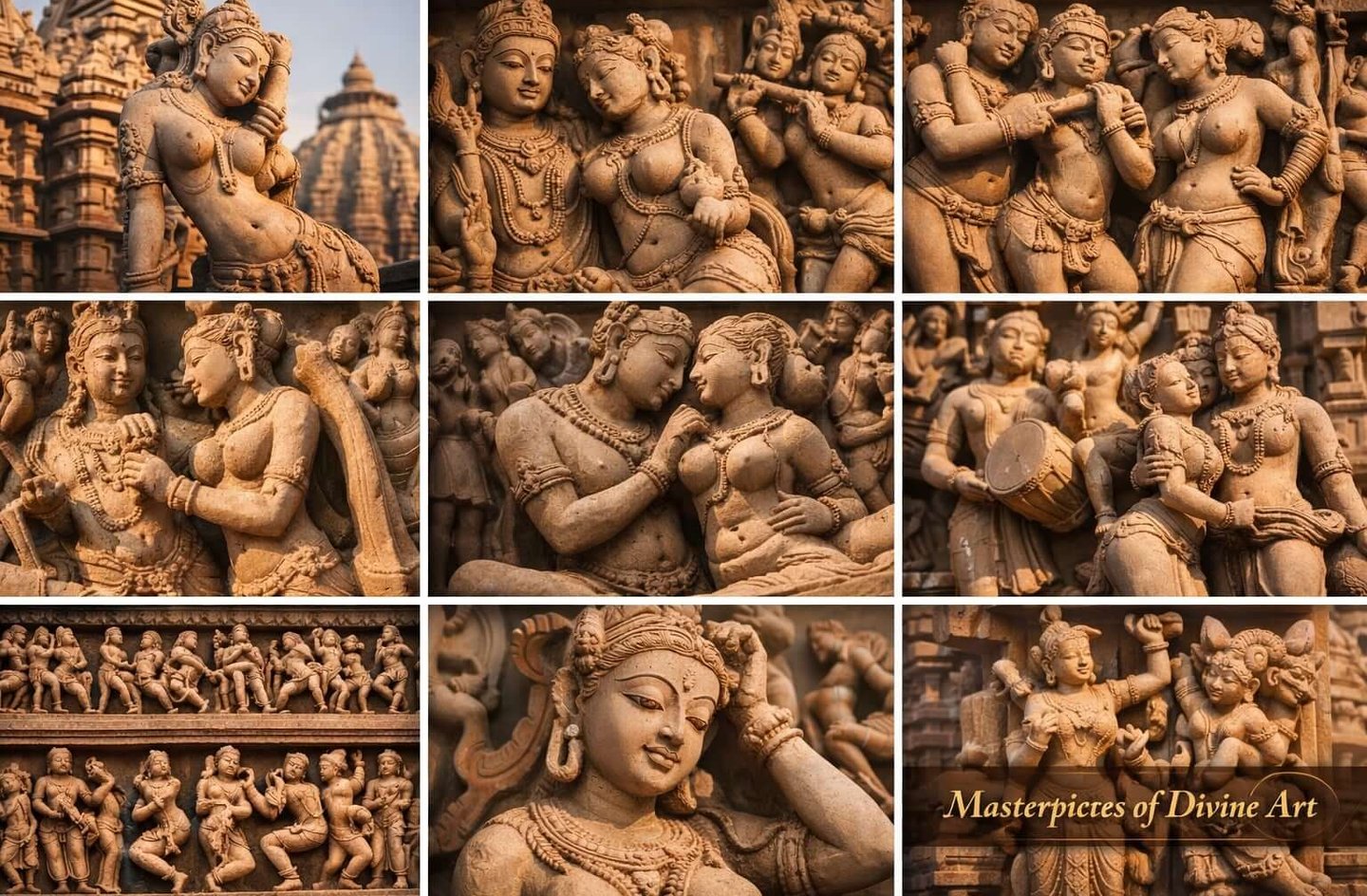
Between 950 and 1050 CE, the Chandela kings of central India commissioned a staggering act of artistic ambition: twenty-five temples, built across the golden plains of what is now Madhya Pradesh, every surface animated by figures that laugh, love, fight, dance, worship, and embrace with a freedom that the modern world has not yet fully understood.
The sculptors of Khajuraho were not decorators. They were philosophers in sandstone, visionaries who understood that the full spectrum of human experience, from the sacred to the sensual, from the cosmic to the intimate, was a worthy subject for art. They carved goddesses with the tenderness of lovers. They depicted desire with the reverence usually reserved for divinity. And they built it all to last forever.
Today, Khajuraho stands as one of UNESCO's most treasured World Heritage Sites and as one of the most profoundly moving places on Earth. To visit is not merely to see something beautiful. It is to encounter a civilisation that understood life with unusual completeness, and chose to carve that understanding into forty-foot towers of pink sandstone, where it has stood, and will stand, for centuries to come.
Khajuraho In Numbers
25 SURVIVING TEMPLES
85+ TEMPLES ORIGINALLY BUILT
1,000 YEARS OF RECORDED HISTORY
1986 UNESCO WORLD HERITAGE DESIGNATION
The Five Worlds Carved Into Khajuraho's Stone
The sculptures of Khajuraho are not decorations. They are a complete civilisational statement, a taxonomy of existence carved in high relief across the bodies of temples. Understanding what you are looking at is understanding what the Chandela dynasty believed about being human.
1. The Divine Figures
The major deities - Shiva, Vishnu, Parvati, Brahma, Lakshmi, Saraswati, appear throughout the temples in forms of serene magnificence. Their faces carry the particular expression that Sanskrit aesthetics calls shanta: equanimity, completeness, the face of a being that lacks nothing. Many of these figures are among the finest examples of medieval Indian devotional sculpture anywhere in the world.
2. The Mithuna - Erotic Couples
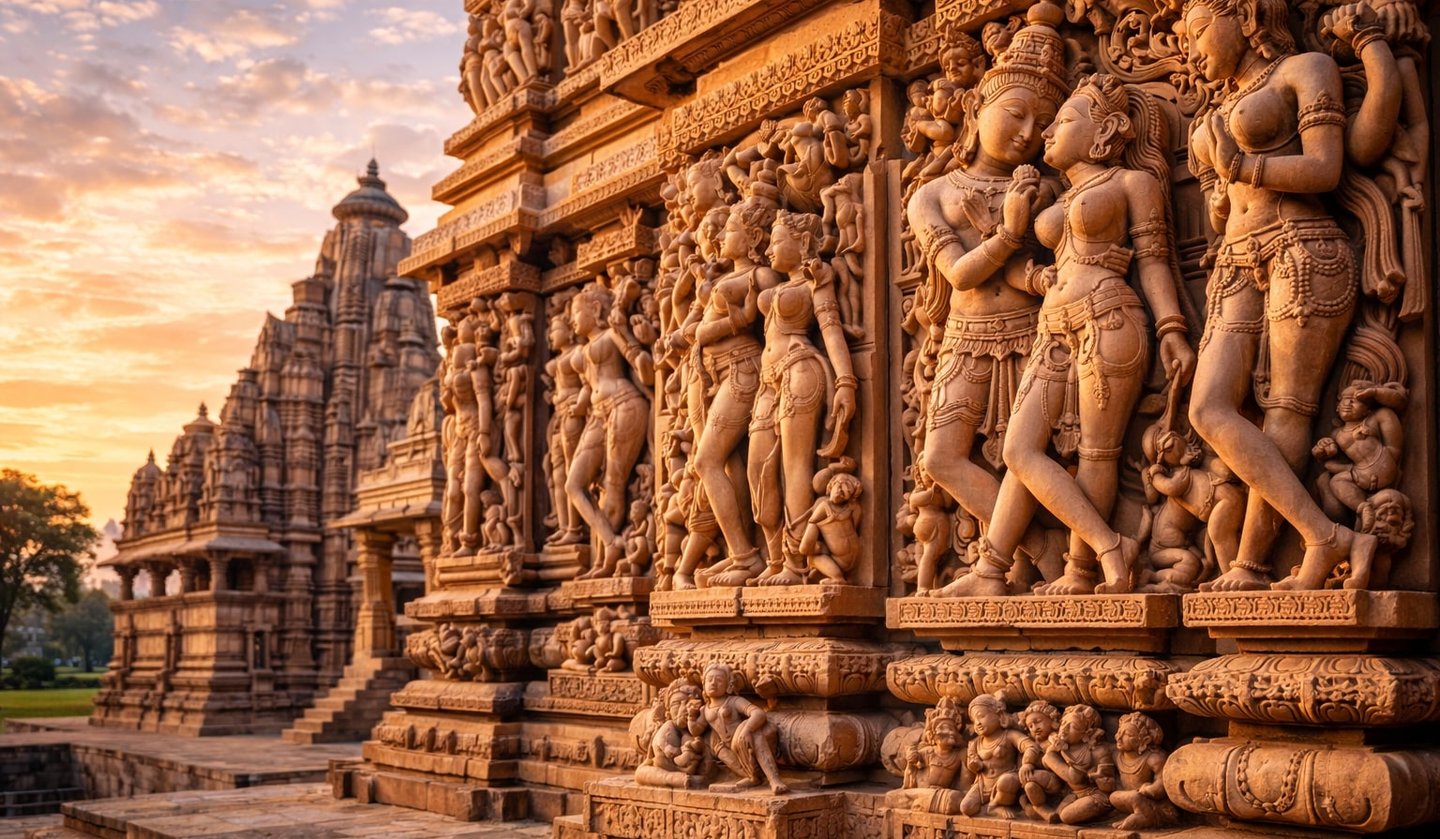
The sculptures that made Khajuraho world-famous. Mithuna - loving couples in various states of physical intimacy, appear primarily on the exterior bands of the larger temples. Their significance is philosophical rather than prurient: they represent the vitality of life, the energy of desire, and the Tantric teaching that the body's deepest experiences can be pathways to transcendence.
They are carved with extraordinary skill. The faces carry not lust but something closer to bliss, an absorption in the moment of union that mirrors the absorption of meditation. To stand before them is not to feel voyeuristic. It is to feel included in a very ancient, very human truth.
3. The Apsaras - Celestial Dancers
Perhaps the most beloved figures at Khajuraho are the Surasundari, celestial beauties who appear across virtually every temple surface in an endless choreography of daily life. They are depicted writing, bathing, playing music, applying makeup, removing thorns from their feet, embracing children, teaching, dancing.
They are carved with the kind of specificity that suggests not divine ideals but actual women, observed with great love and rendered into permanent stone. They are among the most humanly resonant figures in all of world sculpture. Travellers who have stood before them, regardless of background, culture, or era, consistently report the same experience: recognition.
4. The Secular World - Life as It Was Lived
Khajuraho is also a social document of extraordinary richness. Hunting scenes, court scenes, military processions, musicians, acrobats, teachers with students, merchants, women at domestic tasks, the full texture of medieval Indian life is here, carved in the knowledge that it too was worth preserving forever.
The temples tell us what people wore, how they styled their hair, what instruments they played, what they looked like when they laughed. This is civilisation recorded not in text but in three dimensions, at human scale, with human affection.
5. Architectural & Decorative Sculpture
Interspersed throughout are purely architectural sculptures - ornate floral motifs, mythical animals, guardian figures, beautifully carved pilasters and corbels. These are not mere decoration but load-bearing elements of meaning: the grammar that holds the visual sentences of the temple walls together.
The Architecture of Ascent
Why the temples are built the way they are
The temples of Khajuraho follow the Nagara style of North Indian temple architecture, characterised by curvilinear towers called shikharas that rise from a base of horizontal mouldings. The profile of each tower evokes the shape of Mount Meru, the cosmic mountain at the centre of Hindu and Jain cosmology, the axis around which the universe turns. To enter a Khajuraho temple is, architecturally speaking, to approach the centre of creation.
The horizontal bands that encircle the temples at different heights carry different kinds of sculpture and this is not arbitrary. The lowest bands carry elephants, symbols of earthly power and stability. Above them come warriors and horses. Then secular human life. Then the apsaras and celestial beings. And then, at the highest register, the gods. The building is a cosmological diagram.
The mithuna are positioned precisely at the level where the human and the divine begin to intersect. The erotic is not the destination. It is the doorway.
This is what separates Khajuraho from any other approach to erotic art in human history: the explicit placement of desire not as something separate from spirituality, but as a step in the direction of it. The architects were making a theological argument in stone, and it has been standing for a thousand years.
What the Stones Are Actually Saying
And why Khajuraho changes the way you see the world
Imagine standing at the base of the Kandariya Mahadev temple as the early morning light turns the sandstone amber. You look up, and you begin to see them, hundreds of figures, each no larger than your forearm, cascading across the tower in bands of narrative. Celestial dancers frozen mid-pirouette. Warriors in the chaos of battle. Gods receiving offerings from impossibly graceful devotees. And then, there — between a dancing apsara and a four-armed Vishnu, a couple in an embrace so tender, so anatomically honest, so clearly carved with love rather than scandal, that your 21st-century assumptions about what belongs in a sacred space dissolve completely.
This is what Khajuraho does to you. It does not shock. It expands. It widens your idea of what human beings are, what we have always been, and what we have the capacity to celebrate about ourselves.
The temples were built by the Chandela Rajputs, a dynasty that ruled much of central India during a period of extraordinary cultural flowering. Their capital at Khajuraho (then Kharjuravahaka - City of Date Palms) was not on any trade route. It was not a military stronghold. It was a sacred centre, purpose-built for worship, contemplation, and artistic expression. At its peak, it may have held as many as 85 temples. The ones that survive today represent only a fraction of what once stood here, and yet they are enough to constitute one of the greatest artistic legacies in human history.
The so-called erotic sculptures, actually called mithuna in Sanskrit, meaning 'loving couples'- account for perhaps ten to fifteen percent of the total carvings at Khajuraho. They are extraordinary, and they deserve to be seen honestly. But to visit Khajuraho only for the mithuna is to visit the Sistine Chapel only for the ceiling, and miss the four walls. These temples are encyclopaedias of medieval Indian civilisation, its cosmology, its social hierarchy, its daily rituals, its agricultural life, its music and dance, its mythology, its fashion, its philosophy of how to live.
Medieval Indian philosophy, particularly the Tantric traditions that influenced Chandela architecture -held that the material world, including the body and its pleasures, was not an obstacle to spiritual liberation but a vehicle for it. The path to Moksha, to liberation, ran through life, not away from it. The temples express this with architectural rigour: the erotic sculptures occupy the exterior bands of the towers, the zone between the earthly and the divine. As you enter the temple, crossing that threshold , you leave multiplicity behind and move toward the pure, undivided interior. The erotic is not the destination. It is the doorway.
To understand this is to understand why Khajuraho feels so different from every other heritage site you have ever visited. There is no guilt here. There is a civilisation looking at itself clearly at all of what it is and finding it worthy of stone.
The British, when they rediscovered Khajuraho in 1838 through the survey work of T.S. Burt, were famously scandalized. What he did not understand what takes a visit to understand is that the scandal belongs to the eye of the observer. Stand before these carvings with sufficient humility, and what you feel is not transgression. You feel enlargement.
Western travellers in particular often report that Khajuraho produces a quiet revolution in their understanding of what human culture has been capable of. In an era when we are still debating how to talk about bodies, desire, and spirituality, the Chandela sculptors had already built the answer into forty-foot towers of pink sandstone and left it standing for a thousand years.
Sound & Light Show - The Temples After Dark
As darkness settles over the plains of Madhya Pradesh and the air cools to the temperature of memory, the Western Group transforms into something extraordinary. Bathed in golden light, the Sound and Light Show narrates a thousand years of Khajuraho's history through music and cinematic storytelling.
The carvings seem to move in the shifting light. The tower of Kandariya Mahadev glows as though it has generated its own warmth. For international visitors, this is often the moment when Khajuraho stops being a heritage site and becomes an emotional experience.
PRACTICAL DETAILS - SOUND & LIGHT SHOW
◈ English Show: 7:30 PM (Summer) · 6:30 PM (Winter)
◈ Duration: Approximately 50 minutes
◈ Location: Western Group Temple Complex
◈ Booking: Arrange in advance through UK India Tourism for reserved seating
The Khajuraho Dance Festival - Living Sculpture
Every year in late February and early March, the sculpture comes to life. The Khajuraho Dance Festival - one of India's most prestigious classical dance events, brings the country's greatest exponents of Bharatanatyam, Kathak, Odissi, Kuchipudi, Manipuri, and Kathakali to perform against the illuminated backdrop of the Western Group temples.
To watch a Bharatanatyam dancer perform these gestures before the very temple walls that the sculptors drew their inspiration from walls that depict the exact same poses, the same mudras, the same expressions, rendered in stone a thousand years ago, is to experience a continuity of human tradition so long and so alive that time itself seems elastic.
FESTIVAL DETAILS
◈ Dates: Late February to early March annually (check with UK India Tourism for exact dates each year)
◈ Venue: Open-air stage, Western Group Complex
◈ Dance Forms: Bharatanatyam · Kathak · Odissi · Kuchipudi · Manipuri · Kathakali
◈ Booking: This period is Khajuraho's most popular reserve hotels and guides well in advance
The Three Sacred Complexes of Khajuraho
The surviving temples are divided into three geographical groups, each with a distinct character, atmosphere, and artistic emphasis. Together they constitute one of the most complete records of medieval Indian spirituality and artistic culture anywhere on earth.
The Western Complex - UNESCO Core Zone
The crown jewel of Khajuraho. A magnificent cluster of temples rising from a raised stone platform that glows amber in morning light. The Western Group contains the most architecturally ambitious and sculpturally dense temples in the entire complex, including the great Kandariya Mahadev, whose tower rises 31 metres and carries over 900 sculptural figures in a vertical symphony of devotion and desire. No international visitor should leave without giving this complex an entire morning, and returning at dusk when the sandstone turns the colour of fire.
KEY TEMPLES - WESTERN GROUP
◈ Kandariya Mahadev Temple: The masterwork. 31-metre tower. 900+ sculptural figures. Dedicated to Shiva. The single most important temple at Khajuraho and one of the supreme achievements of medieval Indian architecture.
◈ Lakshmana Temple: Among the most complete surviving examples. Dedicated to Vishnu. Exquisite sculptural programmes across all three exterior registers. Exceptional erotic and divine carvings.
◈ Vishwanath Temple: Dedicated to Shiva. The shikhara — the temple tower — displays near-perfect symmetry. A working Nandi shrine completes the sacred complex.
◈ Chitragupta Temple: Rare dedication to Surya, the sun deity. The interior contains one of the most remarkable solar deity images in all of India. Celestial beings crowd the exterior.
◈ Devi Jagadambi Temple: A powerfully feminine temple — three-tiered, with extraordinary apsara carvings. Some of the most emotionally affecting individual sculptures at Khajuraho are found here.
The Eastern Complex - Jain & Hindu Traditions
Where the Western Group overwhelms with its ambition, the Eastern Complex persuades with its serenity. A number of temples here are Jain, dedicated to the Tirthankaras, the great teachers of spiritual liberation — and they carry a different emotional register: quieter, more introspective, precise in their geometry.
The Parsvanath Temple, despite being Jain in dedication, contains some of the most beautiful secular sculptures anywhere in Khajuraho, women writing letters, applying kohl, adjusting their anklets. Life observed with extraordinary affection and carved with the patience of people who believed that the everyday was sacred.
KEY TEMPLES- EASTERN GROUP
◈ Parsvanath Temple: The largest Jain temple at Khajuraho. Breath taking secular sculptural detail — daily life rendered with extraordinary intimacy and skill. Not to be missed.
◈ Adinath Temple: Dedicated to the first Jain Tirthankara. Elegant and composed. Three-tiered exterior with fine apsara carvings.
◈ Ghantai Temple: Now partially ruined, but notable for its exquisite carved columns and Jain sculptural iconography.
◈ Brahma Temple: A small, beautifully proportioned Vishnu temple beside the sacred Khajur Sagar lake. The setting is as memorable as the architecture.
The Southern Complex -The Quiet Revelation
Scattered across open countryside south of the main village, the Southern Group temples are visited by fewer travellers and are better for it. The Dulhadev Temple stands in a quiet setting that makes its carvings — among the most finely detailed in all of Khajuraho feel like a private discovery.
Come here in the afternoon, when the light is long and golden and the crowds have dispersed. The Chaturbhuj Temple contains one of the most imposing interior sculptures in all of Khajuraho: a nearly three-metre four-armed Vishnu that commands the inner sanctum with absolute authority.
KEY TEMPLES - SOUTHERN GROUP
◈ Dulhadev Temple: Exquisite craftsmanship in a peaceful, uncrowded setting. The apsara carvings here are among the finest individual sculptures in the entire complex.
◈ Chaturbhuj Temple: Houses a nearly 3-metre Vishnu sculpture inside the garbhagriha. Monumental and serene.
◈ Beejamandal Site: An active excavation site revealing the buried foundations of a large medieval temple. A living encounter with archaeological discovery.
Getting to Khajuraho - International Travel Guide
Khajuraho has its own domestic airport (Khajuraho Airport, IATA: HJR) with direct flights from Delhi, Varanasi, and Agra. International travellers arrive via Delhi (Indira Gandhi International Airport, IATA: DEL) or Mumbai (Chhatrapati Shivaji Maharaj International Airport, IATA: BOM), then connect domestically.
RECOMMENDED ARRIVAL ROUTES
◈ From Delhi: Fly direct to Khajuraho - approximately 1 hour. Alternatively, train to Jhansi (2.5 hrs) then drive (3 hrs) - a scenic overland approach.
◈ From Varanasi: Short domestic flight (approx. 40 mins) OR 7-hour road journey - recommended for travellers who want to absorb the landscape.
◈ From Agra: Road journey via Orchha - a beautiful route through Bundelkhand that passes another extraordinary forgotten city.
◈ From Mumbai: Connect via Delhi. UK India Tourism arranges seamless transfer packages from all gateway cities.
How Many Days? Honest Guidance.
◈ Minimum - 1 day: You will see everything. You will understand little. Not recommended for serious travellers.
◈ Recommended - 2 nights / 2 full days: One morning at the Western Group. Sound and Light Show. One day for Eastern Group, Southern Group, museum, and a return to the Western temples at dusk. This is the right amount.
◈ Ideal - 3 nights: Everything above, plus time to absorb slowly. A third morning for the museum in depth, the State Tribal Arts Museum, a slow walk through the village, and a final contemplative visit to your favourite temple. Those who spend three days leave with Khajuraho permanently installed in their interior landscape.
The Right Guide Changes Everything
The difference between a guided and unguided visit to Khajuraho is the difference between hearing an orchestra and watching it through soundproof glass. The sculptural programmes are dense with iconographic meaning that is invisible without context, what deity is this? What does this gesture signify? Why is this figure placed here and not there?
UK India Tourism provides expert English-speaking guides who have spent years studying Khajuraho's art history and can bring every band of carving to life with narrative precision and genuine intellectual enthusiasm. They are not reading from a script. They love this subject. That difference is felt immediately.
Combining Khajuraho With the Wider India Journey
Khajuraho pairs naturally with India's other great ancient wonders. The classic combination is Varanasi - Khajuraho - Agra: three encounters that move from the world's oldest continuously inhabited city, to the world's most extraordinary temple sculpture complex, to the world's most beautiful building.
Add Orchha, the remarkable forgotten Mughal-Bundela city two hours from Khajuraho and you have one of the most concentrated heritage journeys available anywhere on Earth. UK India Tourism designs these circuits with the rhythm of genuinely immersive travel: not sightseeing, but understanding.
SIGNATURE HERITAGE CIRCUITS
◈ The Golden Triangle + Khajuraho: Delhi · Agra · Jaipur · Khajuraho · Varanasi. The complete northern India cultural arc.
◈ The Heart of India: Varanasi · Khajuraho · Orchha · Bhopal · Mandu. A journey through central India's forgotten kingdoms.
◈ Sacred India: Varanasi · Bodh Gaya · Khajuraho · Ajanta · Ellora. India's greatest sacred art sites in one extraordinary journey.
When to Come - The Complete Seasonal Guide
Oct – Nov
Excellent: Post-monsoon freshness. Lush greenery. Clear skies. Ideal photography. Warm days, comfortable evenings.
Dec – Jan
Peak Season: Cool, dry, perfect sightseeing conditions. The most comfortable weather. Book hotels in advance.
Feb – Mar
Outstanding: Dance Festival season (late Feb to early March). The finest time to visit. Book 3–6 months ahead.
Apr – Jun
Hot: Temperatures 35–45°C. Not recommended for extended outdoor walking. Temples beautiful in empty heat.
Jul – Sep
Monsoon: Dramatic skies and emerald plains. Atmospheric but some disruption. Best for adventurous travellers.
Khajuraho Is, Among All Things, a Love Story
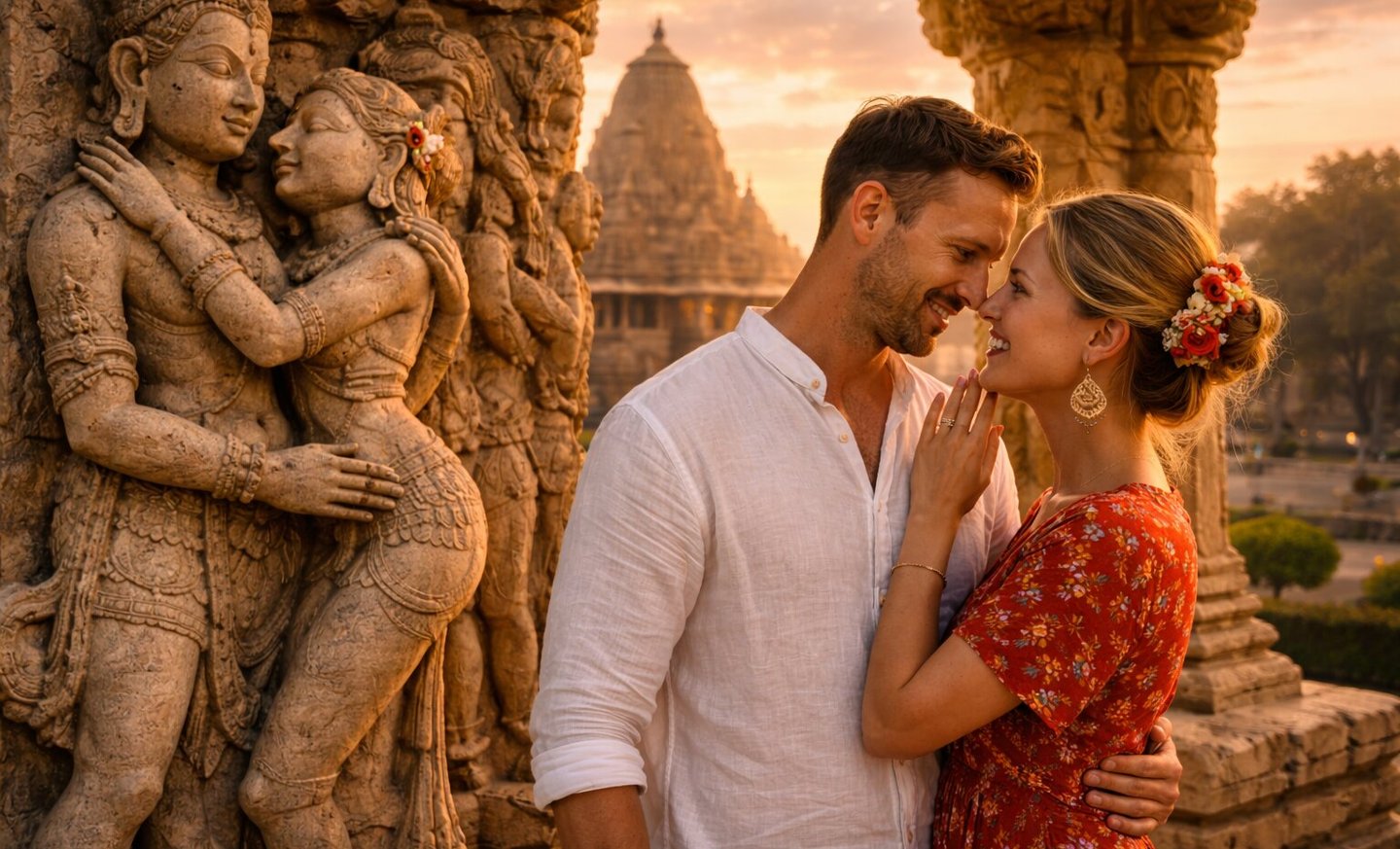
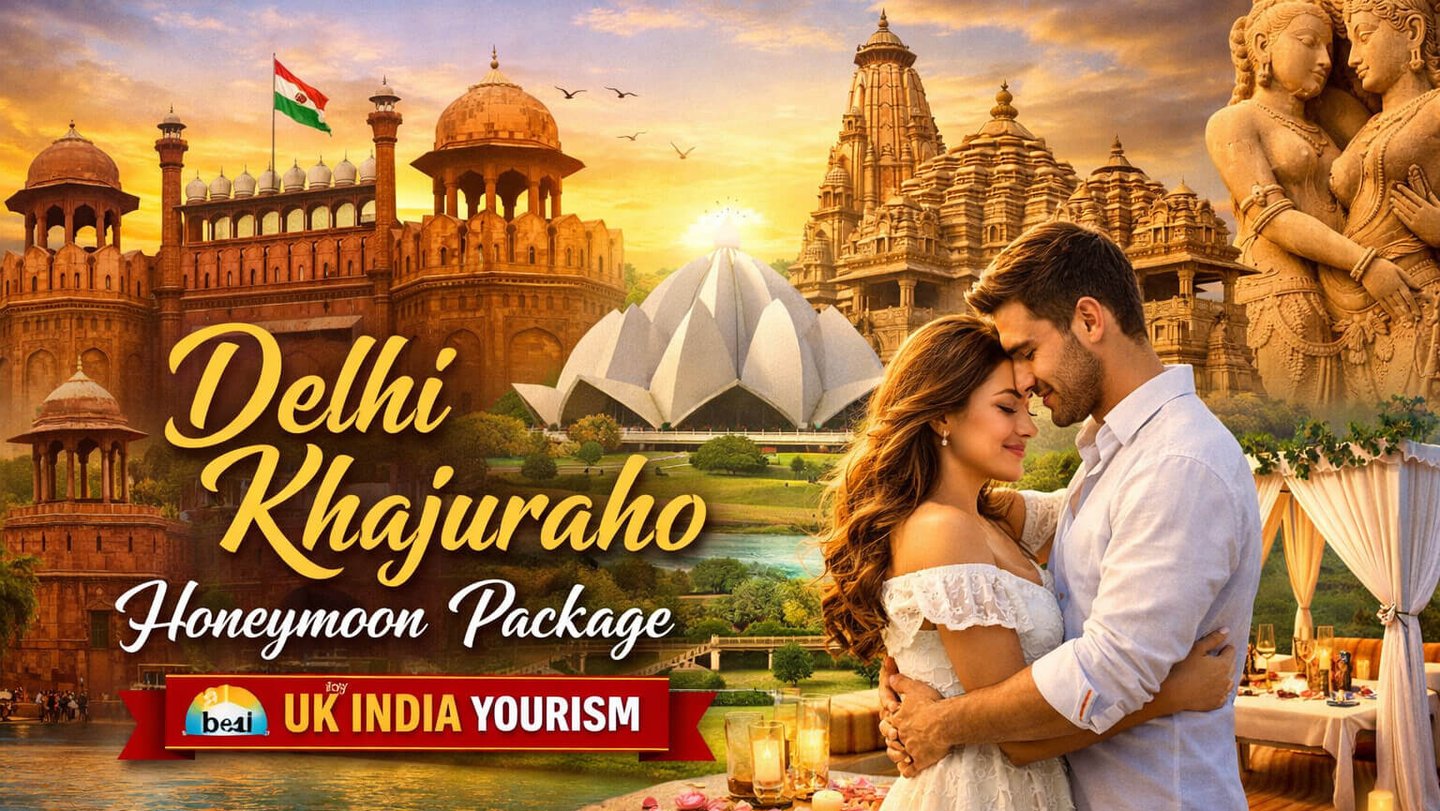
Honeymoon couples have discovered what the Chandela dynasty knew a thousand years ago: Khajuraho is an extraordinarily romantic place. Not because of the mithuna carvings though they do make for remarkable conversation but because the entire complex is built around a philosophy that love is the most serious subject in the universe.
To walk these temple grounds in the company of someone you love, watching the light change over stone that has been witnessing love stories for ten centuries, is to understand your own story as part of something immeasurably larger and older. There is nowhere on Earth quite like it for a honeymoon.
UK INDIA TOURISM HONEYMOON PACKAGE INCLUDES
◈ Private guided temple tours: Your own expert guide, at your pace, with no other group
◈ Dawn access: At the Western Group — the most atmospheric and romantic time to visit
◈ Premium hotel: Carefully selected heritage and luxury properties in Khajuraho
◈ Candlelit dining: Arranged at the finest in-destination restaurants
◈ Sound & Light Show: Reserved seating for the evening performance
◈ Full private transport: Air-conditioned private vehicle throughout
◈ Personalised care: 24/7 UK India Tourism support for the duration of your stay
Why Travel with UK India Tourism?
There is no shortage of tour operators offering India. There is, however, a meaningful difference between a company that sells India and a company that understands it. UK India Tourism was built for international travellers — primarily from the United Kingdom, Europe, United States, Canada, and Australia, who want to experience India at its full depth, not its surface.
WHAT SETS US APART
◈ Expert guides: Art historians and cultural specialists, not generic tourism guides. People who have spent years at these temples and genuinely love them.
◈ Tailored itineraries: No two travellers are the same. Cultural immersion, honeymoon, photography, academic, luxury - we design the journey around you.
◈ Premium logistics: Private transport, handpicked hotels, seamless connections. Every detail arranged before you arrive.
◈ International fluency: We speak your language, literally and culturally. Designed for Western travellers who want depth, not a checklist.
◈ 24/7 support: Throughout your India journey, a UK India Tourism contact is always reachable. Nothing is left to chance.
◈ Honest pricing: Luxury and budget-conscious options. Transparent costs. No hidden extras.
Khajuraho - UNESCO World Heritage - City of Art, Dance & Divine Architecture
Khajuraho is located in Chhatarpur District, Madhya Pradesh, India, approximately 620km south of Delhi. The site consists of 25 surviving temples within three geographical clusters: the Western Group (UNESCO core zone), Eastern Group, and Southern Group. Designated a UNESCO World Heritage Site in 1986, Khajuraho's temples were built by the Chandela Rajput dynasty between approximately 950 and 1050 CE. The site originally comprised over 85 temples; those surviving represent the most significant intact concentration of medieval Indian temple sculpture in the world.
International travellers arrive via Delhi (Indira Gandhi International Airport, IATA: DEL) or Mumbai (Chhatrapati Shivaji Maharaj International Airport, IATA: BOM), connecting domestically to Khajuraho Airport (IATA: HJR). Direct domestic flights operate from Delhi, Varanasi, and Agra. UK India Tourism provides complete transfer and guiding services from all international gateway cities.
The Khajuraho Dance Festival (Khajuraho Nritya Samaroh) is held annually in late February and early March, organised by Madhya Pradesh Kala Parishad. The festival presents India's foremost classical dancers performing the principal classical dance forms - Bharatanatyam, Kathak, Odissi, Kuchipudi, Manipuri, and Kathakali, against the illuminated backdrop of the Western Group temples. This is widely regarded as one of the finest cultural events in India, and is open to international visitors.
The best time to visit Khajuraho is October to March, when temperatures are pleasant and sightseeing conditions are ideal. February and March offer the additional attraction of the annual Dance Festival. UK India Tourism recommends a minimum stay of two nights for a meaningful experience of the complete site. Expert English-speaking guides are essential for understanding the sculptural programmes; UK India Tourism provides specialist art-history guides for all international visits.
Khajuraho has been waiting a thousand years.
You could arrive this winter.
Every serious traveller has a list of places they must see. Khajuraho belongs on that list and at the top of it. Contact UK India Tourism to begin planning your extraordinary journey.
UK INDIA TOURISM
UK: +44 7345 191205
India: +91 9958 480873
Email: sales@ukindiatourism.co.uk
Begin your love story in the most extraordinary place on Earth. Contact UK India Tourism to design your bespoke Khajuraho honeymoon experience.
UK: +44 7345191205
UK India Tourism© 2026, all rights reserved
India: +91 9958480873
⭐⭐⭐⭐⭐ 4.9/5 | 2,600+ Travelers | 18 Years | 98% Recommend