
Package 14: Golden Triangle & Heritage Heartland Tour
Route: (Delhi → Agra → Jaipur → Orchha → Khajuraho → Gwalior → Delhi)
Duration: 10 Days / 9 Nights
Price: Request For Price (Rates based on twin sharing accommodation)
Private AC Car
Best for: Culture lovers, couples, heritage explorers, photographers, International tourists, travellers who want iconic India + hidden royal towns
Beyond the Golden Triangle - Into the Heart of Royal India
The Golden Triangle - Delhi, Agra, Jaipur, is where most visitors to India begin their story. And with good reason. These three cities contain some of the most extraordinary monuments ever built by human hands: the Taj Mahal, the Red Fort, the Amber Fort, the City Palace. They are, without question, magnificent. But they are also just the opening chapter.
This Tour Package takes the classic Golden Triangle and extends it into territory that most international travellers never reach - into the quieter, wilder, more intimate world of Central India's royal heartland. Orchha, with its riverside palaces and cenotaphs reflected in the Betwa. Khajuraho, with its UNESCO-listed temples covered in carvings of such artistic complexity that scholars are still unpacking their meaning. Gwalior, with one of the most formidable hill forts in the entire subcontinent.
Together, these three destinations transform a famous itinerary into something genuinely rare, a journey that gives you iconic India and hidden India in a single, seamless, beautifully paced ten-day arc. This is the tour for travellers who want to go further.
Day by Day Itinerary
Day 1: Arrival in Delhi - Welcome to India
At Indira Gandhi International Airport, our representative will be waiting to transfer you to your hotel in a private, air-conditioned vehicle. Delhi's scale and energy announce themselves immediately - this is one of the great capital cities of the world, and even the drive from the airport carries a charge of arrival that is entirely its own.
Depending on your flight time, the evening offers options as gentle or as exploratory as you wish:
India Gate - the sandstone war memorial at the ceremonial heart of New Delhi, beautifully lit after dark, is an ideal first stop: impressive, accessible, and unmistakably Delhi.
Connaught Place - the grand circular commercial centre of New Delhi, with its colonnaded Georgian architecture, pavement cafés, and busy evening energy, is excellent for a first dinner and a first feel of the city.
Rest well. Delhi gives generously to those who arrive rested.
Day 2: Delhi Sightseeing - Old Delhi & New Delhi
After breakfast, today is a full, well-designed introduction to one of Asia's most historically layered cities. Delhi has been continuously inhabited and repeatedly rebuilt for over three thousand years, and the monuments of each successive civilisation sit alongside the next in a density of heritage that is unique even by Indian standards.
Red Fort - The great Mughal citadel built by Emperor Shah Jahan in 1639, its massive red sandstone walls rising 33 metres above the street and enclosing a complex of palaces, audience halls, and gardens that once represented the absolute centre of Mughal imperial power. The Diwan-i-Khas (Hall of Private Audiences), where the famous Peacock Throne once stood, and the Diwan-i-Aam (Hall of Public Audiences), where the emperor appeared before his subjects, give a visceral sense of the scale and ambition of Mughal governance. On Sundays, the fort is particularly atmospheric — full of Indian families, school groups, and the particular noise and colour of Delhi at leisure.
Qutub Minar Complex - Built in the twelfth century to mark the establishment of the Delhi Sultanate , the first Muslim Kingdom in India - the Qutub Minar is a 73-metre minaret of red sandstone and marble, the tallest brick minaret in the world and one of the finest examples of early Indo-Islamic architecture anywhere. The surrounding complex includes the Quwwat-ul-Islam Mosque, the first mosque built in India after the Islamic conquest, and the mysterious Iron Pillar of Delhi - a seven-metre column of wrought iron dating from the fourth century CE that has stood in the open air for 1,600 years and shows almost no corrosion, a metallurgical achievement that modern scientists still cannot entirely explain.
Humayun's Tomb - Built in 1572 by the widow of the Mughal Emperor Humayun, this garden tomb is widely acknowledged as the architectural forerunner of the Taj Mahal, the first great garden tomb of the Mughal tradition, with its characteristic double dome, its charbagh (four-part garden), and its sublime proportions. It is quieter than many Delhi monuments and more beautiful for the space. UNESCO-listed and recently restored to something close to its original glory, it is one of the most satisfying heritage experiences in the entire city.
Evening is free for exploration - Delhi's restaurant scene is extraordinary, and the area around your hotel will offer excellent options for dinner.
Day 3: Delhi → Agra - The Taj Mahal & Agra Fort
After breakfast, we drive south to Agra - approximately 200 kilometres, three to four hours on the Yamuna Expressway, one of India's smoothest highway connections. Arrive late morning and go directly to the monument that has drawn the world to India for four centuries.
The Taj Mahal - There is very little that can be usefully added to what has already been written about the Taj Mahal. It is one of the seven wonders of the modern world. It is, by wide consensus, the most beautiful building ever constructed. It was built by Emperor Shah Jahan between 1632 and 1653 as a mausoleum for his beloved wife Mumtaz Mahal, who died in childbirth. Over twenty thousand workers from across Asia laboured for over two decades to complete it. The white Makrana marble from which it is built changes colour through the day, cream in the morning light, brilliant white at noon, gold in the late afternoon, silver under the moon.
What surprises most visitors is not the Taj itself, they have seen it in photographs all their lives but the way it makes them feel. There is an emotional quality to standing before it that photographs cannot convey and that very few buildings in the world possess. It is worth the journey for that quality alone.
Agra Fort - A short distance from the Taj, the great red sandstone fort of Agra is one of the finest surviving Mughal fortifications in India, a UNESCO World Heritage Site that served as the main residence of the Mughal emperors until the court moved to Delhi. Within its walls, the palaces built by successive emperors, Akbar, Jahangir, Shah Jahan - layer the centuries visibly, each in a distinct architectural language. From the Musamman Burj, the octagonal tower where Shah Jahan spent his final years under house arrest by his son Aurangzeb, with a distant view of the Taj Mahal, the poignancy of the monument he built is complete.
Evening is free - the local marble craft industry, for which Agra is famous, produces both extraordinary high-end inlaid work and affordable decorative pieces, and the shops near the fort are excellent for browsing.
Day 4: Agra → Jaipur via Fatehpur Sikri - The Ghost City & the Pink City
After breakfast, we drive west toward Jaipur but the drive makes a stop that is, in its own way, as extraordinary as anything in Agra.
Fatehpur Sikri - Built by the Emperor Akbar between 1571 and 1585 as his new imperial capital, Fatehpur Sikri was abandoned barely fourteen years after its completion, possibly due to water shortage, possibly for strategic reasons and has remained almost perfectly preserved in its abandonment ever since. The result is one of the most haunting and magnificent architectural sites in India: an entire Mughal imperial capital, complete and deserted, its red sandstone palaces and mosques and audience halls standing exactly as they were left over four centuries ago. The Buland Darwaza, the Gate of Magnificence, the largest gateway in the world at 54 metres - dominates the approach to the Jama Masjid within. The Panch Mahal, a five-storey pavilion of diminishing colonnades, and the Diwan-i-Khas, Akbar's hall of private audience with its extraordinary central pillar, are among the finest pieces of Mughal architecture anywhere. Fatehpur Sikri is everything the term "living history" promises and rarely delivers.
Continue to Jaipur - arriving in the evening, time for a walk through the local market, perhaps the famous Johari Bazaar for jewellery or the Bapu Bazaar for textiles.
Day 5: Jaipur Sightseeing - The Pink City in Full
After breakfast, a full day in one of India's most colourful, most photographed, and most rewarding cities.
Hawa Mahal (Palace of Winds) - The most iconic facade in Jaipur: a five-storey screen of 953 small latticed windows through which the royal women of the Kachwaha court could observe the street processions below without being seen. Built in 1799 in the form of Lord Krishna's crown, it is unmistakably, gloriously Rajasthani — and one of the most photographed buildings in India.
City Palace - The seat of the Jaipur royal family, still partially inhabited by the Maharaja's descendants, is a complex of courtyards and palaces in the heart of the old city. The Chandra Mahal (accessible by ticketed tour) contains some of the finest decorative interiors in Rajasthan. The palace museum houses an extraordinary collection of royal artifacts, weapons, textiles, and manuscripts.
Jantar Mantar - Built by Maharaja Jai Singh II in 1734, this is the largest stone astronomical observatory in the world, a collection of nineteen monumental instruments designed to measure celestial time and movement with remarkable accuracy, several of them still used by astronomers today. UNESCO-listed and genuinely extraordinary for anyone with even a passing interest in science, mathematics, or architecture.
Amber Fort - On the northern outskirts of Jaipur, climbing the hillside above the Maota Lake, the Amber Fort is the finest fort-palace complex in Rajasthan and one of the most magnificent in India. Its Sheesh Mahal (Mirror Palace), the walls, ceilings, and arches entirely covered in tiny mirror mosaic set in patterns of extraordinary delicacy, is one of the great decorative interiors of the world. At sunset, the fort glows golden above the lake below.
Day 6: Jaipur → Orchha - The Long Drive to Royal Calm
An early start is essential today. The drive from Jaipur to Orchha is approximately 400 kilometres - the longest single journey of the tour, taking seven to eight hours with stops. We recommend departing by 7:30 AM to arrive comfortably before dark.
The drive crosses the state boundary from Rajasthan into Madhya Pradesh and the landscape changes with it. The desert quality of Rajasthan gives way to a greener, more forested terrain. The road passes through Bharatpur and Gwalior before dropping south to the Betwa River.
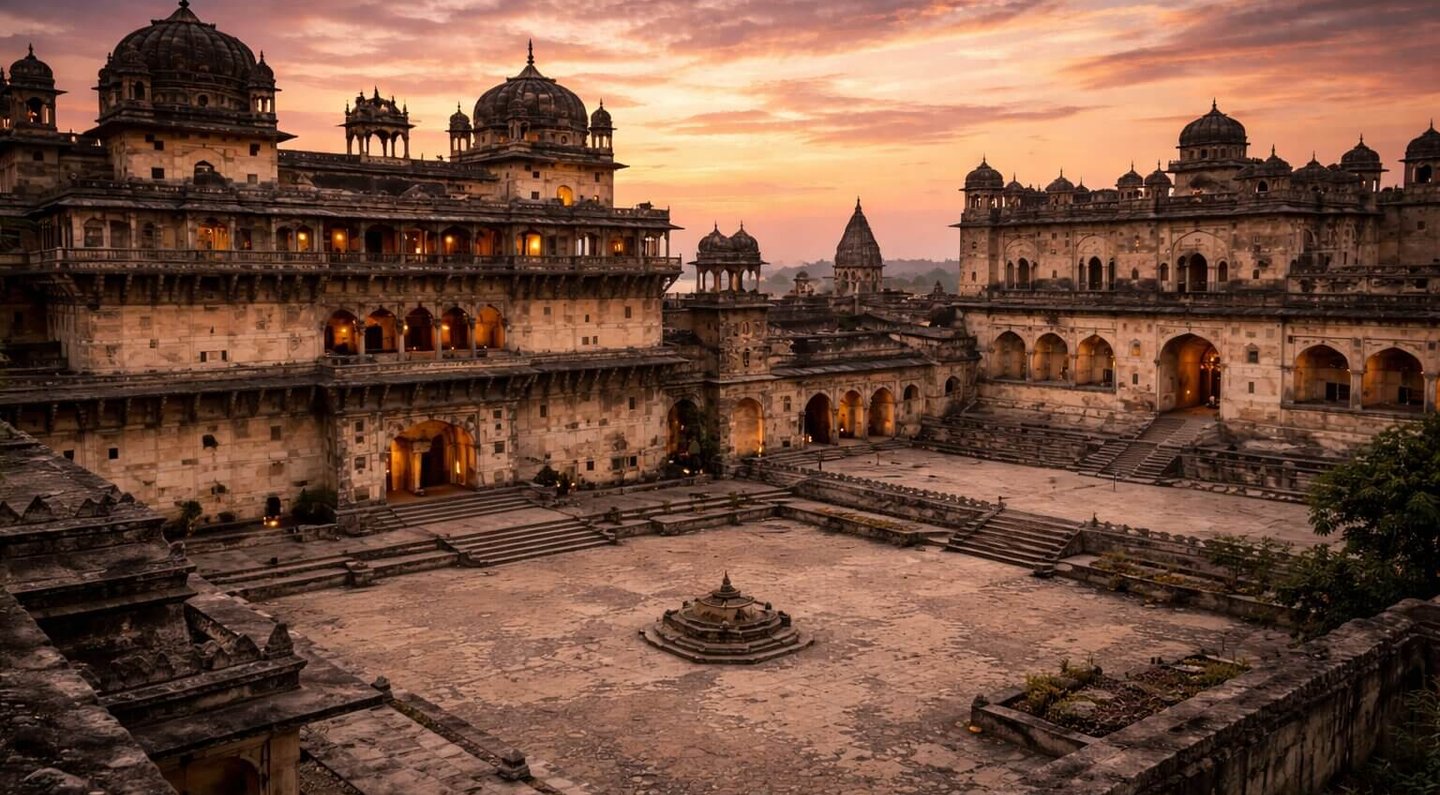
Orchha reveals itself quietly. There is no dramatic arrival moment, just a small town, a medieval bridge over a rushing river, and then, suddenly, the silhouettes of palace towers and chhatri domes against the sky. Check in to your hotel — several excellent properties here are converted heritage buildings and walk to the river in the evening. The Betwa moves fast and clear over its rocky bed, and the chhatris, the royal cenotaphs of the Orchha rulers, standing in a row along the riverbank, catch the last light of the day in their carved stone. This is one of the most beautiful evening scenes in Central India, and almost nobody knows it is here.
Day 7: Orchha Sightseeing + Drive to Khajuraho
After breakfast, the morning belongs to Orchha and it gives generously.
Orchha Fort Complex - The fort of Orchha, built by the Bundela Rajput ruler Rudra Pratap Singh in the sixteenth century, contains within its walls a sequence of palace buildings of extraordinary character. The Jahangir Mahal, built to honour the visit of Emperor Jahangir, is the finest example of Bundela architecture in India, a four-storey palace of ornate carved stone that manages to be simultaneously monumental and intimate. The Raja Mahal next door is older and simpler, its interior walls covered in vibrant fresco murals depicting scenes from the Ramayana and the life of Krishna in colours that have retained their brightness across four centuries.
Ram Raja Temple - Unique in India, this is the only temple in the country where Lord Ram is worshipped in his form as a king rather than a deity, complete with ceremonial guards who present arms at prayer time. The story of how a domestic palace became a temple, and why an idol that was only meant to rest here briefly has been fixed in its place for four hundred years, is one of the loveliest pieces of local mythology in Central India.
Chhatris by the River - The fourteen royal cenotaphs along the Betwa riverbank, each built to honour a Orchha ruler, are the defining image of the town. Seen from the opposite bank, or from the bridge above the rapids, they form a silhouette against the sky that is unlike anything else in India, part temple, part tomb, part sculpture. They are unforgettable.
After sightseeing, we drive to Khajuraho, approximately 180 kilometres, three to four hours. Check in to your hotel in the evening.
Day 8: Khajuraho - UNESCO Heritage Temples & the World's Greatest Stone Carvings
Khajuraho is one of India's most remarkable UNESCO World Heritage Sites and one of its most misunderstood. The temples here, built by the Chandela dynasty between 950 and 1050 CE, are famous worldwide for their erotic carvings but to describe Khajuraho primarily through that lens is to miss the far larger and more extraordinary achievement that surrounds those celebrated panels.
These are temples of astonishing architectural and sculptural ambition. Their exterior walls carry thousands of carvings depicting every aspect of medieval Indian life, celestial beings and warriors, musicians and dancers, hunting scenes and royal processions, everyday domestic moments, in a density and quality of stone sculpture that has no parallel anywhere in the world. The erotic panels, representing perhaps ten percent of the total carvings, are understood variously as tantric philosophy, as instruction, as the celebration of human life as an aspect of the divine. They are carved with the same skill and the same seriousness as every other panel.
Western Group of Temples - The main complex, and the finest concentration of temples. The Kandariya Mahadev Temple, the largest and most elaborately carved, rises to 30 metres with a verticality that gives it something of the quality of a Gothic cathedral, all upward aspiration, all decorated surface, all architectural energy directed toward the sky. The Lakshmana Temple and the Chitragupta Temple are each extraordinary in their own specific ways. Allow at least three hours here, moving slowly, letting the stone speak.
Eastern Group of Temples - A short distance away, the eastern group includes both Hindu and Jain temples of considerable beauty, less visited and often entirely peaceful. The Parsvanatha Temple contains some of the finest individual carvings in Khajuraho, including a celebrated panel of a woman removing a thorn from her foot whose naturalism and grace would not be out of place in a classical Greek collection.
Evening in Khajuraho: a light-and-sound show at the Western Group (seasonal), or simply dinner in the town and the quiet satisfaction of having spent a day in the presence of genuine genius.
Day 9: Khajuraho → Gwalior - The Fort That Commands Everything
After breakfast, we drive north to Gwalior, approximately 280 kilometres, five to six hours through the forests and plains of northern Madhya Pradesh. Gwalior is dominated, completely and magnificently, by its fort.
Gwalior Fort - Standing on a sandstone plateau 100 metres above the city on every side, Gwalior Fort has been called by the Emperor Babur "the pearl amongst fortresses in India" and the description holds. The fort's history spans fifteen centuries and a remarkable range of ruling dynasties - Hindu Rajputs, Muslim sultans, Mughals, and Marathas all held it at different periods, and each left their mark. The scale is extraordinary: three kilometres long and a kilometre wide at its broadest, it contains within its walls a complex of palaces, temples, and reservoirs that is itself a small town. The Man Mandir Palace, built by Raja Man Singh in the fifteenth century, is covered in extraordinary tilework in turquoise, yellow, and green, geometric and animal patterns of great sophistication that cover the exterior towers in a richness of colour that is startling against the plain sandstone of the walls. The Sas Bahu Temple complex, built in the eleventh century, contains carving that rivals Khajuraho in its quality. The views from the fort's ramparts over the city below and the plains beyond stretching to the horizon in every direction, are magnificent.
Check in to your hotel in Gwalior. A final evening on the road - dinner, rest, and the last night of a journey that has taken you from the seat of Mughal empire to the medieval heartland of Central India.
Day 10: Gwalior → Delhi - The Road Home
After breakfast, we begin the final drive north to Delhi, approximately 320 kilometres, five to six hours depending on traffic. The road passes through Agra, and the familiar landscape of the Yamuna plain, seen again in the light of a journey nearly complete, has a different quality, not of arrival but of departure, the comfortable melancholy of a journey ending well.
Arrive in Delhi in the afternoon or early evening, with timing planned carefully around your flight. Our driver will take you directly to Indira Gandhi International Airport for your onward journey.
Your Golden Triangle & Heritage Heartland Tour ends here with the Taj Mahal in your photographs, the mirror palace of Amber in your memory, the cenotaphs of Orchha at sunset behind your eyes, the stone carvings of Khajuraho still asking their ancient questions, and the pearl of Gwalior Fort standing above the plains of Central India exactly as it has stood for fifteen centuries.
Most travellers see the Golden Triangle and believe they have seen the best of India's heritage. You have seen the best of it and then gone further, into the India that the tourist trail hasn't quite reached. That further India is where the real story lives.
✅ Inclusions
✅ 9 Nights accommodation — quality 3 / 4-star properties across all destinations ✅ Daily breakfast at your hotel ✅ Private AC car / SUV with English-speaking driver for the complete tour ✅ All sightseeing as per itinerary ✅ All tolls, parking, and driver allowances ✅Monument entry fees
❌ Exclusions
❌ International flights and airfare ❌ Lunch, dinner, and personal expenses ❌ Travel insurance and visa charges
Best Time to Visit
October to March is the ideal season, comfortable temperatures across both North and Central India, clear skies for photography, and the finest conditions for the long driving days this tour involves. December and January bring cool, crisp weather that is perfect for outdoor sightseeing. February and March offer warming temperatures and the beginning of wildflower season in Central India's forests.
Avoid April to June (extreme heat across the entire route) and July to September (monsoon - roads and some heritage sites are affected).
Route Feasibility Check
Here is an honest assessment of every leg of the journey:
Leg Distance Drive Time Verdict Delhi → Agra ~200 km 3–4 hrs ✅ Easy Agra → Jaipur via Fatehpur Sikri ~250 km 4–5 hrs ✅ Comfortable Jaipur → Orchha ~400 km 7–8 hrs ⚠️ Long - needs early start Orchha → Khajuraho ~180 km 3–4 hrs ✅ Easy Khajuraho → Gwalior ~280 km 5–6 hrs ✅ Manageable Gwalior → Delhi ~320 km 5–6 hrs ✅ Fine - plan around flight time
Frequently Asked Questions
Q: Is this suitable for first-time visitors to India? Yes, it is - in fact, an ideal first-time itinerary. It includes the monuments that define India's global reputation, while adding destinations that deepen and enrich the understanding of what India's heritage actually encompasses. The private transport and 4-star accommodation provide the comfort that first-time visitors benefit from.
Q: Is the Day 6 drive from Jaipur to Orchha really manageable? Yes, with an early start. We recommend departing Jaipur by 7:30 AM at the latest. The road via Bharatpur is well-maintained, and with a comfortable lunch stop midway, the journey is long but not arduous. Arriving in Orchha before dark is the goal, and it is consistently achievable.
Q: Can we upgrade to 5-star hotels? Yes, luxury upgrades are available at all major destinations on this route. The pricing will be adjusted accordingly and shared with you in advance of booking.
Q: Is Orchha worth the detour for international visitors? Without question. Orchha is one of the most genuinely surprising heritage discoveries available to any traveller in India, a medieval Rajput town of extraordinary architectural richness that remains almost entirely off the international tourist trail. The contrast with the crowds of Agra and Jaipur makes it feel like a personal discovery. Almost everyone who goes thanks us for including it.
Why Book This with UK India Tourism?
Because the difference between a good India tour and a great one is almost never about which monuments you visit. It is about pace, planning, and the confidence of knowing that every detail, the hotels, the driver, the routing, the timing, has been handled by people who have done this before and care about getting it right.
READY WHEN YOU ARE
UK: +44 7345 191205
India: +91 9958 480873
Email: sales@ukindiatourism.co.uk
Contact UK India Tourism for your personalised price quote.
UK India Tourism
Travel Specialists for UK, USA, Canada, Australia, France, Poland, Singapore, Japan & Beyond
UK: +44 7345191205
UK India Tourism© 2026, all rights reserved
India: +91 9958480873
⭐⭐⭐⭐⭐ 4.9/5 | 2,600+ Travelers | 18 Years | 98% Recommend