
Time from Jantar Mantar to John Harrison
A deep story of time—John Harrison’s precision clocks and Jaipur’s Jantar Mantar observatory reveal how humanity captured time on Earth and in the sky.
Adarsh Gupta
1/9/20264 min read
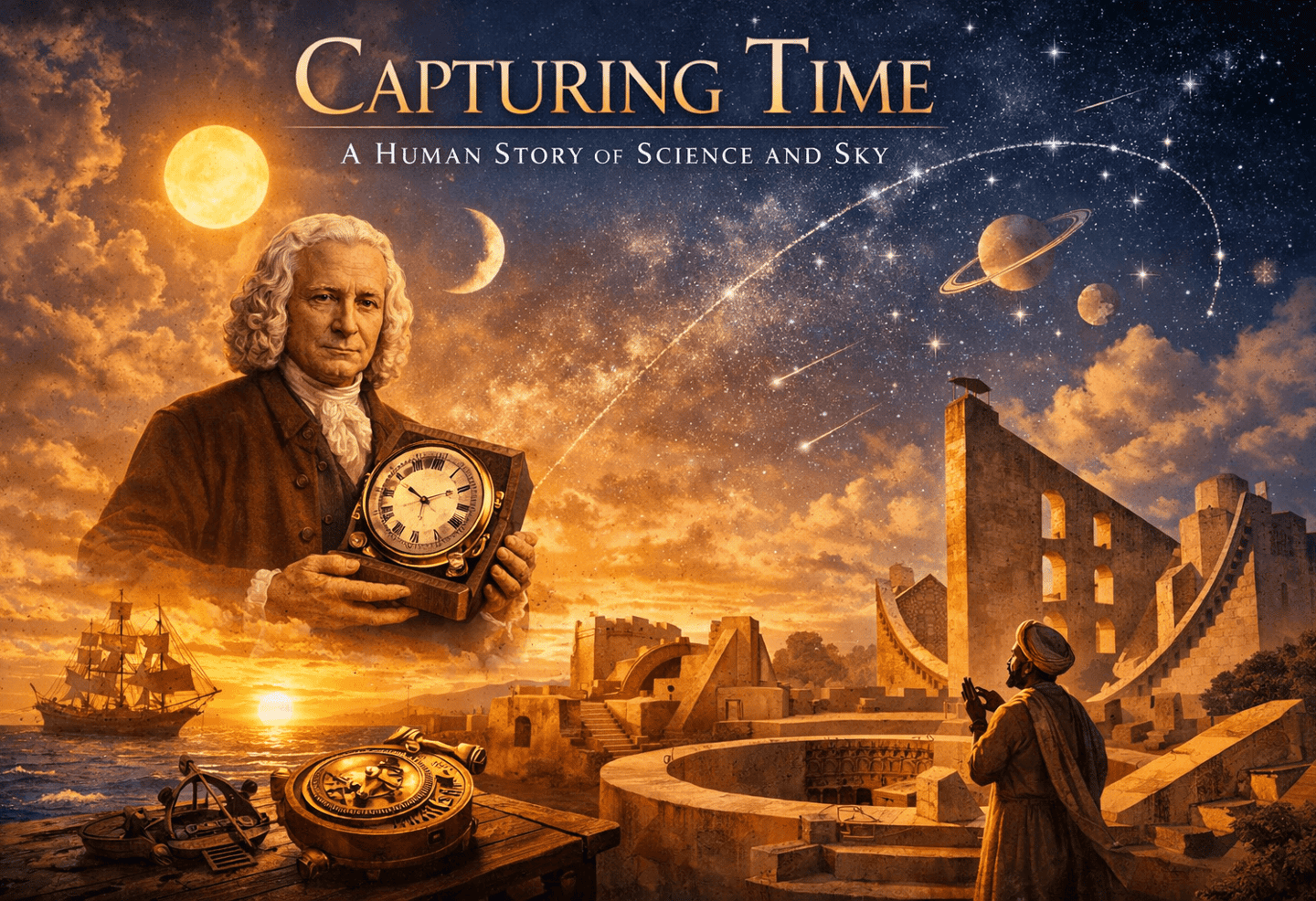
Capturing Time: A Human Story of Science and Sky
From the moment human beings looked up at the sun and noticed its shadow move, time stopped being invisible. It became something that could be watched, anticipated, and eventually understood. Across civilizations, time was never merely counted, it was interpreted, woven into agriculture, rituals, navigation, faith, and survival. Long before seconds and minutes ruled daily life, time was read in dawns and dusks, in seasons, in the rhythm of stars crossing the night sky.
As societies grew more complex, so did their relationship with time. Farmers needed calendars. Sailors needed precision. Kings and states needed synchronization. Time slowly shifted from being a natural companion to a scientific challenge. The human story of time is therefore not a single invention, but a layered journey of observation, mathematics, experimentation, and imagination. Some cultures chose to observe the heavens, letting the cosmos reveal its order. Others sought to engineer certainty, compressing time into devices that could travel anywhere, independent of sky or season.
This journey reveals something profound: time itself never changed, humanity did. We built tools not just to measure time, but to command distance, predict nature, and bring order to an unpredictable world. Stone, shadow, brass, and balance wheels became languages through which humans conversed with the universe.
From this vast human quest emerge two remarkable milestones. In Britain, John Harrison transformed time into a portable mechanical truth, reshaping navigation and global movement. In India, the Jantar Mantar, commissioned by Sawai Jai Singh II, turned architecture into astronomy, allowing time to be read directly from the sky. Their stories mark two extraordinary paths in humanity’s enduring attempt to capture time, one through science and machinery, the other through sky and stone.
John Harrison and Britain’s Scientific Mastery of Time
From the Longitude Crisis to the Marine Chronometer
Introduction: Why Time Became a National Emergency
In the late 17th and early 18th centuries, Britain’s future depended on the sea. Trade routes, naval dominance, colonial expansion, and human lives were all tied to safe navigation. While sailors could determine latitude by observing the sun or stars, longitude remained dangerously uncertain. Miscalculations led to catastrophic shipwrecks and enormous economic loss.
Timekeeping became the missing link. To know longitude, sailors needed to know precise time at a fixed reference point while sailing across changing longitudes. This turned time from a philosophical concept into a problem of national survival.
The Longitude Act of 1714: Government Meets Science
To force a solution, the British Parliament passed the Longitude Act of 1714, offering unprecedented financial rewards for anyone who could provide a practical and accurate method to determine longitude at sea. The prize was enormous, up to £20,000 - equivalent to millions today.
This was revolutionary. For the first time, a government openly funded innovation through competitive scientific incentives, creating the Board of Longitude to evaluate solutions. Timekeeping was no longer academic—it was state policy.
John Harrison: The Outsider Who Changed Everything
John Harrison was not an astronomer, professor, or naval officer. He was a self-taught carpenter and clockmaker from Yorkshire. Where experts looked to celestial calculations, Harrison believed the answer lay in engineering.
His idea was radical:
Build a clock so accurate that it could keep time aboard a moving ship, unaffected by motion, temperature changes, humidity, or pressure.
At the time, this seemed nearly impossible.
The Five Timekeepers That Redefined Precision
Harrison spent over four decades refining his solution through a series of machines:
H1 & H2
Large, brass mechanisms designed without pendulums to survive ship motion. These early designs proved the concept but were not yet accurate enough.
H3
A long experimental phase introduced breakthroughs such as:
Temperature-compensated balances
Reduction of friction
Improved oscillation control
H4: The Breakthrough
H4 was revolutionary. About the size of a large pocket watch, it maintained accuracy across long sea voyages, losing only seconds over weeks. It proved that portable mechanical time was achievable.
H5
A refinement proving that H4’s success was repeatable, not accidental.
Resistance, Politics, and Delayed Recognition
Despite success, Harrison faced skepticism. The scientific establishment favoured astronomical solutions like lunar distance calculations. Mechanical time threatened existing authority.
The Board of Longitude delayed full payment, demanding repeated trials. Only after royal intervention did Harrison receive substantial rewards. While recognition came late, his solution changed navigation forever.
Britain’s Lasting Achievement
Harrison’s work produced more than a clock. It created:
Reliable ocean navigation
Standardized maritime time
Foundations for Greenwich Mean Time
The mechanical discipline of modern life
Time became portable, abstract, and independent of nature—a machine-generated constant.
Jantar Mantar, Jaipur: Measuring Time Through the Cosmos
A Monumental Science of Stone, Shadow, and Sky
Introduction: When Time Was Observed, Not Stored
Long before mechanical clocks dominated daily life, time was understood through the movement of celestial bodies. In 18th-century India, this understanding reached its most monumental expression at Jantar Mantar.
This was not symbolic architecture. It was functional science, designed to read time, seasons, and planetary motion directly from the sky.
Commissioned by Sawai Jai Singh II, Jantar Mantar emerged from dissatisfaction with existing astronomical tables. Jai Singh believed precision could be improved by building instruments on a massive scale.
Between 1724 and 1734, he constructed observatories across India, with Jaipur hosting the most advanced and complete collection.
How Jantar Mantar Works
Jantar Mantar does not contain clocks. It contains calculators made of stone.
Its instruments function through:
Solar shadows
Earth’s axial tilt
Geometric projection
Celestial alignment
The Samrat Yantra
The largest and most famous structure, the Samrat Yantra, is a colossal equinoctial sundial aligned with Earth’s axis. Under ideal conditions, it can measure time to an accuracy of about two seconds.
Other Instruments
Jaiprakash Yantra: Bowl-shaped structures mapping celestial coordinates
Rama Yantra: Measures altitude and azimuth
Misra Yantra: Combines multiple astronomical functions
No mechanical motion exists inside these structures. The universe itself provides the movement.
Why Monumental Scale Matters
By enlarging instruments, small angular shifts in the sky become visible movements on stone surfaces. This reduces observational error and increases precision without lenses or electronics.
The observatory turned astronomy into architecture.
Purpose and Public Science
Jantar Mantar served multiple roles:
Correcting calendars
Predicting eclipses
Tracking solstices and equinoxes
Educating scholars and observers
Unlike private instruments, this science was visible, civic, and shared.


Comparison: Two Civilizations, Two Sciences of Time
Philosophy
Mechanical Time: Time preserved inside a device
Astronomical Time: Time revealed through celestial motion
Accuracy
Both achieved second-level precision—but through opposite strategies:
Britain defeated environmental instability
Jaipur amplified natural signals
Purpose
Britain: Navigation, trade, empire
Jaipur: Knowledge, astronomy, calendrical order
Legacy
Chronometers led to global time standards
Jantar Mantar remains a living astronomical monument
Conclusion: Two Ways to Understand Time
One tradition carried time across oceans.
The other anchored time beneath the sky.
Neither replaced the other.
Together, they show that time can be engineered or observed, conquered or contemplated.
And both remain among humanity’s greatest scientific achievements.
UK: +44 7345191205
UK India Tourism© 2026, all rights reserved
India: +91 9958480873
⭐⭐⭐⭐⭐ 4.9/5 | 2,600+ Travelers | 18 Years | 98% Recommend