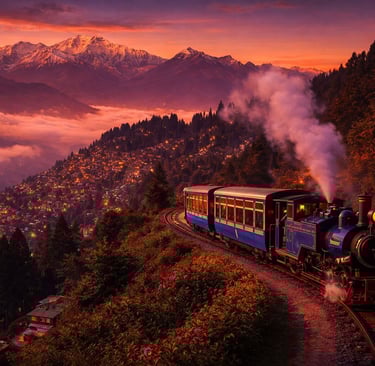
Package 23: Darjeeling Gangtok India Tours Package
Route: Darjeeling → Gangtok → Darjeeling
Duration: 8 Days / 7 Nights
Price: GBP 1,899 per person (Twin Sharing Accommodation)
Private AC Car
Best for: Mountain lovers, couples, honeymooners, families, nature travellers, photographers, USA/UK tourists, travellers who want tea gardens + Himalayas + culture
Two Mountains, One Journey, A Lifetime of Memory
The eastern Himalayas keep a different kind of promise from the rest of India. Where the north offers grandeur and heat and the sensory overwhelm of ancient civilisations pressing against each other across millennia, the hills of West Bengal and Sikkim offer something quieter and, for many travellers, more lastingly affecting. They offer stillness. They offer the specific quality of mountain air at two thousand metres, clean and cool and carrying the smell of pine and mist and, in Darjeeling, always and everywhere, tea. They offer mornings when the clouds part and the Himalayan peaks appear above the ridgeline, white and enormous and entirely indifferent to the human world below, and the sight of them produces in the observer a silence that is not emptiness but its opposite, a fullness too large for words.
The Darjeeling & Gangtok Himalayan Duo, gives you both of the eastern Himalayas' two finest destinations in a single, beautifully paced journey.
Darjeeling - the hill station that the British built in the clouds and that India has cherished ever since. Its tea gardens, cascading down the hillsides in a carpet of cultivated green. Its colonial architecture, preserved in the particular amber of a place that time has chosen to treat gently. Its Toy Train, the UNESCO-listed narrow-gauge railway that has been threading its impossible path through the mountains since 1879 with a cheerful disregard for the laws of gradient. Its sunrises over Kangchenjunga, the third highest mountain in the world, appearing above the cloud layer in a sequence of colours from amber to gold to brilliant white that redefines, every single morning, what the word "magnificent" is capable of meaning.
And then Gangtok, the capital of Sikkim, India's smallest and perhaps most beautiful state, perched on a ridge above the Teesta Valley at an altitude of 1,650 metres, its streets clean and ordered in a way that surprises visitors accustomed to the cheerful chaos of most Indian cities, its monasteries and Buddhist cultural institutions giving it a quality of spiritual calm that Darjeeling approaches but Gangtok fully embodies. Where Darjeeling is colonial and romantic and tea-scented, Gangtok is Himalayan and Buddhist and luminous, a different kind of mountain beauty, quieter and somehow more ancient.
Together, they tell a complete story of the eastern Himalayan world that neither could tell alone.
This is the tour for mountain lovers who want more than a single hill station. For couples and honeymooners seeking the most romantic possible Himalayan escape. For photographers who want the tea garden light of Darjeeling and the monastery colour of Gangtok. For nature travellers who understand that the best moments in the mountains are not the dramatic ones but the quiet ones, a mist-wrapped ridge, a prayer flag against the blue sky, a cup of Darjeeling tea drunk in the garden where it was grown.
Eight days. Seven nights. Two Himalayan worlds. Come slowly.
Day by Day Itinerary
Day 1: Arrival & Transfer to Darjeeling - The Mountain Road Begins
Your journey begins at Bagdogra Airport or New Jalpaiguri (NJP) Railway Station, the twin gateways to the eastern Himalayan hill stations from the rest of India, where our private representative will be waiting to receive you and begin the long, beautiful drive up into the mountains.
The journey to Darjeeling takes approximately three hours, and it earns every minute of attention you give it. The road begins in the flat, warm, tropical plains of the Siliguri corridor, the narrow strip of lowland Bengal connecting the main body of India to its north-eastern states and then begins to climb. The change is gradual and then sudden: the temperature drops, the vegetation thickens and changes character from tropical to temperate, and the first tea gardens appear on the hillsides with the quiet certainty of something that has always been there and always will be.
The road passes through Kurseong, the "Land of White Orchids," a smaller hill town of considerable charm at a lower elevation, excellent for a chai stop before the final climb to Darjeeling. As the car crests the last ridge and the town reveals itself, the scale of the surrounding landscape opens up in every direction: the valley below, the tea gardens on every hillside, and on clear days, the distant white summits of the Himalaya appearing above the cloud layer to the north, vast and unhurried.
Check in to your hotel. The evening is for settling into the pace of the hills, a walk along Mall Road, Darjeeling's colonial-era promenade, a cup of tea in one of the town's excellent small cafés, and the first deep breath of mountain air that makes every subsequent breath taken at lower altitude feel slightly insufficient by comparison.
Day 2: Tiger Hill Sunrise + Darjeeling Town Exploration
The alarm goes before dawn. It is worth it without qualification.
Tiger Hill Sunrise - At 2,590 metres, Tiger Hill is the highest accessible viewpoint from Darjeeling, and on a clear morning it delivers one of the most extraordinary natural spectacles in India. In the pre-dawn darkness, wrapped in layers against the mountain cold, you wait as the sky lightens from black to deep blue to pearl. And then the sun rises, and Kangchenjunga, 8,586 metres, the third highest mountain on Earth catches the first light on its five summits in a sequence from amber to gold to brilliant, blinding white. The entire Himalayan panorama stretches across the northern horizon, peak after peak emerging from the cloud layer, each one immense, each one beautiful, together forming a skyline of such improbable grandeur that the mind struggles to process it as real landscape rather than painted backdrop.
On exceptionally clear mornings, the distant summit of Mount Everest is visible to the northwest, a small white triangle 180 kilometres away, identifiable once you know exactly where to look, and extraordinary in the simple fact of its visibility from this forested hill above a town famous for its tea.
After sunrise, breakfast at the hotel and a morning of town exploration:
Batasia Loop & Ghoom - The spectacular spiral section of the Toy Train track at Batasia, surrounded by garden and war memorial, is one of the most photographed spots on the entire DHR route. The nearby Ghoom Monastery - Darjeeling's oldest Tibetan Buddhist gompa, built in 1850, housing a magnificent Maitreya Buddha statue, has a quality of genuine, functioning spiritual life that distinguishes it from more touristic heritage experiences.
Chowrasta & Mall Road - The broad pedestrian square at the top of Mall Road, where Darjeeling's social life has gathered for a hundred years, is the perfect afternoon destination: views of the mountains, roasted corn from a street vendor, the specific warm contentment of being in a beautiful place with nowhere else to be. The shops selling Darjeeling tea in beautiful packaging, woollen shawls, and Tibetan craft objects make excellent browsing.
Day 3: Darjeeling Tea Trails- Inside the World's Most Famous Gardens
After breakfast, today belongs to the experience that gives Darjeeling its global identity and its most enduring magic.
Tea Estate Experience - Your private car takes you through the hillside roads connecting Darjeeling's most celebrated estates, Happy Valley, one of the oldest operational estates in the district; Makaibari, the biodynamic estate whose teas achieve record international auction prices and the landscape between them is one continuous, rolling, impossibly green cultivation, the tea bushes covering every south-facing slope in geometrically precise rows that produce, from a distance, the effect of a green corduroy laid over the hills.
A guided walk into the gardens reveals the extraordinary care and knowledge involved in producing what is arguably the world's most carefully cultivated agricultural product. The plucking process - workers selecting only the top two leaves and the bud of each shoot with a speed born of decades of practice, the processing stages of withering, rolling, oxidation, and drying and finally the tasting session, sitting in the estate with a cup of tea grown and processed in the garden around you, understanding for the first time what the words "fresh" and "terroir" actually mean when applied to tea.
Darjeeling tea drunk in Darjeeling is to the tea you know at home what a wine drunk in its vineyard is to the same bottle opened elsewhere. It is simply, completely, the finest version of the thing.
The afternoon is free for photography in the gardens, the late light on the tea bushes, the mountain women moving through the rows in their coloured saris, Kangchenjunga appearing and disappearing in the mist, or for a return to town for café time and the particular pleasure of a Darjeeling evening.
Day 4: Darjeeling Toy Train + Leisure - The Most Charming Railway in the World
After breakfast, today delivers what many of our travellers describe as the most purely joyful travel experience of the entire journey.
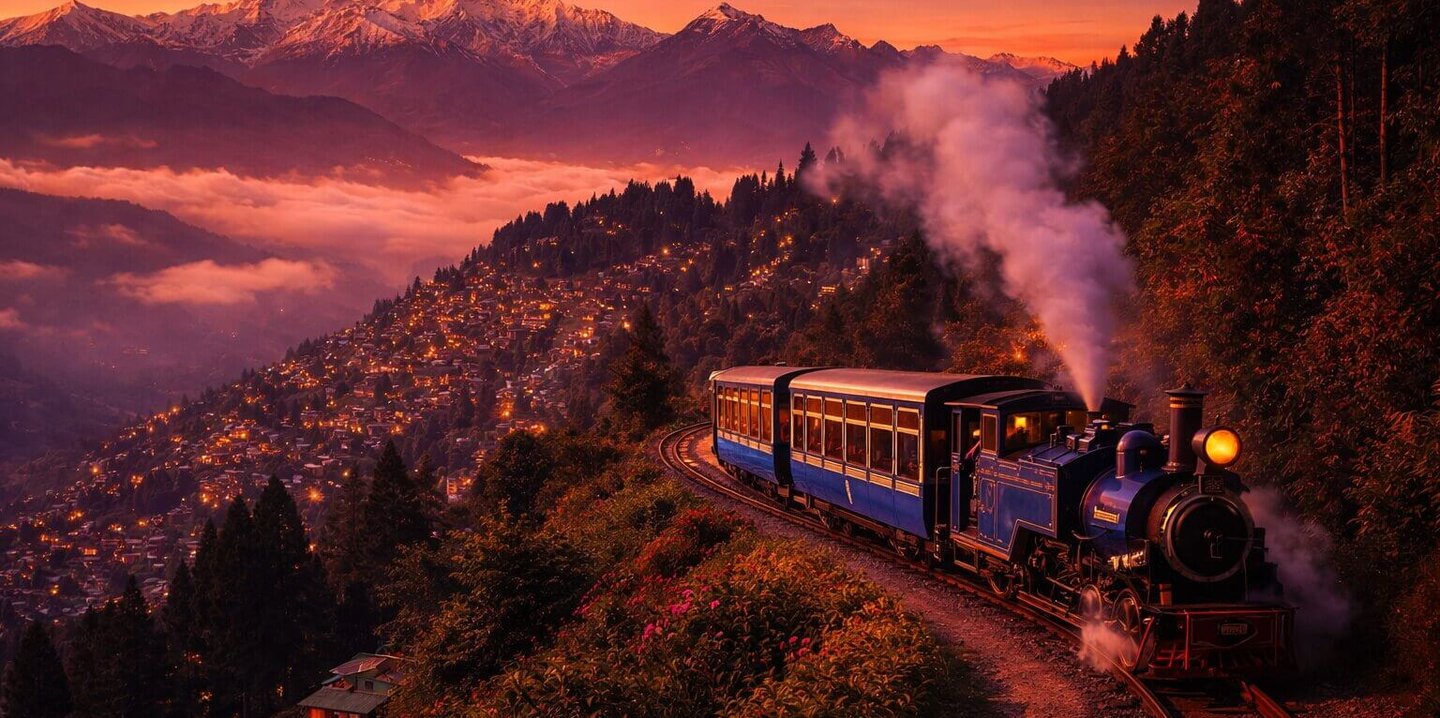
The Darjeeling Himalayan Railway - UNESCO World Heritage Site, engineering marvel, childhood dream made real. Built between 1879 and 1881 on a two-foot narrow gauge, this railway climbs through spirals, reversing stations, and loops of such audacious improbability that the Victorian engineers who built it were not entirely believed by their colleagues until the completed line was inspected in person.
The heritage section ride, operating on the spectacular stretch around Darjeeling and Ghoom, India's highest railway station — moves at the cheerful, unhurried pace that the phrase "toy train" promises and fully delivers. The small steam locomotive threads through the streets of mountain settlements so narrow that its steam drifts into the open-fronted tea shops. It curves through forest sections where the Himalayan flowers lean in from the embankment. It pauses at Ghoom Station - 2,258 metres above sea level, where the air is thin and the views over the surrounding hills are magnificent in every direction. And throughout, the whistle sounds in the mountain mist: the same sound that has been accompanying these hills since 1879, and one of the most beloved sounds in all of Indian travel.
Note: Toy Train tickets booked subject to availability and current DHR schedule. We advise on status well in advance.
The afternoon is completely yours, perhaps the most restful afternoon of the entire tour, spent moving between Chowrasta and the cafés of Mall Road at whatever pace the mountain air prescribes. Tomorrow the road moves on to Gangtok, and Darjeeling deserves a proper, unhurried goodbye.
Day 5: Darjeeling → Gangtok - The Drive into Sikkim
After a good breakfast, we pack the car and begin the drive to Gangtok, the capital of Sikkim and the second great destination of this Himalayan journey.
The drive covers approximately 100 kilometres and takes three to four hours and it is, from the first kilometre to the last, a journey of considerable scenic beauty. The road descends from Darjeeling through the tea garden landscape before dropping to the Teesta River, the great mountain river of Sikkim, its water an extraordinary glacial blue-green, rushing through a steep gorge of forested hillsides and then climbing the opposite bank into Sikkim.
The crossing into Sikkim marked by a checkpoint where Inner Line Permits are noted, is also a crossing into a noticeably different world. Sikkim, which joined India only in 1975 after centuries as an independent Buddhist kingdom, retains a cultural and political character distinct from the rest of the country. It is India's cleanest state, a plastic bag ban has been in force since 1998, and the difference in the roadsides and riverbanks is immediately visible. It is also one of India's most ecologically protected, large portions of the state are designated national park or biosphere reserve and the forested hillsides above the Teesta are some of the most pristine and beautiful in the entire Himalayan region.
Gangtok appears on its ridge above the valley in the late afternoon a town of considerable charm, its streets orderly and its atmosphere genuinely and characteristically peaceful. The MG Marg, the pedestrianised main street of Gangtok, lined with cafés, craft shops, restaurants, and the cheerful evening commerce of a mountain town that takes a quiet pride in its cleanliness and its character, is the perfect first evening destination.
Check in to your hotel and take the evening at your own pace. Gangtok in the evening, with its mountain air and its Buddhist prayer flags and its shops full of Sikkimese craft and Tibetan jewellery, is immediately and completely welcoming.
Day 6: Gangtok Sightseeing- Monasteries, Viewpoints & Mountain Culture
After breakfast, a full day exploring Gangtok's extraordinary cultural and natural heritage.
Rumtek Monastery - The most significant Tibetan Buddhist monastery in Sikkim, Rumtek is the seat of the Karma Kagyu lineage of Tibetan Buddhism and one of the most important monasteries outside Tibet itself. Built on a ridge above the Teesta Valley approximately 24 kilometres from Gangtok, its setting alone is magnificent, the monastery complex perched on its hillside with the valley below and the forested mountains rising on every side. The main temple, with its elaborate thangka paintings and ceremonial objects, and the older Dharma Chakra Centre contain treasures of Tibetan Buddhist religious art and practice that are both historically extraordinary and genuinely moving in their spiritual atmosphere. The resident monks go about their daily practice with the unhurried focus of people whose relationship with time is governed by something older than clocks.
Tashi Viewpoint - One of the finest panoramic viewpoints in all of Sikkim, Tashi offers on clear days a view of Kangchenjunga and the surrounding Himalayan peaks from a perspective different from Darjeeling's Tiger Hill, broader, more northerly, the peaks appearing at a different angle that reveals their three-dimensional mass in a way that the Darjeeling view, magnificent as it is, does not quite achieve. The viewpoint is most spectacular in the morning or late afternoon, when the light is oblique and the peaks cast long shadows across the lower ranges.
Enchey Monastery - Perched on a ridge above Gangtok, this monastery of the Nyingma school of Tibetan Buddhism is both architecturally beautiful and atmospherically peaceful, prayer flags surrounding it on every side, the sound of monks chanting audible from the approach path, the views of the town below and the mountains beyond combining in a composition of great natural and cultural beauty.
Institute of Tibetology & MG Marg - The Namgyal Institute of Tibetology, housing one of the finest collections of Tibetan manuscripts, thangkas, and religious artifacts outside Tibet, is an excellent cultural visit for those with historical and scholarly interest. The afternoon on MG Marg, the pedestrianised heart of Gangtok, its craft shops full of Sikkimese hand-woven textiles, Tibetan jewellery, prayer wheels, and the excellent local Chhurpi cheese, is the finest shopping experience of the entire Himalayan portion of the journey.
Day 7: Gangtok Excursion - High Mountain Landscapes & Himalayan Grandeur
After breakfast, today takes you higher into the Sikkim landscape toward the mountain scenery that makes this state one of the most photographically extraordinary destinations in India.
Tsomgo (Changu) Lake Excursion - Subject to weather conditions and permit availability, the excursion to Tsomgo Lake at 3,753 metres above sea level, one of the highest lakes in India, is the most spectacular single day trip available from Gangtok. The drive from Gangtok climbs through rhododendron forests and alpine meadows on the old Silk Road route toward the Nathu La pass on the Tibet border, the landscape growing more dramatically Himalayan with every kilometre of altitude gained.
Tsomgo Lake itself is a glacial lake of extraordinary beauty, oval-shaped, approximately one kilometre long, its colour shifting between deep blue and emerald green depending on the season and the sky above it. Surrounded by steep hillsides that are covered in snow for much of the year and carpeted in wildflowers during summer, with the Himalayan peaks rising behind them on the northern horizon, it is a landscape of such complete, unhurried natural beauty that visitors who have spent the preceding days in Darjeeling and Gangtok, already two of India's most beautiful places are still stopped in their tracks by it.
The return route passes through Kyongnosla Alpine Sanctuary, one of Sikkim's protected ecological areas, where the rhododendron forest in spring bloom is one of the great natural spectacles of the eastern Himalayas, the trees covered in flowers of red, pink, and white against a background of snow peaks and blue sky that seems almost deliberately composed for maximum visual impact.
Note: The Tsomgo Lake excursion requires an Inner Line Permit, which we arrange in advance. The road is subject to weather and seasonal conditions, we advise on access status at time of travel and organise the best available excursion accordingly.
Evening back in Gangtok, a final dinner on MG Marg, the mountain air cool and clear around you, the prayer flags of Enchey Monastery visible on the ridge above. Tomorrow, the road returns to Darjeeling.
Day 8: Gangtok → Darjeeling - The Journey Home
After breakfast, we make the return drive from Gangtok to Darjeeling, the same mountain road in reverse, the Teesta River valley below and the tea gardens appearing again as the road descends into West Bengal and climbs back to Darjeeling.
The three to four hour drive is, on the return, a kind of gentle review of the journey, the landscapes seen again in a different light, the mind processing the accumulated beauty of eight days in the eastern Himalayas. The tea garden approach to Darjeeling, seen again after three days in Sikkim, has a particular warmth of familiarity, the green rows of cultivated bushes, the familiar smell of the town, the specific quality of Darjeeling light that you now know well enough to miss.
From Darjeeling, we provide your onward transfer to Bagdogra Airport or New Jalpaiguri Railway Station as per your departure arrangements, the final mountain road descent, the altitude dropping and the temperature rising, the plains of Bengal opening below as the hills release you.
Your Darjeeling & Gangtok Himalayan Duo Tour ends at the airport or station - eight days, seven nights, and a journey through two of the most beautiful places in India that leaves behind it the specific, permanent, entirely reliable imprint that only mountain travel makes: a quality of light remembered, an altitude felt in the lungs, the sound of a prayer flag in the wind, the smell of tea on a cold morning, and the white peaks of Kangchenjunga rising above the cloud layer in a sky too blue to be ordinary.
✅ Inclusions
✅ 7 Nights Accommodation - Quality 3-star / 4-star properties ( as available ) in Darjeeling (4 nights) and Gangtok (3 nights), selected for comfort, mountain views, and the specific warmth that the best Himalayan hotels provide.
✅ Daily Breakfast - A proper breakfast at your accommodation every morning.
✅ Private Car for All Transfers & Sightseeing - Your dedicated vehicle for the complete journey: airport or station pickup, all local sightseeing in Darjeeling and Gangtok, the inter-destination drive, the Gangtok excursion, and final departure transfer.
✅ Tea Garden Experience - Guided visit including plantation walk, processing facility, and tasting session.
✅ Toy Train Ride - Heritage section booking attempted as early as possible, subject to DHR schedule and availability.
✅ Gangtok Sightseeing & Excursion - All destinations mentioned in the itinerary, including Tsomgo Lake excursion (subject to permit and weather).
✅ All Tolls, Parking & Driver Allowances - No hidden road costs.
❌ Exclusions
❌ International flights and domestic flights to/from Bagdogra ❌ Monastery entry donations❌ Ropeway or cable car tickets in Gangtok — optional, payable directly ❌ Lunch, dinner, and personal expenses ❌ Travel insurance and visa charges
Best Time to Visit
March to May: Spring is the finest season for both destinations. The famous Darjeeling first flush tea harvest in March and April. Rhododendrons blooming across the Sikkim hillsides in spectacular red and pink. Clear mountain views and pleasant temperatures throughout. Tsomgo Lake accessible and at its most beautiful.
October to December: Post-monsoon clarity delivers some of the finest Himalayan views of the entire year. October and November are peak season for good reason, brilliant skies, Kangchenjunga visible almost daily from Tiger Hill, the Sikkim forests turning golden. December brings snow to the higher elevations and a magical quality of cold-weather mountain atmosphere.
July and August - monsoon months. Heavy rainfall, lush green landscapes, but limited mountain visibility and some road disruption. Not recommended for this itinerary.
Frequently Asked Questions
Q: Is this tour suitable for honeymoon couples? It is among the finest honeymoon experiences available in India, two mountain destinations of extraordinary beauty, a pace that is genuinely unhurried, and the specific quality of romantic atmosphere that only the eastern Himalayas produce. The Toy Train, the tea garden mornings, the monastery evenings, the Tsomgo Lake excursion, every element of this journey conspires naturally toward romance. We can arrange honeymoon room decoration and special experiences on request.
Q: Can we add Lachung and Yumthang Valley to the Sikkim section? Yes, Lachung and the Yumthang Valley (known as the Valley of Flowers), north of Gangtok at approximately 3,564 metres, is one of Sikkim's most spectacular excursions, particularly in spring when the rhododendron bloom transforms the valley into something genuinely extraordinary. This extension requires two additional days and adjusted pricing, plus permits, and is subject to road and seasonal conditions. Contact us to plan this extension.
Q: Is the Tsomgo Lake excursion guaranteed? The Tsomgo Lake road is subject to weather conditions, particularly in winter when snowfall can make it temporarily inaccessible, and to permit regulations. We arrange the Inner Line Permit in advance and advise on road conditions at time of travel. In the unlikely event that Tsomgo Lake is inaccessible, we organise the best available alternative excursion from Gangtok.
Q: How do we get to Darjeeling for the start of the tour? The most convenient routes from major Indian cities are flying to Bagdogra Airport (connected from Delhi, Mumbai, Kolkata, and other cities) or arriving by train at New Jalpaiguri (NJP) Railway Station. For international travellers, Kolkata is the most convenient international hub with onward domestic connections. We arrange pickup from either point.
Why Book This with UK India Tourism?
The eastern Himalayas reward correct planning enormously and punish incorrect planning equally. The Tiger Hill sunrise requires the right season. The Toy Train requires advance booking. The Tsomgo Lake excursion requires permits arranged in advance. The drive between Darjeeling and Gangtok requires a driver who knows the mountain roads and their seasonal variables. And above all, this journey requires a pace that gives each destination the time it needs because rushing through Darjeeling to get to Gangtok faster, or skimming through Gangtok's monasteries in a single morning, produces a journey that covers the ground without inhabiting it.
Package 23 is built on the understanding that eight days is the correct length for this combination - four days in Darjeeling to genuinely enter its world, three days in Gangtok to properly explore its culture and its high mountain excursion, and the return journey that completes the circuit without feeling rushed.
✅ Correct duration - enough time to actually experience both destinations ✅ Private mountain transport - your car, your driver, your pace ✅ Permit and logistics management - Tsomgo, Toy Train, all arranged ✅ Carefully selected accommodation - mountain views, genuine warmth ✅ Honest seasonal advice - we tell you exactly when to come and why.
Where emerald tea gardens meet Himalayan dreams - journey through Darjeeling to the serene heights of Gangtok in one unforgettable escape.
UK India Tourism Company
UK : +44 7345 191205
India: +91 9958 480873
Email: sales@ukindiatourism.co.uk
Travel Specialists for UK, USA, Canada, Australia, France, Poland, Singapore, Japan & Beyond
UK: +44 7345191205
UK India Tourism© 2026, all rights reserved
India: +91 9958480873
⭐⭐⭐⭐⭐ 4.9/5 | 2,600+ Travelers | 18 Years | 98% Recommend