
Package 22: Darjeeling Tea Trails & Toy Train Tour
Darjeeling Tea Gardens + Heritage Toy Train + Himalayan Sunrise
Duration: 6 Days / 5 Nights
Price: Ask for Price ( Twin sharing accommodation )
Private AC Car | Romantic Hill Accommodation
Best for: Nature lovers, couples, honeymooners, tea lovers, mountain seekers, photographers, International tourists, slow-travel explorers
The Hill Station That Smells of Rain and Tea and Something Close to Perfect
There are places in India that impress you with their scale, the Taj Mahal, the deserts of Rajasthan, the ancient cave temples of the Deccan. And then there are places that do something quieter and, in their own way, more lasting. Places that get under your skin not through grandeur but through atmosphere through the particular quality of their light, their air, their pace, and the specific combination of natural beauty and human culture that makes them feel like nowhere else on Earth.
Darjeeling is emphatically, completely, irreversibly one of those places.
Perched at an altitude of over 2,000 metres in the Himalayan foothills of West Bengal, looking north toward the white peaks of the Kangchenjunga massif, the third highest mountain in the world and south over a landscape of tea gardens cascading down the hillsides in every shade of green that green is capable of being, Darjeeling is a hill station of such concentrated beauty and character that the word "charming" seems wholly inadequate to describe it. It is the kind of place that travellers arrive in intending to stay two or three days and find themselves still in a week later, not quite able to identify the specific thing that is making it impossible to leave, but entirely certain that it exists.
The tea, obviously. Darjeeling tea, the most celebrated tea in the world, its first flush and second flush harvests traded at a premium on international markets, its muscatel quality found nowhere else on Earth was first cultivated here in the 1840s when a British surgeon named Archibald Campbell planted seeds from China on the slopes below his house, and the gardens that grew from that experiment now cover the hillsides in an unbroken green tapestry that defines the visual identity of the entire region.
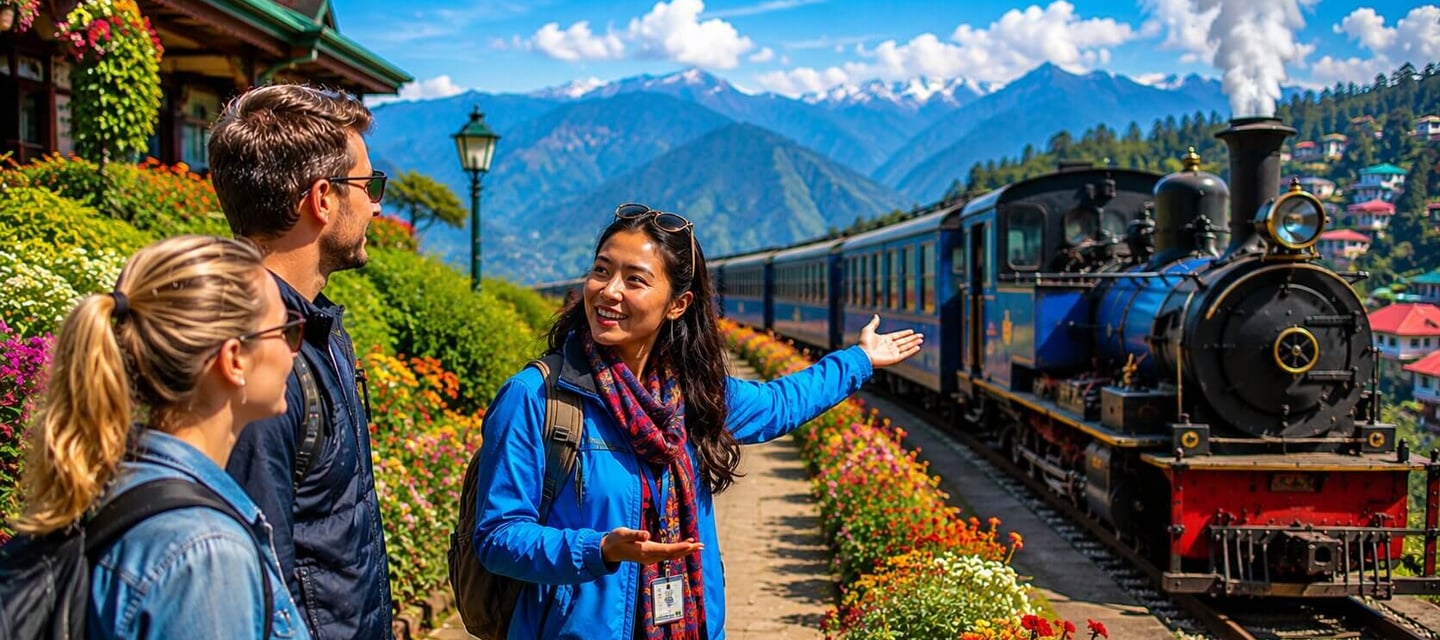
The Darjeeling Himalayan Railway, the Toy Train is a UNESCO World Heritage Site and one of the most beloved pieces of engineering in India.
A narrow-gauge steam railway climbing from the plains below through forests and tea gardens and small mountain towns on a track so steep, so winding, and so audaciously improbable that it seems less like an engineering project and more like an act of optimism. To ride it through the mist and the mountains is one of those experiences that people describe, consistently and without irony, as genuinely magical.
And then there is everything else, the sunrise over Kangchenjunga from Tiger Hill, the Buddhist monasteries whose prayer flags flutter against the mountain sky, the colonial-era buildings of Mall Road with their particular atmosphere of a Raj-era hill station preserved in amber, the small cafés serving excellent coffee alongside slices of homemade cake while the mist rolls in over the ridge outside the window.
The Darjeeling Tea Trails & Toy Train Tour gives you six days and five nights in all of this, carefully paced for the slow, unhurried engagement that Darjeeling specifically rewards. It is designed for travellers who want to breathe mountain air rather than tick boxes. For couples who want the most romantic hill station in India. For tea lovers who want to stand in the gardens where the world's finest tea is grown. For photographers who want the light that only exists at this altitude, in this mist, with these mountains.
Come slowly. Stay fully. Leave reluctantly. That is the correct way to do Darjeeling.
Day by Day Itinerary
Day 1: Arrival & Transfer to Darjeeling - The Mountain Road Up
Your Darjeeling journey begins at Bagdogra Airport or New Jalpaiguri (NJP) Railway Station - the two main gateways to the hill station from the rest of India, where our private representative will be waiting to receive you and begin the drive up into the mountains.
The drive to Darjeeling takes approximately three hours, and it is worth paying full attention to every minute of it. The road begins in the flat, humid Siliguri corridor, the plains of North Bengal, warm and green and densely vegetated and then begins to climb. Gradually at first, then with increasing commitment, the road winds upward through the foothills, the temperature dropping by a degree for every few hundred metres of altitude gained, the vegetation changing from tropical to temperate, the first tea gardens appearing on the hillsides and multiplying until they cover everything in every direction in an unbroken carpet of cultivated green.
The road passes through Kurseong, the "Land of White Orchids," a smaller hill town at a lower elevation that is itself surrounded by tea gardens and worth a chai stop in its own right before climbing the final section to Darjeeling itself. As you approach the town, the scale of the surrounding landscape becomes apparent: the valley below, the tea gardens on every hillside, the distant white peaks of the Himalaya appearing through gaps in the cloud or mist depending on the weather, larger and more improbable than any mountain seen at lower elevation has prepared you for.
Check in to your hotel. Freshen up, breathe the cool, clean, pine-and-tea-scented air, one of the most immediately pleasant things about Darjeeling is simply the quality of the air itself and spend the afternoon settling into the pace of the hills.
Evening Exploration - A gentle first evening walk along Mall Road, Darjeeling's main promenade, lined with colonial-era buildings, small shops, cafés, and the particular warmth of a mountain town that has been welcoming visitors for a very long time, is the ideal introduction. The light at this altitude in the late afternoon has a softness and clarity that photographers find immediately compelling. The views from the various points along Mall Road, north toward the mountains, south over the valley, reward stopping and simply looking.
Dinner at one of Darjeeling's excellent small restaurants - Tibetan, Bengali, and colonial-era Anglo-Indian cuisines are all well represented in the town and an early, comfortable night. Tomorrow begins before sunrise.
Day 2: Sunrise at Tiger Hill + Darjeeling Town Exploration
The alarm goes before dawn. This is the one early morning of the tour, and it is without question worth every minute of lost sleep.
Tiger Hill Sunrise - Tiger Hill, at 2,590 metres above sea level, is the highest point accessible by road from Darjeeling, and on a clear morning, which the season of your visit is selected to maximise - it offers one of the most extraordinary natural spectacles available anywhere in India.
In the darkness before dawn, wrapped in jackets and scarves and the particular companionable silence of a group of people waiting together for something beautiful, you watch the eastern sky. It lightens slowly, pale grey to pearl, pearl to the first gold. And then the sun clears the horizon, and what it illuminates is not merely a sky but a Himalayan panorama of staggering extent: the white peaks rising above the cloud layer in a line that stretches across the entire northern horizon, each summit catching the first light in a sequence from east to west as if the mountains themselves are waking up. Kangchenjunga - 8,586 metres, the third highest mountain on Earth, dominates the northwest, its five summits glowing orange and then gold and then brilliant white as the sun rises fully, a mountain so large that it creates its own weather and defines the entire visual character of this landscape.
On clear mornings, even the summit of Mount Everest is visible from Tiger Hill, a small white triangle far to the northwest, 180 kilometres away, identifiable once you know exactly where to look but extraordinary in the simple fact of its visibility from this distance. To see the world's highest mountain from a hillside above a Darjeeling tea garden, a cup of chai warming your hands, is a genuinely remarkable moment.
After sunrise, we drive back to Darjeeling for breakfast and a morning of relaxed town exploration:
Batasia Loop - On the return route from Tiger Hill, the road passes through the Batasia Loop - a famous spiral section of the Toy Train track where the railway loops back on itself to gain altitude, surrounded by beautifully maintained gardens and a war memorial. The loop is one of the most photographed spots on the entire DHR route, and the gardens, with the mountains visible beyond and the miniature train track curving through them, are a lovely morning stop.
Ghoom Monastery - The oldest Tibetan Buddhist monastery in Darjeeling, built in 1850 and housing a 4.5-metre statue of Maitreya, the Coming Buddha, of extraordinary presence and beauty. The monastery has a quality of authentic, functioning spiritual life, monks going about their daily practice, prayer flags rattling in the mountain wind, the smell of butter lamps and incense, that distinguishes it from the more touristic monastery experiences available elsewhere.
Mall Road & Chowrasta - The afternoon is for Darjeeling town at its most leisurely: the broad pedestrian square of Chowrasta at the top of Mall Road, where locals and visitors alike gather to sit on benches, eat roasted corn, look at the mountains, and simply be in a beautiful place without any particular agenda. The shops around Chowrasta sell Darjeeling tea in beautiful packaging, arguably the finest edible gift available from anywhere in India alongside woollen shawls, Tibetan craft objects, and the small, specific pleasures of a hill station market that has been selling these things for a hundred years.
Café Culture - Darjeeling has an excellent café scene, and an afternoon of café hopping, moving between the small, warm, wood-panelled establishments that serve excellent coffee and homemade baked goods alongside their famous teas, is one of the great simple pleasures of the town. The mist that rolls in over the ridge in the late afternoon, thickening into cloud, makes the warmth inside particularly and specifically delightful.
Day 3: Tea Garden Experience - Inside the World's Most Famous Plantations
After breakfast, today is dedicated entirely to the experience that gives Darjeeling its global identity and its most enduring magic: the tea gardens.
The Tea Garden Drive - Your private car takes you through the hillside roads that wind between Darjeeling's most celebrated tea estates, Happy Valley Tea Estate, one of the oldest operational estates in the district, its gardens cascading down the hillside in immaculate green rows; Makaibari Tea Estate, a biodynamic estate of considerable prestige whose teas consistently achieve record auction prices; and the various smaller gardens that make the landscape of the entire district one continuous, rolling, impossibly green cultivation.
The tea gardens of Darjeeling are extraordinarily beautiful as landscape but to understand them fully requires more than passing through. A guided walk into the gardens, accompanied by a tea estate representative, reveals the extraordinary precision and knowledge involved in producing what is arguably the most carefully cultivated agricultural product in the world:
The plucking process - how the workers, predominantly women, select only the top two leaves and the bud of each tea shoot with a speed and accuracy that comes from decades of practice, their fingers moving through the bush with the speed of people who have done this same thing ten thousand times.
The processing stages - withering, rolling, oxidation, and drying, each step carefully controlled to produce the specific flavour profile that defines Darjeeling tea's celebrated character. The muscatel quality, the distinctive floral, grape-like note found in second flush Darjeeling teas and nowhere else on Earth, is produced by a specific interaction between the tea plant and a leafhopper insect that feeds on the leaves, triggering a chemical response in the plant that creates the compounds responsible for this unique flavour. It is one of the more unlikely and beautiful facts in the entire world of food and drink.
The tasting session - sitting in the estate's tasting room or simply in the open air among the bushes, drinking tea grown and processed in the garden around you, understanding for the first time what the phrase "fresh" means when applied to tea, is a quietly revelatory experience. Darjeeling tea drunk in Darjeeling, freshly processed, is to the tea you drink at home what a glass of wine drunk in the vineyard that produced it is to the same bottle opened on a Tuesday evening in your kitchen. It is simply, fundamentally, the best version of the thing.
The afternoon is free for photography in the gardens - the late afternoon light on the tea bushes, the women workers moving through the rows in their coloured saris, the mountains appearing and disappearing in the mist behind the plantation or for a return to town for more café time and relaxed evening exploration.
Day 4: Darjeeling Toy Train - The Most Charming Railway Journey in the World
After breakfast, today delivers what many of our travellers describe as the single most joyful travel experience of their entire India journey.
The Darjeeling Himalayan Railway, the Toy Train is a UNESCO World Heritage Site and one of the great engineering achievements of the British colonial era in India. Constructed between 1879 and 1881 on a narrow gauge of just 2 feet, the railway climbs from New Jalpaiguri on the plains to Darjeeling at over 2,000 metres through a combination of spirals, reversing stations, and loops of such audacious improbability that Victorian engineers who studied the completed line refused to believe it had been built as described until they saw it for themselves.
The Toy Train experience from Darjeeling operates on a heritage section of the route, typically the section between Darjeeling and Ghoom (India's highest railway station at 2,258 metres) or the scenic circular loop that passes through the Batasia Loop gardens. The train itself, a small, perfectly proportioned steam locomotive pulling a sequence of wooden coaches, is exactly as charming in reality as it is in every photograph you have seen of it, and considerably more so in the experience of actually sitting in it.
The journey moves at a pace that the phrase "toy train" implies, unhurried, cheerful, entirely unconcerned with efficiency, through the mountain landscape at close range. The train passes through the streets of small hilltop settlements so narrow that the locomotive's steam drifts through the open shop fronts and the market stalls. It curves through forest sections where the canopy closes overhead and the mountain flowers lean in from the embankment. It stops at Ghoom station, the highest railway station in India, where the air is noticeably thinner and the views over the surrounding hills are magnificent in every direction. And throughout, the whistle sounds in the mist with a note of pure, uncomplicated nostalgia, the sound that has been accompanying the Darjeeling hills since 1879 and that, if the railways of the world had a hall of fame, would be among its most beloved exhibits.
Note: Toy Train tickets are booked subject to availability and current schedule. We make every effort to secure seats on the preferred service and advise well in advance of any scheduling considerations.
The afternoon after the train ride is entirely yours, perhaps the best possible version of a Darjeeling afternoon, which is to say a Chowrasta bench, a view of the mountains, a pot of second flush Darjeeling tea, and absolutely no requirement to be anywhere else.
Day 5: Leisure Day - Monasteries, Viewpoints & Mountain Calm
After breakfast, today is the gift that only the best itineraries give: a day with no fixed agenda, shaped entirely by weather, mood, and the specific pleasures that Darjeeling has revealed itself to offer you over the preceding days.
Optional: Monastery Exploration - Darjeeling and its surrounding hills are home to several significant Tibetan Buddhist monasteries, each with its own character and atmosphere. The Yiga Choeling Monastery at Ghoom, a quiet, beautifully maintained gompa with ancient thangka paintings and a deeply contemplative atmosphere, is an excellent morning visit. The Dali Monastery on the road to Tiger Hill houses a community of monks in active daily practice, and the views from its grounds over the surrounding hills are among the finest in the district.
Optional: Viewpoint Drives - The roads around Darjeeling access a series of viewpoints that each offer a different perspective on the mountain landscape. Senchal Lake, on the road above Darjeeling, is a peaceful reservoir set in a wildlife sanctuary whose forested hills offer excellent birdwatching and the specific peaceful quality of a protected natural area at altitude. Mirik, approximately 50 kilometres from Darjeeling, is a smaller lake town of considerable charm with its own tea gardens and a quality of unhurried beauty that feels even further from the ordinary world than Darjeeling itself.
Café Day - For couples and slow travellers, a day that simply moves between Darjeeling's best cafés, bookshops, and viewpoints at whatever pace feels right is entirely sufficient and entirely wonderful. The Glenary's Bakery & Restaurant on Mall Road, a Darjeeling institution since 1935, its bakery counter displaying cakes and pastries of the Anglo-Indian tradition alongside excellent coffee, is a mandatory stop. The small bookshops scattered through the lanes below Chowrasta carry selections of Himalayan travel writing, local history, and fiction that make excellent afternoon reading in a café as the mist rolls in.
The evening is for a final good dinner in Darjeeling, the best Tibetan momos (steamed dumplings) you will find anywhere outside Tibet itself, or a full Bengali fish curry, or the distinctive thukpa (noodle soup of Tibetan origin) that is the most warming possible meal on a cool mountain night.
Day 6: Departure - The Mountain Road Down & the Warmth of Goodbye
After a final breakfast at your hotel, we pack the car and begin the descent from the hills, the same mountain road, in reverse, the tea gardens scrolling past the window one last time as the altitude drops and the air gradually warms and the landscape transitions back from temperate hills to tropical plains.
The drive back to Bagdogra Airport or NJP Railway Station takes approximately three hours, and the journey gives you time to process the days that have just passed, the sunrise over Kangchenjunga, the tea estate in the morning mist, the Toy Train whistle echoing through the hills, the particular quality of a café on a cold Darjeeling afternoon with a pot of the world's finest tea on the table and the mountains visible through the window.
Your Darjeeling Tea Trails Tour ends at the airport or railway station but Darjeeling, as every visitor discovers in their own time and their own way, does not end quite so cleanly. It surfaces in unexpected moments: in the smell of a good Darjeeling tea brewed at home, in the memory of a specific quality of mountain light, in the sound of a train whistle heard from a distance that triggers, without warning, the image of a small steam engine rounding a curve above a valley of green tea gardens and disappearing into the mist.
That is what the mountains do. They get inside you. And they stay.
✅ Inclusions
✅ 5 Nights Accommodation - Quality 3-star Hill properties in Darjeeling, selected for comfort, mountain views, and the specific character that makes a Darjeeling hotel stay memorable. Heritage properties available on request.
✅ Daily Breakfast - A proper sit-down breakfast at your accommodation every morning.
✅ Private AC Car with Driver - Your dedicated vehicle for all transfers: airport or station pickup, all local sightseeing, tea garden visits, Tiger Hill sunrise drive, and final departure transfer.
✅ Tea Garden Experience - Guided visit to Darjeeling tea estate including plantation walk, plucking demonstration, processing facility visit, and tasting session.
✅ Toy Train Ride - Darjeeling Himalayan Railway heritage section ride, booked subject to availability. We confirm booking status well in advance.
✅ All Tolls, Parking & Driver Allowances - No hidden road costs.
❌ Exclusions
❌ International flights and domestic flights to/from Bagdogra ❌ Ropeway / cable car tickets (optional activity, payable directly) ❌ Monastery entry donations (customary, very modest) ❌ Lunch, dinner, and personal expenses ❌ Travel insurance and visa charges
Best Time to Visit
Darjeeling offers two distinct and equally rewarding seasons:
March to May - Spring brings the most dramatic mountain views of the year as the skies clear after winter. The famous first flush tea harvest, the most prized Darjeeling tea of the year, picked in March and April from the first new growth after winter dormancy, makes this the finest time for tea enthusiasts. Rhododendrons bloom across the hillsides in vivid red and pink, the air is crisp and clear, and Kangchenjunga appears with extraordinary frequency and clarity.
October to December - Post-monsoon Darjeeling is freshly washed and brilliantly clear. The second flush harvest has been completed and the estates are still fragrant. October and November deliver some of the finest mountain visibility of the entire year, with Kangchenjunga appearing in full majesty on most clear mornings. December brings the possibility of snow on the higher peaks and an atmospheric coolness to the town that makes the café culture particularly rewarding.
July and August are the monsoon months, heavy rainfall, dramatic cloud effects and lush green landscapes but limited mountain visibility and some road disruption. Not recommended for the standard itinerary.
Frequently Asked Questions
Q: Is the Toy Train ride guaranteed? We make every effort to secure Toy Train tickets as early as possible, and in the vast majority of cases we succeed. Availability depends on the current DHR schedule and operational status, which can occasionally be affected by track maintenance or weather. We advise on availability at the time of booking and, in the unlikely event of unavailability, arrange the best alternative scenic route experience as a substitute.
Q: Is Darjeeling suitable for senior travellers? Yes, with some considerations. The town itself is hilly and walking between levels requires reasonable mobility. However, the private car eliminates most walking demands, your driver takes you directly to each destination. The Toy Train is fully accessible. The tea garden visit involves a gentle walk on relatively flat plantation paths. We can tailor the itinerary further to suit specific mobility requirements on request.
Q: Is Darjeeling a good honeymoon destination? It is one of the finest honeymoon destinations in India - romantic, beautiful, private, and possessed of a quality of atmosphere that couples consistently describe as uniquely conducive to the kind of slow, intimate holiday that a honeymoon should be. The misty mountain evenings, the firelit cafés, the sunrise over Kangchenjunga, the Toy Train through the hills, all of it conspires toward romance in a way that feels organic rather than manufactured. We can arrange honeymoon room decoration and special experiences on request.
Q: How do we reach Darjeeling? The most convenient routes from major Indian cities are: fly to Bagdogra Airport (served from Kolkata, Delhi, Mumbai, and other cities) and drive up; or train to New Jalpaiguri (NJP) Railway Station (well connected to Kolkata and beyond) and drive up. We arrange pickup from either point. For international travellers, Kolkata is the most convenient international hub, with onward domestic connections to Bagdogra.
Why Book This with UK India Tourism?
Darjeeling is a place that rewards correct pacing above almost anything else. Too rushed, and you leave feeling that you glimpsed something beautiful without ever quite entering it. Too loosely planned, and the mountain weather, which has its own very definite opinions about what it will and won't permit on any given morning, can disrupt the things that matter most.
We plan the Tiger Hill sunrise for the clearest season. We book the Toy Train as early as possible. We choose tea estates that offer genuine, substantive experiences rather than brief tourist walk-throughs. We select hotels for their views and their warmth and their understanding of what guests who have come this far are actually looking for. And we build the leisure day into the itinerary deliberately, because Darjeeling is not a place to be efficiently processed, but a place to be fully experienced, and that requires time that isn't filled with anything in particular.
✅ Correct pacing - never rushed, always present ✅ Tea estate expertise - genuine immersion, not a tourist walk-through ✅ Toy Train secured - booked early, advised transparently ✅ Sunrise timing- planned for maximum visibility probability ✅ Private mountain travel - your car, your driver, your pace.
Sip stories where the clouds brew magic on the Darjeeling Tea Trails & Toy Train journey.
Ride the whispering hills of Darjeeling Himalayan Railway, where every turn tastes like timeless tea.
UK India Tourism Company
UK : +44 7345 191205
India: +91 9958 480873
Email: sales@ukindiatourism.co.uk
Travel Specialists for UK, USA, Canada, Australia, France, Poland, Singapore, Japan & Beyond
UK: +44 7345191205
UK India Tourism© 2026, all rights reserved
India: +91 9958480873
⭐⭐⭐⭐⭐ 4.9/5 | 2,600+ Travelers | 18 Years | 98% Recommend