Package 20: Braj Holi Festival Tour - India in 9 Days
Route: Delhi → Mathura → Vrindavan → Barsana → Nandgaon → Agra → Jaipur → Delhi
Duration: 9 Days / 8 Nights
Price: Request For Price (Rates based on twin sharing accommodation)
Private AC Car | Morning Breakfast
Best for: USA/UK tourists, festival lovers, photographers, first-time India visitors, couples, families, cultural explorers
The Colour That Gets Inside You and Never Entirely Leaves
Every country has a festival that defines it. A moment in the calendar when its deepest cultural identity rises to the surface and becomes visible to the whole world when the things that a people believe about life and beauty and celebration and the divine are made physical, made loud, made unmistakably real.
India's is Holi.
And of all the Holi celebrations that take place across the length and breadth of the Indian subcontinent in every state, every city, every village, every apartment rooftop, none comes close to the celebrations of the Braj region of Uttar Pradesh. Not in antiquity. Not in intensity. Not in cultural depth. Not in the sheer, overwhelming, life-affirming joy that they produce in every person lucky enough to witness them.
The Braj region, centred on the towns of Mathura, Vrindavan, Barsana, and Nandgaon is the sacred heartland of Lord Krishna, the most beloved deity in the Hindu tradition. Krishna was born in Mathura. He grew up in Nandgaon and Vrindavan. He played Holi with the gopis (the milkmaids of Vrindavan) in a celebration of such joy and abandon that it became, over three thousand years of retelling, the template for the festival that the entire world now associates with India. And so Holi in Braj is not merely a festival. It is a homecoming. It is a re-enactment of something so ancient and so loved that the distinction between celebration and devotion has long since dissolved.
In Vrindavan, the celebration begins days before the official Holi date and continues for days afterward, the temples and ghats and narrow lanes drenched in colour and music and the particular abandon that only comes when an entire community decides, simultaneously and wholeheartedly, to be joyful. In Barsana, the legendary Lathmar Holi where the women of the village playfully beat the men with bamboo staves while the men defend themselves with shields, re-enacting a scene from Krishna's life, is one of the most photographed cultural events in the world. In Nandgaon, the reciprocal celebration the following day is equally extraordinary.
The Braj Holi Festival Tour brings you to all of this. Nine days, eight nights, beginning and ending in Delhi, covering the complete Braj festival circuit before moving to the Taj Mahal at Agra and the royal splendour of Jaipur. It is a journey that combines the most visceral, most joyful, most emotionally overwhelming cultural experience that India offers with the monuments that define India's global heritage reputation.
Festival magic. Heritage wonders. Private comfort. One seamless, unforgettable journey.
Day by Day Itinerary
Day 1: Arrival in Delhi - Welcome & First Evening
At Indira Gandhi International Airport, our private representative will be waiting with a warm welcome and your private, air-conditioned SUV transfer to your hotel. After a long international flight, comfort and ease are the priority and both are delivered from the first moment.
Delhi announces itself immediately, its scale, its energy, its extraordinary density of historical layers visible even from the expressway. This is the capital of the world's largest democracy and one of its oldest continuously inhabited cities, and it makes no attempt to understate either fact.
The evening is gentle, a relaxed orientation drive through the ceremonial heart of New Delhi:
India Gate - The great sandstone war memorial at Rajpath, lit beautifully after dark, is the perfect first image of India - grand, accessible, and quietly moving.
Rashtrapati Bhavan (Drive Past) - The vast domed Presidential Palace seen from Rajpath in the evening light, one of the great formal vistas of any capital city in the world.
Connaught Place & Janpath Market - A walk through the Georgian colonnaded lanes of Connaught Place, a browse through Janpath's craft stalls, and a good dinner nearby, the ideal first evening in a city that will offer considerably more tomorrow.
Rest well. The festival journey begins in earnest over the days ahead.
Day 2: Delhi Sightseeing - Heritage & City Highlights
After breakfast, a full morning of Delhi's finest UNESCO heritage the perfect cultural grounding before the colour and celebration of the Braj festival immersion ahead.
Qutub Minar Complex - The twelfth-century minaret of red sandstone and marble that marks the establishment of the Delhi Sultanate, the first Islamic kingdom in India, rises 73 metres above the surrounding complex of early Indo-Islamic architecture. The Iron Pillar of Delhi, standing in the same courtyard and defying corrosion for 1,600 years, remains one of ancient India's most intriguing metallurgical mysteries.
Humayun's Tomb - The magnificent garden tomb built in 1572 as the architectural predecessor of the Taj Mahal, its double dome, its charbagh garden, and its serene proportions making it one of the most beautiful buildings in Delhi and a UNESCO World Heritage Site of quiet, understated magnificence.
Delhi Haat - The government-run crafts market where artisans from every state in India display traditional work - textiles, pottery, jewellery, woodwork, is an excellent introduction to the breadth of Indian craft tradition and a good place for early gift shopping at fair, transparent prices.
The evening is free. Delhi's restaurant culture is extraordinary, let the city feed you well tonight before the road south begins tomorrow.
Day 3: Delhi → Mathura - Enter the Land of Krishna
After breakfast, we drive south from Delhi to Mathura, approximately 150 kilometres, two to three hours through the flat Gangetic plain of Uttar Pradesh. The drive is unremarkable in landscape but remarkable in what it represents: you are entering the most sacred geography in the Krishna devotional tradition, the physical terrain where the stories that half a billion Hindus carry in their hearts actually took place.
Mathura is one of India's seven sacred cities, a place of pilgrimage for over three thousand years, the birthplace of Lord Krishna, and the spiritual and geographical heart of the Braj region. Even before the festival reaches full intensity, the city in the days approaching Holi carries a specific and unmistakable charge — the streets busier than usual, the temple areas crowded with pilgrims arriving from across India, the bazaars selling the powdered colours and water pistols and flower garlands of the festival, the sound of devotional music drifting from every direction.
Check in to your hotel. The evening is an excellent time to walk through Mathura's ghats on the Yamuna River, the stone steps descending to the sacred water where pilgrims bathe at dawn and where, in the evenings, a smaller version of the Ganga Aarti ceremony is conducted with oil lamps and conches and the particular atmosphere of a genuinely holy place. The river here carries the weight of the stories told about it, the river on whose banks Krishna played, the river whose waters the young god charmed with his flute, and the reverence with which pilgrims approach it is palpable and moving even to those who come without specific religious belief.
The festival atmosphere builds around you through the evening. The colours are coming.
Day 4: Vrindavan Holi - India's Most Famous Celebration
This is the day.
Early morning, after breakfast, we drive to Vrindavan, just 15 kilometres from Mathura, a town of over five thousand temples that is considered the most sacred of all the Braj towns, the place where the young Krishna spent his childhood among the gopis, where every lane and every ghat carries the memory of a divine story. On any ordinary day, Vrindavan is extraordinary. On Holi, it is something else entirely.
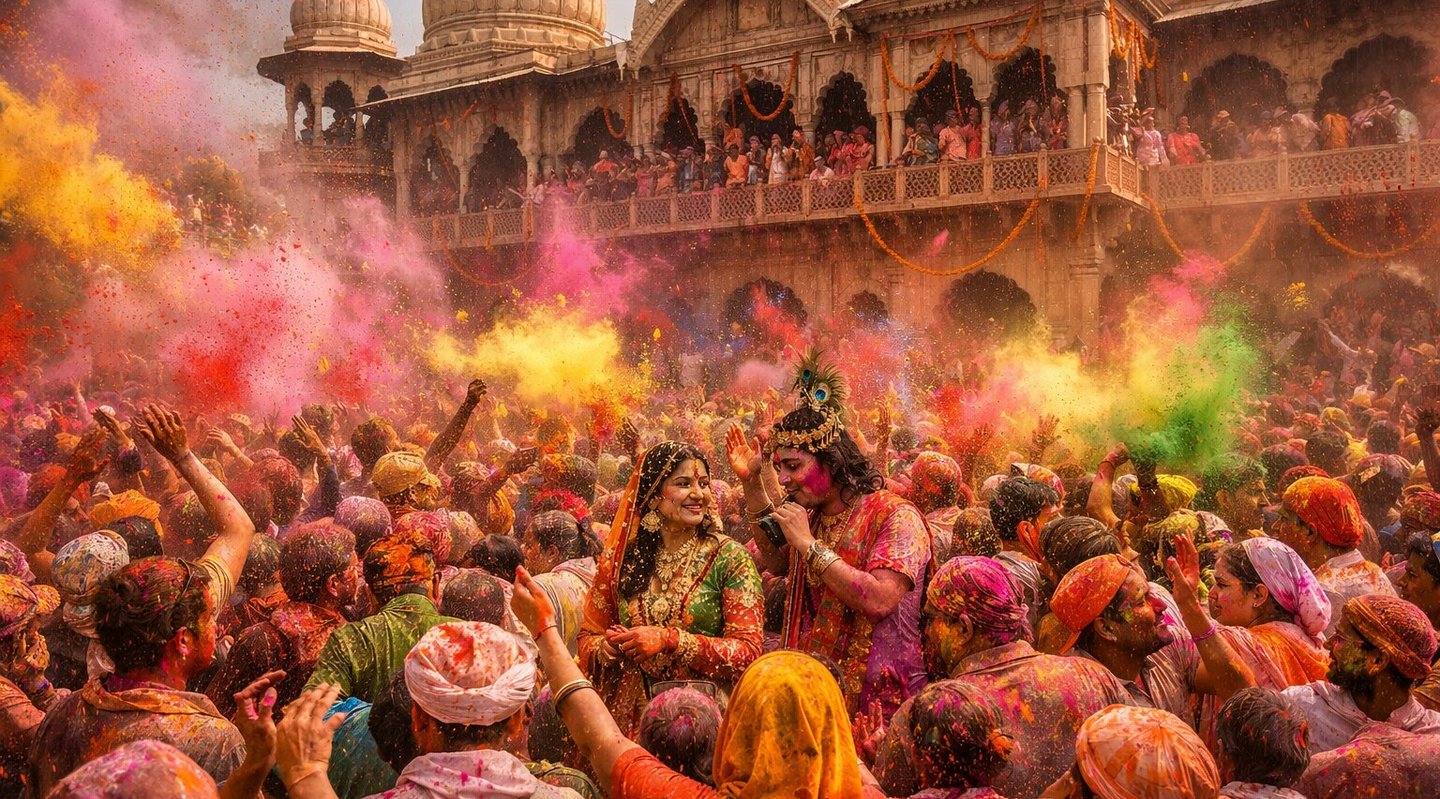
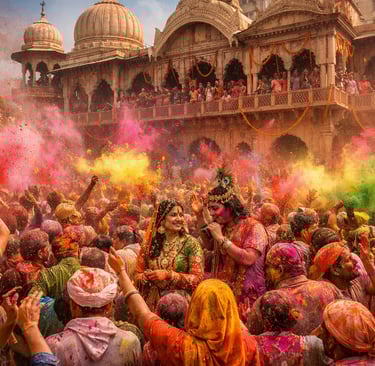
The Vrindavan Holi celebration, centred on the ancient and magnificent Banke Bihari Temple, the ISKCON Temple, and the Radha Raman Temple is the Holi that photographers fly from London and New York and Tokyo to witness. It is the Holi that appears on the covers of travel magazines and in the portfolios of documentary photographers. It is the Holi that people who have experienced it describe, years later, as one of the defining moments of their travelling lives.
What makes it so extraordinary is not merely the colours though the colours are overwhelming, clouds of vivid powder in magenta and saffron and electric blue and deep green rising above the temple courtyards and drifting through the narrow lanes in billows that temporarily obscure the sky. It is the combination of colour and music and devotion and the absolute abandon of a community in the full expression of its most joyful festival. The kirtan singing that fills the temple courtyards, the call-and-response devotional songs of the Krishna tradition, sung by priests and pilgrims together at a volume and intensity that seem to physically vibrate the air, is the sound of pure, unself-conscious joy. The gulal (dry colour powder) thrown by strangers who immediately become, through the act of colouring you, something between friends and family. The laughter. The dancing. The flower petals thrown alongside the colours in the older Phoolon Wali Holi (Holi of Flowers) tradition at the Banke Bihari Temple.
A note for travellers: We provide guidance on appropriate clothing (old clothes that you are happy to sacrifice to colour), protective eyewear, and the best positioning within the temple areas for both safety and the fullest experience. Our local support ensures that you participate confidently, comfortably, and in the most rewarding way possible. The Holi colours are natural and skin-safe; a shower at the hotel afterward removes most of them, though a faint tint may persist for a day or two worn, by most travellers, as a badge of honour.
Return to your Mathura hotel in the afternoon - coloured, exhilarated, and carrying memories that will not fade as quickly as the gulal.
Day 5: Barsana & Nandgaon - The Legendary Traditions of Braj Holi
If Vrindavan represents Holi at its most visually overwhelming, Barsana and Nandgaon represent it at its most culturally specific, two small towns with Holi traditions so ancient and so distinctive that they have become famous around the world in their own right.
Lathmar Holi at Barsana - The town of Barsana is the legendary home of Radha, Krishna's divine consort and the object of his most celebrated love. The Lathmar Holi tradition here re-enacts a famous episode from the Krishna stories: when Krishna came to Barsana to play Holi with Radha and her companions, the women of the town playfully drove him and his friends away with bamboo staves. The men defended themselves with shields. In Barsana, this episode is replayed every year in the days before the main Holi date, the women of the town wielding decorated bamboo lathis (staves), the men of Nandgaon (who come as visitors, as Krishna did) defending themselves with shields, both sides singing and dancing and throwing colours throughout.
The result is one of the most extraordinary cultural spectacles in India, simultaneously a religious re-enactment, a community celebration, a battle of gender wit, and a thoroughly joyful festival. The colours fly, the music plays, the crowd roars with laughter and devotion in equal measure.
Holi at Nandgaon - The reciprocal celebration takes place at Nandgaon, the hometown of Krishna himself, where the Barsana women arrive the following day to apply colour to the men and re-enact the playful traditions in reverse. The Nand Bhawan Temple at the top of the hill is the spiritual centrepiece, and the processions and singing that fill the town throughout the day carry the specific warmth of a community that has been celebrating this way for generations beyond counting.
Together, the Barsana and Nandgaon celebrations give you the deepest available insight into what Holi means in the Braj tradition, not merely as a festival of colour but as a living devotional practice, an annual reunion with the stories that define this community's identity and its relationship with the divine.
Return to Mathura in the afternoon. The Braj Holi experience is complete and there is nothing quite like it anywhere else in the world.
Day 6: Mathura → Agra - The Taj Mahal & Mughal Grandeur
After breakfast, we drive south to Agra, barely 60 kilometres from Mathura, less than an hour and a half. The contrast between the ancient, devotion-saturated world of Braj and the Mughal imperial grandeur of Agra is one of the most striking transitions in Indian travel, from the streets of Krishna's birthplace to the monument built by a grief-stricken Mughal Emperor for his dead wife, from folk celebration to architectural perfection, from colour to white marble.
The Taj Mahal - After the intensity of the Holi celebrations, there is something particularly powerful about encountering the Taj Mahal's absolute stillness and absolute beauty. The white Makrana marble, the perfectly resolved proportions, the reflection of the monument in the long pool of the hauz-i-kausar, all of it has a quality of silence and serenity that feels, after the joyful noise of Braj, deeply restorative as well as magnificent. Built by Shah Jahan between 1632 and 1653 as a mausoleum for his beloved Mumtaz Mahal, it remains, four centuries after its completion, the most beautiful building ever raised by human hands. No photograph prepares you for it. No previous visit diminishes it.
Agra Fort - A short drive from the Taj, the great UNESCO-listed red sandstone citadel of the Mughal Emperors, its layered palaces built by Akbar, Jahangir, and Shah Jahan across successive generations - is a heritage experience of considerable depth. The Musamman Burj, where Shah Jahan spent his final imprisoned years with a distant view of the monument he built for the woman he loved, closes the Taj story with a poignancy that stays.
Evening in Agra: the famous marble inlay craft shops of the city produce work in the same pietra dura technique as the Taj's decorative panels, beautiful, genuinely skilled, and available at a wide range of prices.
Day 7: Agra → Jaipur via Fatehpur Sikri - The Abandoned City & the Pink City
After breakfast, we drive west toward Jaipur but the route passes through one of the most extraordinary heritage sites in India.
Fatehpur Sikri - Emperor Akbar's complete and perfectly preserved abandoned Mughal capital, built in red sandstone and deserted fourteen years after completion, stands on its ridge exactly as it was left four centuries ago. The Buland Darwaza, the 54-metre gateway that is the largest in the world, the five-storey Panch Mahal pavilion, the Jama Masjid, and the Diwan-i-Khas audience hall are among the finest pieces of Mughal architecture anywhere. The atmosphere of a great city emptied and time-stopped is unique and genuinely haunting.
Continue to Jaipur - the Pink City of Rajasthan, arriving in the evening. The warm rose-coloured sandstone of the old city walls, the bazaars spilling colour and commerce onto the pavements, the palace towers rising above the rooflines, after a week of extraordinary experiences, Jaipur still has the power to surprise. Check in and explore the evening markets at leisure.
Day 8: Jaipur Sightseeing - Royal Forts, Palaces & the Living Pink City
After breakfast, a full day in Rajasthan's most magnificent city:
Amber Fort - The finest fort-palace in Rajasthan, rising above Maota Lake on the city's northern outskirts, its sequence of royal courtyards and apartments culminating in the Sheesh Mahal, the Mirror Palace, its walls and ceilings entirely covered in tiny mirror mosaic of such delicacy and complexity that a single candle flame, reflected and multiplied by thousands of mirrors, illuminates the entire chamber. One of the great decorative interiors of the world.
Hawa Mahal - The iconic five-storey screen of 953 latticed windows, the Palace of Winds built in 1799 as the most photographed facade in Rajasthan and the defining image of Jaipur. Morning light on the pink sandstone is the finest time to photograph it.
City Palace - The royal palace complex, partially still inhabited by the Maharaja's family, housing museums of extraordinary collections, miniature paintings, royal costumes, weapons, and historical artifacts tracing the long Kachwaha dynasty of Jaipur.
Jantar Mantar - The UNESCO-listed stone astronomical observatory of 1734, nineteen monumental instruments of remarkable scientific precision, still accurate today, built by a Maharaja who was as much astronomer as ruler.
Jaipur's Bazaars - The Johari Bazaar for the gemstones and jewellery that have made Jaipur the gem capital of India. The Bapu Bazaar for textiles and Rajasthani craft. An evening in Jaipur's markets is one of the great shopping experiences of Indian travel.
Day 9: Final Jaipur Sightseeing + Drive to Delhi - The Journey Home
After breakfast, the morning completes Jaipur's highlights:
Jaigarh Fort - Perched on the ridge directly above Amber, the military counterpart to its palatial neighbour, home of the Jaivana Cannon, the largest wheeled cannon ever cast, its six-metre barrel a testament to Rajput military ambition. The views from Jaigarh's ramparts over the valley and the distant plains are extraordinary.
Jal Mahal (Photo Stop) - The Water Palace, standing on its island in the middle of Man Sagar Lake, reflected in the still water as the morning light warms the pink sandstone, one of the most beautiful photo stops in all of Rajasthan.
After a good lunch in Jaipur, we begin the afternoon drive back to Delhi approximately 270 kilometres, five hours with comfortable breaks. Arrive in Delhi in the late evening. Your private SUV takes you directly to Indira Gandhi International Airport as per your departure flight timing.
Your Braj Holi Festival Tour ends at the departure gate, nine days, eight nights, and an accumulation of experiences that covers more emotional range than most journeys three times its length. The colour clouds of Vrindavan. The roar of the Lathmar Holi crowd at Barsana. The Taj Mahal in the silence of a clear morning. The Mirror Palace of Amber catching the afternoon light. Jaipur's bazaars in the golden hour.
And underneath all of it, the ancient, joyful, deeply human truth of Holi itself: that colour is not merely decoration. That celebration is not merely entertainment. That the impulse to throw open your arms, cover yourself and everyone around you in colour, and simply, completely, unreservedly rejoice, is one of the most beautiful things human beings have ever decided to do together.
You carry it home. It stays.
✅ Inclusions
✅ 8 Nights Accommodation - Quality 3-star / 4-star properties ( as available ) across Delhi (2 nights), Mathura (3 nights), Agra (1 night), and Jaipur (2 nights). ✅ Daily Breakfast - A proper breakfast at your accommodation every morning. ✅ Private AC Car / SUV with English-Speaking Driver - Your dedicated vehicle for the complete tour. All road journeys, festival transfers, and local sightseeing. ✅ Braj Holi Festival Experience Support - Local guidance, festival logistics, positioning advice, and colour protection tips for the safest and most rewarding celebration experience. ✅ All Sightseeing as per Itinerary - Every monument, temple, and festival location mentioned is built into your plan. ✅ All Tolls, Parking & Driver Allowances - No hidden road costs.
❌ Exclusions
❌ International flights and airfare ❌ Lunch, dinner, and personal expenses ❌ Travel insurance and visa charges
Best Time - Festival Dates & Planning
This package operates exclusively during the Holi festival season, generally March, with specific dates varying each year according to the Hindu lunar calendar. The Braj Holi celebrations spread across multiple days in the week surrounding the main Holi date:
Lathmar Holi at Barsana - typically two days before the main Holi date
Lathmar Holi at Nandgaon - typically the day before the main Holi date
Vrindavan Holi - runs across multiple days, with the most intense celebrations on and around the main Holi date
Main Holi (Dhulandi) - the national celebration day
We confirm exact festival dates for each year and plan the itinerary accordingly. Early booking is strongly recommended, this is one of the most sought-after festival tours in India and accommodation in the Braj region during Holi fills months in advance.
Frequently Asked Questions
Q: Is Braj Holi safe for international tourists? Yes, with the right planning, private transport, and experienced local guidance that Package 20 provides, Braj Holi is a safe and extraordinary experience for foreign visitors. Our support team accompanies you through the festival areas, advises on positioning and timing, and ensures that your experience is celebratory, comfortable, and memorable for all the right reasons. We recommend old clothes, protective eyewear for the most intense celebrations, and following your guide's advice on crowd management.
Q: Will we experience the real, authentic Holi - not a tourist version? Completely and without reservation. The Vrindavan temple celebrations, the Lathmar Holi at Barsana and Nandgaon, the kirtan singing, the colour throwing, the devotional atmosphere, these are exactly as they have been for generations, participated in by the local communities as their own festival. International visitors join as welcome guests in a celebration that is entirely genuine. This is not a performance staged for tourists. It is the real thing.
Q: What should we wear and bring for the Holi celebrations? We recommend bringing old clothes in white or pale colours that you are happy to never wash clean again, the Holi colours are the best souvenir you will take home on your clothing. Comfortable, flat, closed shoes. A small waterproof bag for your phone and camera if you wish to protect them. Protective eyewear. Sunscreen. A sense of humour and a willingness to be completely, cheerfully covered in colour by strangers who mean it entirely as an act of joy and welcome.
Q: Can we upgrade to 5-star hotels, particularly in Agra and Jaipur? Yes, luxury upgrades are available at all destinations. The Oberoi Amarvilas in Agra, with its extraordinary Taj Mahal views from every room, and the Rambagh Palace in Jaipur are both exceptional options for couples and travellers seeking a premium experience. Revised pricing is shared in advance.
Why Book This with UK India Tourism?
Holi is extraordinary. Braj Holi is extraordinary in a way that multiplies that adjective until it barely contains what it's describing. But Holi, like any festival, needs the right planning to deliver its full potential, the correct locations, the right timing within the festival calendar, safe and comfortable transport between celebration sites, and local guidance that ensures you are in the right place at the right moment.
We have brought travellers from the United Kingdom, the United States, Europe, and beyond to Braj Holi and we have learned, journey by journey, exactly what makes the difference between a festival experience that is merely colourful and one that is genuinely, permanently life-changing. The combination of Vrindavan's temple celebrations with the specific, irreplaceable traditions of Barsana and Nandgaon. The hotel in Mathura that positions you ideally for all three festival locations. The driver who knows the back roads that keep you out of the worst festival traffic. The timing of the Taj Mahal visit and the Jaipur sightseeing that makes the week feel balanced and complete rather than exhaustingly packed.
These are the details we handle. Your job is simply to arrive and be present for one of the most joyful, most colourful, most deeply human celebrations that any culture anywhere in the world has ever devised.
Lose yourself in a whirlwind of colour and devotion in Braj, where Holi isn’t a festival, it’s a living legend.
Celebrate the world’s most magical Holi in Mathura & Vrindavan, where every colour echoes the eternal romance of Lord Krishna.
UK India Tourism
UK : +44 7345 191205
India: +91 9958 480873
Email: sales@ukindiatourism.co.uk
Travel Specialists for UK, USA, Canada, Australia, France, Poland, Singapore, Japan & Beyond
UK: +44 7345191205
UK India Tourism© 2026, all rights reserved
India: +91 9958480873
⭐⭐⭐⭐⭐ 4.9/5 | 2,600+ Travelers | 18 Years | 98% Recommend