
Package 24: Kolkata & Darjeeling Heritage Tour India
Kolkata → Darjeeling → Kolkata
Duration: 8 Days / 7 Nights
Private AC Car + Fast AC Train | 3-Star / 4-Star Accommodation
Price: Ask for Price ( Twin sharing accommodation )
Best for: Culture lovers, heritage explorers, mountain seekers, couples, families, photographers, USA/UK tourists, first-time East India travellers
The City That Feels Everything & the Hills That Say Nothing and Both Are Perfect
India has many cities. It has only one Kolkata.
There is something about this city, something in its particular combination of crumbling colonial grandeur and fierce intellectual pride, of street-level chaos and drawing-room culture, of the smell of marigolds and incense and the Hooghly River and the very specific, slightly sweet smell of a Kolkata morning that produces in almost every visitor the same response: the sense of having arrived somewhere that takes its own identity completely seriously, that has been thinking about literature and politics and spirituality and food for two hundred and fifty years without interruption and intends to continue doing so regardless of what the rest of India or the rest of the world thinks about it.
Kolkata is the city of Rabindranath Tagore and Mother Teresa, of the Indian Museum and Victoria Memorial, of the Durga Puja celebrations that transform the entire metropolis into one enormous, joyful, impossibly elaborate act of collective worship. It is the city where the British Empire had its first great Indian capital and left behind architecture of such ambition that the buildings still stop pedestrians on Park Street in their tracks a century after their construction. It is the city where the street food, the kathi rolls, the mishti doi, the puchka, the kosha mangsho, is arguably the finest urban food culture in India, which is the highest possible bar.
And then four hours north by Fast AC Train, and then three hours higher by mountain road, there is Darjeeling. Cool and misty and tea-scented and entirely, deliberately unlike everything you have just left behind. Where Kolkata is dense and warm and emotionally overwhelming, Darjeeling is open and cool and quietly, persistently beautiful. Where Kolkata presses in from every direction, Darjeeling opens out to the valley below, to the tea gardens on every hillside, to the Himalayan peaks on the northern horizon, to a sky that at this altitude seems larger and closer than any sky seen at sea level.
The Kolkata & Darjeeling Heritage Tour combines both. Eight days, seven nights, using India's excellent Fast AC Train service to connect the two destinations smoothly and comfortably, with private car for all local travel. It is a journey that covers more emotional range than most tours three times its length: the full, rich, intellectually demanding pleasure of Kolkata's cultural heritage, and the quiet, restorative, altitude-scented beauty of the Darjeeling hills.
This is East India at its most complete. And it begins, as all great things in this part of the world begin, in Kolkata.
Day by Day Itinerary
Day 1: Arrival in Kolkata - Welcome to the City of Joy
At Netaji Subhas Chandra Bose International Airport, our private representative will be waiting - your name on a board, a genuine welcome, and a private, air-conditioned vehicle to carry you to your hotel. The drive from the airport into central Kolkata is already a first encounter with the city's character: the old trams still running on their colonial-era tracks, the yellow Ambassador taxis that have somehow survived into the twenty-first century as an act of pure Kolkata stubbornness, the grand buildings of the British era glimpsed between the street trees, the extraordinary density of a city of fifteen million people living at full volume in every direction.
Kolkata calls itself the City of Joy - a name taken from Dominique Lapierre's celebrated novel and while joy is not the first word that occurs to every visitor on first encounter (overwhelming, remarkable, and astonishing all arrive first), it is ultimately the most accurate. There is a particular warmth to Kolkata that no other Indian city quite replicates, a warmth rooted in its extraordinary cultural pride, its traditions of hospitality, and the specific humanity that comes from a city that has always taken its intellectual and spiritual life more seriously than its economic ambitions.
The first evening is gentle, rest after travel, perhaps a brief walk in the neighbourhood around your hotel, a first encounter with the famous Kolkata street food from a nearby stall. The kathi roll - spiced meat or egg wrapped in a flaky paratha, is the perfect first Kolkata meal: quick, extraordinary, and available everywhere at any hour.
Rest well. Kolkata gives generously to those who arrive rested and ready.
Day 2: Kolkata Sightseeing - Colonial Heritage & the City's Grand Legacy
After breakfast, a full day exploring the magnificent colonial heritage of what was once the capital of British India, a city that the Empire built with such confidence and such ambition that the buildings it left behind remain, a century after independence, among the finest examples of European colonial architecture anywhere in the world.
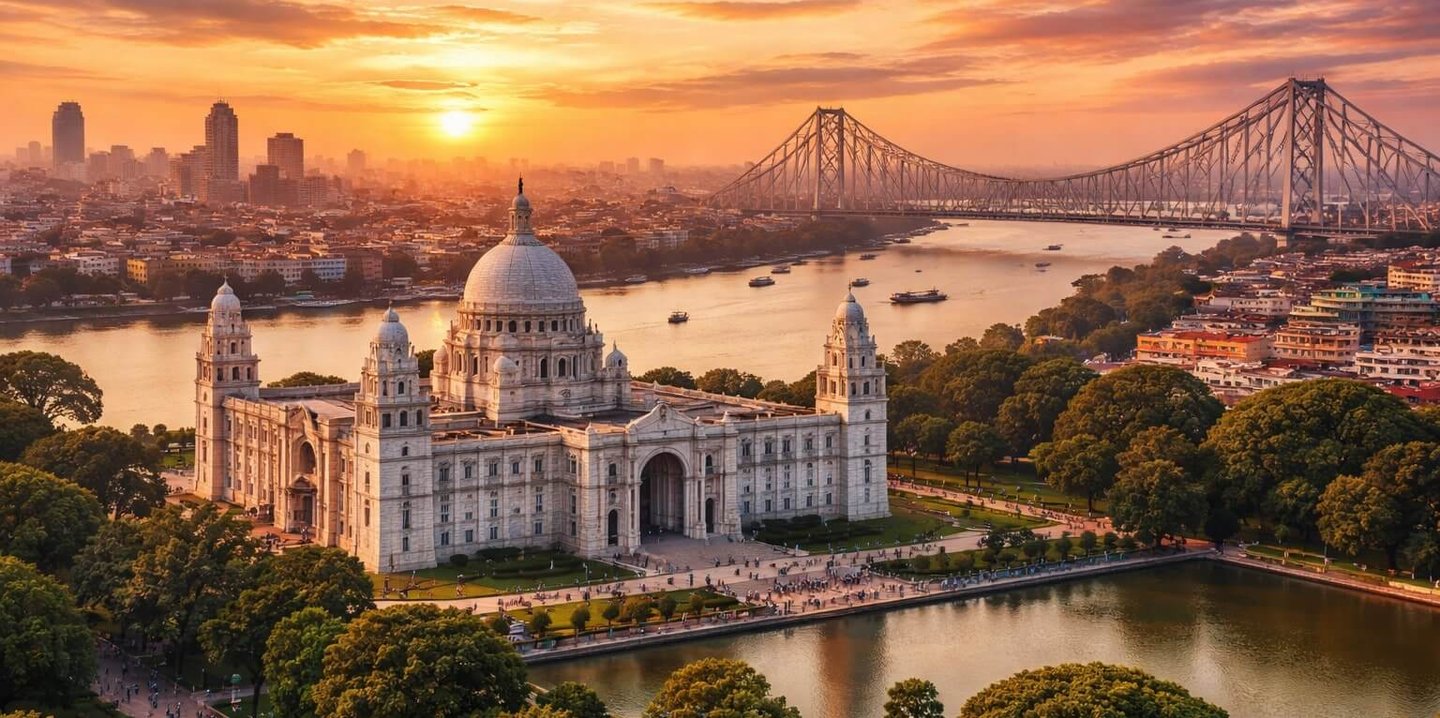
Victoria Memorial - The centrepiece of Kolkata's colonial heritage and one of the most magnificent buildings in India, the Victoria Memorial was built between 1906 and 1921 as a monument to Queen Victoria and the glory of the British Empire in India. Constructed from brilliant white Makrana marble, the same marble used in the Taj Mahal, its great dome rising 56 metres above the manicured gardens that surround it on every side, it is a building of extraordinary visual impact and enormous historical complexity. Today it functions as a museum of remarkable depth, its galleries tracing the full arc of British India from the first trading posts of the East India Company through the Raj to independence with collections of paintings, manuscripts, weapons, and royal artifacts that constitute one of the finest archives of colonial-era Indian history anywhere in the world. The gardens surrounding the memorial, with their ornamental pools and their avenue of royal palms, are among the finest public gardens in any Indian city.
The Indian Museum - The oldest and largest museum in India, founded in 1814, the Indian Museum on Chowringhee Road houses collections of such breadth and depth that a single visit barely scratches their surface. Natural history, archaeology, art, anthropology, geology, the museum covers the full range of human and natural knowledge with the particular confidence of an institution that has been doing so for over two hundred years. The Gandhara sculpture gallery, with its extraordinary collection of Greco-Buddhist art from the ancient northwest, and the Egyptian mummy ( Kolkata's Indian Museum has an Egyptian mummy, and it is genuinely and pleasingly inexplicable) are among the most celebrated individual exhibits.
The Colonial Streets & Park Street - Between and around these great institutions, the streets of central Kolkata offer a walking experience of considerable architectural richness. The Writers' Building, the High Court, St Paul's Cathedral, and the grand facades of Dalhousie Square (now renamed B.B.D. Bagh) together constitute a concentration of colonial public architecture that has no equivalent anywhere else in India. Park Street - Kolkata's most celebrated boulevard, lined with restaurants, bakeries, and shops that have been there since the 1950s and 1960s and feel absolutely no obligation to modernise, is an essential afternoon experience. The Flurys café on Park Street, founded by a Swiss confectioner in 1927, serving its famous afternoon tea and pastries in a room that has barely changed since the Raj, is one of those specific, irreplaceable experiences that only Kolkata offers.
Day 3: Kolkata Cultural Day - Spiritual Heritage, River Ghats & Real Kolkata
After breakfast, today moves from the colonial surface of Kolkata into its deeper cultural and spiritual identity, the layers that the British buildings overlay but never quite cover.
Kalighat Temple - One of the most important Hindu temples in India and the sacred site after which Kolkata is named, the Kalighat Kali Temple is dedicated to the goddess Kali, the most powerful and most terrible manifestation of the divine feminine in the Hindu tradition, destroyer of evil and mother of the universe simultaneously. The temple is ancient, the current structure dates from 1809, but the site of worship is believed to be considerably older and it operates at the full intensity of a genuinely active pilgrimage centre, with thousands of devotees moving through its precincts daily. The atmosphere is overwhelming in the specific way that only major Hindu temples manage: loud, crowded, fragrant with flowers and incense, vibrating with the sound of bells and chanting and the general noise of faith conducted at full volume. It is not for everyone at every moment, but it is undeniably, completely alive and it gives a depth of insight into the living religious culture of Bengal that no heritage museum can approximate.
Mother House - Missionaries of Charity - A short distance from Kalighat, in a quiet lane of central Kolkata, the Mother House of the Missionaries of Charity is the global headquarters of the organisation founded by Mother Teresa of Calcutta in 1950. Mother Teresa, canonised as a saint by the Catholic Church in 2016, spent nearly fifty years working in the streets and slums of Kolkata and her simple tomb in the Mother House, in a room of complete whiteness and complete silence, is one of the most moving heritage visits available in the city. The museum attached to the Mother House traces her life and work with quiet dignity. Whether or not one shares her faith, the force of character and the scale of compassion it represents are impossible to stand before without being affected.
Prinsep Ghat - On the banks of the Hooghly River, the distributary of the Ganges on which Kolkata was built the Prinsep Ghat is one of the city's most beautiful and most atmospheric riverside spaces. The neo-Gothic colonnade built in 1843 in honour of the orientalist James Prinsep frames a view of the river that is genuinely lovely: the water wide and brown and busy with boats, the Vidyasagar Setu suspension bridge downstream, the opposite bank green and quiet in the late afternoon light. In the evenings, Prinsep Ghat fills with Kolkata's young people, students, couples, families, taking the river air with the relaxed confidence of people exercising a right that has belonged to this community for generations. The flower market at Mullik Ghat, a short walk away, is one of Kolkata's most photogenic daily spectacles, thousands of marigold garlands and rose offerings traded at dawn and dusk in a riot of colour and scent that has been happening on this riverbank for centuries.
Local Markets & Street Food - The afternoon in Kolkata's markets, New Market, the grand covered market built in 1874 and still one of the finest shopping experiences in the city; the Gariahat Market for Bengali textiles and household goods; the street stalls of College Street (the largest second-hand book market in the world, selling everything from nineteenth-century Sanskrit manuscripts to last week's paperback thrillers), is the fullest possible expression of what Kolkata does better than anywhere else in India: the integration of commerce and culture and street life into something that is simultaneously a marketplace and a theatre, a transaction and a conversation, a place to buy things and a place to understand everything about the people selling them.
Day 4: Kolkata → NJP by Fast AC Train → Drive to Darjeeling- Into the Hills
After breakfast, we transfer to Howrah Railway Station, the great Victorian railway terminus on the western bank of the Hooghly, one of the busiest railway stations in the world, its red brick facade as instantly recognisable as any building in Kolkata, to board the Fast AC Train for New Jalpaiguri (NJP).
This is one of the most important and most appreciated design decisions in this tour package. The distance from Kolkata to NJP is approximately 570 kilometres, a road journey of ten or more hours through the Bengal plains that would consume an entire day and deliver travellers exhausted to the foot of the hills. By Fast AC Train, the same distance is covered in approximately four to five comfortable hours in an air-conditioned carriage with complimentary snacks, meals, and mineral water served throughout. You arrive at NJP rested, fed, and ready for the final leg of the journey, the mountain road up to Darjeeling.
The train journey itself is a pleasure, watching the Bengal countryside pass outside the window, the flat, intensely cultivated plains of West Bengal moving from the density of the Kolkata metropolitan area through agricultural land of extraordinary productivity, rice fields and jute and the occasional flash of a pond or river catching the light. As the train approaches NJP, the first suggestion of the hills appears on the northern horizon, a darkening of the skyline, an irregularity in the flatness that grows, kilometre by kilometre, into the unmistakable profile of the Himalayan foothills.
At NJP, your private car and driver are waiting. The three-hour drive to Darjeeling climbs from the warm plains through the tea garden foothills, the temperature dropping noticeably with every hundred metres of altitude gained, the vegetation thickening and changing from tropical to temperate, the switchback road revealing new panoramas of the valley below at every curve. It is a beautiful drive that many travellers find among the most scenic of the entire tour.
Check in to your Darjeeling hotel in the evening. Step outside. Breathe the cool, pine-and-tea-scented mountain air. After three days in the warm, energetic, sensory fullness of Kolkata, the contrast is immediate and complete and completely wonderful.
Day 5: Darjeeling Sunrise + Town Exploration - The Hills Begin
The alarm sounds before dawn. This is the one early morning of the Darjeeling section, and it earns every minute of lost sleep.
Tiger Hill Sunrise: At 2,590 metres, Tiger Hill delivers what is widely considered the finest sunrise viewpoint in India. As the sky lightens from black to blue to gold, Kangchenjunga - 8,586 metres, the third highest mountain on Earth, catches the first sunlight on its five summits in a sequence of colours from amber to brilliant white that produces, in almost every visitor regardless of their previous experience of mountains, a silence of genuine and unperformed awe. On clear mornings, even Mount Everest is visible on the north-western horizon, a small white triangle 180 kilometres away, extraordinary in the simple fact of its visibility.
After sunrise, breakfast at the hotel and a morning of gentle town exploration:
Batasia Loop & Ghoom Monastery: The famous spiral of the Toy Train track at Batasia, surrounded by gardens and a war memorial, is one of the most photographed spots on the DHR route. The Ghoom Monastery, Darjeeling's oldest Tibetan Buddhist gompa, houses a magnificent Maitreya Buddha statue and carries a quality of genuine spiritual life that distinguishes it from more touristic heritage experiences.
Mall Road & Chowrasta - The afternoon belongs to Darjeeling town at its most leisurely: the broad pedestrian square of Chowrasta, the shops selling Darjeeling tea in beautiful packaging, woollen shawls, and Tibetan craft objects, and the excellent small cafés where a cup of second flush Darjeeling tea consumed in the hills where it was grown is one of the great simple pleasures of Indian travel.
Day 6: Darjeeling Tea Trails - The World's Most Famous Gardens
After breakfast, today is dedicated to the experience that defines Darjeeling's global identity.
Tea Estate Experience - Your private car moves through the hillside roads connecting Darjeeling's most celebrated estates. A guided walk into the gardens reveals the extraordinary craft of tea production: the precision of the plucking process, workers selecting only the top two leaves and the bud of each shoot with a speed that comes from decades of practice. The processing stages of withering, rolling, oxidation, and drying, each step carefully controlled to produce Darjeeling's celebrated character. And the tasting session, sitting in the estate with a cup of tea grown and processed in the garden immediately around you, which reveals, definitively and permanently, the difference between great tea drunk in its place of origin and great tea drunk anywhere else.
The afternoon is for photography in the gardens, the late light on the tea bushes, the women workers in their coloured saris moving through the rows, the mountains appearing through the mist behind the plantation or for a return to town for café time and the specific contentment of a Darjeeling evening.
Day 7: Darjeeling Toy Train + Leisure - UNESCO Heritage on Rails
After breakfast, today delivers what many of our travellers describe as the most purely joyful travel experience of the entire journey.
The Darjeeling Himalayan Railway - UNESCO World Heritage Site and one of the great engineering achievements of the Victorian era, the Toy Train has been threading its impossible narrow-gauge path through these mountains since 1879 with a cheerful disregard for gradient and a complete indifference to the passage of time. The heritage section ride, moving through the streets of mountain settlements so narrow that the locomotive's steam drifts into the open shop fronts, curving through forest sections where the Himalayan flowers lean in from the embankment, pausing at Ghoom Station where the air is noticeably thinner and the views magnificent, is exactly as charming in reality as it is in every photograph, and considerably more so in the experience of actually sitting in it. The whistle in the mountain mist. The views of the valley through the carriage window. The specific happiness of a train that was built to be delightful and has succeeded, for nearly a hundred and fifty years, in being exactly that.
Note: Toy Train tickets booked subject to DHR schedule and availability. We advise on status in advance.
The afternoon is entirely yours - Chowrasta, the cafés, the shops, the specific pleasure of a final unhurried Darjeeling afternoon with nowhere else to be. Tomorrow, the mountain road descends.
Day 8: Drive to NJP → Fast AC Train to Kolkata - The Journey Home
After a final breakfast at your hotel, we begin the descent from the hills, the same mountain road in reverse, the tea gardens scrolling past as the altitude drops and the air warms and the plains of Bengal open below. Arrive at NJP and board the afternoon Fast AC Train back to Kolkata, again with complimentary snacks, meals, and mineral water served throughout, arriving in Kolkata in the late evening.
Your private car meets you at Howrah Station and takes you to your onward destination - airport, hotel, or wherever your journey continues from here.
Your Kolkata & Darjeeling Heritage Tour ends in the city where it began but the journey you carry home is considerably larger than the one you arrived with. The Victoria Memorial in the morning light. The overwhelming energy of Kalighat. The silence of Mother Teresa's tomb. The Hooghly River at dusk from Prinsep Ghat. Kangchenjunga rising white above the cloud layer at Tiger Hill. The taste of tea drunk in the garden where it was grown. The Toy Train whistle in the Darjeeling mist.
East India, in all its depth and all its beauty, has delivered itself completely. And it stays.
✅ Inclusions
✅ 7 Nights Accommodation - Quality 3-star / 4-star properties in Kolkata (3 nights) and Darjeeling (4 nights), selected for comfort, location, and character.
✅ Daily Breakfast - A proper breakfast at your accommodation every morning.
✅ Fast AC Train Travel - Comfortable reserved seating on the Kolkata (Howrah)–NJP and NJP–Kolkata services, with complimentary snacks, meals, and mineral water included on both journeys.
✅ Private AC Car - Dedicated vehicle for all transfers: airport pickup, all Kolkata sightseeing, NJP to Darjeeling hill drive, all Darjeeling local sightseeing, and final station drop.
✅ Tea Garden Experience - Guided estate visit including plantation walk, processing demonstration, and tasting session.
✅ Toy Train Ride - Booked subject to DHR availability, confirmed in advance.
✅ All Tolls, Parking & Driver Allowances - No hidden road costs.
❌ Exclusions
❌ International flights and domestic flights to/from Kolkata ❌ Ropeway or cable car tickets in Darjeeling ❌ Lunch, dinner, and personal expenses ❌ Travel insurance and visa charges
Best Time to Visit
October to March - The finest season for Kolkata, with pleasantly warm days and cool evenings ideal for extended city sightseeing. October and November deliver the post-monsoon clarity that gives Darjeeling its finest mountain views. December and January bring cool crisp weather to both destinations.
March to May - Spring is the finest season for Darjeeling specifically — the famous first flush tea harvest in March and April, rhododendrons blooming on the hillsides, and clear mountain views combining to make this the most beautiful time in the hills. Kolkata is warming in April and May but still comfortable for sightseeing.
Frequently Asked Questions
Q: Is the Fast AC Train the best way to travel between Kolkata and Darjeeling? Without question. The road journey from Kolkata to the Darjeeling hills is extremely long and tiring, not appropriate for a holiday of this character. The Fast AC Train covers the distance comfortably, with food served and reserved seating throughout, and delivers you at NJP rested and ready for the scenic mountain drive. It is the intelligent, comfortable, and correct choice for international travellers.
Q: Is Kolkata safe and suitable for first-time visitors to India? Kolkata is one of India's safest and most visitor-friendly major cities, with a long tradition of welcoming international travellers and a population genuinely proud of the cultural heritage they have to share. The private transport and experienced local support provided throughout Package 24 make navigation of the city entirely straightforward and consistently enjoyable.
Q: Can this tour be extended to include Gangtok or other Sikkim destinations? Yes, Gangtok connects naturally from Darjeeling and can be added as an extension of two to three additional days, essentially combining Package 24 with elements of Package 23. Contact us to plan this extension with adjusted pricing and duration.
Q: Is Darjeeling suitable for senior travellers? Yes, the private car eliminates most walking demands, and the key experiences of the Darjeeling section (Tea Garden visit, Toy Train ride, Tiger Hill sunrise drive) are all accessible without strenuous physical activity. We can adapt the pace further to suit specific requirements on request.
Why Book This with UK India Tourism?
East India is the part of the subcontinent that most international tour operators know least well and plan most carelessly. The result, for travellers who book generic packages, is often a rushed, poorly sequenced journey that fails to give either Kolkata or Darjeeling the time they need. Kolkata compressed into a single day of landmark photography. Darjeeling visited without the tea estate experience or the Toy Train. The journey between them made exhausting by unnecessary road travel.
Package 24 is built on a completely different foundation. Three full days in Kolkata, enough time to move beyond the Victoria Memorial into the spiritual and street-level culture that makes the city genuinely extraordinary. Four days in Darjeeling, enough time for the sunrise, the tea gardens, the Toy Train, and the leisure that allows the hills to actually restore rather than merely be visited. Fast AC Train between the two, the comfortable, catered, intelligent alternative to an exhausting road marathon.
✅ The right duration for both destinations ✅ Fast AC Train - comfortable, catered, correct ✅ Private car throughout - your pace, your schedule ✅ Cultural depth in Kolkata - beyond the colonial landmarks ✅ Complete Darjeeling experience - sunrise, tea, train, and time
Where colonial echoes meet mountain whispers - discover the timeless soul of Kolkata & Darjeeling in one unforgettable journey.
UK India Tourism
UK : +44 7345 191205
India: +91 9958 480873
Email: sales@ukindiatourism.co.uk
Travel Specialists for UK, USA, Canada, Australia, France, Poland, Singapore, Japan & Beyond
United Kingdom: +44 7345191205
UK India Tourism© 2026 All rights reserved
India: +91 9958480873
⭐⭐⭐⭐⭐ 4.9/5 | 2,600+ Travelers | 18 Years | 98% Recommend