
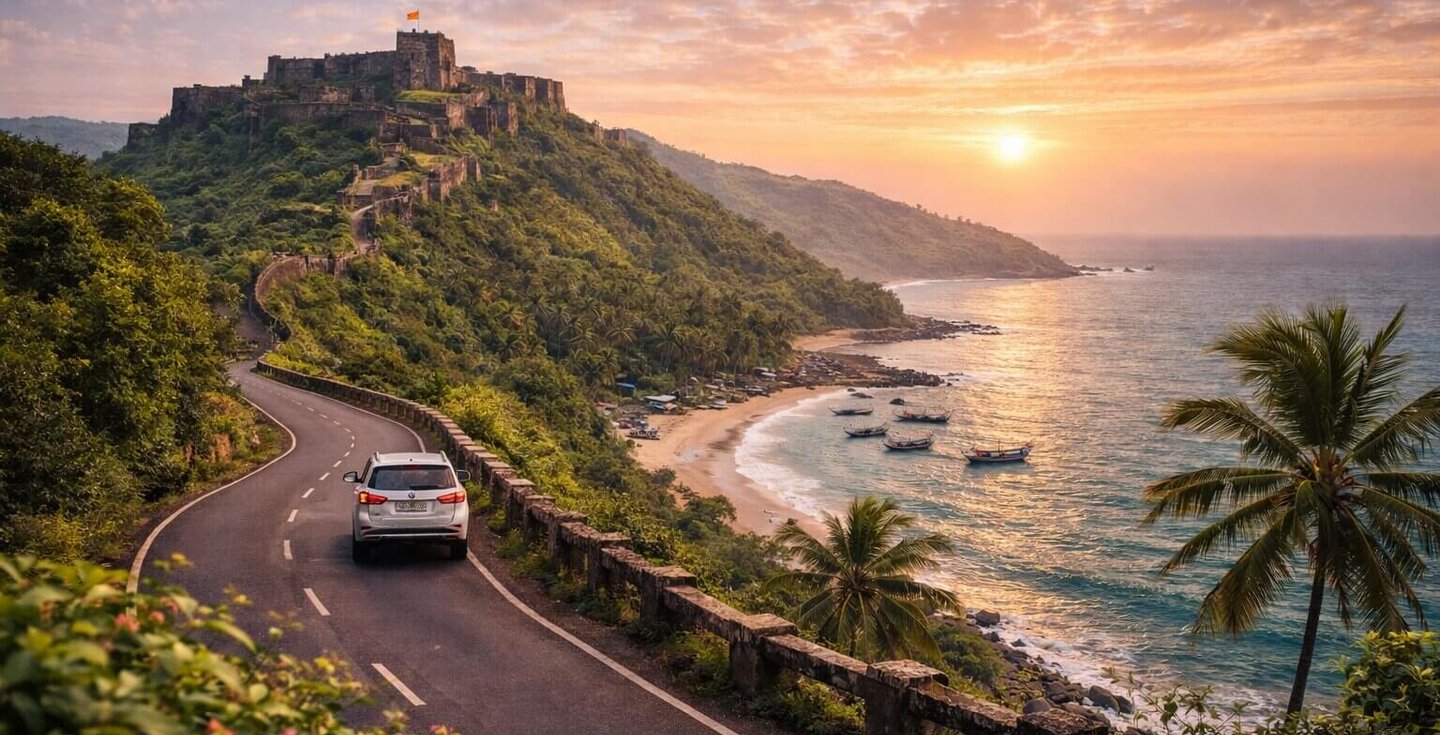
Package 12: Konkan Coastal Bliss Road Trip
Route: (Mumbai – Alibaug – Ratnagiri – Mumbai)
Duration: 6 Days / 5 Nights
Price: GBP 1,299 per person(Rates based on twin sharing accommodation)
Private AC Car
Best for: Beach lovers, couples, families, peaceful holiday seekers, nature travellers, USA/UK tourists, weekend escape planners, offbeat India explorers
The India That Moves at the Pace of the Sea
There is an India that most visitors know the India of golden temples and desert palaces, of crowded bazaars and ancient monuments, of colours so saturated they seem almost invented. It is a magnificent India, and it earns every superlative that has ever been written about it.
And then there is this India. The quieter one. The one that smells of salt air and ripe mangoes and woodsmoke from a beach fire at dusk. The one where the road curves through coconut palms and suddenly, without warning, the Arabian Sea appears below you - vast, silver, breathing and you pull over without discussion because there is simply no other reasonable response. The India where a fisherman mends his net on a beach that has no name on any tourist map, where a two-hundred-year-old sea fort rises from the ocean on a rocky island and reflects the sunset in its ancient stones, where a plate of freshly caught Konkani fish curry served at a roadside stall redefines everything you thought you understood about the relationship between simplicity and perfection.
The Konkan Coastal Bliss Road Trip traces one of India's most beautiful stretches of coastline, the western seaboard of Maharashtra, where the Western Ghats tumble down to the Arabian Sea in a cascade of forests, rivers, fishing villages, and beaches that remain, even now, gloriously unhurried by the demands of mass tourism. Beginning in the electric, exhausting, irreplaceable city of Mumbai, it moves south through Alibaug - the beach escape that has been Mumbai's weekend retreat for generations and then deeper, further, into the wild green coastal beauty of Ratnagiri, where the coastline becomes dramatic and cinematic and the mangoes are the finest in India, before looping back to Mumbai with a road that hugs the landscape and offers a different revelation around every bend.
This is a tour for beach lovers who want more than a sun lounger. For couples seeking the romance of sunset over an ancient sea fort with no one else in sight. For families whose children need space and ocean and the freedom that only a road trip provides. For senior travellers who want beauty without exhaustion. For first-time India coastal visitors who want to understand that India's relationship with the sea is as deep, as complex, and as beautiful as its relationship with its temples and its history.
In six days and five nights, the Konkan coast will show you things that stay. Not because they are dramatic, though some of them are but because they are real, and because the particular combination of sea air and slow roads and good food and salt-washed light does something to the nervous system that no amount of urban touring quite manages. It slows you down to the right speed.
Day by Day Itinerary - Six Days Along India's Most Beautiful Coastline
Day 1: Arrival in Mumbai - The City That Never Lets You Be Neutral About It
Every great journey needs a beginning worthy of what follows. Mumbai is more than worthy, it is, by any measure, one of the great cities of the world, and arriving in it for the first time, or the fifth, or the fifteenth, never entirely loses its charge of electricity and wonder.
At Mumbai Airport, our representative will be waiting for you, calm, organised and ready to navigate the organised chaos of India's busiest city on your behalf. You will be transferred to your hotel in a private, air-conditioned vehicle, the city opening itself around you as you travel: the elevated expressways, the harbour glimpsed between buildings, the extraordinary density of human life at every intersection, the billboards and the street food stalls and the doubled-decker buses that are somehow still operating, cheerfully anachronistic, in the middle of the twenty-first century.
Mumbai is not a city that offers itself gradually. It arrives all at once, fully formed, maximally itself and the best way to begin to understand it is simply to step into it.
Depending on your arrival time, we have a gentle, carefully chosen first evening planned:
Marine Drive Sunset Walk - Marine Drive is Mumbai's great democratic promenade, a three kilometre sweep of art deco buildings facing the curve of Back Bay, its sea wall crowded every evening with every stratum of Mumbai society: office workers loosening their collars after a long day, young couples sitting close on the low wall watching the waves, street food vendors pushing carts of bhel puri and chaat, school children in uniform, elderly couples walking with the slow purposefulness of people who have been doing this same walk for forty years. The sunset from Marine Drive, the sun dropping into the Arabian Sea, the water turning gold and then red, the string of streetlamps along the curve of the bay beginning to switch on one by one, is one of the great free spectacles of Indian city life. Stand here, breathe the sea air, eat something from a street vendor, and let Mumbai work its particular magic on you.
Gateway of India - A short drive from Marine Drive, the Gateway of India stands at the edge of Apollo Bunder on the harbour front, a vast Indo-Saracenic arch built to commemorate the visit of King George V and Queen Mary in 1911, and later, in a historical irony of considerable poetry, the point through which the last British troops marched as they departed independent India in 1948. At night, lit against the dark harbour, with the grand Victorian bulk of the Taj Mahal Palace Hotel behind it and the dhows and tourist launches bobbing on the water below, it is one of the great photogenic moments of Indian travel. The contrast between the colonial architecture and the chaotic, joyful, entirely Indian life that swirls around it, the balloon sellers, the photograph touts, the families eating ice cream, the pigeons - is distinctly and wonderfully Mumbai.
Colaba Causeway Market - Running south from the Gateway area through the historic Colaba neighbourhood, this lane-long street market is one of Mumbai's most atmospheric evening destinations. Stalls selling everything from Tibetan jewellery to printed cotton dresses, from leather sandals to small Ganesha statues, from vintage postcards to Bollywood memorabilia crowd both sides of the pavement. The shops behind them, the old provision stores, the bars with their swinging wooden doors, the cafés that have been there since before independence, add layers of history to what is already a rich sensory experience. Colaba Causeway at night, busy and bright and smelling of street food and incense and the harbour, is quintessentially, irresistibly Mumbai.
A good dinner tonight — Mumbai is one of India's great restaurant cities, and Colaba in particular offers everything from Irani café classics to contemporary coastal cuisine and then rest well. Tomorrow, the city gives way to the sea.
Day 2: Mumbai → Alibaug — The Coastal Drive South & the First Taste of the Konkan
After breakfast, we load the car and leave the city behind and the leaving of Mumbai is itself an experience. The route south from the city crosses Vashi Bridge over the Thane Creek and then drops through the satellite towns of Navi Mumbai before the road begins to open up, the urban density thinning, the palm trees appearing with increasing frequency, the quality of the air changing in small but perceptible ways until suddenly you realise you can smell the sea.
Alibaug lies approximately 95 kilometres from central Mumbai by road a distance that takes around two hours on a good day, though the coastal route we take adds a little time and infinitely more beauty. The town has been Mumbai's most beloved weekend escape for over a century, close enough to reach without heroic travel, far enough to feel genuinely removed from the city's pace, and sitting on a stretch of coastline that offers beaches, forts, sea air, and the particular peace that only coastal Maharashtra seems to know how to produce.
The drive through the Konkan countryside leading to Alibaug is already, before you arrive anywhere, worth the journey. The road winds through groves of coconut palms, past rice fields that in season are a green so saturated it seems artificial, through small villages where fishing nets are spread to dry in courtyards and where the smell of drying fish and coconut oil and red chilli hangs warmly in the air. The roadside stalls selling sol kadhi (the beautiful pink Konkani kokum drink), fresh coconuts opened with a single stroke of a machete, and paper cones of roasted groundnuts are not attractions, they are just what the road looks like here, and they are wonderful.
Arrive in Alibaug in the early afternoon. Check in to your hotel or beach resort accommodation here is chosen for proximity to the sea, quality of service, and the particular atmosphere of a property that understands what its guests have come for. A sea breeze from a first-floor balcony. The sound of waves at night. The smell of salt in the bedsheets.
After lunch at leisure, the afternoon is perfectly timed for the coast:
Alibaug Beach Sunset - Alibaug Beach is the town's main beach, a long, gentle arc of dark sand that is never quite as crowded as comparable beaches near major Indian cities, and at sunset empties further still into a quality of golden, quiet beauty. The beach faces west, and the sunset over the Arabian Sea from here, the sun dropping below a horizon that has nothing between you and the coast of Africa, is the kind of moment that resets the nervous system. Walk the shoreline barefoot. Let the waves come to your feet. Let the journey of getting here dissolve into the simple, irreducible pleasure of being at the edge of the ocean at the end of a golden day.
Varsoli Beach - A short distance from Alibaug Beach, Varsoli is quieter, less visited, and arguably more beautiful, a clean stretch of pale sand flanked by casuarina trees, with a quality of silence and remoteness that is remarkable given how close it sits to one of the world's great megacities. This is the beach for photographs, for sitting in the early evening light with a cold drink, for the kind of unhurried conversation that only happens when there is nothing else requiring your attention.
Local Seafood Dinner - Alibaug's restaurants serve some of the finest Konkani seafood on the Maharashtra coast, and dinner tonight should be a full, leisurely exploration of what that tradition offers. The Bombay duck (a local fish, despite its name) fried to a shattering crispness. The surmai (king fish) marinated in coconut and turmeric and grilled over charcoal. The prawn curry in a sauce of fresh coconut, kokum, and red chilli that is at once fierce and sweet and deeply satisfying. The sol kadhi, that extraordinary pink drink made from kokum and coconut milk, drunk cold alongside the meal as a digestive and a pleasure simultaneously. Konkan seafood is not merely good food. It is a cuisine that tastes like the sea itself, immediate, generous, and honest.
Day 3: Alibaug - Forts, Beaches & the Slow Pleasure of Coastal Exploration
Today is one of the most satisfying days of the entire journey and it contains none of the rushing that ruins so many sightseeing days. This is Alibaug at its own pace: a fort on a sea island, a beach that curves to the horizon, and as much or as little in between as suits your mood.
Murud-Janjira Fort - This is one of the most extraordinary historical sites on the entire western coast of India, and one that most travellers, even well-travelled India visitors, have never heard of, which makes it all the more remarkable when you finally see it.
Murud-Janjira is a sea fort, not a fort overlooking the sea, but a fort built directly in the sea, rising from a rocky island in the middle of Rajapuri Creek, its twenty-two-metre walls rising directly from the water on all sides with no beach or shallow access. It was constructed over several centuries beginning in the fifteenth century by the Siddis, descendants of African Habshi traders and soldiers who established an extraordinary maritime kingdom on the Konkan coast and it was never, in its entire history of nearly three hundred years of active use, successfully captured or breached. Not by the Portuguese, whose colonial power dominated the region. Not by the Marathas under Shivaji, who attempted to take it multiple times and failed. Not by the British. Murud-Janjira stands today in essentially the same form as it did at the height of Siddi power, its towers and bastions intact, its deep freshwater wells still functional inside its walls, its gateways still carrying the carved stone lions and elephants of its builders.
The journey to Murud-Janjira is itself part of the experience, a short but atmospheric boat ride from Rajapuri village, the fort growing from the water as you approach until it fills your entire field of vision, enormous and improbable and frankly rather magnificent. Inside, the scale of the fortification is immediately, physically apparent: walls thick enough to drive a vehicle through, bastions large enough to serve as rooms, cisterns deep enough to supply a garrison of several thousand for months. And from the upper battlements, the views in every direction, the Arabian Sea to the west, the Konkan coast stretching north and south, the creek and its fishing villages below are extraordinary.
Kashid Beach - On the return route from Murud-Janjira, Kashid Beach is a revelation quite possibly the most beautiful beach in the entire Alibaug district, and one of the finest on the Maharashtra coast. Unlike the dark volcanic sand of Alibaug and many nearby beaches, Kashid's sand is pale almost white in bright sun and the beach itself is long, wide, and curved in a gentle arc that gives uninterrupted views north and south. The water here is relatively calm and clear, the surrounding landscape a backdrop of green hills tumbling down to the shoreline, and the overall effect is of a beach that belongs in a different country entirely, one that has specifically arranged its geography for maximum beauty.
Photographers will spend hours here. Families will not want to leave. Couples who walk to the far end of the beach and turn back to see the curve of the bay and the hills beyond will understand immediately why Kashid is the most loved beach in this part of the coast.
Optional: Korlai Fort & Lighthouse - For those with the energy and the inclination, the fort of Korlai, perched on a headland a short drive from Kashid, offers one of the finest panoramic viewpoints on the Konkan coast. The ruins of the Portuguese fort here, built in 1521, now beautifully atmospheric in their dilapidation, are reached by a short, moderately steep climb, and from the top, the lighthouse standing above the ruins and the sea visible in three directions, the reward for the effort is considerable. The village of Korlai below is one of the last communities in India where a Portuguese derived creole language - Creole Portuguese of Korlai, spoken by the descendants of the original fort's community, is still in daily use. This linguistic curiosity, the last echo of five hundred years of Portuguese presence on the Konkan coast, is a reminder that this coastline has always been a place where the world's great currents of trade, of empire, of culture have washed in and left their traces.
Evening returns to Alibaug, dinner at your hotel or a local restaurant, the sound of the sea through the window, the particular contentment of a day well spent.
Day 4: Alibaug → Ratnagiri - The Konkan's Great Scenic Drive
After breakfast, we pack the car and begin what many of our travellers describe as the most visually spectacular day of the entire journey: the Konkan coastal drive south to Ratnagiri.
This road, running through the heart of coastal Maharashtra along the old Konkan highway is approximately 220 kilometres and takes around seven hours with stops. We say this not as a warning but as a promise. Seven hours on this road is not a hardship. It is an experience. Because this road is, quite simply, one of the most beautiful drives in India.
The landscape of the Konkan between Alibaug and Ratnagiri is a continuous revelation. The Western Ghats, rising inland to heights of over a thousand metres, send their rivers down through forests of teak and mango and jackfruit to meet the Arabian Sea in a series of estuaries, creeks, and tidal inlets that the road crosses on bridges from which the views — the sparkling water below, the forested hills behind, the coconut palms on the riverbanks, the wooden fishing boats tied in clusters at the village ghats are simply, repeatedly gorgeous. The road itself rises and falls with the coastal topography, climbing through forest and descending to sea level and climbing again, every summit offering a new panorama.
Lunch Stop at Chiplun or Mangaon - Midway through the drive, we stop for lunch at Chiplun (or Mangaon, depending on timing) small Konkan towns that are famous among road trippers on this route for their local restaurants. This is where you eat the kind of meal that the Konkan coast does better than almost anywhere in India: a freshly prepared thali of rice, dal, sabzi, kokum curry, and the day's fish catch, simple, unhurried, delicious, eaten at a wooden table with a fan overhead and the sounds of the town going about its afternoon business outside the door. These meals, eaten at unremarkable roadside restaurants by travellers who stopped only because they were hungry, are consistently among the most fondly remembered food moments of the entire journey.
The road continues south after lunch, more bridges over estuaries, more forests, more sea-glimpses, more small towns with their particular Konkan character: the red-tiled roofs of the traditional wada houses, the church spires left by the Portuguese, the temple gopurams rising above the palm canopy, the smell of fish drying and rice cooking and the particular slightly sweet, slightly salt smell that is the Konkan coast's own signature.
Ratnagiri appears in the late afternoon, a town built on a series of headlands and inlets where the Bhatye Creek meets the Arabian Sea, its skyline punctuated by the towers of Ratnadurg Fort and the white dome of the old lighthouse. After the long, beautiful drive, the sight of it, compact, coastal, unhurried, is deeply welcoming.
Check in to your hotel. If arrival time and energy permit, a short drive to a seaside viewpoint for the sunset is worth every effort, Ratnagiri's geography, with its headlands and the wide sweep of the bay visible from several points around town, produces sunsets of particular dramatic quality. The light on the water, the silhouette of the fort, the fishing boats returning to harbour below, it is a first encounter with Ratnagiri at its most characteristically beautiful.
Dinner at leisure. Ratnagiri is a town that understands fish. Let it show you.
Day 5: Ratnagiri Sightseeing - Forts, Beaches, Temples & the Stories the Sea Tells
Today is the day Ratnagiri reveals itself, and it does so generously with sea views and temple bells and the particular combination of history and landscape that makes this town one of the most rewarding coastal destinations on the entire western seaboard of India.
Ratnadurg Fort - Standing on the headland at the southern entrance to Ratnagiri harbour, the fort of Ratnadurg whose name translates roughly as "Jewel Fort", is one of the finest sea forts on the Konkan coast. Built by the Bijapur Sultanate and later used by the Marathas, it occupies a rocky promontory that juts into the Arabian Sea with the confidence of something that knows it has never been taken by force. The walls, built from the local black basalt, rise directly from the rock of the headland, and the views from the fort's upper levels north along the coast to where the Bhatye Creek estuary opens into the sea, south to the distant headlands, and west to the open Arabian Sea with no land between you and the horizon are among the most magnificent coastal vistas in Maharashtra.
Within the fort, the Bhagavati Temple has been a place of worship for centuries, its presence within the fortification a reminder that the Maratha military tradition was inseparable from spiritual life. The lighthouse that stands on the fort headland, its white tower visible from far out to sea, adds a picturesque element to what is already a remarkably photogenic site. In the early morning, with the light coming in low over the water and the fishing boats returning to harbour below, Ratnadurg Fort is as beautiful a place to stand as anywhere in Maharashtra.
Ganpatipule Beach & Temple - Approximately 25 kilometres north of Ratnagiri town, Ganpatipule is the most celebrated destination in the district and its double attraction, spiritual and natural, explains its enduring and well-deserved popularity.
The Swayambhu Ganesh Temple here is one of the most significant Ganapati temples in Maharashtra, its idol believed to have appeared naturally from the rock, self-manifested, in the Sanskrit tradition that gives these shrines their special sanctity. The temple sits at the base of a rocky hillside, directly behind the beach, and the combination of the temple's spiritual atmosphere and the sea immediately before it creates a setting of unusual and powerful beauty. Pilgrims come from across Maharashtra and beyond, dressed in their finest, moving through the temple with the focused attention of genuine devotion and there is something deeply moving about watching faith practised at the edge of the ocean, with the waves providing a continuous, indifferent backdrop to the most human of activities.
The beach at Ganpatipule is, quite simply, one of the finest on the Konkan coast, broad, long, and curved in a generous arc of pale sand backed by coconut palms, with water that is cleaner and calmer than many nearby beaches. The beach faces west and the sunsets here, the sun going down directly over the open water, the temple silhouetted against the pink sky, the waves catching the last light are of the kind that make travellers stay longer than they planned and return sooner than they expected.
Thiba Palace - Back in Ratnagiri town, the Thiba Palace is a heritage building of unusual and poignant history. Built in 1910 by the British colonial government as a residence for King Thebaw of Burma, the last king of the Konkan Burma dynasty, who was exiled here after the British annexation of upper Burma in 1885 - it is a building that carries its history in every room. The exiled king lived here for twenty-seven years, far from his homeland, his court, and his people, and died here in 1916, having never seen Burma again. Today, the palace is a museum housing artefacts from the royal household, and the experience of walking through its rooms, high ceilings, teak floors, the remnants of a royal life lived in enforced exile in a beautiful but alien landscape, is one of those historical encounters that is simultaneously fascinating and quietly heart breaking.
The palace garden, with its old trees and the views from its terrace over the surrounding town and the distant sea, is a peaceful and lovely place to spend a quiet half hour.
Optional: Local Mango Products & Konkan Shopping - Ratnagiri is not merely a coastal town, it is the heartland of the Alphonso mango, widely considered the finest variety of mango in the world. The Alphonso (known locally as Hapus) grown in the laterite soil of the Ratnagiri and Sindhudurg districts has a depth of flavour, a creaminess of texture, and a fragrance so intense it fills a room that no mango grown anywhere else on Earth quite matches. If you visit in season (approximately March to June), the opportunity to eat a fresh Alphonso mango in Ratnagiri is an experience that mango lovers describe with the reverence normally reserved for great wine. Outside season, the local shops offer a remarkable range of mango-derived products, the aamras (mango pulp) preserved in jars, mango pickle in its extraordinary Konkan variants, aam papad (dried mango leather), and the local aamrakhand (mango-flavoured sweetened yogurt) that is one of Maharashtra's great dessert traditions.
The local markets also offer excellent opportunities for Konkan craft and food shopping: kokum syrup, cashew products from the coastal cashew orchards, dried fish (a Konkan staple and an excellent, if aromatic, gift for adventurous food lovers), and traditional Konkan pottery and wickerwork.
Evening is your own, a last sunset over the Arabian Sea, a last plate of Konkani fish curry, a last walk along the Ratnagiri waterfront with the sound of the harbour and the smell of the sea. Tomorrow, the road home begins.
Day 6: Ratnagiri → Mumbai - The Long Road Home & the Pleasure of Remembering
After breakfast on the final morning, we pack the car and begin the return drive north to Mumbai, the same road, but experienced differently in the other direction, in the other light, at a slightly different season of your understanding of this coastline.
The return drive mirrors the outward journey in distance and time, and we build in the same quality of scenic breaks, a chai stop where the road crosses an estuary and the view downstream to where the river meets the sea is worth ten minutes of silence, a lunch stop at a roadside restaurant where the fish is fresh and the price is fair and the cook knows exactly what they are doing. The Konkan landscape, seen again from the other direction, reveals details that the outward journey, in its forward momentum, might have missed.
There is a particular satisfaction in the return leg of a road trip - the accumulated miles of the journey behind you, the familiar landscape confirming its details, the knowledge that you are carrying home more than you set out with. Not only the mango products and the block-printed cloth and the small Ganesh figure bought at the temple shop at Ganpatipule, but the images and the tastes and the sounds that travel lodges in the memory and refuses to release: the sunset over Alibaug Beach, the spray from the boat to Murud-Janjira, the silence of the fort at Ratnadurg in the early morning, the taste of a kokum curry eaten at a table outside a roadside restaurant with the Konkan hills behind it and the sea glinting in the distance.
Arrive in Mumbai in the early evening. Your private car takes you directly to the airport or to your hotel for any onward journey with the city closing around you again, that familiar electricity, that impossible density of human life and ambition and noise and beauty that is, and has always been, the particular genius of Mumbai.
Your Konkan Coastal Bliss Road Trip ends here. Six days. Five nights. Two remarkable coastal towns. One ancient sea fort that the world's great empires could not breach. Beaches of pale sand and dark sand and sand that glows gold at sunset. The most beautiful drive in Maharashtra. Seafood of a quality and freshness that redefines the genre. And the steady, salt-washed, horizon-expanding presence of the Arabian Sea, following you like a companion all the way.
What's Included in Your Package
Every element of this road trip has been selected to deliver maximum comfort, quality and enjoyment from the first mile to the last:
✅ Private AC Car with Driver for All Days - Your own dedicated, air-conditioned vehicle with an experienced, English-speaking driver for the complete six-day journey. The car is yours, your schedule, your stops, your pace. If you want to pull over because the light on the creek is extraordinary, you pull over. If you want to stop for a roadside coconut, you stop. This is road travel as it should be: entirely on your own terms.
✅ Fuel, Tolls, Parking & Driver Allowances - Every road cost is included. No toll booth surprises, no parking fees, no driver expense discussions. The road is fully covered.
✅ 5 Nights Accommodation - Carefully selected properties in Mumbai (1 night), Alibaug (2 nights), and Ratnagiri (2 nights), each chosen for quality, location, and the specific character of their destination. Beach proximity in Alibaug. Sea views in Ratnagiri. Reliable comfort in Mumbai.
✅ Daily Breakfast - A proper sit-down breakfast at your accommodation every morning of the tour.
✅ All Sightseeing as per Itinerary - Every beach, fort, temple, and heritage site mentioned in this itinerary is built into your plan.
✅ Support for Best Food Stops & Safe Breaks - Our driver knows this road, and knows where to stop. The best lunch dhabas, the cleanest rest stops, the most reliable fuel stations, all planned so that the driving days are comfortable and unhurried.
❌ What Is Not Included
Complete transparency, as always:
❌ Lunch & dinner - Meals beyond daily breakfast are your own. This is actually one of the pleasures of this tour, choosing your own seafood restaurants in Alibaug and Ratnagiri, discovering your own roadside lunch stop on the coastal highway, eating at your own pace and preference.
❌ Personal expenses & tips - Shopping, tips for guides, personal purchases, and similar costs are the traveller's responsibility.
❌ Travel insurance - Strongly recommended for all international travellers. Please ensure comprehensive coverage before departure.
Best Time to Visit the Konkan Coast
The Konkan coast has a longer ideal travel season than many Indian destinations:
October – November: Post-monsoon Konkan is at its greenest and most lush. The rivers are full, the waterfalls are still flowing, the vegetation is at its most vivid, and the weather is warm and clear without being oppressive. The sea is calm and the beaches are at their finest. Excellent for all activities.
December – February: Peak season and the most comfortable time to travel. The weather is pleasantly warm by day (mid-to-high twenties Celsius) and refreshingly cool in the evenings. The sea is calm, the skies are clear, and the Konkan coast is at its most immediately accessible and enjoyable. Ideal for beach time, fort visits, and the long coastal drive.
March – May: Warming temperatures but the mango season begins in March, making this a wonderful time for food-focused travellers. The beaches are quieter as domestic tourism reduces slightly, and the landscape has a golden, late-summer quality that photographers find very appealing. May brings significant heat, but the coastal breeze along the Konkan makes it more manageable than inland destinations.
June – September (Monsoon): The Konkan monsoon is one of the most dramatic in India, this is one of the highest-rainfall regions in the country, and between June and September the coast receives extraordinary volumes of rain. The landscape becomes intensely, almost aggressively green. Waterfalls appear everywhere. The sea is wild and impassable for boats. Most forts and beaches are inaccessible or significantly reduced in their accessibility. Adventure travellers who love the monsoon find the Konkan during this season extraordinary but it is not recommended for the standard itinerary of this package.
Frequently Asked Questions
Q: Is the boat ride to Murud-Janjira safe and suitable for senior travellers or families with young children? Yes, the ferry crossing to Murud-Janjira is a short, calm ride on a covered wooden boat across a sheltered creek. The water is calm and the crossing is well-managed. Senior travellers and young children make this journey regularly and without difficulty. The entry into the fort from the boat involves a few steps, but nothing steep or demanding. We recommend wearing comfortable flat shoes and bringing water.
Q: How long is the drive from Alibaug to Ratnagiri on Day 4, and is it tiring? The drive is approximately 220 kilometres and takes around seven hours with scenic and lunch stops. We plan this day with the understanding that the journey itself is part of the experience, this is one of India's most beautiful coastal roads and the stops along the way are enjoyable rather than merely functional. We recommend a good breakfast before departure and building in at least one roadside chai stop in addition to the main lunch break. Our driver knows the road well and plans the timing to ensure you arrive in Ratnagiri before dark, with time for a sunset viewpoint if energy permits.
Q: Is this tour suitable for senior travellers? Yes, this package is specifically noted as senior-friendly, and the design reflects that. The pace is relaxed with no early morning departures except by choice, no strenuous hiking, no long walks on difficult terrain. The longest drive is Day 4, and it is a scenic pleasure rather than a test of endurance. All accommodation is carefully selected for comfort and accessibility. We can adapt any element of the itinerary further to suit specific mobility requirements or health considerations, simply let us know when booking.
Q: Can we extend the tour to include more of the Konkan coast - Goa or Sindhudurg? Absolutely. The Konkan coast extends south from Ratnagiri through the extraordinary Sindhudurg district, home to some of the finest sea forts in India, including Sindhudurg Fort itself (another island fort, built by Shivaji) and continues to Goa. A two or three-day extension south from Ratnagiri before the return to Mumbai is an excellent addition for travellers with more time. The route through Sindhudurg to Goa is one of the most beautiful road journeys in western India. Contact us to plan this extension.
Q: What is the seafood situation for travellers who don't eat fish? The Konkan coast is deeply, thoroughly a seafood culture and the fish curry and rice tradition here is one of India's great regional cuisines. However, every restaurant along the route also serves excellent vegetarian Maharashtrian food - rice, dal, vegetables, chapatis, and local specialities that are satisfying and delicious. Gujarat-style vegetarian food is not the tradition here, but Maharashtrian vegetarian cooking is richly varied and always available. Travellers who don't eat fish will eat extremely well.
Why Travellers Love This Package
This tour earns its following not through grand claims but through the accumulated quality of its specific pleasures that reveal themselves day by day, mile by mile:
✅ Two iconic coastal destinations in one seamless loop - Alibaug and Ratnagiri are distinct in character, complementary in what they offer, and connected by one of the most beautiful drives in India. Together they tell a complete story of the Konkan coast that neither could tell alone.
✅ The perfect balance of beaches, heritage, and nature - This is not merely a beach holiday, though the beaches are magnificent. It is not merely a heritage tour, though the forts and the palace and the temple are extraordinary. It is the combination, sea and history and landscape and food and the particular quality of time on a road trip that makes it something more than the sum of its parts.
✅ A relaxed, genuinely senior-friendly pace - No forced marches. No 5 AM safari departures. No itinerary so tightly packed that there is no room for the unplanned, the roadside stop for a coconut, the extra hour on a beach because the light is too beautiful to leave, the decision to have one more plate of that prawn curry before the bill.
✅ Great for couples seeking coastal romance - A sunset over an ancient sea fort from a boat on the water. A beach with no one else in sight. A seafood dinner at a table overlooking the harbour. The long, beautiful coastal drive with the windows down and the sea visible through the palms. The Konkan coast, on a road trip, is one of the most romantic travel experiences India offers.
✅ Perfect for first-time India coastal travellers - The Konkan is accessible, safe, beautiful, and genuinely different from the India of the tourist trail. It introduces the coastal subcontinent at its most welcoming, its most flavourful, and its most visually stunning.

Ready for India's Most Beautiful Coastal Road Trip?
Your Konkan journey, planned with care and delivered in comfort.
The road is open. The palm trees are leaning into the sea breeze. The Arabian Sea is waiting at the end of the next curve. A plate of Konkani fish curry is being prepared somewhere ahead of you.
And the coast is calling.
UK: +44 7345 191205
India: +91 9958 480873
Email: sales@ukindiatourism.co.uk
UK India Tourism
Travel Specialists for UK, USA, Canada, Australia, France, Poland, Singapore, Japan @ beyond
UK: +44 7345191205
UK India Tourism© 2026, all rights reserved
India: +91 9958480873
⭐⭐⭐⭐⭐ 4.9/5 | 2,600+ Travelers | 18 Years | 98% Recommend