Package 17: Mumbai City Tour with Elephanta Caves
Route: Mumbai - Elephanta- Mumbai
Duration: 5 Days / 4 Nights | Private AC Car
Price: GBP 1,199 per person (Twin Sharing)
Best for: USA/UK tourists, first-time India visitors, couples, families, Bollywood lovers, city explorers, culture & heritage travellers
The City That Never Asks You to Slow Down
There are cities that welcome you gently. Mumbai is not one of them.
Mumbai arrives all at once, in a wave of noise and colour and salt air and the sheer, staggering density of human life operating at full volume in every direction simultaneously. It is the city where twelve million stories are being lived at the same moment, where a fisherman mends his net fifty metres from a five-star hotel, where a Bollywood film crew closes a street that five minutes later is flowing with traffic again, where the most ornate Victorian Gothic architecture in Asia stands directly beside a street food cart that has been serving the same vada pav recipe for thirty years and will serve it for thirty more.
Mumbai is India's financial capital, its entertainment capital, its fashion capital, and its most visited city and it wears all of these identities simultaneously, without apology or contradiction. It is overwhelming. It is magnificent. It is, for the vast majority of travellers who spend time within it, completely and permanently unforgettable.
The Mumbai City Tour with Elephanta Caves - gives you the best of this extraordinary city in five days and four nights, moving through its iconic landmarks and hidden neighbourhoods, across the harbour to its most remarkable UNESCO heritage site, and behind the scenes of the world's largest film industry. It is a tour designed for the traveller who wants to understand Mumbai, not merely to photograph it from a distance, but to feel it: the sea wind on Marine Drive, the echo of ancient rock-cut temples on an island in the middle of the harbour, the particular electric energy of a city that genuinely never sleeps.
This is Mumbai as it deserves to be experienced with comfort, with guidance, and with the time to actually take it all in.
Day by Day Itinerary
Day 1: Arrival in Mumbai - The City Receives You
At Chhatrapati Shivaji Maharaj International Airport, our private representative will be waiting to welcome you and transfer you to your hotel in a private, air-conditioned vehicle. The drive from the airport into central Mumbai is itself a first encounter with the city's scale and character, the elevated expressways above the urban sprawl, the distant shimmer of the harbour, the extraordinary density of the city pressing in on every side with its particular combination of grandeur and chaos.
Check in, rest, and refresh. Mumbai asks a great deal of its visitors, energy, attention, appetite and the best way to give it all of those things is to arrive at Day 2 genuinely rested.
If arrival time and energy permit, a gentle first evening in the neighbourhood around your hotel is a perfectly good introduction: the street food, the noise, the remarkable human theatre of a Mumbai pavement at dusk. There is no formal agenda for tonight. The city will introduce itself in its own way and at its own pace, which is always faster than you expect.
Day 2: Mumbai Sightseeing- Iconic Landmarks, Coastal Drives & the Soul of the City
After a good breakfast, your private car and English-speaking driver begin what is genuinely one of the great urban sightseeing days available anywhere in India, a full day moving through the layers of Mumbai's extraordinary identity, from its colonial architectural heritage to its beloved seafront to the chaotic, colourful commerce of its most famous market street.
Gateway of India - There is no more iconic starting point in Mumbai. Built to commemorate the visit of King George V and Queen Mary in 1911 - the first British monarchs to visit India, the Gateway is a 26-metre Indo-Saracenic arch of yellow basalt standing directly on the harbour at Apollo Bunder, its feet almost in the water of the Arabian Sea. It has been a symbol of arrival and departure for over a century: the point through which viceroys entered India in full imperial ceremony, and the point through which the last British troops departed in 1948 as independent India watched. Today it is surrounded by the full, cheerful chaos of Mumbai tourism, balloon sellers, boat ticket touts, pigeons, families from across India taking photographs, the grand Victorian facade of the Taj Mahal Palace Hotel behind it reflecting in the harbour water.
Stand here for a while. Watch the ferries leave for Elephanta Island you will be on one of them tomorrow. Watch the fishing boats and the tourist launches on the water. Let the Gateway work its particular magic, which it does reliably and without effort.
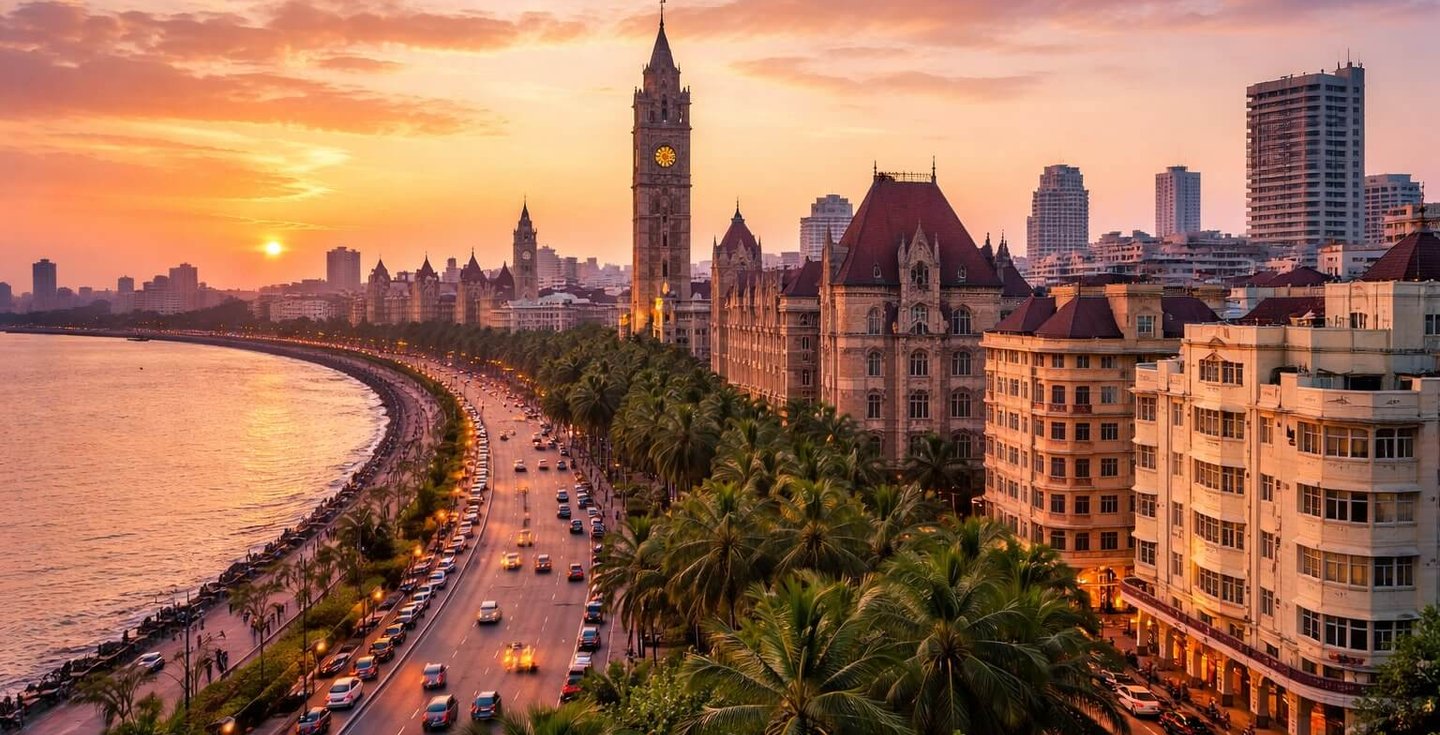
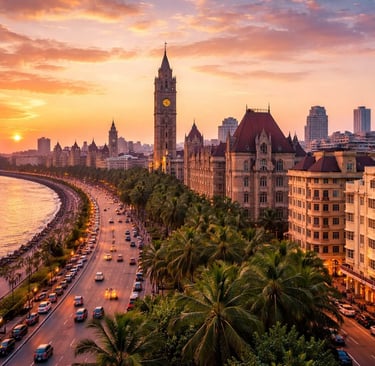
Marine Drive - A few kilometres north of the Gateway, Marine Drive is Mumbai's great public space, a three-kilometre curved promenade along the shore of Back Bay, its art deco apartment buildings on one side and the open Arabian Sea on the other, its sea wall the city's most democratic sitting spot. At any hour of the day or evening, Marine Drive's wall is occupied by Mumbaikars of every description - students, office workers, elderly couples, street food vendors, young lovers, and the occasional film crew using the backdrop of the sea and the art deco skyline for something or other. The view from the southern end of the Drive, looking north along the curve of the bay as the sun sets over the water, is the image that defines Mumbai in the Indian imagination. It is called the Queen's Necklace - the string of street lamps along the curved bay seen from above at night resembling a diamond necklace and the name is completely, obviously right.
Colaba Causeway Market - Running south from the Gateway area through the historic Colaba neighbourhood, this lane-long street market is one of Mumbai's most atmospheric and enjoyable shopping experiences. Stalls selling everything from Tibetan jewellery to embroidered cotton clothing, from leather sandals to small bronze Ganeshas, from vintage maps of the subcontinent to Bollywood poster prints crowd both sides of the pavement, and the shops behind them, old Irani cafés, provision stores, bars with wooden shutters, small restaurants that have been serving the same Parsi dishes since the 1950s, add layers of history to what is already a rich sensory experience. Colaba Causeway is the place to buy gifts, to eat street food, to bargain cheerfully, and to understand the commercial character of a city that has been doing business enthusiastically for six centuries.
Chhatrapati Shivaji Maharaj Terminus (CST) - The final stop of the day is one of the most extraordinary buildings in Asia. Built between 1878 and 1887 as the headquarters of the Great Indian Peninsula Railway, CST - known to Mumbaikars simply as VT, is a UNESCO World Heritage Site and the finest example of Victorian Gothic architecture in India, its soaring stone facade of pointed arches, turrets, gargoyles, stained glass, and carved stone animals rising above one of the busiest railway stations in the world. The contrast between the building's cathedral-like architectural grandeur and the relentless, utterly practical business of a Mumbai commuter station, a hundred thousand people passing through in an hour, every train packed beyond any reasonable European notion of capacity, is one of the great visual paradoxes of India, and one of its most compelling.
Photograph it from the traffic island opposite as the evening light turns the stone gold. Then stand and watch it for a while, building, street, and station operating simultaneously at full intensity. This is Mumbai at its most exactly itself.
Day 3: Elephanta Caves - Ancient Wonder on a Harbour Island
After breakfast, we drive to the Gateway of India to begin the most unexpected and most historically remarkable day of the tour.
From the Gateway, a ferry ride of approximately one hour carries you across Mumbai Harbour to Elephanta Island - a small, forested island in the middle of the bay that holds, within its rocky hillside, one of the greatest collections of ancient rock-cut sculpture in the world. The ferry ride itself is a pleasure, the harbour busy with fishing boats and container ships and other ferries, the Mumbai skyline receding behind you as the island grows ahead, the sea air sharp and salt-clean after the city.
Elephanta Caves - Designated a UNESCO World Heritage Site in 1987, the Elephanta Caves are a complex of rock-cut temples and sculpture dating primarily from the fifth to eighth centuries CE, a period when the island, then known as Gharapuri, was an important centre of Shaivite Hindu culture and artistic production. The caves were carved directly from the volcanic basalt of the island's hillside by unknown craftsmen over several centuries, and the scale and quality of what they created is genuinely staggering.
The Main Cave (Cave 1) is the centrepiece, a vast pillared hall roughly 27 metres square, its ceiling supported by rows of carved columns, its walls lined with sculptural panels of extraordinary size and refinement. The most celebrated of these is the Trimurti, a three-faced bust of Shiva nearly six metres high, representing the three aspects of the god: the serene creator, the terrible destroyer, and the feminine principle of preservation. It is one of the finest pieces of religious sculpture in the world, not merely in India and its scale, its detail, and its emotional power affect visitors in ways that are difficult to predict and impossible to overstate. To stand before a six-metre stone face carved fifteen hundred years ago on a harbour island and feel the full weight of the artistic and spiritual tradition that produced it is one of those travel experiences that reframes something permanently.
Other panels throughout the cave complex depict Shiva as Nataraja (Lord of the Dance), Shiva and Parvati on Mount Kailash, the Andhakasuravadha (Shiva destroying the demon of blindness), and Ardhanarishvara (the divine androgyne, half Shiva and half Parvati), each panel a masterwork of narrative sculpture that tells its story in stone with clarity and power that needs no translation.
The path from the ferry jetty to the caves climbs through forest on a paved walkway, flanked by stalls selling handicrafts, fresh coconuts, and local snacks. Toy trains and sedan chair services are available for those who prefer not to walk the full distance. The island's resident macaque monkeys - bold, numerous, and completely unimpressed by UNESCO status, accompany the journey with cheerful opportunism.
Return by ferry to Mumbai in the afternoon. The evening is yours - shopping, a good restaurant, a walk along Marine Drive as the city lights come on. After a day among ancient stone gods, Mumbai's contemporary energy feels, if possible, even more vivid than before.
Day 4: Bollywood Experience - Behind the Scenes of the World's Greatest Dream Factory
Today is, for many of our international visitors, the day they have been anticipating most and it consistently delivers.
What is Bollywood? The numbers, first: the Indian film industry produces over 1,500 films per year- more than Hollywood, more than any other national cinema on Earth. Of these, the Hindi-language films produced primarily in Mumbai - Bollywood, in the global shorthand are the most widely distributed, the most internationally recognised, and the most culturally significant. Bollywood films are watched by an estimated 3.6 billion people worldwide, across more than a hundred countries. The industry employs over two million people in Mumbai alone. Its stars are among the most recognised human faces on the planet.
To visit Mumbai without engaging with Bollywood is to visit Liverpool without acknowledging the Beatles, technically possible, but a significant wilful omission.
Bollywood Studio / Film City Visit - Your Bollywood experience centres on a guided visit to one of Mumbai's working film studios or the vast Film City complex in Goregaon, subject to availability and current production schedules, which vary by day and season. Film City, covering over 520 acres of the Aarey Colony forest, is effectively a self-contained filmmaking city containing dozens of outdoor sets, sound stages, indoor shooting floors, and supporting infrastructure, the largest studio complex in Asia and the nerve centre of Bollywood production.
A guided tour moves through the facility revealing sets that may be dressed as Mughal palaces, contemporary apartments, courtrooms, village streets, or spaceship interiors, sometimes with active shooting visible nearby. The experience of seeing a Bollywood production at close range, the dozens of technicians, the elaborate lighting rigs, the costumes, the multiple takes of a single shot, the extraordinary gap between the sliver of scene being captured and the epic finished product that will eventually appear on screen, gives international visitors a genuine and fascinating insight into an industry that most of the world knows only through its finished product.
Bollywood enthusiasts may wish to invest time in exploring the Bollywood merchandise and memorabilia shops of the studio area, where posters, costumes, and film artifacts make excellent and very specific gifts.
Evening is at leisure - Mumbai's restaurant scene is world-class, and the options for dinner range from the legendary Leopold Café in Colaba (open since 1871, a Mumbai institution) to contemporary rooftop restaurants overlooking the harbour, to the simple, extraordinary pleasure of a street-side vada pav eaten standing up at a stall that has been perfecting the recipe since before you were born.
Day 5: Final Morning & Departure - Mumbai Says Goodbye
After a final breakfast at your hotel, the morning is shaped entirely by your flight time and Mumbai, characteristically, has options for every window of remaining time.
A final walk along Marine Drive. A return to Colaba for any last-minute gifts not yet purchased. A quiet chai at an Irani café, those beautiful, slightly crumbling establishments with their marble-top tables and their glass-fronted display cases and their complete indifference to interior design trends of any decade, that represent one of Mumbai's most specific and most beloved cultural institutions, a legacy of the Zoroastrian Iranian immigrants who arrived in the early twentieth century and opened cafés that are still, a hundred years later, among the best places in the city to sit and think.
When your flight time approaches, your private car takes you directly to Chhatrapati Shivaji Maharaj International Airport with time to spare.
Your Mumbai City Tour ends at the departure gate but Mumbai, as every visitor discovers sooner or later, does not let go easily. It surfaces in unexpected ways: in the sound of film music from somewhere, in the memory of the Trimurti rising from the rock of Elephanta in the half-light of the cave, in the image of the Gateway lit against the harbour at dusk, in the smell of sea air and street food and the particular mix of the old and the new that is Mumbai's signature and its gift.
✅ Inclusions
✅ 4 Nights Accommodation: Quality 3-star and 4-star properties in Mumbai, selected for location, comfort, and ease of access to the city's main sightseeing areas.
✅ Daily Breakfast: A proper breakfast at your accommodation every morning.
✅ Private AC Car with English-Speaking Driver: Your dedicated vehicle for all transfers, city sightseeing, and local journeys throughout the tour. No shared transport.
✅ All Sightseeing as per Itinerary: Every landmark, market, and experience mentioned is built into your plan.
✅ Mumbai Local Support: Your driver's knowledge of Mumbai's traffic, routing, and timing is a genuine practical asset in a city where these things matter enormously.
✅ All Tolls, Parking & Driver Allowances: No hidden road costs.
❌ Exclusions
❌ International flights and airfare ❌ Bollywood studio / Film City entry tickets — payable directly, costs vary by studio and season ❌ Lunch, dinner, and personal expenses ❌ Travel insurance and visa charges
Best Time to Visit
October to March is the ideal season for Mumbai - warm and sunny without the intense heat of summer, and clear of the monsoon that brings extraordinary rainfall to the city between June and September.
October – November: Post-monsoon Mumbai is fresh and clear, the city washed clean, the harbour sparkling. Excellent weather for the Elephanta ferry and outdoor sightseeing.
December – February: Peak season and the most comfortable time to visit. Pleasant temperatures, clear skies, and the city at its most visitor-friendly. December brings a festive energy to Mumbai's streets and restaurants.
March: Warming but still comfortable. The last good month before the pre-monsoon heat makes extended outdoor sightseeing more demanding.
The monsoon (June–September) is dramatic and atmospheric, but the Elephanta ferry service can be disrupted by rough harbour conditions and outdoor sightseeing is weather-dependent. Not recommended for this itinerary.
Frequently Asked Questions
Q: Is this tour suitable for first-time visitors to India from the UK or USA? It is one of our most recommended first India experiences for exactly this audience. Mumbai is simultaneously the most internationally connected and the most comprehensively Indian of all the country's major cities - it combines genuine world-class infrastructure and hospitality with an authentically overwhelming Indian character that gives first-time visitors an immediate, vivid, and very complete sense of what India is. Private transport and a knowledgeable driver remove the stress of navigation in a city where both can be genuinely challenging.
Q: Is the Elephanta ferry suitable for families with children and senior travellers? The ferry from Gateway of India to Elephanta is a covered boat service operating on sheltered harbour waters -comfortable and safe in good weather for all ages. The path to the caves from the jetty is a gradual uphill walk of about 500 metres on a paved pathway. Toy trains and sedan chair services are available for those who prefer not to walk. The caves themselves are accessible without any strenuous climbing.
Q: Can we add a Goa extension after Mumbai? Absolutely, Goa is an excellent and very natural addition to this package, accessible by overnight train or a short domestic flight. The contrast between Mumbai's urban intensity and Goa's coastal relaxation makes the combination particularly satisfying. Contact us to plan your Goa extension with additional nights and cost.
Q: Is the Bollywood studio visit guaranteed? The Bollywood studio experience is offered subject to availability and current production schedules, which vary. We book the best available option at the time of your visit and advise in advance of any scheduling limitations. Film City visits are generally reliable; specific studio sets depend on current productions. We recommend flexibility on this day and build the itinerary accordingly.
Why Book This with UK India Tourism?
Mumbai is one of the world's great cities and also one of its most logistically demanding. Its traffic is legendary. Its distances are deceptive. Its attractions are spread across a peninsula that can take an hour to cross at the wrong time of day. Getting Mumbai right, the right sequence of sightseeing, the right timing, the right routing through the city, requires knowledge that only comes from experience.
At UK India Tourism, we design the Mumbai itinerary the way a knowledgeable local would - starting sightseeing early to beat the traffic, routing efficiently between sites, timing the Elephanta ferry to make the most of the day, and ensuring that the Bollywood experience is booked and confirmed well in advance. Your driver's knowledge of the city is itself one of the tour's inclusions, worth considerably more than it might initially appear in a city where local knowledge is the difference between a smooth day and a frustrating one.
✅ Private car comfort throughout - no shared car transport, no strangers ✅ Correct sightseeing sequence - time-saving, logical, and enjoyable ✅ Full local support - someone who knows Mumbai is always with you ✅ UNESCO heritage, coastal beauty, and Bollywood, the complete Mumbai story.
UK India Tourism
UK: +44 7345 191205
India: +91 9958 480873
Email: sales@ukindiatourism.co.uk
Travel Specialists for UK, USA, Canada, Australia, France, Poland, Singapore, Japan & Beyond
UK: +44 7345191205
UK India Tourism© 2026, all rights reserved
India: +91 9958480873
⭐⭐⭐⭐⭐ 4.9/5 | 2,600+ Travelers | 18 Years | 98% Recommend