
Package 21: Pushkar Fair India Tour Packages
Route: (Delhi – Agra – Jaipur – Pushkar Fair – Delhi)
Duration: 8 Days / 7 Nights
Price: GBP 1,899 per person ( Twin sharing accommodation )
Private AC Car | Morning Breakfast | All meals at Pushkar Fair Ground
Best for: Festival lovers, culture explorers, photographers, couples, families, International tourists, Rajasthan heritage travellers, shopping lovers
The Fair at the Edge of the Desert - Where Rajasthan Reveals Its Soul
There are festivals that entertain. There are festivals that impress. And then, very occasionally, there are festivals that transport you that place you so completely inside a world that is unlike your own that you forget, for days at a time, that any other world exists.
The Pushkar Camel Fair is that kind of festival.
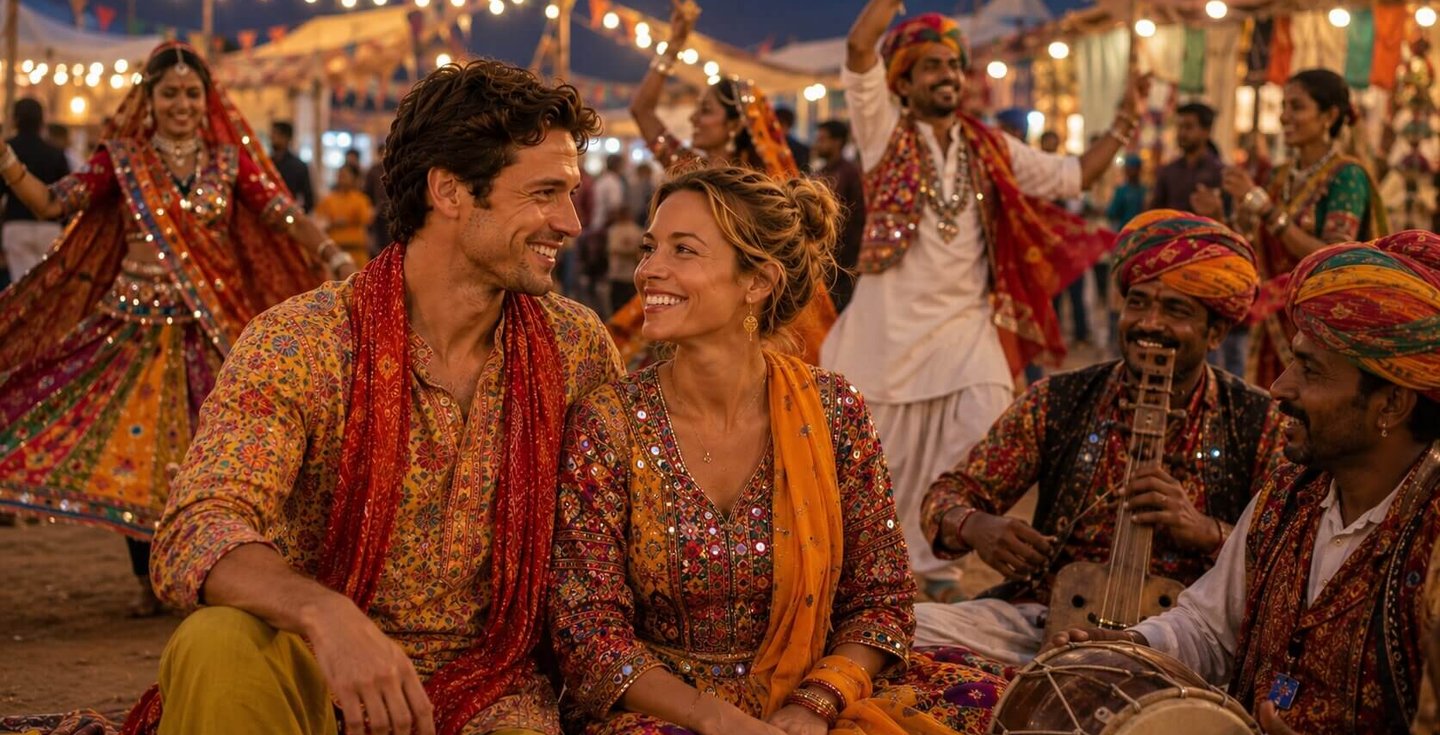
Every year in November, in the days surrounding the full moon of the Hindu month of Kartik, something extraordinary happens in the small desert town of Pushkar in Rajasthan. From across the Thar Desert from villages so remote that the journey takes days, thousands of camel traders, horse dealers, livestock merchants, folk artists, pilgrims, holy men, acrobats, musicians, and storytellers converge on the flat sandy plain outside the town. They come with their animals, tens of thousands of camels decorated with embroidered saddlecloths and brass bells and coloured tassels, their long legs folding elegantly beneath them as they settle into the sand. They come with their families, their traditions, their instruments, and their crafts. They come, as their fathers and grandfathers came before them, because the Pushkar Fair is not merely a commercial event, it is a gathering of a whole cultural world, an annual reunion of the desert communities of Rajasthan that has been happening in this same place for centuries.
The result, for the traveller fortunate enough to witness it, is one of the most visually, culturally, and emotionally overwhelming experiences available anywhere in the world. The scale of it, the sheer number of animals and people and colours and sounds filling the sandy plains in every direction is genuinely difficult to process on first encounter. And then, gradually, the specific details emerge from the general spectacle: the camel trader from the Thar desert negotiating the price of an animal in a language of gestures and expressions that has its own ancient grammar. The Rajasthani folk musicians playing dholak and sarangi by firelight as the desert night closes in. The women of the Rabari community, in their brilliant embroidered costumes and heavy silver jewellery, moving through the fair with the unhurried grace of people entirely at home in a world that the rest of us can only visit. The holy men at the ghats of Pushkar Lake performing their sunrise rituals as the camels stir and the desert turns gold.
The Pushkar Fair Special Tour brings you to all of this, combining the festival with the monuments that define Rajasthan's heritage reputation: the Taj Mahal in Agra, the abandoned Mughal capital at Fatehpur Sikri, and the royal splendour of Jaipur's forts and palaces. Eight days, seven nights, private AC transport throughout, and uniquely, two full days at the fair rather than the rushed single-day visit that most itineraries offer, because Pushkar rewards time and patience in ways that cannot be hurried.
This is Rajasthan at its most complete: the marble perfection of the Taj, the royal confidence of Jaipur, and the ancient, dusty, magnificent democracy of the desert fair.
Day by Day Itinerary
Day 1: Arrival in Delhi - Welcome & First Evening
At Indira Gandhi International Airport, our private representative will be waiting - your name on a board, a warm welcome, and a private, air-conditioned SUV to carry you to your hotel in comfort. The journey from the airport into central Delhi is already a first encounter with India's scale and energy the elevated expressways, the Mughal domes visible above the treeline, the extraordinary density of a city of thirty million going about its evening business with absolute, self-assured normalcy.
Check in, rest, and refresh. The evening is gentle and optional:
India Gate - The great sandstone war memorial at the heart of New Delhi, lit beautifully after dark, is an ideal first image of India, grand, accessible, and genuinely moving in its simplicity.
Rashtrapati Bhavan (Drive Past) - The vast domed Presidential Palace seen from Rajpath in the evening light, one of the great formal vistas of any world capital.
Connaught Place & Janpath Market - The Georgian colonnaded commercial centre of New Delhi offers an excellent first evening browse, craft stalls at Janpath, good restaurants throughout Connaught Place, and the particular energy of Delhi at its most confident and accessible.
An early night is wise. Tomorrow, the road to the Taj begins.
Day 2: Delhi → Agra - The Taj Mahal & the Monument That Changes Everything
After breakfast, we drive south to Agra, approximately 200 kilometres on the smooth Yamuna Expressway, three to four comfortable hours arriving in time for the monument.
The Taj Mahal - Seventeen thousand words have been written about the Taj Mahal for every one that is actually necessary, which is none because the Taj Mahal is not a building that benefits from description. It is a building that benefits from presence. What photographs cannot convey and what words cannot capture is the specific emotional quality of standing before it: the way the proportions resolve themselves into something that seems to exist outside the normal rules of architecture, the way the white Makrana marble changes colour through the day from cream to brilliant white to gold, the way the reflection in the long pool doubles the monument and the sky simultaneously into something that seems to have no edges.
Built by Emperor Shah Jahan between 1632 and 1653 as a mausoleum for his beloved wife Mumtaz Mahal, who died in childbirth bearing their fourteenth child, the Taj is a monument to grief made magnificent. Twenty thousand workers from across Asia laboured for over two decades to produce it. It has been drawing the world to India ever since. Standing before it, you understand immediately why.
Agra Fort - A short drive from the Taj, the great UNESCO-listed red sandstone citadel of the Mughal Emperors contains within its walls a sequence of palaces built by Akbar, Jahangir, and Shah Jahan each in their distinct architectural language, together forming one of the finest concentrations of Mughal heritage in India. The Musamman Burj, the octagonal tower where Shah Jahan spent his final years imprisoned by his son Aurangzeb, with a distant view of the Taj Mahal he built for the woman he loved, gives the whole story of this city its heart breaking final chapter.
Evening in Agra is excellent for the famous marble inlay craft shops, the local tradition of pietra dura work, using the same technique as the Taj's decorative panels, produces pieces of genuine beauty at a wide range of price points.
Day 3: Agra → Jaipur via Fatehpur Sikri - Mughal Ghost City & the Pink City
After breakfast, we drive west toward Jaipur but the route pauses at one of the most extraordinary detours in India.
Fatehpur Sikri - Emperor Akbar's complete, perfectly preserved, and entirely abandoned Mughal capital stands on its sandstone ridge exactly as it was left over four centuries ago, an entire imperial city of extraordinary architectural ambition, deserted fourteen years after its completion and frozen in time since. The Buland Darwaza, the largest gateway in the world at 54 metres, built to commemorate Akbar's conquest of Gujarat, rises above the Jama Masjid with an authority that immediately communicates why this man ruled the largest empire of his age. Within the complex, the Panch Mahal five-storey pavilion, the Diwan-i-Khas audience hall with its extraordinary central pillar, and the royal residential quarters reveal an architectural vision of remarkable sophistication. The atmosphere of a great city standing complete and empty, its stones warm in the sun, its courtyards echoing is haunting and beautiful in equal measure.
Continue west into Rajasthan, the landscape changing as you cross the state border, the flat plains giving way to the rocky, scrubby, vividly coloured terrain of the Aravalli Hills, the roadside increasingly decorated with the ochres and terracottas and bright pinks of Rajasthani architecture.
Jaipur appears in the early evening, the Pink City, its old city walls the warm rose colour of the sandstone from which they are built, its bazaars alive with the particular energy of a Rajasthani market town that has been doing enthusiastic business for three centuries. Check in to your hotel and explore the local market at leisure. The jewellery stalls alone, Jaipur is the gemstone capital of India are worth an hour of browsing.
Day 4: Jaipur Sightseeing- Royal Forts, Palaces & the Living Heritage of Rajasthan
After breakfast, a full day in one of India's most rewarding and most photographed cities.
Amber Fort - The finest fort-palace complex in Rajasthan, climbing the hillside above Maota Lake in a sequence of royal courtyards and palatial apartments that together form one of the most complete and magnificent expressions of Rajput architectural ambition anywhere in India. The Sheesh Mahal - the Mirror Palace, its walls, ceilings, and arches entirely covered in tiny mirror mosaic set in patterns of extraordinary complexity, is one of the great decorative interiors of the world. A single candle flame, reflected and multiplied by thousands of mirrors, illuminates the entire chamber. The effect is simply, completely extraordinary.
Hawa Mahal (Palace of Winds) - The five-storey screen of 953 small latticed windows through which the royal women of the Kachwaha court could observe the street processions below without being seen built in 1799 in the form of Lord Krishna's crown, the most photographed facade in Rajasthan and the defining image of Jaipur. Morning light on the pink sandstone is the finest time to encounter it.
City Palace - The seat of the Jaipur royal family, partially still inhabited by the Maharaja's descendants is a complex of courtyards and palaces housing museums of extraordinary collections: miniature paintings of breath taking delicacy, royal costumes, weapons, historical textiles, and artifacts tracing the long and proud Kachwaha dynasty through the centuries.
Jantar Mantar - The UNESCO-listed stone astronomical observatory built in 1734 by Maharaja Jai Singh II, a collection of nineteen monumental instruments of remarkable precision, designed to measure celestial time and movement with an accuracy that still impresses astronomers today. Genuinely fascinating for any traveller with interest in science, architecture, or the history of human curiosity about the sky.
Evening in Jaipur's famous bazaars, the Johari Bazaar for the gemstones and jewellery that have made this city a world centre of gem trading, the Bapu Bazaar for Rajasthani textiles, the Nehru Bazaar for leatherwork and craft. Jaipur shopping is both a pleasure and an investment in objects of genuine quality.
Day 5: Jaipur → Pushkar — The Desert Town & the Fair Begins
After breakfast, we drive west from Jaipur to Pushkar, approximately 145 kilometres, two and a half to three hours through the Aravalli Hills, the road dropping eventually into the broad sandy plain that surrounds Pushkar and its sacred lake.
Pushkar is one of India's most ancient and most sacred towns, a place of pilgrimage for Hindus for thousands of years, built around the shores of Pushkar Lake, a body of water believed to have appeared where the petals of Lord Brahma's lotus flower fell to Earth. The Brahma Temple here - one of the very few temples in India dedicated to Brahma the Creator has been drawing pilgrims from across the subcontinent for centuries. The 52 ghats surrounding the lake, the hundreds of temples, the narrow bazaar lanes spilling with marigold garlands and silver jewellery and sacred objects, Pushkar on any ordinary day is a town of considerable spiritual beauty and character.
During the days of the fair, it is something else entirely.
Even on the afternoon of Day 5, before your full fair days begin, the evidence of what is happening on the plains outside the town is unmissable: the camel trains moving along the roads toward the fairground, their bells audible from a considerable distance; the traders from the desert villages setting up their stalls in the bazaars with the practised efficiency of people who have done this same thing every November for decades; the smell of woodsmoke and camel and desert dust that is the specific, irreplaceable scent of the Pushkar Fair.
Check in to your luxury tent accommodation, a highlight of Package 21 in its own right. The tented camps at Pushkar Fair are not roughing it in any sense of the word. These are beautifully appointed canvas structures with proper beds, attached bathrooms, heating for the cool November nights, and dining arrangements that serve the full range of Rajasthani cuisine. Staying in the tented city that grows up around the fairground during the fair period, waking to the sound of camel bells and the smell of morning chai being brewed over fires, is one of the most atmospheric accommodation experiences available anywhere in India.
Note: All meals at Pushkar Fair Ground, breakfast, lunch, and dinner are included in Package 21. You will eat well.
The evening walk around Pushkar Lake at sunset, the ghats lit by oil lamps, the priests conducting their evening rituals at the water's edge, the fair sounds audible from the plains beyond the town, is the perfect gentle introduction to what tomorrow will deliver in full.
Day 6: Pushkar Fair - Full Day in the World's Greatest Camel Fair
After breakfast at the camp, the day is yours and the fair is vast enough, rich enough, and surprising enough that a full day within it barely touches the surface of what it contains.
The Camel Fair Grounds - The fairground itself occupies an enormous sandy plain to the northeast of the town, and the first sight of it from the approach road, the thousands of camels spread across the sand in every direction, the coloured tents and stalls and crowds filling the spaces between, the general organised chaos of a market that has been operating on this same ground for centuries, is one of those genuinely jaw-dropping travel moments that no amount of prior knowledge quite prepares you for.
The camels themselves are magnificent and deserve close attention. These are working animals of the Thar Desert, bred and traded by communities whose entire economy and cultural identity is built around them, and their owners take enormous pride in their condition and their decoration. The finest animals arrive adorned with embroidered saddlecloths in vivid colours, their necks painted with geometric patterns, their bridles hung with brass bells and coloured tassels, their owners sitting beside them with the composed dignity of people who know the value of what they have brought to sell. The trading is conducted in a language of negotiation, gestures, whispered numbers, the studied indifference that is the universal grammar of serious commerce, that is fascinating to observe even without understanding a word of it.
Folk Performances & Cultural Events - Throughout the fair, the cultural programme runs continuously across multiple performance areas. Kalbelia dancers, women of the snake-charmer community of Rajasthan, their black skirts spinning in wide circles as they move, their movements incorporating the sinuous, fluid gestures of the serpent tradition they carry, perform to the sound of the pungi flute with a grace and energy that has earned the Kalbelia dance a UNESCO Intangible Cultural Heritage designation. Puppet shows in the Kathputli tradition, with their vividly painted marionettes enacting stories of Rajput heroism and romance. Camel races and camel beauty contests, the latter judged on the elaborateness of the animal's decoration, the smoothness of its grooming, and the pride of its bearing that are simultaneously sporting events and cultural celebrations of the camel's central place in Thar Desert life.
The Fair Bazaars - The market stalls that surround the fairground and line the lanes of Pushkar town during the fair period constitute one of the finest craft markets in Rajasthan, which is saying a very great deal. Here, gathered from across the desert region, are:
The silver jewellery of the Rajasthani tribal tradition, heavy, bold, geometric pieces in the styles of the Rabari and Gurjar communities, worn as investment as much as adornment. The embroidered textiles of the Thar Desert, the distinctive mirror-work and chain-stitch embroidery of western Rajasthan, covering everything from small pouches to large wall hangings in patterns of extraordinary intricacy. The block-printed fabrics of the Rajasthani printing tradition, the Bagru and Sanganer styles, their geometric and floral patterns in natural dyes of remarkable depth and beauty. Leather goods, camel leather bags, belts, and sandals worked in the Jodhpuri tradition. Brasswork, lacquerwork, and the miniature paintings of the Rajasthani school, tiny masterworks in the Mughal-derived tradition, painted on silk or ivory with brushes of a single hair.
Budget generously for time and money in the fair bazaars. What you carry home from Pushkar will not be souvenirs, they will be objects of genuine craft, made by skilled hands from living traditions.
Pushkar Lake at Evening - As the light fades over the fair and the evening aarti begins at the lake ghats, a walk back through the town to the lakeside delivers a complete change of register, from the energetic commerce and spectacle of the fairground to the quiet devotion of the temple town. The lake at dusk, the priests chanting, the oil lamps floating on the water, the surrounding hills darkening above, it is a reminder that Pushkar is, beneath its festival identity, a place of genuine and ancient spiritual significance.
Dinner at the camp - a full Rajasthani meal served under canvas as the desert night closes in, cool and star-filled, the sounds of the fair drifting across from the plain.
Day 7: Pushkar Fair - Second Full Day & the Deeper Pleasures of the Festival
The second full day at Pushkar is, in the experience of our travellers, consistently the better one.
On Day 6, the fair overwhelms. The scale, the colour, the noise, the sheer quantity of things happening simultaneously, it is a lot to absorb. By Day 7, the eye has calibrated. The ear has learned to distinguish the specific sounds worth following. The sense of direction within the fairground is more confident. And the result is an experience that is considerably more intimate, more observational, and more deeply satisfying than the first day's exhilarating but slightly bewildering immersion.
Photography at the Fair - Pushkar Fair is a photographer's dream at every hour of the day, and each hour has its own specific quality. Sunrise at the camel grounds, when the early light is horizontal and golden and the camels are still settling for the morning and the traders are brewing their first chai, is the most atmospheric and most rewarding time for photography of the animals and the people who bring them. Midday brings the energy of active trading and the cultural performances at their most intense. Late afternoon, as the light turns amber and the shadows lengthen across the sand, produces images of extraordinary beauty, the camel silhouettes against the evening sky, the embroidered colours of the craft stalls glowing in the low light, the faces of the desert traders caught in the specific quality of Rajasthani late-afternoon sun.
Final Shopping & Unhurried Exploration - The second day in the fair bazaars is for going back to the stall you walked past yesterday and now know you should have stopped at. For the longer conversation with the silver jeweller whose work you admired. For the Kalbelia dancer whose performance yesterday you want to watch again, more slowly, from a better position. The unhurried pace of the second day is one of the specific reasons we build it into this itinerary because Pushkar is the kind of place that gives more the longer you stay.
Final Evening at Pushkar Lake - The last evening in Pushkar should be spent at the lake. The full moon of Hindu month - Kartik, around which the fair calendar is organised, illuminates the white temple spires and the still water of the lake with a light that is specific and beautiful and entirely appropriate to a place that has been a destination of pilgrimage for three thousand years. This is Pushkar at its most quietly, completely itself.
Day 8: Pushkar → Delhi - The Journey Home
After a final breakfast at the camp, the last meal of the full-board Pushkar experience, we pack the car and begin the drive back to Delhi. The journey is approximately 400 kilometres, five to six hours with comfortable breaks, following the road back through the Aravalli Hills and across the Rajasthan-Delhi border.
The drive gives you time, the particular kind that long road journeys produce, to let the fair settle into memory. The camel trains you followed through the fairground. The Kalbelia dancer's spinning skirt in the afternoon light. The silver bracelet you bought from a Rabari woman whose smile, when you admired her work, was one of the warmest things the journey offered. The desert night outside the tent, the stars, away from all city light, abundant and brilliant above the sandy plain.
Arrive in Delhi in the early to mid evening. Your private SUV takes you directly to Indira Gandhi International Airport as per your departure flight timing.
Your Pushkar Fair Special Tour ends at the departure gate, eight days, seven nights, and a journey that has covered the white marble perfection of the Taj Mahal, the royal splendour of Jaipur's forts, the haunting beauty of Fatehpur Sikri's abandoned streets, and the extraordinary, ancient, irreplaceable spectacle of the world's greatest camel fair in the desert town that has hosted it every November for longer than anyone can remember.
✅ Inclusions
✅ 7 Nights Accommodation - Quality 3-star / 4-star hotel properties ( as available ) in Delhi (1 night), Agra (1 night), and Jaipur (2 nights), plus luxury tent accommodation with attached bathrooms, comfortable beds, heating, and dining arrangements at the Pushkar Fair campsite (2 nights).
✅ All Meals at Pushkar Fair Ground - Breakfast, lunch, and dinner fully included during both nights at the Pushkar camp. All meals are also included on fair days.
✅ Daily Breakfast - At hotel accommodation in Delhi, Agra, and Jaipur.
✅ Private AC Car / SUV with English-Speaking Driver - Your dedicated vehicle for the complete tour. All road journeys and local sightseeing throughout.
✅ Pushkar Fair Experience Planning & Support - Our local guidance ensures you are in the right place at the right time throughout the fair, with all logistics planned for the smoothest and most rewarding festival experience.
✅ All Sightseeing as per Itinerary - Every monument, heritage site, and festival location mentioned is built into your plan.
✅ All Tolls, Parking, Monument Entry Fees, Driver Allowances - No hidden road costs.
❌ Exclusions
❌ International flights and airfare ❌ Personal expenses and tips ❌ Travel insurance and visa charges ❌ Lunch and dinner outside Pushkar (in Delhi, Agra, and Jaipur)
Best Time - Festival Dates & Booking
The Pushkar Fair takes place in November, in the days surrounding the full moon of the Hindu month of Kartik. The exact dates vary each year according to the Hindu lunar calendar and are confirmed at the time of booking.
The fair typically runs for five days around the full moon, with the camel trading most intense in the first three days and the cultural and religious programme most prominent in the final two. Two full days at the fair, as Package 21 provides, is the correct amount of time to experience both dimensions properly.
Book well in advance. Pushkar Fair tent accommodation at quality campsites fills months ahead of the festival. We strongly recommend securing your booking as early as possible, the finest camps are in very limited supply during the fair period.
Frequently Asked Questions
Q: Is the Pushkar Fair suitable for first-time visitors to India? It is one of the finest possible introductions to the depth and richness of Indian cultural life, and the combination with the Taj Mahal and Jaipur makes it one of the most complete first-time itineraries available. The private transport, quality accommodation, and local support provided throughout mean that first-time visitors navigate the fair confidently and comfortably.
Q: Is the tent accommodation genuinely comfortable? The luxury tents at Pushkar's premium campsites are considerably more comfortable than the word "tent" might suggest, proper beds, attached bathrooms with hot water, electric heating for the cool November nights, and full dining service. This is glamping in the truest and most genuine sense: the experience of sleeping close to the desert environment with none of the hardship. Most of our guests describe the tent stay as one of the most memorable accommodation experiences of the entire tour.
Q: Is Pushkar Fair safe for international tourists? Yes, the Pushkar Fair is one of India's most internationally visited festivals, and the town and fairground during the fair period are well accustomed to foreign visitors. With private transport, guided support, and the local knowledge that UK India Tourism provides, international travellers navigate the fair comfortably and safely. Standard sensible precautions, keeping valuables secure, staying with your guide in the busiest areas, apply as they do anywhere.
Q: Can we add Jodhpur or Udaipur as an extension? Yes, both are natural extensions from Pushkar. Jodhpur, the Blue City, is approximately 150 kilometres west of Pushkar and can be added as an excellent two-night extension before or after the fair. Udaipur, the lake city, is approximately 270 kilometres south. Both require additional days and revised pricing, which we will provide on request.
Q: Can we upgrade to luxury 5-star hotel accommodation in Delhi, Agra, and Jaipur? Yes, luxury upgrades are available at all three cities. Revised pricing is shared in advance of booking.
Why Book This with UK India Tourism?
The Pushkar Fair is one of the world's great cultural events and it is also one of the events most likely to be experienced badly without the right planning. The tent accommodation that sounds atmospheric in a brochure but delivers something cold and uncomfortable without hot water. The single rushed day at the fair that skims the surface without reaching what lies beneath. The tiring road journey that eats into the time that should be spent at the fairground.
Package 21 is built to avoid every one of these pitfalls. The luxury tent accommodation is selected and inspected. The two full days at the fair are the single most important design decision in the entire itinerary. The routing through Agra and Jaipur gives the festival experience the heritage context that makes it part of a complete Rajasthan story rather than an isolated spectacle. The full-board meals at the camp mean that food is never a logistical concern during the fair days, you eat well, you rest well, and your full attention is available for the extraordinary thing happening around you.
✅ Two full days at the fair - the correct approach ✅ Luxury tent accommodation - comfort without compromise ✅ Full meals included at Pushkar - no logistical concerns ✅ Private transport throughout, your schedule, your pace ✅ Taj Mahal + Jaipur + Pushkar - the complete Rajasthan story.

Step into a living postcard of India - where camels, culture, and celebration come alive in your Pushkar Fair journey.
UK India Tourism
UK : +44 7345 191205
India: +91 9958 480873
Email: sales@ukindiatourism.co.uk
Travel Specialists for UK, USA, Canada, Australia, France, Poland, Singapore, Japan & Beyond
UK: +44 7345191205
UK India Tourism© 2026, all rights reserved
India: +91 9958480873
⭐⭐⭐⭐⭐ 4.9/5 | 2,600+ Travelers | 18 Years | 98% Recommend