
Package 10: White Rann of Kutch Desert Festival Tour
Route: ( Ahmedabad – Bhuj – White Rann (Dhordo) – Craft Villages – Bhuj – Ahmedabad)
Duration: 6 Days / 5 Nights
Price: Request For Price(Rates based on twin sharing accommodation)
Private AC Tour | Best Season: November to February
Best for: Culture lovers, festival travellers, photographers, couples, families, International tourists, offbeat India explorers, craft & shopping lovers
There are moments in travel that resist being put into words. Moments that photographs can gesture toward but never quite capture. Moments that, when you try to describe them to someone who wasn't there, trail off into silence, because no sentence is wide enough to hold them.
Standing on the White Rann of Kutch at full moon is one of those moments.
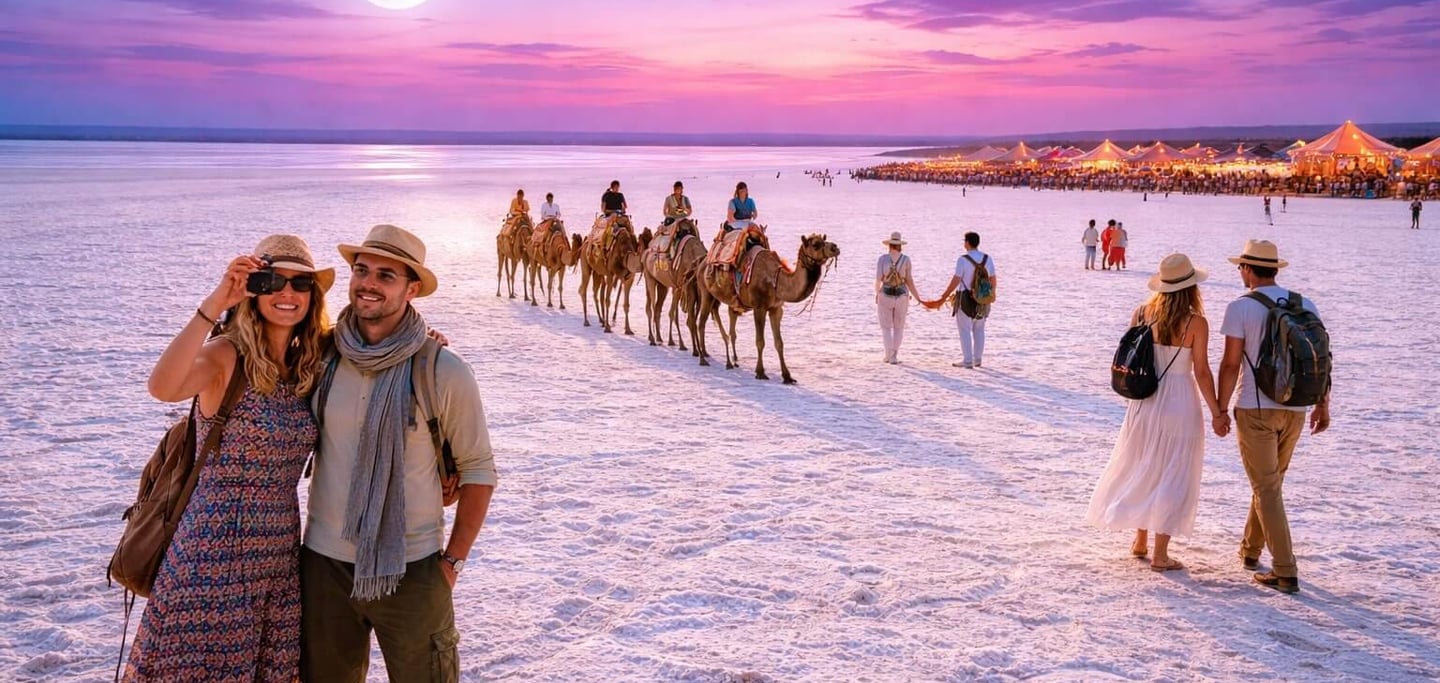
Imagine a desert that isn't sand - it's salt. Pure, crystalline, ancient salt, compressed into a crust that stretches in every direction to the very edge of the sky, twenty-seven thousand square kilometres of it, flat as a mirror, white as fresh snow. Now imagine standing at the centre of it as the sun goes down. The white turns gold. Then amber. Then rose. Then the deepest, most improbable violet. And then the moon rises — and the whole desert begins to glow. Silver. Luminous. Otherworldly. As if the ground itself has become a second sky.
Now add music. The resonant, chest-deep thrum of a dholak drum. The piercing sweetness of a shehnai. The jingle of ankle bells as Kutchi folk dancers move through firelight in costumes of embroidered mirror-work that catch and scatter the light like a thousand tiny suns. Add the smell of wood smoke and Kutchi dal, the warmth of a clay cup of masala chai in your hands, the laughter of your fellow travellers gathered under a canvas sky.
This is the Rann Utsav - Gujarat's most extraordinary cultural festival and it transforms an already magical landscape into something that feels genuinely, completely unlike anywhere else on Earth.
The White Rann of Kutch Desert Festival Tour is our most immersive, most atmospheric and most emotionally resonant short journey. In just six days and five nights, it delivers an experience so concentrated, so richly layered, and so unlike anything available in mainstream tourism that travellers routinely describe it as the highlight of their entire India journey, even if they have been to the Taj Mahal, even if they have seen the ghats of Varanasi, even if they have ridden elephants in Jaipur.
The Rann does something to people. It opens them up. It quiets the noise. It makes the world feel simultaneously very small, just you and the white horizon and absolutely vast. This is the tour that brings you there. Beautifully, unhurriedly, completely.
Day-by-Day Itinerary - Six Days in the Landscape of Elsewhere
Day 1: Arrival in Ahmedabad - First Evening in India's Most Welcoming Heritage City
Your journey into the White Rann begins, as all great Gujarat journeys do, in Ahmedabad, the city that serves as both the gateway to the state and a destination of extraordinary richness in its own right.
At Ahmedabad Airport or Railway Station, our private representative will be waiting for you — calm, organised, ready to make the transition from travel to arrival as smooth as possible. You'll be transferred to your hotel in a private, air-conditioned vehicle. If you've just stepped off a long-haul flight from the UK or the United States, the comfort of that car, the cool air, the familiar sight of a city coming to life around you, it all signals the same simple, important thing: you've arrived, and you're in good hands. Depending on your arrival time, we have a gentle, pressure-free first evening planned:
Sabarmati Riverfront Walk - Ahmedabad's beloved riverside promenade is one of the great evening walks of India. As the sun lowers over the Sabarmati River and the heat of the day softens into something warm and golden, locals emerge in their hundreds — families, couples, children chasing the last light. The smell of street food drifts from nearby stalls. The water catches the city lights. This is India at its most liveable, and it is a perfect, uncomplicated way to let the journey begin.
Local Market Browsing - If you have the energy and the curiosity, a short wander through the streets near your hotel will reward you immediately. Ahmedabad's commercial lanes are alive with colour and commerce, snacks being fried, chai being poured, fabrics being folded, the small persistent pleasures of a city that has been doing business on its streets for six hundred years.
Optional Gujarati Dinner Experience - This is our strongest recommendation for your first evening. Gujarat is famous, across India and increasingly around the world, for the extraordinary richness and variety of its vegetarian cuisine, and Ahmedabad is its finest expression. A traditional Gujarati thali that magnificent circular platter of a dozen or more small dishes, from sweet kadhi to spiced vegetables, from warm rotis to cooling yogurt, from tamarind chutneys to saffron-kissed rice is not merely a meal. It is an introduction to a culture's entire way of relating to food: generous, celebratory, endlessly varied, and deeply delicious. This dinner, on your first night, sets the tone for everything that follows.
Rest well. Tomorrow, the road west begins.
Day 2: Ahmedabad → Bhuj - Crossing into the Kingdom of Kutch
After a good breakfast at your hotel, we load the car and set out westward toward Bhuj, the district capital of Kutch and the gateway through which every White Rann journey must pass.
The drive to Bhuj takes approximately five to six hours, and it is a journey worth paying attention to. You cross the flat agricultural plains of central Gujarat - cotton fields and groundnut farms, small town bazaars, temple gopurams rising above the tree line, the occasional peacock on a roadside fence (India's national bird is surprisingly common on Gujarat's rural roads). As you travel further west, the landscape gradually opens up. The sky grows larger. The horizon extends. The colours shift subtly - less green, more ochre, the earth taking on the particular quality of land that lives close to the desert.
The crossing into Kutch is a geographical and atmospheric threshold. Kutch, which literally means "something which intermittently becomes wet and dry" in Sanskrit, a reference to the region's seasonal flooding and drying, is not merely a district. It is a world. Geographically isolated by the Rann to the north and the Gulf of Kutch to the south, it developed over centuries as its own distinct cultural universe, with its own languages and dialects, its own music traditions, its own extraordinary craft heritage, its own architecture and its own identity, fierce and proud and warmly welcoming to those who come with genuine curiosity.
Bhuj itself is a city of remarkable character. The 2001 earthquake that devastated the region, one of the worst in India's recorded history, killing over 20,000 people and destroying vast swathes of the historic city, might have erased Bhuj. Instead, the city rebuilt with astonishing resilience, and much of what was damaged has been carefully, lovingly restored. The Aina Mahal, the Prag Mahal, the old city bazaars, they stand again, and they tell a story not only of history and heritage but of a community that refused to let its past be buried.
Arrive in Bhuj in the early evening. Check in to your hotel. The evening is yours, intentionally relaxed, intentionally gentle. A walk through the old bazaar, a local Kutchi dinner, perhaps the first sighting of Kutchi craft, the embroidered textiles and mirrored fabrics that spill out of the market stalls here like the contents of a very beautiful dream.
Tomorrow, the desert begins.
Day 3: Bhuj → White Rann (Dhordo) - Enter the Festival Wonderland
This is the day everything changes.
After breakfast, we drive north from Bhuj toward Dhordo, the small village on the edge of the Great Rann of Kutch that serves as the heart of the Rann Utsav festival experience. The drive takes roughly an hour and a half, and it is itself a kind of preparation, as if the landscape knows what you're approaching and wants to give you time to adjust.
The road narrows. The villages become smaller and further apart. The vegetation thins. The sky becomes enormous, a wide, clear blue vault that seems to stretch further than normal sky should. And then the ground begins to change. The soil lightens. You pass through a checkpoint. And suddenly, the familiar brown earth of India gives way to something startling, something that takes a moment to process: the earth is white. Not pale. Not grey. White. Pure, crystalline, mineral white, spreading before you in every direction like a landscape from a planet where different rules apply.
You have arrived at the White Rann of Kutch.
Check in to your accommodation near the festival grounds, during Rann Utsav season, this means the extraordinary experience of the Tent City (Shaam-e-Sarhad), a purpose-built cultural resort of beautifully appointed tents and cottages on the edge of the desert, where the design itself echoes the craft and colour of Kutch. This is not camping in any rough sense of the word - the Tent City is a remarkable feat of hospitality, combining the immersive experience of sleeping close to the desert with genuine comfort, cultural programming, and food that celebrates the finest traditions of Kutchi cuisine.
Note: Accommodation near the White Rann varies by season and availability. During Rann Utsav (approximately November to February), tent city and cultural stay options are available. Outside festival season, well-appointed resort accommodation is arranged.
The afternoon begins gently, because the Rann rewards patience, and there is time for everything. Let the festival come to you:
Folk Dance & Cultural Performances - The cultural stage at Rann Utsav is one of the most extraordinary things happening in Indian festival tourism. Artists from across Kutch and Gujarat and sometimes from across Rajasthan and beyond, gather here to perform. The Garba dancers move in concentric circles, their skirts spinning into geometry. The Bhavai performers balance clay pots on their heads while dancing on the edges of glass-covered swords. The Dhamaal drummers of Kutch beat out rhythms that seem to vibrate in your chest. The Langa and Manganiyar musicians from the Thar tradition sing desert songs of extraordinary emotional depth. Each evening's programme is different. Each is unforgettable.
Craft Bazaars - The festival bazaar at Dhordo is one of the finest craft markets in India, and we mean this without qualification. Here, gathered under canvas stalls lit by warm lanterns against the evening sky, you will find:
Kutch embroidery - the region's most iconic art form, featuring densely worked geometric and floral patterns in silk thread on cotton and silk fabrics, often studded with tiny mirrors. Different communities within Kutch - Rabari, Ahir, Mutwa, Sodha, each have their own distinct embroidery style, and all are represented here.
Ajrakh block-printed textiles - deep indigo and madder-red fabrics printed with resist-printing techniques that are hundreds of years old, carried in the traditions of the Khatri community of Kutchi master printers.
Rogan painted cloth - the rarest craft you are likely to encounter anywhere in India, practised today by a single family in the village of Nirona. Rogan involves painting on fabric using a stylus and castor-oil-based paint, creating designs of such symmetrical complexity that they seem mechanically produced and yet every line is drawn by a human hand.
Bandhani tie-dye fabrics - vibrant, joyful textiles dyed using a technique of tying thousands of tiny points of fabric before dyeing, creating patterns of dots and diamonds that explode with colour.
Pottery, lacquerwork, copperwork, leathercraft - the full spectrum of Kutchi artisanal tradition.
We recommend budgeting both time and money generously at the festival bazaar. What you bring home from here will not be souvenirs, they will be objects of genuine art, made by skilled hands, carrying a tradition that deserves to be both supported and celebrated.
Local Kutchi & Gujarati Food - The food at Rann Utsav is an experience in itself. Kutchi cuisine shares the broad outlines of Gujarati cooking, predominantly vegetarian, sweet-salty-spicy in balance but adds its own desert character: heavier on lentils and dried vegetables, richer in ghee, featuring dishes that speak of communities who learned to cook magnificently with what the land gave them. Try the Kutchi dabeli (a spiced potato sandwich that originated in Kutch and has become beloved across Gujarat), the khichdi with kadhi, the sev tameta nu shaak, and the fresh bajra rotis served hot from a clay griddle.
Sunset at the White Rann - This is the centrepiece of Day 3, and nothing we write here can fully prepare you for it.
You drive or walk to the edge of the Rann as the sun begins to lower. And then you wait. The light moves through the sky. The white salt desert below begins to change colour in response. First gold: a warm, honeyed gold that makes the entire landscape look as if it has been dusted with precious metal. Then amber: deeper, richer, the colour of old whisky in firelight. Then rose: the most extraordinary pink, as the sky's reflection pools in the shallow mineral surfaces of the salt. Then, as the sun drops below the horizon, the whole desert moves through violet into a soft, luminous grey and the first stars appear above it.
People stand at the Rann at sunset and they do not speak. There is nothing to say that the light isn't already saying better.
Day 4: A Full Day at the Rann - Sunrise, Desert Life, Festival & Moonlight
Set your alarm for before dawn. This is one of the most important pieces of advice we can give you, and it is entirely worth following.
White Rann at Sunrise - The experience of watching the sun rise over the White Rann is, for many travellers, the single most powerful natural moment of their India journey. In the hour before dawn, the desert is still and dark and absolutely silent. The stars overhead, away from all city light, the Rann offers a sky of extraordinary clarity are beginning to fade. The horizon to the east lightens almost imperceptibly at first, then with increasing urgency, moving from grey to pearl to the first pale gold. And then the sun clears the edge of the Earth, and the entire white desert ignites.
The salt crystals catch the oblique light of early morning and scatter it in every direction. The Rann glows. It is as if the ground itself is generating light rather than merely reflecting it. Photographers who have shot deserts across the world - Sahara, Atacama, Namib, speak of the quality of light on the Rann at sunrise as genuinely unique: softer than the hard-edged desert light of Africa and South America, more diffuse, more dreamlike, as if the salt is translating the sunlight into something gentler.
Bring your camera. Bring someone you love. Bring silence.
After breakfast, the day unfolds at whatever pace feels right to you. The Rann Utsav is designed to be experienced slowly — there is no schedule to follow, no box to tick, no queue to join. It is, refreshingly, a festival that trusts its visitors to find their own way through it.
Salt Desert Photography & Exploration - The Rann by day is a photographer's dream in every light and from every angle. The flatness creates extraordinary perspectives, small figures against infinite white horizons, the perfect symmetry of salt patterns underfoot, the way distant objects seem to float above the ground in the heat haze. If you photograph, you will not stop.
Craft Shopping & Artisan Stalls - Return to the bazaar by day and the experience is different, more intimate, more conversational. The artisans have time to talk. Ask them about their craft, their family, their village. A Rabari embroidery artist will show you the significance of the geometric patterns her community uses different patterns for different life occasions, different colour combinations for different castes and communities. A block-printer will let you watch the precision of the stamping process, the careful alignment, the layering of colours that builds an Ajrakh design from blank white cloth to deep, complex pattern. These conversations are not performances, they are genuine exchanges between skilled people proud of their work and curious visitors who have come far to appreciate it.
More Folk Shows & Cultural Experiences - The daytime cultural programme at Rann Utsav is as rich as the evening offerings: camel rides across the edge of the desert, puppet shows in the Kathputli tradition, folk music sessions where the musicians sit in small groups and play for anyone who wants to listen, craft demonstrations where artisans work live and explain their techniques.
Evening Moonlight Visit to the Rann (if open & weather permits) - On nights when the moon is full or near-full and the festival timing is often deliberately aligned with the lunar calendar, the White Rann becomes something that has no equivalent anywhere else in the world. The moonlight strikes the salt desert and the salt desert does not merely reflect it, it seems to absorb it and re-radiate it, glowing from within with a blue-silver luminosity that is impossible to describe as anything other than magical.
Walking onto the Rann under a full moon, the world becomes binary: above you, a sky of deepest blue scattered with stars; below you, a ground of the same deep blue, glowing silver. The horizon disappears. You are suspended between two versions of sky. The silence is complete.
This is why people come back to the Rann. This is the moment that becomes a permanent part of the traveller who witnesses it.
Day 5: Craft Villages & Bhuj - The Real Kutch Beyond the Festival
After breakfast, we leave the Rann and make our way back toward Bhuj but today is not a travel day. Today is the day we peel back the festival surface and show you the authentic, working, living Kutch that exists year-round, in the villages and workshops and market lanes that the postcards don't always reach.
This is, for many of our travellers, the day that surprises them most.
Kutchi Craft Villages - The area surrounding Bhuj is home to a constellation of artisan villages, each specialising in a different craft tradition, each a living museum of technique and heritage that has been passed from generation to generation for centuries. Depending on your time and interests, we will take you to some of the following:
Ajrakhpur - This village, founded specifically to resettle the master Ajrakh printers of Dhamadka after that village was destroyed in the 2001 earthquake, is now one of the most important textile heritage sites in India. The Khatri family of master printers, led by the legendary Ismail Mohammed Khatri, a National Award winner whose work is displayed in institutions from the V&A in London to the Crafts Museum in Delhi, practises here the ancient tradition of Ajrakh printing. The process is extraordinary: natural dyes made from indigo, madder, pomegranate rind, and turmeric are applied over multiple stages of printing and washing, with each layer of colour building on the last over a process that takes several weeks. The result is fabric of extraordinary depth and beauty that feels as relevant to contemporary design as it does to ancient tradition. You will want to buy. Buy generously, every purchase supports a living art form of genuine world significance.
Bhujodi - Just a few kilometres from Bhuj, this weaving village is one of the most remarkable craft communities in India. The Vankar community, traditional weavers, produce here the famous Kutchi shawl, woven in heavy wool and cotton with geometric patterns that have been standardised through generations of practice into a visual language as distinct and codified as a written script. Walk the lanes of Bhujodi and you will hear looms everywhere, the rhythmic clack and thump of weaving that has been the soundtrack of this village for centuries. The weavers welcome visitors, and the opportunity to buy directly from the maker, knowing exactly whose hands made the thing you are carrying home — is one of the most satisfying transactions in travel.
Nirona Village - This small, quiet village holds one of the rarest cultural treasures in India: the Rogan art tradition, practised by only one family in the entire world, the Khatri family of Nirona. Rogan involves creating paint from heated castor oil and natural pigments, then working it with a metal stylus onto fabric, never touching the cloth with the stylus but instead manipulating threads of the viscous paint through the air between tool and surface. The designs. typically symmetrical, intricate, and of extraordinary visual energy are built up line by line, entirely from the artist's memory and hand. There is no template. There is no mechanical aid. There is only decades of practice and an intimate, almost muscular knowledge of how the paint will behave.
To watch a Rogan artist work is to watch something so skilled it feels like witnessing a physical impossibility. To own a piece of Rogan art is to carry home something genuinely irreplaceable.
Ludiya - A village where the Rabari community, nomadic pastoralists who settled across Kutch centuries ago, practise their distinctive embroidery tradition. Rabari embroidery is immediately recognisable: dense, bold geometric forms in vivid colours, almost always incorporating chain stitch and the tiny mirrors known as shisha. Walk through Ludiya and you will find women sitting in doorways and on charpoy beds in their courtyards, embroidering with a speed and precision that makes the complexity of what they are producing seem effortless. They will invite you to sit. They will show you their work. They will be curious about you. These are among the warmest, most genuine encounters available to any traveller in India.
Bhuj Heritage - Aina Mahal & Prag Mahal - If time permits, a visit to Bhuj's two most remarkable heritage structures adds a final architectural layer to your Kutch experience. The Aina Mahal (Palace of Mirrors), built in the eighteenth century for Rao Lakhpatji of Kutch, is a study in extraordinary excess, its interior lined with Venetian glass mirrors, blue-and-white Delft-style tiles, and decorative elements that reflect the cosmopolitan cultural ambitions of a ruler who sent his master craftsman to Europe to learn glass working techniques. The Prag Mahal next door is an entirely different proposition: a Gothic-revival palace built in the 1860s, its cathedral-like facade and soaring clock tower rising above the surrounding streets with the confident improbability of a building that shouldn't exist here but unquestionably, magnificently does.
Final Shopping in Bhuj Markets - The bazaars of Bhuj's old city are the last, best place for craft shopping in Kutch. More intimate than the festival market, more varied than the individual villages, they offer the full range of Kutchi craft production at fair prices, from the large dramatic pieces, embroidered wall hangings, hand-woven dhurries, Ajrakh bedspreads to the small and beautiful: a pair of Bandhani scarves, a Rogan art bookmark, a pouch of embroidered leather. What you don't buy today, you will wish you had bought tomorrow.
Evening in Bhuj: a final dinner in the town, perhaps at one of the local restaurants that serve authentic Kutchi cuisine - simpler, earthier, and in its own way just as satisfying as the elaborate festival food of the Rann. A last cup of chai. The stars over the desert sky. Tomorrow, the journey home begins.
Day 6: Bhuj → Ahmedabad - The Long Drive Home & the Warmth of Goodbye
After breakfast on your final morning, we begin the drive east to Ahmedabad. The road back across Gujarat gives you time, five to six hours of it, to process everything that has happened in the past six days.
You will find yourself replaying moments. The white horizon at sunset. The sound of the shehnai drifting across the festival grounds. The concentration on the face of the Rogan artist. The way the moonlight turned the desert silver. The smell of indigo in the block-printing workshop. The warmth of the weaver in Bhujodi who showed you how the loom worked, who laughed when you tried to replicate the rhythm.
On arrival in Ahmedabad, depending on your flight or train schedule, we will either have a brief window for any final shopping or simply proceed directly to your airport or railway station drop-off.
You return home carrying more than you arrived with not only the embroideries and the block-printed fabrics and the tiny Rogan art piece wrapped carefully in your bag, but something harder to name and far more durable. A sense of having stood in a place of genuine wonder. A knowledge that India is larger, stranger, more beautiful, and more intricate than even its most enthusiastic advocates usually suggest.
The White Rann does that. It expands the sense of what is possible.
What's Included in Your Package
We believe travel should be transparent, so here is exactly what is covered:
✅ 5 Nights Accommodation - Carefully selected, comfortable properties across all destinations, chosen for quality, location, and hospitality. During Rann Utsav season, accommodation near the White Rann includes cultural tent stay or equivalent (subject to availability). Luxury upgrades available on request.
✅ Daily Breakfast - A proper sit-down breakfast at your accommodation every morning of the tour.
✅ Private AC Vehicle - Your own dedicated, air-conditioned vehicle with an experienced driver for the entire six-day journey. Your vehicle, your schedule, your pace. No shared transport.
✅ All Sightseeing as per Itinerary - Every destination, cultural site, craft village visit, and desert excursion mentioned in this itinerary is covered.
✅ All Tolls, Parking & Driver Allowances - No hidden road costs. Every toll, parking charge, and driver overnight allowance is included.
❌ What Is Not Included
In the interests of complete honesty:
❌ International flights / domestic flights - Airfare is not included. We are happy to advise on the best flight connections to Ahmedabad if needed.
❌ Lunch, dinner & personal expenses - Meals beyond daily breakfast are your own to enjoy. The food options at every stop, from the Rann Utsav food stalls to the local dhabas and restaurants of Bhuj, are part of the adventure, and we encourage you to explore them freely.
❌ Travel insurance - Strongly recommended for all international travellers. We can advise on suitable options.
❌ Visa charges - Indian visa costs and arrangements are the traveller's responsibility.
❌ Camera/video fees - Applicable at some heritage sites, payable directly.
Best Time to Visit
The White Rann of Kutch Desert Festival Tour is designed primarily around the Rann Utsav festival season, which typically runs from November through February, making this one of India's great winter travel experiences.
November - The festival has opened and the energy is fresh and vibrant. The weather is beautifully mild — warm by day, cool and clear by night. The desert light at this time of year is golden and generous, and the Rann has not yet reached the peak crowds of December and January.
December to January - Peak festival season. The Rann Utsav is at full cultural intensity, the weather is at its most pleasant (cool mornings, warm afternoons, cold, crystalline nights), and the full moon calendar, festivals are often timed around full moon nights, delivers the most dramatic moonlight experiences of the season. Book well in advance.
February - The final weeks of the festival season, and often the most relaxed and intimate. Crowds thin, artisan interactions become more personal, and the late-winter light has a softness and warmth that photographers particularly love.
Outside festival season (March to October), the White Rann can still be visited, though the Rann Utsav cultural programming is not operational. The desert itself is present year-round though summer months (April to June) bring extreme heat, and monsoon months (July to September) see the Rann partially flooded, which creates its own remarkable, mirror-like beauty for adventurous travellers.
Frequently Asked Questions
Q: Is the White Rann really white? Is it as spectacular as the photographs suggest? Every single photograph of the White Rann that you have seen is real and in person, it is more impressive, not less. The photographs struggle to convey the scale of it, the silence of it, the way the light changes hour by hour. Yes, it is that white. Yes, it is that vast. Yes, it is genuinely, completely extraordinary.
Q: Is this tour suitable for families with children? It is one of the best possible India experiences for families. The pace is relaxed and flexible, the festival is joyful and child-friendly, the craft villages are endlessly fascinating for curious young minds, and the Rann itself that open, white, impossible landscape, tends to produce in children a wonder that parents find deeply moving to witness. There is nothing physically demanding in this itinerary.
Q: Is this tour suitable for senior travellers? Yes, without reservation. This is one of our most comfortable and least physically demanding tours. The vehicle is private and air-conditioned. The festival grounds are largely flat and walkable. The cultural experiences require no exertion. We can adjust the pace further to suit any specific requirements, simply let us know when booking.
Q: Can we upgrade to luxury tents or better resort accommodation near the Rann? Yes - luxury upgrades are available, subject to availability and season. The Tent City at Rann Utsav offers accommodation ranging from standard to deluxe to suite-level tents, with the premium options providing very genuine comfort and style. Contact us to discuss upgrade options and associated pricing.
Q: We have already visited Ahmedabad - can we fly directly to Bhuj and start from there? Absolutely, the itinerary can be adjusted to begin and end in Bhuj, shortening the tour to 4 nights and reducing travel time. Bhuj has direct flight connections from several Indian cities. Let us know your preference and we will restructure accordingly.
Q: Is the Rann safe for walking? Is the salt surface firm underfoot? Yes, during the dry season (October to March), the salt crust of the White Rann is firm, stable, and perfectly safe to walk on. Visitors are guided to designated walking areas on the Rann, and the experience of walking directly on the salt surface, hearing it crunch slightly underfoot, feeling its faint mineral warmth, is one of the tactile pleasures of the whole journey. Wear comfortable, closed shoes.
Q: What should we pack for this tour? Beyond standard India travel essentials, we recommend: sunglasses (the Rann is extremely bright by day), a warm layer or two (nights near the desert can be cold, particularly December through January), comfortable walking shoes, and most importantly, significant camera storage and battery capacity. You will take more photographs here than anywhere else in your life.
Why Book This Journey with UK India Tourism?
The White Rann of Kutch is not a complicated destination to reach but it is a destination that is remarkably easy to experience badly. Too rushed, and you miss the sunrise. Too crowded, and the silence that defines the Rann is swallowed by noise. Poorly timed, and the moon is wrong. Wrong accommodation, and the magic of sleeping near the desert is replaced by the frustration of a property that doesn't deliver on its promise.
Getting the Rann right requires knowledge, timing, and the kind of quiet attention to detail that comes from experience.
At UK India Tourism, we have built this tour package, around every lesson we have learned from years of bringing travellers from the United Kingdom, the United States, Europe, and beyond, to this most extraordinary of Indian landscapes.
You get:
✅ Perfect timing - We know the festival calendar, the moon calendar, and the weather patterns. We plan your visit to maximise the chances of sunrise and moonlight experiences at their most spectacular.
✅ A pace designed for genuine experience - We build in two full days at the Rann because one day is never enough. Two days allows you to be present, not merely visiting.
✅ The craft village layer - Most Rann tours stop at the festival and consider their work done. We add Day 5 in the villages because we know that the living craft culture of Kutch is as important and as moving as the landscape, and because the two together, desert wonder and human artistry, create a complete picture of what makes this region so remarkable.
✅ Private comfort throughout - Your vehicle, your driver, your schedule. No shared coaches, no strangers, no compromise on the pace that suits you.
✅ The expertise that UK and USA travellers trust - We understand what international travellers need: clear communication, reliable logistics, accommodation standards that deliver, and the confidence that someone who knows what they're doing is handling the details so that you can be fully present for the moments that matter.
This is the Rann tour designed not for the maximum number of guests, but for the maximum quality of experience.
Ready to Stand on the White Desert Under the Stars?
White Rann of Kutch Desert Festival Tour is available seasonally, with Rann Utsav period bookings (November to February) recommended well in advance. Places at the festival tent city are limited, and the most sought-after accommodation sells out months ahead of peak dates.
Whether you're a photographer chasing the perfect desert light, a couple seeking an unforgettable shared experience, a family wanting to show your children something genuinely extraordinary, or a traveller who has simply always wanted to know what it feels like to stand on white salt under an Indian full moon, this journey is for you.
Contact UK India Tourism today for your personalised price quote and availability check.
The White Rann is waiting. The moon is rising over a desert that looks like no place else on Earth. The drums have started somewhere near the festival stage. The chai is hot. The stars are out.
And the only thing missing is you.
UK: +44 7345 191205
India: +91 9958 480873
Email: sales@ukindiatourism.co.uk
UK India Tourism
Travel Specialists for UK, USA, Canada, Australia, France, Poland, Singapore, Japan @ beyond
UK: +44 7345191205
UK India Tourism© 2026, all rights reserved
India: +91 9958480873
⭐⭐⭐⭐⭐ 4.9/5 | 2,600+ Travelers | 18 Years | 98% Recommend