
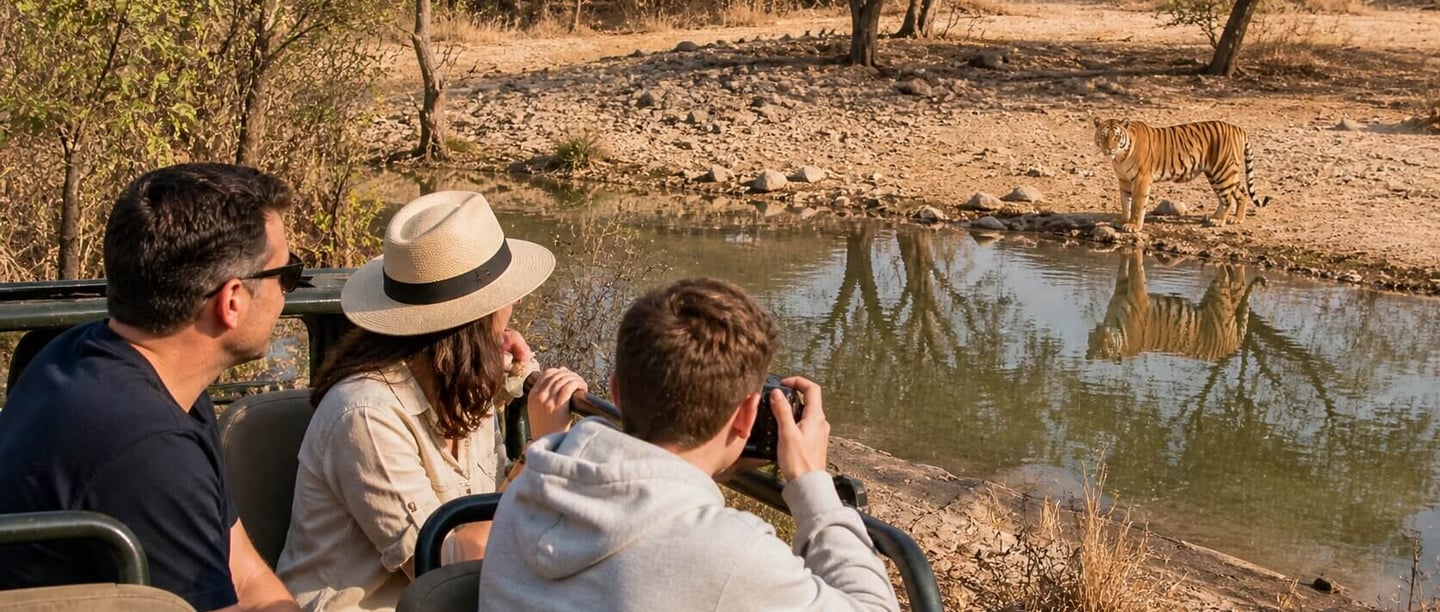
Package 7: India Wildlife Tour - Tigers & Nature (Ranthambore Tiger & Bharatpur Bird Tour) ( Delhi - Ranthambore - Bharatpur - Delhi)
Duration: 7 Days / 6 Nights
Request for Price (Rates based on twin sharing accommodation)
Best for: Wildlife lovers, tiger safari seekers, bird watchers, photographers, couples, families, UK/USA tourists, Nature-first travellers
◆ THE JOURNEY ◆
India Beyond Monuments
If your ideal India journey blends the thrill of a tiger safari with the calm beauty of wetland birdlife, this tour is crafted for you, bringing together two of India’s most iconic wildlife experiences in one seamless, deeply rewarding escape.
This is India beyond forts and monuments, though history still rises at Ranthambore Fort above the jungle. Here, mornings unfold in misty forests, evenings glow with golden skies, and every moment becomes a story worth carrying home.
Whether you're a wildlife photographer, a bird enthusiast, a couple seeking something unique, or a family wanting to share nature’s magic, this journey is designed with you in mind.
◆ DESTINATION DEEP-DIVE ◆
Ranthambore National Park
Ranthambore National Park is among India’s most celebrated tiger reserves, set across 1,300 sq km where the Aravalli and Vindhya ranges meet. Rocky ridges, dense forests, open grasslands, and quiet lakes create a dramatic, cinematic wilderness, made even more magical by ancient ruins and the towering Ranthambore Fort watching over it all.
Tigers of Ranthambore
Home to over 70 Bengal tigers, Ranthambore offers some of the best chances in the world to see tigers in the wild. The park’s open terrain and habituated big cats make sightings frequent and unforgettable. Legends like Machali, the famed “Lady of the Lakes,” have made this reserve iconic among wildlife lovers.
Beyond the Tiger
The wilderness here is rich and varied Leopards roam rocky cliffs, sloth bears forage at dusk, and marsh crocodiles bask near the lakes of Padam Talao and Raj Bagh. With over 300 bird species, from serpent eagles to paradise flycatchers, Ranthambore is as much a birding haven as it is a tiger kingdom.
◆ DESTINATION DEEP-DIVE ◆
Keoladeo National Park, Bharatpur
Keoladeo National Park, also known as the Bharatpur Bird Sanctuary, is a compact 29 sq km wetland in eastern Rajasthan and a UNESCO World Heritage Site since 1985. Once a royal duck-hunting reserve of the Maharaja of Bharatpur, it was transformed through engineered flooding into one of Asia’s richest bird habitats.
A Paradise for Bird Watchers
Over 370 bird species thrive here, especially in winter when migrants arrive from Central Asia, Siberia, and China. Painted storks dominate the skyline in nesting colonies, while herons, egrets, spoonbills, ibises, and sarus cranes animate the wetlands. The critically endangered Siberian crane, once a regular visitor, remains a symbol of ongoing conservation efforts.
More Than Just Birds
Beyond birdlife, the park offers shaded cycling trails, grasslands, and tranquil waterways. Sambar deer roam freely, pythons bask in the reeds, and otters glide through channels. At its heart stands the historic Keoladeo temple, adding a quiet spiritual charm.
Keoladeo isn’t just a sanctuary, it’s a place where nature slows time, inviting you to pause and simply watch life unfold.
◆ DAY BY DAY ◆
Your Wild Itinerary
A perfectly paced 7-day journey, never rushed, always meaningful. Private comfort travel throughout with your dedicated English-speaking representative.
DAY 1 - ARRIVAL DAY ( New Delhi )
Your India adventure begins the moment you land at Indira Gandhi International Airport, where your UK India Tourism representative will be waiting to welcome you. After the long journey from the UK or USA, your priority is comfort, a smooth, private SUV transfer to your hotel where you can settle in and refresh at your own pace.
If you arrive with energy to spare, the evening in Delhi offers some wonderful and gentle introductions to one of the world's great cities. India Gate, the grand sandstone war memorial that anchors the heart of New Delhi, is particularly magnificent in the soft glow of evening floodlights. A slow drive past the President's House along the ceremonial Rajpath gives you a sense of Delhi's imperial scale. Connaught Place, the circular colonial-era commercial hub, buzzes with restaurants, cafes, and shops, while the open-air stalls of Janpath Market are perfect for picking up scarves, spices, and souvenirs to take home.
This is a deliberately gentle start. There are no early morning calls tomorrow, just a comfortable breakfast before heading south towards the jungle.
Tip: Don't change your watch to India time the moment you land. Let yourself adjust naturally over the first day and sleep well tonight, your first safari is the day after tomorrow.
DAY 2 - DRIVE DAY ( Delhi - Ranthambore )
After a relaxed breakfast, your driver and representative will collect you from the hotel for the journey south to Ranthambore. The drive itself, roughly five hours through the heart of Rajasthan, is a journey worth savouring. You leave behind the enormous, chaotic energy of Delhi and watch the landscape slowly shift: the urban sprawl gives way to flat agricultural plains, which give way to drier, rockier countryside as Rajasthan's distinctive terrain begins to assert itself.
Villages of ochre and terracotta slide past the windows. Roadside dhabas offer chai and snacks if you want to stop. By the time you reach the outskirts of Sawai Madhopur, the gateway town to Ranthambore, the air smells different: drier, dustier, wilder.
Check into your jungle-side accommodation in the early evening. Most properties near Ranthambore are purpose-built for wildlife travellers - comfortable, atmospheric, and positioned just minutes from the park gates. The evenings here are genuinely magical: sitting outside after dinner as the darkness deepens, listening to the sounds of the jungle just beyond the fence, knowing that somewhere out there, tigers are moving through the night.
Tip: Go to bed early tonight. Morning safaris depart around 6:30am and the early light in Ranthambore, golden and soft through the forest is absolutely extraordinary.
DAY 3 - FULL SAFARI DAY ( Ranthambore )
This is the day that wildlife lovers travel thousands of miles for. Two complete safaris, one in the magical early morning and one in the warm afternoon light, give you the best possible opportunity to experience Ranthambore's extraordinary wildlife in all its depth and variety.
Your morning safari begins before sunrise, when the park gates open and the mist still hangs between the trees. This is when Ranthambore is at its most atmospheric and most active. Tigers are often seen returning from overnight hunts, walking openly along the dry riverbeds and patrol routes they have used for generations. Your naturalist guide will read the signs, pug marks in soft earth, alarm calls from deer and peacocks, the sharp bark of a sambar and navigate the zones with expert precision.
The afternoon safari catches a different mood entirely: the light is warm and golden, the shadows long, and the lakes come alive as the heat of the day draws animals to the water. The marsh crocodiles are usually out on the banks, and it is not uncommon to see tigers lying in the shade near Padam Talao, cooling themselves in the shallows as the sun begins its descent. Sambar and spotted deer move through the meadows in large herds. The sheer drama of watching a 200-kilogram Bengal tiger walk across an open clearing in golden light is something that never leaves you.
DAY 4 - SAFARI + HERITAGE ( Ranthambore )
Your third safari of the trip takes place this morning and the cumulative advantage of multiple safaris cannot be overstated. Wildlife sightings are never guaranteed, but each additional safari dramatically improves your chances and allows you to explore the park's different zones, each of which has its own character and resident animals. Your guide will use knowledge from previous outings to target the most productive areas based on recent sightings and animal movement patterns.
In the afternoon, you visit one of Ranthambore's most extraordinary and often overlooked treasures: the Ranthambore Fort itself. Built in the 10th century and later strengthened by successive Rajput rulers and Mughal emperors, the fort is a UNESCO World Heritage Site and an architectural marvel. The approach road winds upward through the forest you may well spot langur monkeys and spotted deer along the way before emerging at a series of towering gateways built from warm sandstone.
From the highest ramparts of the fort, the view is simply breath taking: the entire tiger reserve spreads below you in every direction, a vast, undulating ocean of green broken by the silver glint of lakes and the occasional flight of raptors rising on thermals. You are looking down at the living wilderness, the same wilderness you explored from the inside this morning. It is a perspective that makes the Ranthambore experience uniquely complete, and one that very few wildlife destinations in the world can offer.
Tip: Visit the Ganesh temple inside the fort complex, it is one of the most revered Ganesh temples in all of India, and the atmosphere inside the ancient walls at dusk, with the sounds of the jungle rising from below, is deeply memorable.
DAY 5 - DRIVE DAY ( Ranthambore - Bharatpur )
After a final breakfast in the shadow of the tiger country you have come to know over the past three days, your journey continues eastward to Bharatpur, a drive of approximately two hours through the agricultural heartland of eastern Rajasthan and into the state of Uttar Pradesh's border region.
The transition between Ranthambore and Bharatpur is one of the most pleasing contrasts in Indian wildlife tourism. Where Ranthambore is dramatic and rugged, rocky ridges, dense dry deciduous forest, the electric tension of big-cat country, Bharatpur is soft, green, and contemplative. The flat wetlands of Keoladeo unfold in every direction, the air thick with birdsong and the gentle sound of water moving through channels and bunds.
Arrive, check in, and spend the rest of the afternoon at a gentle pace. Walk along the canal roads that border the park boundary, watch the late afternoon light settle over the treetops, and let the distinctive rhythm of this extraordinary place begin to work its quiet magic on you. This evening is yours to enjoy at leisure, perhaps a quiet dinner as the sounds of the night shift from the calls of deer to the calls of owls and nightjars.
DAY 6 - FULL NATURE DAY ( Bharatpur )
Today is one of the most unusual and rewarding days of the entire trip, a day that operates on an entirely different rhythm from the excitement of Ranthambore. Keoladeo National Park is best explored slowly, quietly, and with eyes wide open, and today you have the full day to do exactly that.
The park can be explored on foot, by cycle rickshaw, or by hiring bicycles, all of which allow you to move quietly through the sanctuary in a way that no motor vehicle can. A local specialist bird guide is highly recommended (and easily arranged) and will transform your experience: what appears to you as a cluster of nondescript brown birds in a reed bed will reveal itself, through their expert eye, as a gathering of three globally rare species.
The mornings at Keoladeo are extraordinary. As the mist lifts off the water, the great nesting colonies of painted storks, grey herons, and cormorants come to life in the tall trees around the main lake. The cacophony is joyful and overwhelming in equal measure. By mid-morning the light is perfect for photography, clear, warm, and angled beautifully across the water. Kingfishers perform their vertical dives with metronomic precision. Bee-eaters flash brilliant green and turquoise in the tamarind trees. The stately sarus crane, standing over five feet tall with its distinctive red head, stalks through the long grass with extraordinary dignity.
In the afternoon, the pace slows further. Cycle along the quiet paths that thread through woodland and open meadow. Stop by the ancient Keoladeo temple at the heart of the park. Watch the smooth-coated otters in the canal channels. As the day fades, the evening light across the wetlands turns everything gold and copper, and the roosting birds fill the trees with a sound and spectacle that is nothing short of magnificent.
Tip: If you have binoculars, this is the day to use them. Even basic binoculars will transform your experience at Keoladeo. Ask your guide to point out the best locations for rare winter migrants if you are visiting between November and February.
DAY 7 - DEPARTURE DAY ( Bharatpur - Delhi )
After a final breakfast, your private vehicle departs Bharatpur for the drive back to Delhi, approximately three to four hours, arriving comfortably in time for your evening flight. Your representative will assist with the airport transfer and ensure the final practicalities of your journey are completely smooth.
The journey home gives you time to absorb everything you have experienced over the past seven days: the silence before a tiger appears on the road ahead, the electric noise of ten thousand birds taking flight at once, the view from the ancient fort over a jungle that has barely changed in a thousand years, the golden afternoon light on still water, and that particular quality of attention, heightened, present, alive that only the natural world can produce.
This is what UK India Tourism designs every itinerary to deliver: not just a tour, but an experience that stays with you. We hope to welcome you back to India's wild side very soon.
◆ WHAT'S COVERED ◆
Inclusions & Exclusions
✓ INCLUDED
✓ Hotel accommodation - 3 star / 4 star options / resorts - as available
✓ Daily breakfast at hotels & resorts
✓ Private air-conditioned car throughout the journey
✓ English-speaking personal representative
✓ All Ranthambore safaris as per itinerary
✓ Ranthambore Fort visit
✓ Keoladeo National Park entry
✓ Sightseeing as per itinerary plan
✓ All tolls, parking & driver allowances
✗ NOT INCLUDED
✗ International flights & airfare
✗ Lunch, dinner & personal expenses
✗ Travel insurance & visa charges
✗ Camera fees (if applicable inside parks)
✗ Optional local bird guide at Keoladeo
✗ Tips & gratuities
◆ WHEN TO GO ◆
Best Time to Visit
October to March is by far the finest season for wildlife holidays in North India. The monsoon has cleared, the vegetation has settled, and the cooler temperatures make game drives genuinely comfortable and enjoyable. This is also the period when Keoladeo's winter migratory visitors arrive from Central and Northern Asia, transforming the sanctuary into one of the most spectacular bird habitats anywhere in the world.
November to February represents the absolute peak of the season: tiger activity is high at Ranthambore as the undergrowth has thinned after the monsoon and the animals are visible at greater distances; morning temperatures are cool and refreshing; and Keoladeo is filled with its maximum diversity of species. Book well in advance for these months as both accommodation and safari permits are in high demand.
✦ Peak / Best Season (Sep–Mar) · Blank = Off Season / Monsoon Closure
Important: Ranthambore National Park typically closes during the monsoon season (July to September 30). Always confirm park opening dates when booking, as these can vary year to year.
◆ WHY CHOOSE US ◆
Why Book with UK India Tourism
Booking a wildlife tour in India is not simply a matter of finding the right destinations, it requires meticulous timing, deep local knowledge, strong relationships with park authorities, and the kind of on-the-ground logistical expertise that only comes from years of experience operating these routes. At UK India Tourism, wildlife tours are not an add-on to our programme, they are a passion.
We Know the Parks
Our team has worked with Ranthambore and Bharatpur for many years. We know which safari zones are currently most productive, which guides are the most knowledgeable, and how to time park permits for maximum wildlife activity. When safari permits are released by the forest department, which happens on a rolling basis and can sell out quickly, our team is ready to secure the best allocations for our clients.
Private Travel, Always
Every journey we operate runs on a private basis. You travel with your own dedicated vehicle and representative, never shared with strangers, never rushed to meet another group's schedule, never compromised. Your pace is your own. If you want to linger at a waterhole for an extra hour because a tiger is resting in the shallows nearby, we linger. This is the only way to truly experience Indian wildlife.
Realistic, Well-Paced Itineraries
We design our wildlife itineraries to allow animals and our clients room to breathe. We do not pack three national parks into five days or schedule four-hour drives between consecutive early morning safaris. The pace of Package 7 reflects what actually makes for an outstanding wildlife experience: enough time in each location to move beyond the surface, to learn the rhythms of the place, and to be present when the extraordinary happens.
Specialists in UK & International Travellers
We understand exactly what travellers from the UK, USA, and Europe need when visiting India: clear communication at every step of the journey, comfortable and reliable vehicles, accommodation that balances character with genuine comfort, and a representative who is not just a driver but a genuine ambassador for the natural world. Our clients return to us year after year and that is the only measure of quality that matters to us.
Fully Customisable
Package 7 as described is a tried-and-tested itinerary that we know delivers outstanding results. But every traveller is different, and we are happy to adapt the itinerary to your specific interests and requirements. Want to add a third national park such as Jim Corbett or Bandhavgarh? Want to extend your time at Ranthambore for additional safaris? Want to upgrade to a luxury jungle lodge? We can arrange all of this and more, simply ask.
◆ COMMON QUESTIONS ◆
Frequently Asked
Will we definitely see a tiger in Ranthambore?
Tiger sightings are never guaranteed, this is wild nature, and no one can promise what any particular animal will do on any given day. However, Ranthambore is consistently among the top two or three reserves in India for reliable tiger sightings, and three safaris spread across two days gives you a genuinely strong chance of an encounter. Our guides have exceptional knowledge of individual tigers and current movement patterns, and we select zones based on the most recent activity reports.
Is Bharatpur worth visiting even if I'm not a birdwatcher?
Absolutely and without reservation. Keoladeo is not a specialist destination, it is simply one of the most beautiful and peaceful natural places in India. The cycling and walking trails are delightful, the landscape is gorgeous, and the sheer abundance of wildlife (not just birds — deer, otters, pythons, and more) makes it endlessly engaging. Many of our clients who arrive with little interest in birds leave having had one of the most unexpectedly moving experiences of their entire trip.
Can we add more national parks to the itinerary?
Yes, and we actively encourage customisation. Popular additions include Jim Corbett National Park in Uttarakhand (famous for tigers and elephants), Bandhavgarh in Madhya Pradesh (one of the highest tiger densities in India), and Kanha (the inspiration for Rudyard Kipling's The Jungle Book). Each addition changes the routing and pricing, please contact us for a bespoke quote.
Is this itinerary suitable for families with children?
Yes, this is an excellent family itinerary. Children are typically captivated by the safari experience, and Keoladeo's cycling trails are particularly family-friendly. We recommend this package for children aged 7 and above. We can adjust the pace and timing of each day to suit families, and our representatives are experienced in making wildlife tours accessible and enjoyable for younger travellers.
What level of physical fitness is required?
This is a comfortable, low-impact itinerary. Safaris are conducted from seated positions in open-sided jeeps or canters. The Ranthambore Fort involves a moderate amount of walking on uneven stone paths, comfortable shoes are recommended. Keoladeo can be explored entirely by cycle rickshaw if you prefer not to walk or cycle yourself. No hiking, trekking, or strenuous activity is involved unless you specifically request it.
◆ BOOK YOUR ADVENTURE ◆
Ready to Explore India's Wild Side?
Tigers, ancient forests, UNESCO wetlands, and bird paradise, all in one beautifully crafted, perfectly paced seven-day journey. This is India at its most wild, most beautiful, and most unforgettable.
READY WHEN YOU ARE
UK: +44 7345 191205
India: +91 9958 480873
Email: sales@ukindiatourism.co.uk
UK India Tourism
Travel Specialists for UK, USA, Canada, Australia, France, Poland, Singapore, Japan @ beyond
UK: +44 7345191205
UK India Tourism© 2026, all rights reserved
India: +91 9958480873
⭐⭐⭐⭐⭐ 4.9/5 | 2,600+ Travelers | 18 Years | 98% Recommend