Package 5: South India Temple & Culture Tour
(Chennai -Mahabalipuram- Pondicherry- Thanjavur- Madurai-Rameswaram)
Duration: 9 Days / 8 Nights
Price on Request (Rates based on twin sharing accommodation)
Private AC Car, Complimentary Morning Breakfast
Best for: Culture lovers, temple explorers, history lovers, spiritual travellers, families, senior travellers, USA/UK tourists, South India first-timers
Discover India’s Ancient Soul: The South India Temple & Culture Tour
Most travellers who visit India see the north: the Taj Mahal, the forts of Rajasthan, the chaos and colour of Delhi. And they leave having seen something magnificent. But they leave without having seen India’s deepest layer, the one that has been here the longest, the one that has changed the least, the one that still hums with the same devotion it has carried for three thousand years.
That layer is South India. And its heartbeat is Tamil Nadu.
The South India Temple & Culture Tour is a nine-day journey through the most spiritually and historically significant sites in Tamil Nadu, one of the world’s oldest living civilisations. From the sun-bleached shores of Mahabalipuram, where ancient stone temples have faced the Bay of Bengal for over a thousand years, to the soaring gopurams (gateway towers) of the Meenakshi Temple in Madurai, to the sacred island of Rameswaram where the ocean winds carry the scent of jasmine and incense, every day of this tour offers something that is rare in the modern world: genuine, unbroken antiquity.
This tour is designed for International travellers who want to experience India beyond the Golden Triangle for culture lovers, temple explorers, spiritual seekers, history enthusiasts, and families or senior travellers seeking a thoughtfully paced, deeply meaningful journey through one of Asia’s greatest civilisations.
South India does not shout. It speaks quietly, in stone and ritual and ocean breeze. But what it says stays with you forever.
Tour Highlights at a Glance
Accommodation: Comfortable 3-Star / 4-Star Hotels (upgrade available)
Transport: Private Air-Conditioned Car for all transfers
Guide: English-Speaking Experienced Representative throughout
Meals: Daily Morning Breakfast at Hotel
Best Season: October to March
UNESCO Heritage Sites: Mahabalipuram Shore Temple & Monuments, Brihadeeswarar Temple (Thanjavur)
Major Temple Visits: Kapaleeshwarar, Brihadeeswarar, Meenakshi Amman, Ramanathaswamy
Day by Day Itinerary: Your 9-Day South India Journey
Each day of this tour has been carefully sequenced to guide you deeper into Tamil Nadu’s extraordinary landscape of temples, coastline, colonial history, and living spiritual culture. The pace is comfortable and unhurried, designed for travellers who want to absorb, not just tick off.
Day 1: Arrival in Chennai - Welcome to South India
Your South India journey begins at Chennai International Airport (or Chennai Central Railway Station, depending on your arrival route), where our private representative will be waiting to welcome you and transfer you smoothly to your hotel.
Chennai, formerly Madras, is one of India’s great southern cities: a sprawling, vibrant metropolis on the Bay of Bengal with a character quite distinct from anything in the north. It is India’s cultural capital of classical dance and Carnatic music, home to some of the country’s finest temples, and the gateway to Tamil Nadu’s extraordinary heritage.
After your air journey as you feel a bit exhausted, today is intentionally gentle. Check in, rest, and let the warm South Indian air and the gentle rhythms of the city settle around you.
Overnight: Chennai
Day 2: Chennai -Temples, History & Coastal City Life
Chennai is a city that rewards those who take the time to look beneath its modern surface. Today, you explore its most important cultural and spiritual landmarks, a beautiful introduction to the Tamil Nadu you will spend the next week discovering.
Marina Beach: The World’s Second Longest Urban Beach
Your morning begins at Marina Beach, the second longest urban beach in the world, stretching nearly 13 kilometres along the Bay of Bengal. In the early hours, it is extraordinary, fishermen hauling in their nets, joggers and yoga practitioners, vendors selling sundal (spiced chickpeas), and the ocean wide and silver in the morning light. This is Chennai’s great communal living room, and it is unlike any beach you have seen before.
Kapaleeshwarar Temple: Tamil Devotion in Stone & Colour
One of the oldest and most important temples in Chennai, the Kapaleeshwarar Temple is a magnificent example of Dravidian temple architecture. Dedicated to Lord Shiva and Goddess Karpagambal, the temple’s soaring gopuram (entrance tower) is covered in thousands of painted stucco figures depicting scenes from Hindu mythology, every inch of it alive with colour and story. Step inside for a glimpse of living South Indian devotion: incense smoke, the sound of bells, garlands of jasmine, and the murmur of ancient Sanskrit prayers.
Fort St. George: Where British India Began
Built in 1644 by the British East India Company, Fort St. George is the oldest surviving British fortification in India and the foundation stone of colonial Madras. Within its walls you’ll find the Fort Museum, a fascinating collection of colonial-era portraits, weapons, and artefacts and St. Mary’s Church, the oldest Anglican church in Asia, built in 1680. A remarkable place where the story of modern India and the British connection intersects.
Overnight: Chennai | Meals: Breakfast
Day 3: Chennai to Mahabalipuram - Stone Temples by the Sea
The drive from Chennai to Mahabalipuram takes approximately 1.5 hours along the scenic East Coast Road - one of India’s most beautiful coastal drives, with the Bay of Bengal glittering to your left and casuarina groves to your right. Mahabalipuram (also known as Mamallapuram) is a small coastal town that belies its enormous historical significance.
During the 7th and 8th centuries, the Pallava dynasty, one of ancient India’s most artistically gifted kingdoms, created here a collection of rock-cut temples, cave sanctuaries, and stone sculptures that represent the very birth of Dravidian temple architecture. In 1984, the entire complex was designated a UNESCO World Heritage Site.
Shore Temple: A Thousand Years Facing the Ocean
The Shore Temple is perhaps the most evocative monument in all of South India. Built in the early 8th century from granite blocks, it stands directly on the shoreline, its two towers rising against the backdrop of the Bay of Bengal. For over 1,300 years, it has faced the sea, weathered by salt wind and ocean spray. There is something profoundly moving about its setting, an ancient act of devotion, still standing, still facing the horizon.
Five Rathas: Chariots of the Gods
The Pancha Rathas (Five Rathas or Five Chariots) are a group of monolithic rock-cut temples, each carved from a single granite boulder. Named after the five Pandava brothers of the Mahabharata, they represent five different styles of ancient Indian temple architecture. They were never completed, which is precisely what makes them so extraordinary: you can see the master craftsmen’s intentions frozen mid-creation, as if the work stopped yesterday.
Arjuna’s Penance: The World’s Largest Rock Relief
Carved on the face of two enormous natural boulders, Arjuna’s Penance (also known as the Descent of the Ganges) is the largest open-air bas-relief in the world, measuring 27 metres wide and 9 metres high. Its surface is covered in hundreds of figures - gods, humans, celestial beings, elephants, deer, and mythological creatures, all streaming toward a central cleft representing the sacred Ganges River. It is one of the most complex and beautiful works of art in human history.
The evening in Mahabalipuram is one of the great quiet pleasures of South India - the sun descending over ancient stone, the sound of the ocean, and the feeling of having touched something genuinely ancient.
Overnight: Mahabalipuram | Meals: Breakfast
Day 4: Mahabalipuram to Pondicherry - Where India Speaks French
The drive from Mahabalipuram to Pondicherry (also written Puducherry) takes approximately 1.5 hours along the coast and when you arrive, you will feel as though you have crossed not just a state border but an entire continent.
Pondicherry was a French colonial territory from 1674 to 1954, nearly three centuries of French presence that left an indelible mark on the town’s architecture, cuisine, street layout, and culture. Nowhere else in India looks or feels quite like it.
White Town (French Quarter): Boulevards by the Bay
The French Quarter also called White Town, is the jewel of Pondicherry. Wide, tree-lined streets of bougainvillea-draped colonial villas in mustard, ochre, white, and terracotta. Street names in French. Cafés serving croissants and filter coffee. A slow, deeply civilised atmosphere quite unlike any other Indian town. Walking these streets in the morning, when the light is soft and the flowers are in bloom, is one of the great simple pleasures of South India travel.
Promenade Beach Road: A French Riviera in India
Pondicherry’s beachfront Promenade is a beautifully maintained seafront boulevard lined with colourful colonial buildings, a French war memorial, and the iconic Gandhi statue gazing out to sea. In the early morning and evening it fills with locals and visitors strolling, cycling, and watching the waves, the atmosphere is calm, unhurried, and quietly elegant.
Sri Aurobindo Ashram (Optional): A Place of Stillness
For those drawn to India’s rich spiritual traditions, a visit to the Sri Aurobindo Ashram, founded by the philosopher and yogi Sri Aurobindo in 1926, offers a rare experience of genuine peace. The ashram remains an active spiritual community and houses the samadhi (memorial) of Sri Aurobindo and the Mother, around which flowers are always fresh and silence is always observed.
Pondicherry is the kind of place that makes you want to stay longer. Its pace is gentle, its beauty is effortless, and its blend of French elegance and Indian soul is unlike anywhere else on Earth.
Overnight: Pondicherry | Meals: Breakfast
Day 5: Pondicherry to Thanjavur - The Land of the Great Temple
Today’s drive takes you inland through the lush, flat delta of the Kaveri River — the agricultural heartland of Tamil Nadu, often called the Rice Bowl of South India. Green paddy fields stretch to the horizon, egrets stand in the water, and ancient temples punctuate the landscape at every turn. After approximately four hours, you arrive in Thanjavur (also known as Tanjore) - a city of extraordinary cultural significance.
Thanjavur was the capital of the great Chola dynasty, one of the longest-ruling dynasties in human history, which at its peak controlled much of South Asia and influenced civilisations as far away as Southeast Asia and Cambodia. The Cholas built temples the way other empires built armies, as an expression of divine power and human ambition and their greatest creation awaits you.
Brihadeeswarar Temple: A UNESCO Wonder of the Ancient World
The Brihadeeswarar Temple is one of the most extraordinary buildings human beings have ever constructed. Built by the great Chola Emperor Raja Raja I between 1003 and 1010 AD, over a thousand years ago, it remains the largest temple in India and one of the largest in the world. Its main vimana (tower) soars to 66 metres, constructed entirely without mortar, its stones fitted together with a precision that engineers still study today. The capstone at the top, a single granite block weighing 80 tonnes, was raised to the summit using an earthen ramp stretching kilometres into the distance.
It is a UNESCO World Heritage Site, part of the Great Living Chola Temples grouping and the word ‘living’ is key. This is not a ruin. Daily rituals, processions, and prayers have continued here without interruption for over a thousand years. Stand inside its great courtyard and you feel the weight of that continuity pressing gently down on you.
Brihadeeswarar is not just a temple. It is evidence of what human devotion — sustained across a thousand years- looks like in stone.
Overnight: Thanjavur | Meals: Breakfast
Day 6: Thanjavur to Madurai - The City That Never Sleeps
The drive from Thanjavur to Madurai takes approximately three hours through the heartland of Tamil Nadu, a landscape of temples, sugar cane fields, and roadside shrines garlanded with fresh flowers. As you approach Madurai, the skyline begins to be dominated by the unmistakable silhouette of the great Meenakshi Temple’s towers, visible from miles away.
Madurai is one of the oldest continuously inhabited cities in the world, with a recorded history stretching back over 2,500 years. It has been the capital of the great Pandya kingdom, a trading hub for ancient Rome and Greece, and one of the most important centres of Tamil literature, culture, and devotion. Today it is a city of extraordinary energy noisy, fragrant, alive at every hour and the spiritual heart of Tamil Nadu.
Evening: Madurai’s Fragrant Bazaars & Local Culture
Your first evening in Madurai is best spent simply absorbing the city’s extraordinary atmosphere. The markets around the Meenakshi Temple are an assault on the senses in the most wonderful way:
• Flower Markets - Madurai is famous throughout India for its jasmine (malligai), and the flower markets near the temple overflow with garlands of extraordinary fragrance, used daily for temple offerings and worn in women’s hair across Tamil Nadu.
• Textile Bazaars - Madurai’s cotton textiles are legendary. The traditional Madurai Sungudi, a hand-tied and dyed cotton sari has a Geographical Indication tag and makes for an exceptional, authentic gift.
• Street Food - Try Madurai’s famous kari dosa, jigarthanda (a uniquely local cold drink), and filter coffee served in the traditional Tamil style, tumbled between two vessels to create a perfect froth.
Overnight: Madurai | Meals: Breakfast
Day 7: Madurai - The Meenakshi Temple & the Soul of Tamil Nadu
If there is one sight in South India that leaves travellers genuinely speechless, it is the Meenakshi Amman Temple. Today you stand before it, and you understand why.
Meenakshi Amman Temple: A City Within a City
The Meenakshi Amman Temple is not simply a temple. It is a 14-hectare sacred complex, a walled city within a city, containing fourteen towering gopurams (gateway towers), their surfaces covered in over 33,000 painted stucco sculptures of gods, demons, mythological heroes, and celestial beings. The tallest gopuram rises to 52 metres. Every surface, from floor to sky, is alive with colour and story.
Dedicated to the goddess Meenakshi (an incarnation of Parvati) and her consort Lord Sundareswarar (Shiva), the temple has been the religious and cultural centre of Madurai for over 2,000 years. Its main sanctuaries are among the most sacred in the Hindu world, and the rituals performed here daily, the procession of the deity’s palanquin, the evening worship, the consecration of the idol with flowers and incense, have continued unbroken for centuries.
Even for visitors of no particular religious tradition, the Meenakshi Temple is one of the most extraordinary human achievements you will ever encounter. Budget at least two hours. You will want more.
Thirumalai Nayakkar Palace: The Court of the Nayak Kings
Built in 1636 by King Thirumalai Nayak, this grand palace was once one of the most magnificent royal residences in South India. Though only a quarter of the original structure survives today, what remains is impressive: a vast central courtyard framed by enormous pillars, a celestial pavilion of sweeping arches, and stucco ceilings of considerable artistry. The evening sound-and-light show (where available) brings the palace’s history dramatically to life.
Overnight: Madurai | Meals: Breakfast
Day 8: Madurai to Rameswaram - A Sacred Island at the Edge of India
The drive from Madurai to Rameswaram takes approximately four hours, and as you travel it, the landscape gradually transforms: the fields give way to sand, the sky opens wide, and the air takes on the clean, salt-sharp quality of the open ocean. You are heading to one of the holiest places in all of India.
Rameswaram is a small island town on Pamban Island, separated from mainland India by the Palk Strait and from Sri Lanka by just 30 kilometres of open sea. According to Hindu tradition, it was from this shore that Lord Rama built his legendary bridge (Adam’s Bridge or Rama Setu) to cross to Lanka and rescue Sita. In the Hindu pilgrimage tradition, Rameswaram is one of the four sacred dhams, the divine corners of India and among the holiest destinations on the subcontinent.
Ramanathaswamy Temple: The Corridor of a Thousand Pillars
The Ramanathaswamy Temple is one of the twelve Jyotirlinga shrines (the most sacred Shiva temples in India) and one of the most magnificent temple complexes in the country. Its defining architectural feature is extraordinary: the world’s longest temple corridor - 1,212 metres of colonnaded passages, their rows of sculpted pillars stretching so far into the distance that the perspective creates an effect almost like an optical illusion. Walking these corridors in the early morning, when pilgrims carry brass vessels of sacred water and the bells toll in the inner sanctum, is one of the most spiritually powerful experiences India has to offer.
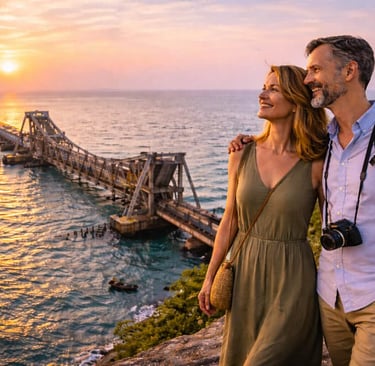
Pamban Bridge: Engineering Drama Over the Ocean
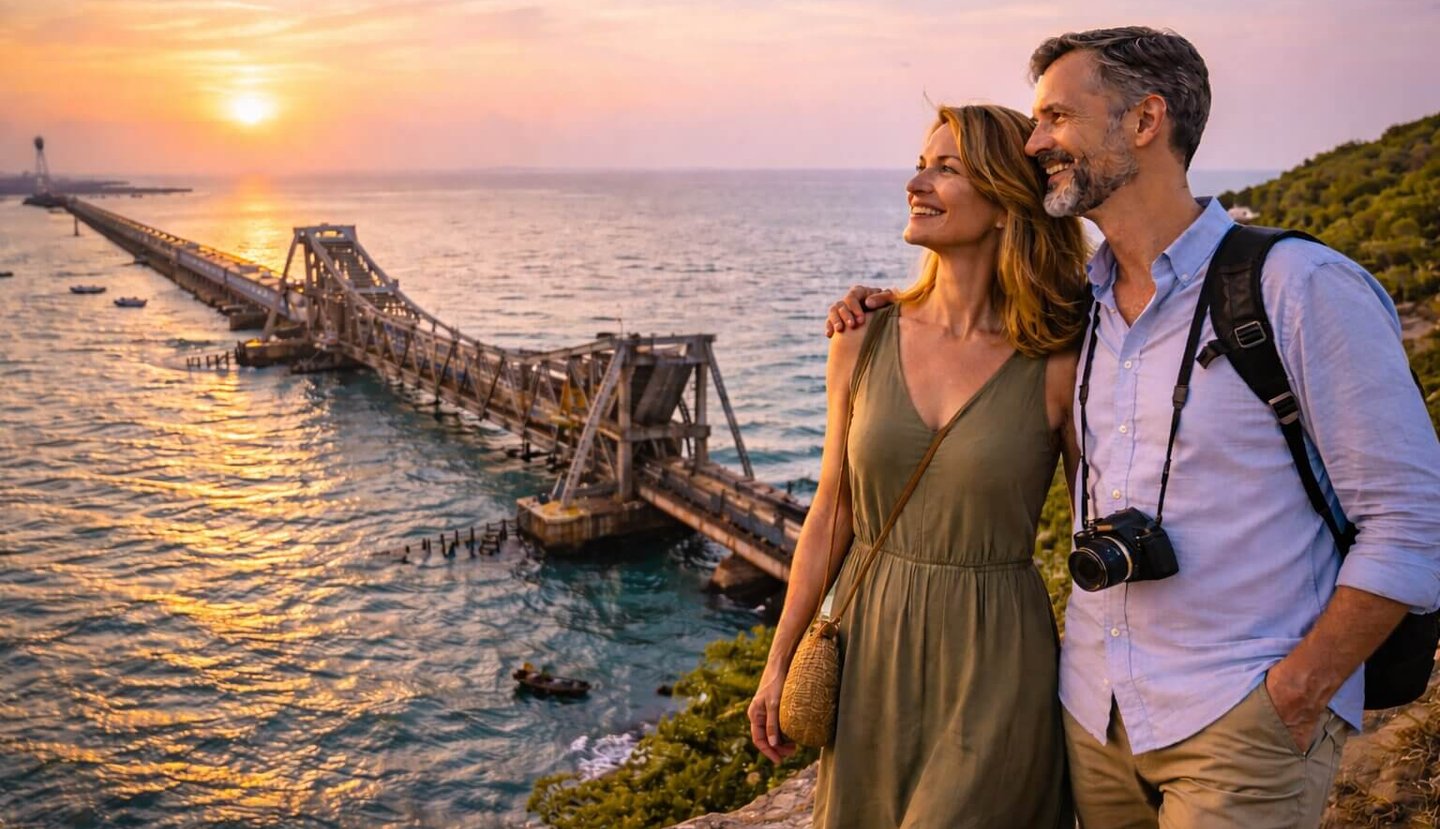
The Pamban Bridge, India’s first sea bridge, opened in 1914, connects Pamban Island to mainland India across 2 kilometres of open ocean. The view from the bridge road, or from the vantage points nearby, is one of the most dramatic in South India: the turquoise waters of the Palk Strait stretching in every direction, the island’s white shoreline glowing in the sun, and the distant haze of Sri Lanka on the horizon.
Rameswaram is the kind of place where time feels different. The ocean is everywhere. The wind carries incense and salt. And the sense of arriving somewhere both ancient and deeply alive is overwhelming.
Overnight: Rameswaram | Meals: Breakfast
Day 9: Departure - The Journey Home Begins
After a final South Indian breakfast, perhaps idli, sambar, and filter coffee, by now a comforting morning ritual, your private vehicle makes the transfer to the airport or railway station as per your onward travel plans.
Most travellers depart from Madurai Airport (approximately a 4-hour drive from Rameswaram), which has flights connecting to Chennai, Bangalore, Mumbai, and Delhi, with onward international connections. Your representative will coordinate your transfer timing to ensure a smooth, unhurried departure.
You leave Tamil Nadu carrying something that cannot quite be named: the residue of three thousand years of devotion, artistry, and civilisation. The temples, the jasmine, the ocean winds, the stone corridors with their thousands of silent pillars. South India has given you something rare, a glimpse of human culture at its most ancient, most continuous, and most alive.
Departure: Madurai Airport / Railway Station | Meals: Breakfast
What’s Included in Your South India Temple & Culture Package✓
✓ Hotel accommodation (3-Star / 4-Star as available, upgrade available)
✗ International / domestic flights & airfare
✓ Daily breakfast at hotel
✗ Lunch, dinner & personal expenses
✓ Private air-conditioned car for all transfers
✓Temple entry fees
✗camera charges
✓ English-speaking experienced representative throughout
✗ Travel insurance & visa charges
✓ All sightseeing as per day-wise itinerary
✗ Tips & gratuities (discretionary)
✓ All tolls, parking charges & driver allowances
✗ Optional activities & excursions
✓ Airport / railway station pick-up and drop-off
✗ Boat rides or ferry charges (Rameswaram)
Best Time to Visit South India for a Temple & Culture Tour
Tamil Nadu is a year-round destination, but the window from October to March offers the most comfortable conditions for temple sightseeing and travel.
October – November
Post-monsoon freshness. Cooler, green, and vibrant. Excellent for photography and sightseeing. Festival season begins.
December – January
Peak season. Pleasantly cool (20–28°C). Best weather for long temple visits. Tamil festivals including Pongal in January are spectacular.
February – March
Warm and beautiful. Flowers in bloom. Fewer crowds than December. Excellent value.
April – June
Hot and humid. Not ideal for first-time visitors or senior travellers. Coastal towns offer some relief.
July – September
Monsoon season in parts of Tamil Nadu. Some disruption to travel, but also lush and dramatic. Reduced prices.
Festival Highlight:
If you can time your visit for January, the Tamil harvest festival of Pongal (usually 14–17 January) is one of the most joyful and colourful cultural experiences in all of India, streets decorated with kolam patterns, sugarcane and turmeric offerings, and a palpable spirit of thanksgiving and celebration across the entire state.
Why Book Your South India Tour with UK India Tourism?
South India is a deeply rewarding travel destination, but it requires a different kind of guidance to the north. The temples are vast and complex, the distances between sites are substantial, the culture is distinct, and for first-time visitors — particularly from the UK, USA, and Australia — having a knowledgeable, English-speaking representative by your side makes all the difference between a confusing experience and a transformative one.
. Exclusively Private Travel: Your vehicle, your guide, your pace. You never share with other travellers, and the itinerary flexes around your needs and energy each day.
• Expert Temple Navigation: Our guides understand Hindu temple etiquette, protocols, and significance in depth. They ensure you experience each temple correctly, respectfully, and meaningfully — not just as a tourist attraction.
• Thoughtfully Paced Itinerary: This tour is designed to be comfortable and sustainable, particularly for senior travellers and families. Each day’s driving and sightseeing is carefully balanced.
• Transparent Pricing: No hidden costs. All upgrades and customisations are quoted clearly before confirmation.
• Trusted by UK & International Travellers: UK India Tourism was built specifically for International travellers who want India done properly: safely, privately, and with depth.
• Fully Customisable: Want to add Kerala backwaters after Rameswaram? Mysore? Hampi? Simply ask and we will design it for you.
Frequently Asked Questions
Is this South India tour suitable for senior travellers?
Yes, this is one of our most popular tours among senior International travellers. The itinerary is carefully paced, with a comfortable private vehicle and an experienced guide who understands the importance of moving at a comfortable speed. Most temple sites are accessible on foot at a gentle pace, though some involve steps and uneven surfaces. Please let us know any specific mobility requirements when you enquire and we will ensure the itinerary is appropriately adapted.
Do I need to remove shoes inside temples?
Yes. At all Hindu temples in South India, you will be required to remove your footwear before entering. This is an important mark of respect for sacred spaces, and our guide will ensure you are fully prepared for this and all other temple protocols before each visit. Dress code is also important: shoulders and knees should be covered, and modest, comfortable clothing is strongly recommended throughout the tour.
Can non-Hindus visit all the temples on this tour?
Most of the temples on this itinerary welcome visitors of all faiths and nationalities, including the UNESCO-listed Mahabalipuram sites, Brihadeeswarar Temple, and Thirumalai Nayakkar Palace. At the Meenakshi Amman Temple and Ramanathaswamy Temple in Rameswaram, the innermost sanctuaries are restricted to Hindu visitors, but the outer courtyards, corridors, and architectural wonders are accessible to all. Your guide will explain clearly what is accessible and how to respectfully experience each site.
Can we upgrade the hotels for more comfort?
Yes. The standard package includes comfortable 3-star and 4-star hotels, all carefully selected for quality, cleanliness, and location. We can upgrade to superior 4-star or 5-star properties at each destination — including heritage properties in cities like Pondicherry and Madurai that offer exceptional character and comfort. Upgraded pricing will be provided transparently before confirmation.
Can we add Kerala or other South India destinations to this tour?
Absolutely. This itinerary is an excellent foundation for a longer South India journey. Popular extensions include Kochi (Fort Kochi’s colonial heritage and backwater access), the Kerala backwaters (houseboat stays on Alleppey’s canals), Munnar (hill station and tea plantations), Mysore (the Mysore Palace and Chamundeshwari Temple), and Hampi (the extraordinary ruined city of the Vijayanagara Empire, a UNESCO World Heritage Site). All extensions are designed and quoted to the same standard of private, curated travel.
How do we travel between destinations on this tour?
All travel between cities on this tour is by private air-conditioned car, with your dedicated driver and representative. The routes are scenic and the drives are manageable, the longest single drive is approximately four hours (Madurai to Rameswaram). Your guide will ensure all driving days include comfortable rest stops and, where appropriate, points of interest along the route.
Begin Your South India Journey Today
Tamil Nadu is one of the world’s great travel destinations - ancient, alive, and profoundly moving. In nine days, this tour gives you its finest temples, its most beautiful coastline, its most extraordinary history, and its most sacred pilgrimage sites, all delivered privately, comfortably, and with the depth that only expert local guidance can provide.
The Shore Temple at sunset. The corridors of Rameswaram at dawn. The painted towers of the Meenakshi Temple rising against the Tamil Nadu sky. The jasmine-scented lanes of Madurai. The French boulevards of Pondicherry. This is South India at its finest.
READY WHEN YOU ARE
UK: +44 7345 191205
India: +91 9958 480873
Email: sales@ukindiatourism.co.uk
UK India Tourism
South India Travel Specialists for UK, USA, Canada, Australia, France, Poland, Singapore, Japan and beyond
UK: +44 7345191205
UK India Tourism© 2026, all rights reserved
India: +91 9958480873
⭐⭐⭐⭐⭐ 4.9/5 | 2,600+ Travelers | 18 Years | 98% Recommend