Package 27: The Grand Central India Road Journey
Route: Delhi - Agra - Orchha - Khajuraho - Bandhavgarh - Kanha - Bhedaghat - Jhansi - Gwalior - Delhi
Duration: 16 Days / 15 Nights
Private AC Car | 3-4 Star Accommodation & Forest Resorts as available
Price: Ask for Price ( Twin sharing accommodation )
Best for: Culture lovers, heritage explorers, honeymoon couples, friend groups, couples, families, photographers, USA/UK / Canada / Australia / Singapore / Japan / European tourists, First-time India travellers
The Journey That Tells the Whole Story of India
Some tours show you India. This extraordinary sixteen-day private road journey takes you deep into its heart, weaving together ancient kingdoms, UNESCO temples, legendary tiger forests, spectacular marble landscapes and the timeless Taj Mahal at sunrise.
The Grand Central India Road Journey is a seamlessly planned private circuit from Delhi and back, exploring the historic Bundelkhand heartland and the wild beauty of Madhya Pradesh. No airports or domestic flights. Just one private vehicle, an expert driver-guide, and sixteen unforgettable days on the road.
Designed for travellers from the United Kingdom, United States, Canada, Australia, France, Poland, Singapore, Japan and beyond who want to go far deeper than the standard Golden Triangle, this is India at its most complete, most authentic, and most unforgettable.
What Makes This Journey Extraordinary
This is no ordinary road trip. You travel the same highway south and north, yet experience an entirely different world each way, never repeating a destination, never retracing a moment. From the Taj Mahal and the forgotten kingdom of Orchha to Khajuraho’s ancient temples, the tiger forests of Bandhavgarh and Kanha, and the marble magic of Bhedaghat, every day reveals a new chapter of India.
Into The Jungle Book Country
Enter the forests that inspired Kipling’s timeless world of Mowgli and Shere Khan. Kanha’s magnificent sal forests, rare barasingha and regal Bengal tigers create a wilderness of almost mythical beauty. Nearby Bandhavgarh adds ancient forts rising above one of India’s most dramatic tiger landscapes.
Palaces, Temples & Hidden Wonders
Discover Orchha’s romantic palaces, Khajuraho’s extraordinary UNESCO temples, the mighty Gwalior Fort and, of course, the timeless beauty of the Taj Mahal.
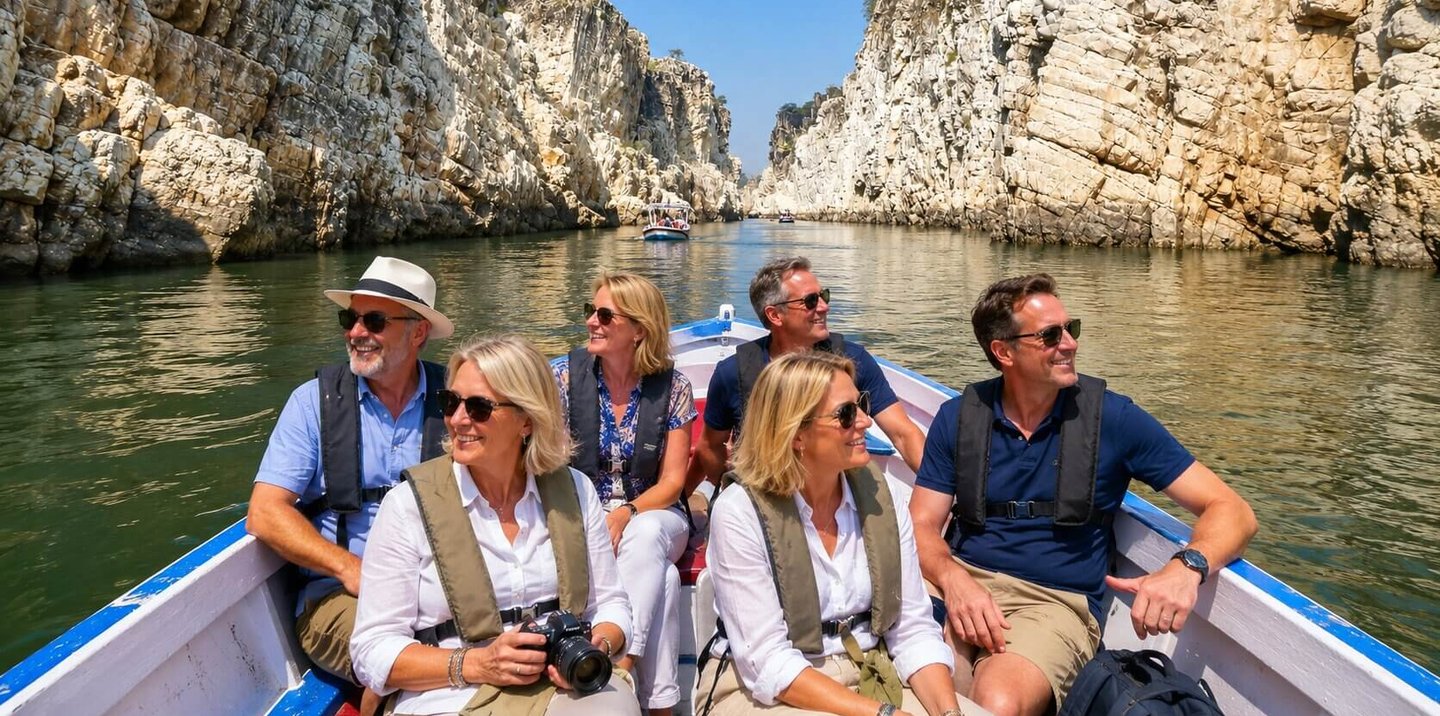
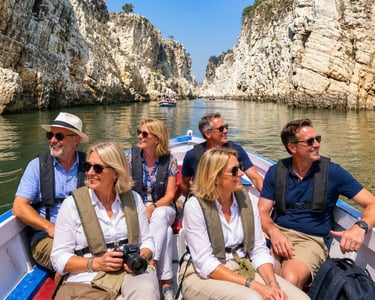
Then comes the secret surprise: Bhedaghat, where the Narmada River glides between towering white marble cliffs, a breath-taking finale to an unforgettable journey.
Day-by-Day Itinerary
All drives are in a private, air-conditioned vehicle with your expert driver-guide. Accommodation is at carefully selected heritage hotels, boutique lodges and premium jungle resorts at each stop.
Day 1 - Delhi to Agra (203 km / approx. 3.5 hours)
Your Grand Central India Road Journey begins the moment your vehicle pulls out of Delhi onto the Yamuna Expressway, one of India's finest highways, smooth and fast, with the ancient Mughal landscape unfolding on either side. You arrive in Agra by mid-afternoon with time to settle into your hotel, take your first evening stroll through the old city lanes, and perhaps catch the Taj Mahal in the peach light of sunset from the Mehtab Bagh garden across the river.
Day 2 - Agra: The Taj Mahal & Agra Fort
The Taj Mahal at sunrise is one of the handful of travel experiences that genuinely exceeds all expectation. Your guide collects you in the pre-dawn darkness. You arrive at the main gate as it opens. The mausoleum emerges slowly from the morning mist, white marble against a pink sky, utterly silent, impossibly perfect. This is the moment every India journey is built around. After the Taj, explore Agra Fort - a UNESCO World Heritage Site in its own right, where Shah Jahan spent his final years gazing from his tower at the monument he built for his beloved Mumtaz.
Later in the day, we explore the majestic Agra Fort, an impressive UNESCO World Heritage Site that echoes the grandeur and power of the Mughal Empire.
Day 3 - Agra to Orchha, via Gwalior (318 km / approx. 5 hours)
The highway south from Agra carries you through Gwalior, a quick drive-past of India's most imposing medieval hill fort, visible from the road as a vast sandstone cliff topped with towers and battlements. You arrive in Orchha by late afternoon: a small, magical town on the Betwa River where the Bundela Rajput kingdom reached its height in the sixteenth century and time appears to have stopped completely. Check in and take the short walk to the Ram Raja Temple as the evening aarti begins.
Day 4 - Orchha: The Hidden Kingdom
A full, unhurried day in one of India's most enchanting and most overlooked destinations. The morning begins at the Orchha Fort Complex: the Jehangir Mahal, built for a Mughal emperor's royal visit, its facade encrusted with tile-work of cobalt blue; the Raja Mahal, its interior walls alive with 16th-century murals of hunting scenes, court life and celestial beings. The Laxmi Narayan Temple - a unique architectural hybrid of fort and temple, carries frescoes of rare quality. The fourteen riverside Chhatris, the royal cenotaphs of the Bundela kings, cast long reflections on the Betwa at dusk.
The Ram Raja Temple is the single most extraordinary sight in Orchha: the only temple in India where Lord Ram is worshipped as a reigning king, complete with a uniformed police Guard of Honour at morning and evening prayers. Witness the evening aarti here, when lamps are lit across the courtyard and devotional music fills the ancient air, one of the most moving experiences on the entire journey.
Day 5 - Orchha to Khajuraho (175 km / approx. 4 hours)
The drive east to Khajuraho passes through the quintessential Bundelkhand countryside: dry scrub forests, rocky outcrops, small farming villages with hand-painted walls, bullock carts on red-dust tracks, and the slow, wide Dhasan river glittering under a high blue sky. You arrive at Khajuraho in time to visit the Western Temple Group in the golden afternoon light — the most celebrated of the temple clusters, where the famous erotic carvings are revealed in extraordinary relief by the low-angle sun. This is one of those rare sights that is simultaneously shocking and profoundly beautiful.
Day 6 - Khajuraho: Temples, Art and the Living Jungle
The morning is devoted to a deeper exploration of Khajuraho's temples, both the Western Group and the quieter, less-visited Eastern Group of Jain temples, where the intricacy of the stonework is if anything even more impressive. Your guide brings the iconography alive: the deities, the mithunas, the celestial apsaras, the scenes of village life carved in stone a thousand years ago with the confidence and joy of a civilization entirely at ease with the full spectrum of human experience.
The afternoon offers Raneh Falls, twenty kilometres from town, where the Ken River drops through a volcanic canyon of crystalline granite in shades of rose, grey and deep black. It is a sight of dramatic, primeval beauty, quite unlike anything else in Central India.
Day 7 - Khajuraho to Bandhavgarh (250 km / approx. 5.5 hours)
Today the road carries you east and south into the deep forest country of eastern Madhya Pradesh. The landscape changes perceptibly as you travel: the dusty scrub of Bundelkhand gives way to taller trees, richer greens, and the unmistakable feeling of a wilder, less touched India. By evening you arrive at your jungle lodge at Bandhavgarh, the air thick with the scent of sal and teak, a chorus of jungle birds in the canopy and somewhere out there in the darkness beyond the perimeter fence, the territory of India's most famous tigers.
Days 8 & 9 - Bandhavgarh: Tiger Country
Two full days in the national park with the highest tiger density in India. Morning and evening safaris in open-topped jeeps, guided by expert naturalists who read the forest like a book - a fresh pug-mark in the red earth, a sambar deer frozen in alarm, a langur's warning call cascading from the canopy overhead. Bandhavgarh has over seventy tigers within its core zone. Sightings here are not a matter of luck, they are, more often than not, a matter of patience.
Between safaris, time at the lodge pool, birdwatching from the veranda, evenings around the firepit with your naturalist sharing stories of the forest. The ancient Bandhavgarh Fort, believed to be over two thousand years ago, stands within the park itself, its battlements draped in forest, enormous reclining Vishnu statues carved into the hillside below. History and wilderness, woven together in a single extraordinary place.
Day 10 - Bandhavgarh to Kanha (220 km / approx. 5 hours)
The transfer between the two great parks is a journey through the very heart of Central India's tribal heartland. The road passes through Mandla district, home to the Gond and Baiga communities, whose villages of terracotta-painted houses and sacred groves are among the most visually striking in all of India. Arrive at your Kanha jungle lodge by late afternoon; time to settle in, take the evening forest walk, and prepare for what lies ahead.
Days 11 & 12 - Kanha: The Jungle Book Forest
If Bandhavgarh is tiger theatre, Kanha is tiger poetry. The landscapes here are softer, wider, more expansive, great meadows of golden grass (the famed Kanha meadow is one of the most beautiful wildlife habitats in Asia) ringed by dense forest, threaded by clear streams. The barasingha - the swamp deer once brought back from the very brink of extinction in this park, grazes in herds that seem like something from another age. The tigers of Kanha are famously relaxed around safari vehicles, allowing extended sightings of extraordinary intimacy.
This is the landscape that inspired Rudyard Kipling to write The Jungle Book and standing in a Kanha meadow at dawn, with mist rising from the grass and a family of spotted deer crossing the tree-line, you will understand exactly why. These forests are Mowgli's forest. The magic here is entirely real.
Day 13 - Kanha to Bhedaghat / Jabalpur (175 km / approx. 4 hours)
Leaving Kanha behind, the return journey north begins with its most spectacular surprise. Bhedaghat, on the outskirts of Jabalpur, is one of India's most astonishing natural wonders. A three kilometre gorge cut by the sacred Narmada River through solid white marble cliffs, some rising a hundred feet above the water. Downstream, the Dhuandhar Falls - 'The Smoke Cascade', thunder into a boiling pool of white water. A boat ride through the marble gorge, with the cliffs glowing white and gold above you in the afternoon sun, is one of those rare travel moments that renders you genuinely speechless. Stay overnight in Jabalpur.
Day 14 - Bhedaghat to Jhansi (330 km / approx. 5.5 hours)
The highway north carries you back through the Bundelkhand plateau towards Jhansi, the city of India's most beloved warrior queen. Rani Lakshmibai of Jhansi led the 1857 uprising against British colonial rule from this city with a ferocity and tactical brilliance that made her a legend across the subcontinent. For British travellers in particular, Jhansi carries a complex and powerful resonance. The fort rises on its rocky hill above the city exactly as it did when Rani Lakshmibai made her famous leap on horseback from its battlements. Stay overnight in Jhansi.
Day 15 - Jhansi: Fort & Museum, then Gwalior (105 km / approx. 2 hours)
Morning at Jhansi Fort - fifteen acres of battlements, temples and towers, with the Rani Jhansi Museum inside containing her armoury, portraits and personal artefacts. Your guide brings the story of 1857 to vivid life. After lunch, a short drive north to Gwalior, one of India's most spectacular, and most underrated, medieval cities. Check in and take the evening walk to view the great fort in the last light of day: a massive sandstone cliff bearing the palaces and temples of the Tomar dynasty, rising two hundred and ninety feet above the plains like the prow of a stone ship.
Day 16 - Gwalior Fort and back to Delhi (320 km / approx. 5 hours)
A morning of extraordinary sightseeing: the Man Singh Palace inside Gwalior Fort, with its mosaic tilework of peacock blue and yellow, some of the finest decorative work of the fifteenth century anywhere in India. The Sas Bahu temples within the fort complex. And most extraordinarily, the rock-cut Jain statues on the cliff face of the fort, enormous figures of the twenty-four tirthankaras, carved directly into the sandstone, some thirty feet tall, standing in absolute serenity in their carved niches above the city below. After a farewell lunch in Gwalior, the highway carries you north through the plains towards Delhi, arriving in the evening, changed by everything you have seen.
Enjoy some time at leisure and relax at your Delhi hotel. At the appropriate time, our driver will escort you to Indira Gandhi International (IGI) Airport for your onward flight, according to your flight schedule.
What Is Included
• 15 nights' accommodation - 3 / 4 star properties and decent jungle resorts as available
• All Morning breakfast daily
• Private air-conditioned vehicle with expert driver-guide for the full 16 days
• 4 jeep safaris - 2 morning and 2 evening safaris each at Bandhavgarh and Kanha
• All park entry fees, safari permits and naturalist fees at both national parks
• Expert Guidance and Support
• Boat ride through the Bhedaghat marble gorge
• All monument entry fees and taxes throughout the journey
• UK India Tourism 24/7 personal concierge support throughout your trip
Best Time to Travel
October to March - The Prime Season
The months from October through March offer the finest conditions across the entire route. Days are bright and warm (20–28°C), nights are cool and comfortable, and the national parks are at their most active. Tiger sightings at both Bandhavgarh and Kanha are at their peak between November and February, when the dry conditions bring animals to water sources. Orchha, Khajuraho, Agra and Gwalior are best explored in the cooler months, when walking the monuments is a genuine pleasure.
April to June - Hot and Thrilling
The pre-monsoon months are intensely hot (35–42°C), but offer the single best tiger-viewing conditions of the year, the forests thin out, the water sources dry up, and tigers concentrate around the few remaining waterholes. For dedicated wildlife travellers, April and May at Bandhavgarh and Kanha can deliver sightings of extraordinary frequency and duration. The cultural stops on the route are best done in early morning.
As we travel in a comfortable air-conditioned car or SUV throughout the journey, the road trip remains pleasant and relaxing most of the time. It also gives us the wonderful opportunity to savour the diverse and delicious flavours of India, with each destination offering its own unique culinary experiences.
Monsoon (July to September) - National Parks Closed
Both Bandhavgarh and Kanha close for the monsoon season (generally 1 July to 15 October). The cultural legs of the journey remain accessible, but the wildlife component cannot be undertaken in these months.
Why This Journey - The Complete India Experience
Most India tours offer fragments: the Golden Triangle here, a tiger reserve there, a temple circuit somewhere else. The Grand Central India Road Journey is the rare itinerary that binds India's greatest narrative threads into a single, coherent story.
Heritage India
The Taj Mahal - the greatest monument to love in human history. The Orchha Fort complex - a 16th-century kingdom that the modern world has barely touched. Khajuraho's thousand-year-old temples - a UNESCO World Heritage Site of breath-taking artistic ambition. Jhansi Fort - the birthplace of India's most iconic act of resistance. Gwalior - one of medieval India's most unconquerable fortresses.
Wild India
Bandhavgarh is famed for its remarkable population of Bengal tigers and its dramatic landscape, dominated by a hilltop fort believed to be over 2,000 years old. Few places in India combine wildlife, history and natural beauty so seamlessly. Kanha - the Jungle Book forest, home to the barasingha deer ( stag ), vast open meadows and some of the most relaxed tiger sightings in Asia.
Natural India
Bhedaghat - three kilometres of pure white marble gorge, carved by the sacred Narmada River, glowing silver by moonlight. Raneh Falls, a volcanic canyon of crystalline pink and black granite, entirely unknown to most international travellers. The sal forests, the red-dust plateau roads, the Betwa River at Orchha in the early morning mist.
Spiritual India
The Ram Raja Temple at Orchha, where a police Guard of Honour salutes a deity. The evening aarti at the ghats of the Narmada at Bhedaghat. The great Jain tirthankaras carved in their thirty-foot niches into the face of Gwalior Fort. Ancient India - living, breathing, entirely present.
Book Now
The Grand Central India Road Journey is available on a fully private, bespoke basis for individuals, couples, families and small groups. Departure dates are entirely flexible, this tour can begin on any day of your choosing within the season.
To request your personalised itinerary, pricing in your currency, and a detailed tour proposal:
UK: +44 7345 191205
India: +91 9958 480873
Email: sales@ukindiatourism.co.uk
Website: https://ukindiatourism.co.uk/
UK India Tourism Company
Travel Specialists for UK, USA, Canada, Australia, France, Poland, Singapore, Japan @ beyond
UK: +44 7345191205
UK India Tourism© 2026, all rights reserved
India: +91 9958480873
⭐⭐⭐⭐⭐ 4.9/5 | 2,600+ Travelers | 18 Years | 98% Recommend