
Man Eater Champawat Tiger vs Jim Corbett
She killed 436 people. He had three bullets and a dog. The most terrifying wildlife encounter in Indian history. The Champawat Tigress and Jim Corbett, 1907.
Adarsh Gupta
6/19/202612 min read
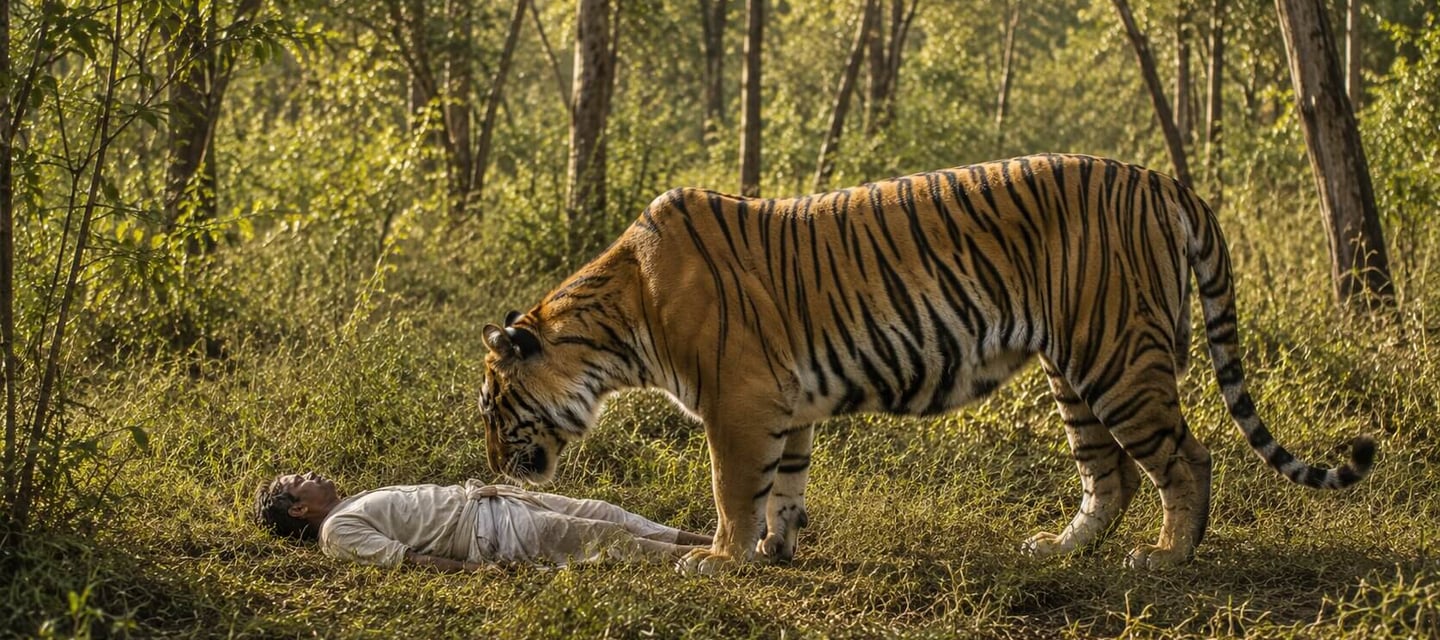
Man Eater Champawat Tiger vs Jim Corbett | The Hunt That Changed History
436 Kills. One Man. Three Bullets.
The true story of the deadliest wild animal in recorded human history, and the one man brave enough to stop her
Before There Was a Hunter, There Was a Tiger
Somewhere in the forests of Nepal, around 1895, a tiger was shot. The bullet did not kill her. It destroyed two of her canine teeth - the long, curved weapons she needed to bring down deer, nilgai, wild boar. She survived the shot. But she could no longer survive the forest. And so the killing began.
The Champawat Tigress was not born a monster. No tiger is. She was, by all accounts, a large and powerful Bengal tigress, about eight feet from nose to tail, over three hundred pounds of muscle and instinct and wild grace. She had lived the way tigers live: invisible, patient, efficient, sovereign. And then a human being shot her in the face. The broken canines that resulted were not just an injury. They were a sentence.
A tiger hunts large prey by seizing it at the throat or the back of the neck, driving those long canines deep and holding until the animal collapses. With her teeth shattered, the Champawat Tigress could no longer do this. She could not kill a sambar, a chital, a gaur. She was starving in one of the most prey-rich forests in Asia. And so she turned, as injured tigers sometimes do, to the only prey she could reliably kill. Humans. We are slow. We are soft. We do not run far. And we are almost always alone when we go to the river, or the field, or the forest edge to collect firewood.
The killing began in Nepal, sometime in the late 1890s. Villagers died. Then more villagers. The Nepalese army was dispatched. Soldiers with guns and military training and the full authority of the state went into the forest to find the tigress. They failed. Completely. The tigress seemed to move like smoke - appearing, killing, vanishing. Every attempt to corner her produced nothing. Every beat drive found an empty forest. The death toll climbed past 200.
Eventually, the Nepalese government expelled her from the country. The army conducted such an intense campaign of noise and pressure in her territory that she crossed the border into British India's Kumaon region. Which meant the terror simply changed address.
A Forest Gripped by Fear
Imagine, if you can, what a man-eating tiger does to a community. Not the dramatic, cinematic version but the real one. The slow, grinding, suffocating version.
Villages stop sending children to school because the route passes through the forest. Women stop going to the river for water because the tiger took the last woman who did. Men stop going to their fields at dawn, the most important agricultural hours of the day because that is when she hunts. The entire rhythm of village life, built across generations around the predictable cycles of nature, collapses under the weight of one impossible, invisible threat.
In the Champawat region of Kumaon, this is what happened. The tigress worked her way through the villages methodically, striking every few weeks, sometimes closer together, always catching people at their most vulnerable - alone, unarmed, unaware. She had become extraordinarily bold. She no longer retreated at the sound of voices or the sight of fire. She had learned that humans were prey. And she had lost any reason to be afraid of them.
By 1907, the Champawat Tigress had killed an estimated 436 people across Nepal and India. This number - 436, is in the Guinness Book of World Records. It is the highest number of fatalities ever attributed to a single wild animal in documented human history. Every one of those 436 was a person with a name, a family, a village that remembered them.
436 people. More than a third of a thousand lives. Taken by a single animal over twelve years of killing. The Champawat Tigress remains, to this day, the most lethal non-human predator in recorded history.
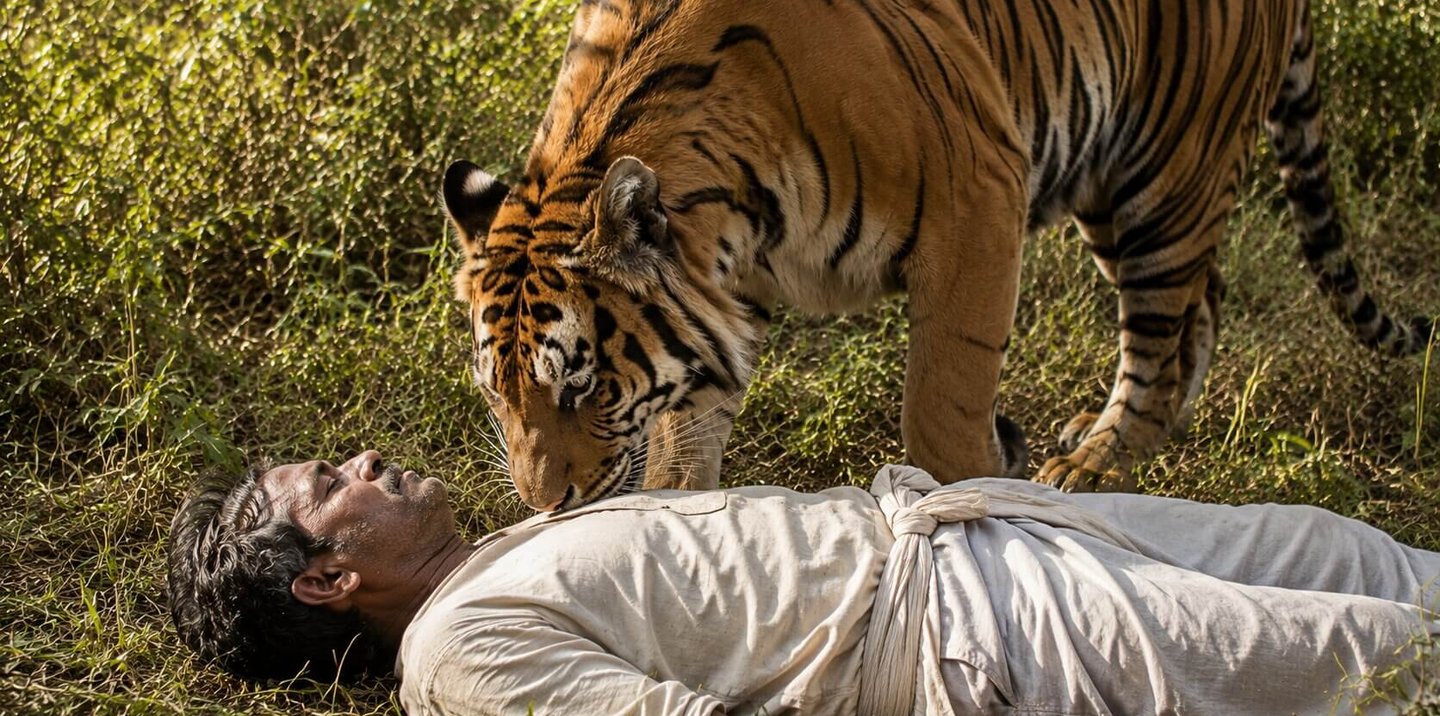
The Government Runs Out of Options
By 1907, the situation had become a crisis that no official in British India could ignore. Bounties had been placed on tigers across the region. An insane, indiscriminate response that killed tens of thousands of tigers while failing entirely to produce the Champawat Tigress. Professional hunters had been tried and had failed. Police parties had been deployed and had returned empty-handed. Military units had beaten the forest and found nothing.
The Deputy Commissioner of Nainital, Charles Henry Berthoud, was a practical man. He needed someone extraordinary. Someone who knew the Kumaon forests better than the tigress herself. Someone who could hunt alone, quietly, without the thundering noise of an army operation that announced its presence for miles in every direction.
He had one name. Jim Corbett. Thirty-one years old. Railway man. Shikari of reputation. Born and raised in these very hills. Berthoud visited Corbett personally, not a telegram this time, but a man sitting across a table, explaining that the tigress had killed again and that nobody else could stop her.
Jim Corbett agreed to go. He set two conditions before he left. First, that all armed patrols, soldiers, and official hunting parties be withdrawn from the area entirely while he worked - noise and confusion would destroy any chance of finding the tigress. Second, that no reward be offered for the kill. Jim Corbett did not hunt for money. He never had. He hunted because people were dying and nobody else could stop it.
Corbett set off for Champawat with his rifle - a .275 Rigby, a handful of cartridges, and his dog Robin. He told nobody exactly what he planned. He had learned long ago that plans made in drawing rooms bear little resemblance to the reality of a jungle with a man-eater in it.
Arriving in the Valley of Fear
Corbett arrived in Champawat to find a community that had been traumatised for years. The streets were quiet at times when they should have been busy. People moved in groups. Men carried sticks and shouted to each other across fields that were too small for the noise. The collective anxiety of 436 deaths hung over every conversation like smoke that would not clear.
He began, as he always began, not with a gun but with listening. He talked to the villagers, not the official version they gave to the British authorities, but the real version, the one told by people who had seen what the tigress had done to their neighbours. He walked the forest edges. He examined kill sites. He read the pugmarks in the mud with the fluency of a man reading a language he had known since childhood.
The tigress was large. She was old by tiger standards, probably ten to twelve years, near the end of her natural life. And she was smart. Every experienced hunter who had tried to ambush her had come away with nothing. She seemed to sense, somehow, when she was being watched. She changed her routes. She avoided the obvious approaches. She was, in the language of the jungle, a difficult customer.
On the first day of serious tracking, Corbett found the remains of the tigress's latest victim, a 16 Year old girl named Premka Devi, from the village of Fungar. The trail of blood led into a ravine. Corbett followed it alone, reading the story written in the earth: where the tigress had dragged the body, where she had stopped to feed, the precise weight and movement of her passage through the undergrowth.
He followed the trail deep into a gorge. The forest closed around him. And then the jungle went silent.
Every experienced hunter knows that silence. It is not the silence of emptiness. It is the silence of something very large and very dangerous that has just become aware of your presence.
Corbett saw the tigress a split second before she charged. She came out of the undergrowth like a russet blur, a blur that was three hundred pounds and accelerating. He fired twice. Both shots hit chest and shoulder but they did not stop her. She veered off at the last moment, crashing into the undergrowth, snarling. Corbett stood in the sudden silence with two spent cartridges and his heart hammering. He had wounded her. He had not killed her. And a wounded man-eater is the most dangerous animal in the world.
He could not follow her into that darkness. Not alone. Not with the light going. He retreated and spent the night in a nearby village, not sleeping, listening to the forest, thinking about what came next.
The Great Beat - 298 Men and One Rifle
The next morning, Corbett went to the tehsildar, the local administrative official of Champawat. He needed help. Not soldiers. Not hunters. He needed numbers. He needed a beat.
A beat, in the language of Indian hunting, is a coordinated drive, a human chain that moves through the forest making noise, pushing the animal ahead of it toward a waiting hunter. It requires organisation, courage, and a great deal of faith that the animal being driven will move in the direction expected rather than turning and charging the beaters. With a healthy tiger, a beat is dangerous enough. With a wounded, cornered, desperate man-eating tigress who had already killed 436 people, it required a particular kind of bravery that is difficult to fully appreciate from the comfortable distance of the present.
The tehsildar organised 298 men. Villagers, mostly farmers, labourers, men whose relatives the tigress had killed, men who were terrified but who had decided that enough was enough. They stretched into a line across the forest and began to move, shouting, beating drums, crashing through the undergrowth, pushing everything before them toward the Champa river gorge where Corbett waited.
It was noon. May 12, 1907. The sun was high and the forest was hot and bright. Corbett stood at his position, rifle up, watching the dense scrub ahead of him. The beat was loud behind three hundred men making more noise than three hundred men usually make, which is considerable. The birds had stopped calling. The deer had fled. The forest was emptying out ahead of the wave of human noise.
And then she came.
The Champawat Tigress broke from cover at a distance of about twenty feet from Jim Corbett. Twenty feet. Less than the length of a safari jeep. She had survived two rifle shots the previous day. She was wounded, cornered, and furious. And she was coming straight at him.
The Shot That Ended Twelve Years of Terror
This is the moment that separates the legend from the man. In every version of this story, what strikes you is not the glamour of it. It is the stillness. A man who has been hunting for twenty-five years, who has walked alone into forests that would make most soldiers hesitate, who has tracked a wounded man-eating tigress through a jungle where she could appear from any direction at any moment, that man does not panic.
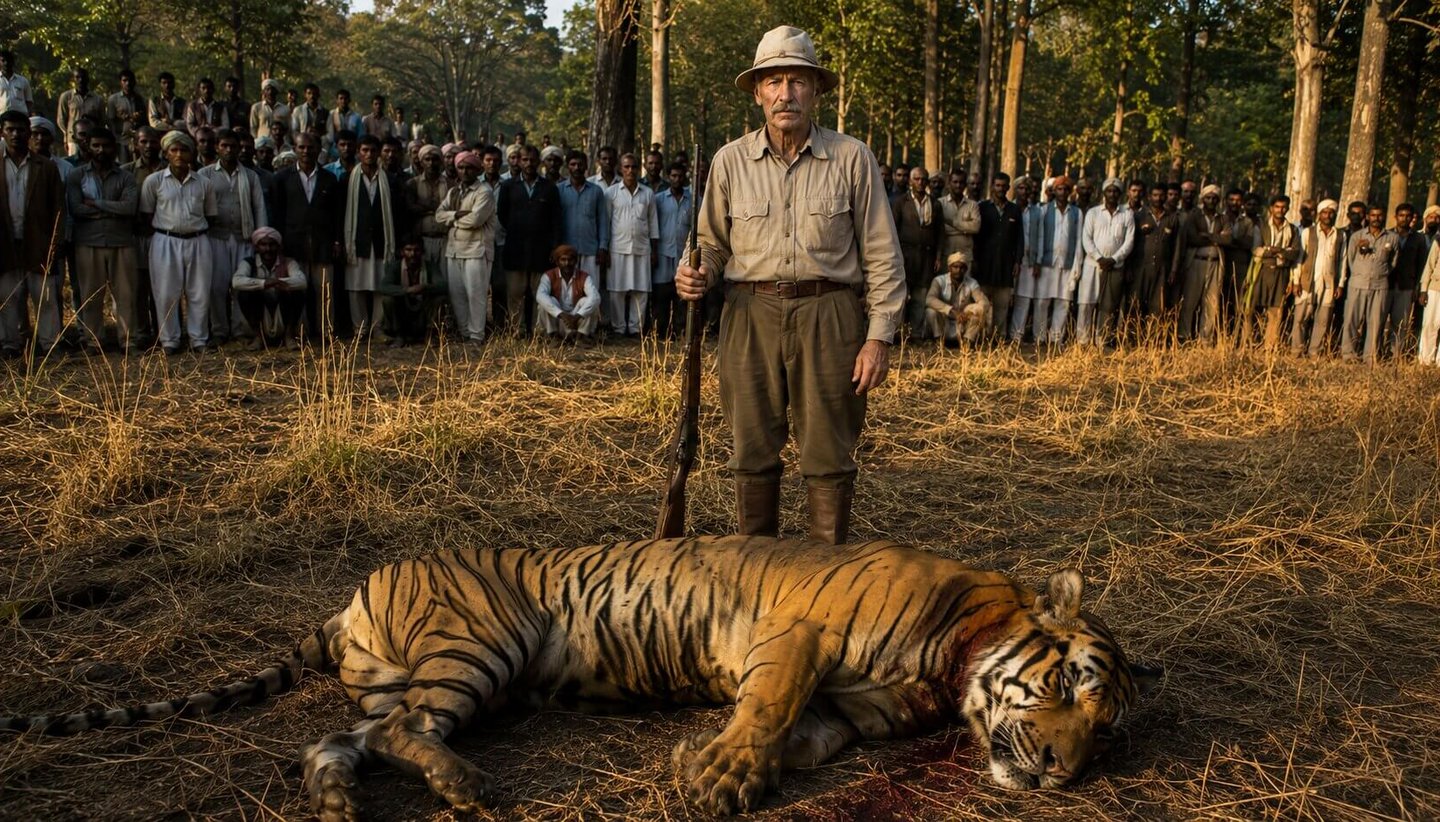
Corbett had borrowed a rifle from the local tahsildar to supplement his own. He fired. The shot hit the tigress and slowed her but still she came. He fired again. And again. The last shot, fired when she was nearly on top of him, hit her foreleg. She stumbled. Crashed. The ground shook. The Champawat Tigress, the most lethal wild animal in recorded human history, lay still twenty feet from where Jim Corbett stood.
The silence after the shot is something no account of this moment quite captures. Three hundred men behind him. A dead tigress in front of him. Twelve years of killing, ended. Four hundred and thirty-six people, avenged. And a thirty-one-year-old railway man from Nainital, standing in a forest clearing in the Kumaon Hills, listening to the jungle start to breathe again.
When the villagers came forward and saw the tigress lying dead, they wept. Not from joy. From something more complex, the release of years of accumulated terror, grief, and helplessness. They embraced Jim Corbett. Some fell at his feet. Some, in the tradition of their faith, touched his feet and called him sadhu - holy man, saint.
An examination of the dead tigress revealed what had turned her into a killer. Her upper and lower canine teeth on the right side were broken, shattered at the root. Old wounds, from a shot fired years before by a poacher or a territorial encounter. She had been hunting humans not from malice, not from preference but from physical necessity. She could not have survived any other way. Jim Corbett, who had killed her because there was no alternative, understood this. He wrote about it with a compassion that is striking even now, more than a century later.
He noted the broken teeth carefully. He measured them. He photographed them. And in his account of the hunt, he made the argument that would come to define his thinking for the rest of his life: a man-eating tiger is not a criminal. It is an animal made dangerous by human action, in this case, a poacher's shot that broke her teeth and left her no other choice. The responsibility, in some deep and uncomfortable sense, began with us.
After Champawat - The Man the Tiger Made
The death of the Champawat Tigress made Jim Corbett famous. News spread through the Kumaon Hills faster than the telegraph could carry it. In Champawat itself, the day she was killed became a local festival. People who had not left their homes for months walked out into the open air and breathed.
For Corbett, it was the beginning not the end. Between 1907 and 1938, he would hunt twelve more documented man-eaters, plus two legendary man-eating leopards, the Panar Leopard (400 kills) and the Leopard of Rudraprayag (125+ kills over eight years). Every time, he came alone. Every time, he asked for no payment. Every time, he came because people were dying and he was the only person who could stop it.
But what the Champawat hunt gave him beyond fame, beyond the gratitude of a community was something less obvious and more lasting. It gave him a profound understanding of what a man-eating animal actually is. Not a monster. Not evil. An animal pushed beyond its natural limits by injury, by habitat loss, by the pressure of an expanding human world encroaching on an ancient wilderness. The hunter had been taught, by the thing he hunted, to think about conservation.
Jim Corbett spent thirty years hunting man-eaters to protect people from tigers. He then spent his remaining years trying to protect tigers from people. Both halves of his life were expressions of the same thing: an absolute, unbreakable love for the jungle and everything that lived inside it.
The Champawat Today - A Pilgrimage for Wildlife Lovers
The town of Champawat still exists in the Kumaon Hills of Uttarakhand, not far from the borders of Nepal. It is a small, quiet hill town the kind of place where the morning mist sits on the mountains and the bazaar comes alive for a few hours and then quiets down again. Most visitors to the region are pilgrims, passing through on the way to the temples of Kumaon or Uttarakhand's famous char dham circuit.
But for wildlife lovers, for the people who come to India to stand in a forest at dawn and watch something magnificent emerge from the trees - Champawat carries a different kind of significance. This was where it began. Where Jim Corbett walked into a forest with a borrowed rifle and found the most dangerous animal in the history of India. Where he stood his ground at twenty feet. Where the shot was fired that ended twelve years of terror and began a lifetime of conservation.
The Bengal tiger that Corbett spent his life both hunting and protecting now numbers over 3,600 in India's wild spaces. The forests that produced the Champawat Tigress - broken, shrinking, threatened by a century of colonial clearance, have been partially restored by the conservation movement that Jim Corbett helped start. Jim Corbett National Park, 250 kilometres from Champawat, carries his name and his legacy. Its 250 tigers are, in some sense, his inheritance.
When you sit in a safari jeep at dawn in Corbett National Park and watch a Bengal tiger walk across the road thirty metres in front of you, pausing for a moment to look at you with those amber eyes before disappearing back into the Sal forest, you are watching the product of everything that one extraordinary man did. The man who hunted them so that the people who lived beside them could survive. The man who stopped hunting them so that the tigers themselves could survive. The man who walked into the forest alone, again and again, with three bullets and a dog and the jungle whispering to him in a language only he could read.
The Champawat Tigress killed 436 people and changed one man's life. That man helped save a species. History, at its most remarkable, sometimes works exactly like that.
Visiting Jim Corbett National Park Today
The park that bears Jim Corbett's name is one of the finest wildlife destinations in Asia. For international travellers from the UK, USA, Australia, and Europe, it offers a wilderness experience that is genuinely irreplaceable, not just for the tigers, but for the elephants, the Gharial crocodiles, the 580 species of birds, and the extraordinary Himalayan backdrop that makes every morning safari feel like the opening frame of a nature documentary.
UK India Tourism specialises in private, luxury, fully customised India tours including bespoke tiger safari itineraries that can be built around Corbett, Tadoba, Ranthambore, or a combination of all three. Our founder Adarsh Gupta has personal guiding experience across every major wildlife destination in India and can help you design an itinerary that puts you in the right forest, at the right time, with the right guides.
Because in a country with 3,600 wild tigers, the difference between seeing one and missing one often comes down to exactly that: the right forest, the right time, the right guide. Jim Corbett understood that better than anyone. We try to carry a little of that understanding into every safari we plan.
Ready when you are
Let Us Bring Your India Dream to Life
UK India Tourism Company
UK: +44 7345 191205
India: +91 9958 480873
Email: sales@ukindiatourism.co.uk
Luxury India Tour Specialists for UK, USA, Canada, Australia, Europe, Singapore, Japan and beyond
UK: +44 7345191205
UK India Tourism© 2026, all rights reserved
India: +91 9958480873
⭐⭐⭐⭐⭐ 4.9/5 | 2,600+ Travelers | 18 Years | 98% Recommend