
Package 11: Gujarat Wildlife Tour with Rann of Kutch
( GIR Safari + The Great Rann of Kutch ) Fast AC Train + Private Car)
Route: (Ahmedabad → Gir (Sasan Gir) → Ahmedabad → Bhuj → White Rann (Dhordo) → Bhuj → Ahmedabad)
Duration: 8 Days / 7 Nights
Price: GBP 1,799 per person(Rates based on twin sharing accommodation)
Best for: Senior tourists, couples, families, wildlife lovers, photographers, culture explorers, International travellers, comfortable holidays with smart budgeting.
The Journey That Gets Everything Right
There is a particular kind of travel wisdom that takes years to acquire, the kind that knows not all journeys need to be road journeys, that knows the difference between a holiday that is memorable and a holiday that is exhausting, that understands the precise value of arriving somewhere rested, comfortable, and ready to be present rather than depleted by the drive that brought you there. This Package is built on that wisdom.
This is Gujarat's most iconic wildlife and desert experience, the Asiatic Lion safari of Gir National Park combined with the moonlit wonder of the White Rann of Kutch, designed and delivered with a specific, deliberate intelligence: Fast AC Trains for the long distances, private car for everything else. No eight-hour road marathons. No overnight bus journeys. No arriving somewhere too tired to appreciate where you are. Instead, the comfort and speed of India's excellent intercity rail network, combined with the total privacy and flexibility of your own dedicated vehicle, creates a travel experience that is simultaneously efficient, comfortable, and — in the most genuine sense of the word, enjoyable from the very first moment to the very last.
This is the tour we designed for senior travellers who deserve to experience India's greatest natural wonders without compromise. For couples who want the magic without the exhaustion. For families who need a pace that works for everyone. For international travellers from the UK, the USA, Europe, and beyond, who come to India with limited time and want to use every day of it well.
Across eight days and seven nights, you will walk through a UNESCO Heritage City at its most beautiful, stand in a wild jungle where the last Asiatic Lions on Earth still roam free, gaze out over a white salt desert that stretches to the very edges of the sky, and carry home from the craft villages of Kutch objects made by hands that have been practising the same art for generations. And you will do it all without once feeling that the journey itself was the hard part.
That, in the end, is the truest luxury of all.
Day by Day Itinerary - Eight Days Across Gujarat's Greatest Wonders
Day 1: Arrival in Ahmedabad - First Footsteps in India's First World Heritage City
Your Gujarat journey begins at Ahmedabad and whether you arrive by air or rail, our representative will be waiting for you at the airport or railway station with your name on a board and a welcome that means it. You will be transferred to your hotel in a private, air-conditioned vehicle, your luggage dealt with, your comfort attended to from the very first minute.
Ahmedabad is India's first UNESCO World Heritage City, a designation awarded in 2017 in recognition of its extraordinary six-hundred-year accumulation of architecture, culture, civic life, and historical significance. It is the kind of city that rewards arrival with immediate interest: the streets are alive with colour and commerce, the food is extraordinary, the heritage is visible in every lane of the old walled city, and the general atmosphere is one of a metropolis that takes genuine pride in what it is and where it has come from.
Depending on your arrival time, we have an easy, unhurried first evening planned:
Sabarmati Riverfront - Ahmedabad's beloved riverside promenade is the perfect introduction to the city's character. In the evenings, the riverfront fills with locals — families, friends, couples, children and there is something quietly wonderful about joining that nightly rhythm on your very first evening in India. The lights of the city reflect in the Sabarmati below. The air carries the smell of street food. The pace is gentle and welcoming.
Atal Bridge - This striking pedestrian bridge over the Sabarmati, designed in the form of a leaf and lit beautifully after dark, is one of Ahmedabad's most photographed modern landmarks. From the bridge, the views of the riverfront and the old city skyline are lovely, a perfect first photograph of your journey.
Law Garden Market - If energy permits after your travels, the evening market at Law Garden is an excellent first encounter with Gujarat's remarkable craft and textile tradition. Stall after stall of Kutchi and Gujarati embroidery, mirror-work, block-printed fabrics, silver jewellery, traditional clothing, and snacks being freshly prepared over gas flames. It is cheerful, colourful, and very good for the spirits after a long journey.
Gujarati Dinner - Gujarat is famous, across the length and breadth of India, for the extraordinary quality and generosity of its vegetarian cuisine. A traditional Gujarati thali on your first evening, that magnificent platter of rotating dishes, from sweet-sour kadhi to spiced vegetables, from hot puris to cooling chaas, is both a pleasure and an orientation. It tells you, immediately and deliciously, where you are.
Rest well tonight. Tomorrow begins early, and begins with a train.
Day 2: Ahmedabad → Veraval by Fast AC Train → Drive to Sasan Gir -The Journey to the Land of Lions
This is one of the great practical pleasures of this package and it begins before sunrise.
Rise early. The car will be waiting at your hotel at a time that allows comfortable arrival at Ahmedabad railway station for the Fast AC Train departing at 05:25 AM toward Veraval. For travellers accustomed to the chaotic, uncomfortable long-distance road journeys that dominate so much of Indian tourism, this train is a revelation.
India's Fast AC trains are a genuine pleasure, air-conditioned coaches of real comfort, reserved seating, and on this service, complimentary snacks, meals, and mineral water included as part of the journey. As the train pulls out of Ahmedabad in the quiet dark of early morning and the city gives way first to suburbs, then to the flat agricultural plains of Gujarat, then gradually to the drier, more open landscape of Saurashtra, there is a particular contentment in watching India go by through a clean window with a hot chai in your hands and the knowledge that someone else is driving.
The journey covers approximately 360 kilometres and takes around six to seven hours, arriving in Veraval around midday. Veraval is a coastal fishing town on the Arabian Sea, one of India's busiest fishing ports, its harbour crowded with wooden dhows in the early morning and while it is not on the tourist trail in any conventional sense, there is a raw, working energy to it that is interesting to pass through. The smell of the sea. The sound of the fish market. The particular atmosphere of a town that has been earning its living from the water for centuries.
From Veraval, your private AC car will be waiting to drive you the short distance to Sasan Gir, approximately 40 kilometres, roughly forty-five minutes through a landscape that begins to feel, imperceptibly but unmistakably, wilder. The road narrows. The trees thicken. The roadside gives way from market stalls to forest edge. And then you arrive at your forest resort near Gir National Park, and the jungle sounds replace the city sounds, and the quality of the air changes, cleaner, greener, carrying the particular smell of dry teak forest warming in the afternoon sun.
Check in. Have lunch. Rest in the afternoon, perhaps sitting on your resort terrace listening to the birdlife of the forest. An early dinner and an early night are wise investments tomorrow, you wake with the jungle.
Day 3: Gir Safari Day - The Last Lions & the Wild Heart of Gujarat
This is the day that people come to Gir for. This is the day that stays with you.
Gir National Park is one of the most important conservation areas on Earth not merely in India, not merely in Asia, but on the planet. It is the only place in the world where the Asiatic Lion (Panthera leo persica) survives in the wild. This magnificent animal, which once ranged in healthy numbers from Greece and the Balkans across Persia, Afghanistan, and deep into the Indian subcontinent, was brought to the very threshold of extinction by a combination of hunting, habitat loss, and human encroachment. By 1900, fewer than a hundred animals remained. By the early twentieth century, the number had dropped to a catastrophic low of fewer than twenty.
The story of what happened next is one of conservation's most remarkable chapters. The rulers of the princely state of Junagadh, persuaded by the personal intervention of Lord Curzon and later by Indian nationalist figures, declared the area a protected reserve. Hunting was banned. The forest was managed. Slowly, agonisingly slowly at first, then with gathering momentum as the ecosystem recovered the population grew. Today, Gir is home to over 600 Asiatic Lions, and the number is still rising. To visit Gir is to witness one of the genuinely great success stories of wildlife conservation anywhere in the world.
Your Gir Jungle Safari departs early the forest is most alive in the hours around dawn, when the temperature is low and the animals are active, when the light is golden and oblique through the teak canopy, when the jungle sounds are at their most rich and complex. You travel in open jeeps on designated safari trails with an experienced naturalist guide whose knowledge of the park, its trails, its animals, its daily rhythms is the product of years of intimate familiarity.
What the forest may offer:
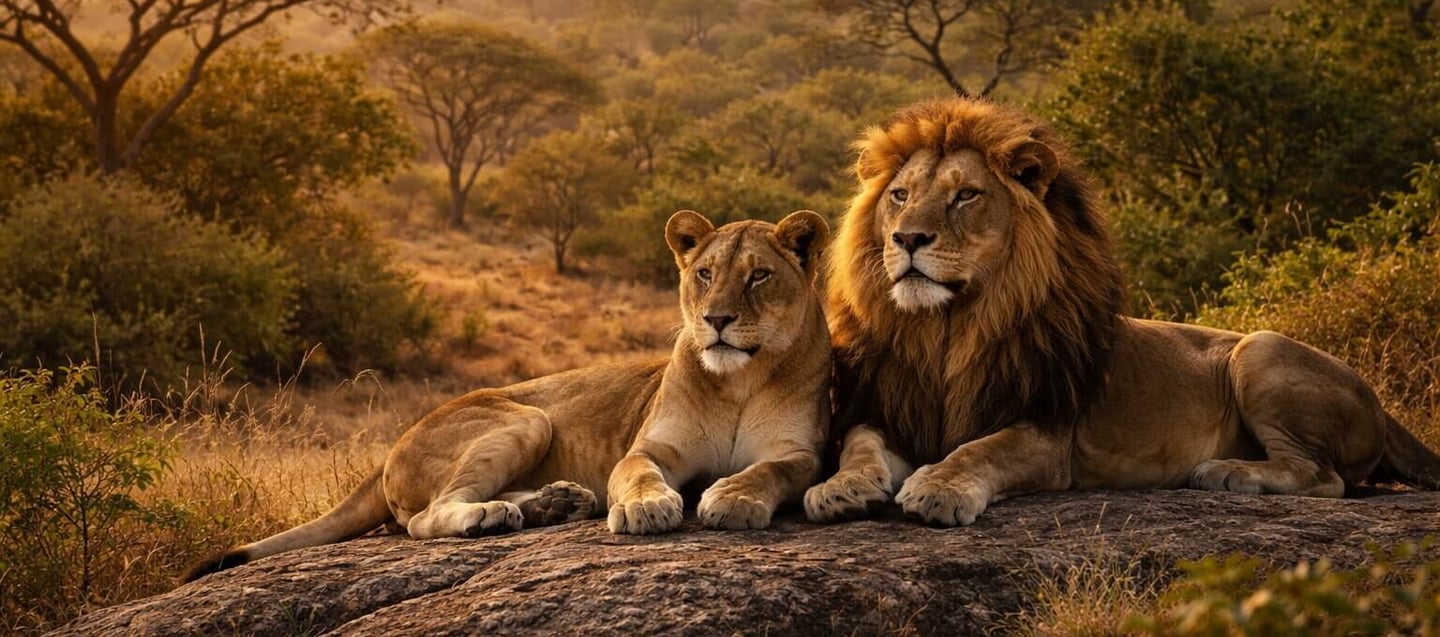
Asiatic Lions - Smaller and more lightly built than their African cousins, the males with shorter, less elaborate manes, but possessed of a presence that is no less magnetic. When a lion appears on the trail ahead sitting in morning shade, moving through dry grass with that characteristic feline indifference to being observed, or simply lying in the sun with the utter confidence of an animal at the top of its world the effect on even the most experienced wildlife watchers is immediate and profound. The world goes very quiet. Time slows. You understand, in that moment, why this animal has been the symbol of royalty and power in human culture for as long as human culture has existed.
Chital (Spotted Deer) - Moving through the forest in small herds, their spotted coats catching the dappled morning light, these are among the most beautiful animals in the Indian jungle. Their alarm call a sharp, penetrating bark is often the first sign that a predator is near.
Nilgai (Blue Bull) - India's largest antelope, the nilgai moves through Gir in small groups, their slate-blue coats giving them a distinctive, almost prehistoric appearance in the forest landscape.
Marsh Crocodiles - The rivers and seasonal water bodies of Gir the Hiran, Shingoda, and Machhundri are home to healthy populations of marsh crocodiles, often seen basking on riverbanks in the morning warmth with a stillness that makes them easy to mistake for logs until they suddenly, explosively, are not.
Indian Peafowl - India's national bird appears throughout Gir in extraordinary abundance. To see a peacock in full display that iridescent tail spread in a wheel of green and gold and blue, trembling with the effort of the display in its natural habitat, against the forest backdrop, is one of the great incidental pleasures of any Gir safari.
Birdlife - Gir has recorded over 300 bird species, and even travellers with no particular interest in birdwatching find themselves staring upward with increasing frequency. Crested serpent eagles, Indian rollers in their improbable blue-and-turquoise livery, paradise flycatchers trailing long white tail streamers, and the prehistoric-looking grey hornbills moving heavily from branch to branch are among the most spectacular.
After the morning safari, return to the resort for breakfast. The afternoon is yours - rest, wander the resort grounds, listen to the forest. If you wish to extend your wildlife experience, Devalia Safari Park (the Gir Interpretation Zone), a smaller enclosed section of the broader Gir ecosystem, offers an additional afternoon safari in a more concentrated wildlife environment, with particularly reliable lion and leopard sightings. This is an excellent optional addition, especially for families with children or for travellers who want to maximise their chances of seeing the full range of Gir's wildlife.
The evening at Gir is always atmospheric. As the light fades, the forest sounds shift, the daytime birds give way to the calls of nightjars and owls, and somewhere in the darkness, the jungle continues its ancient, self-sufficient life regardless of your presence or absence.
Day 4: Gir → Veraval by Train → Ahmedabad - The Comfortable Return
After a relaxed breakfast at your forest resort, your private car takes you back to Veraval Railway Station to board the Fast AC Train returning to Ahmedabad, departing in the afternoon, arriving in Ahmedabad in the late evening.
This return journey, like the outward journey, is the comfortable, civilised travel experience that distinguishes Package 11 from tours that simply put you in a car for hours on end. The same quality of service - complimentary snacks, meals, and mineral water, makes the journey as pleasant as the outward trip, and the hours on the train are an opportunity to rest after two days of early mornings and forest air, to look through your photographs, to discuss what you have seen, to begin the particular process of letting a wildlife experience settle into memory.
Arrive in Ahmedabad in the late evening. Transfer to your hotel by private car. Dinner at leisure, the hotel, a local restaurant, or room service if fatigue has the final vote. This is a rest night, intentionally and without apology. You have walked in the forest where the last Asiatic Lions live. Tomorrow, the city opens itself to you.
Day 5: Ahmedabad Sightseeing + Evening Train to Bhuj - The Heritage Day
After a good night's sleep and a proper breakfast, today gives you something that many multi-destination tours fail to build in: a full, unhurried day in one of India's most remarkable cities.
Ahmedabad's cultural heritage is deep enough to sustain several days of exploration, but today we give you the highlights that are both most accessible and most impressive, a carefully selected sequence of sites that together tell the story of a city that has been, for six centuries, one of India's great centres of commerce, art, architecture, and spiritual life.
Adalaj Stepwell - A few kilometres north of the city centre, this five-storey stepwell is one of the architectural wonders of Gujarat and one of the most extraordinary structures in India. Built in 1499 by Queen Rudabai as a gift to her subjects, providing cool water and shaded rest in the brutal summer heat, it descends five levels into the earth through a sequence of galleries and pavilions carved with such density and precision that the stone itself seems to breathe. Deities, musicians, dancing figures, flowering vines, geometric lattices, every surface is alive with carving, and the interplay of light and shadow as you descend into the well's cool interior is genuinely, deeply beautiful. Visiting Adalaj early in the morning, before the tour groups arrive, when the light falls obliquely through the upper openings and the carved galleries are quiet, is one of the most peaceful and beautiful heritage experiences in Gujarat.
Sidi Saiyyed Mosque & the Tree of Life - Small, unprepossessing from the outside, and containing within its prayer hall one of the most remarkable pieces of stone carving in the world. The Tree of Life jali window, a screen of interlaced stone carved into a design of roots, trunks, branches, and leaves of such delicacy and intricacy that it has become the symbol of Ahmedabad, reproduced on everything from the city's official logo to hotel room prints, is a genuinely staggering piece of craft. It was carved in 1573, and no one since has entirely explained how it was done. Stand before it in the morning light and understand, immediately, why it has been drawing visitors for four and a half centuries.
Sabarmati Ashram - Along the western bank of the Sabarmati, Mahatma Gandhi's ashram is one of the most quietly powerful heritage sites in India. This is where Gandhi lived, worked, wrote, spun his cotton on the charkha, and planned the resistance that would ultimately end British rule over the subcontinent. From this place, in March 1930, he led 78 followers on the Dandi Salt March — a walk of 241 miles to the sea to make salt in defiance of British salt laws, an act of non-violent civil resistance that changed the course of Indian history. The ashram today is a museum and place of reflection, its simple whitewashed buildings preserved exactly as Gandhi left them. Walking through it is a reminder that great historical change is often made from very small, very plain rooms.
Café Time & Shopping - The afternoon is yours. Ahmedabad has a thriving café culture, and the lanes of the old city and the CG Road area offer excellent options for coffee, lunch, and browsing. The Manek Chowk area of the old city transforms in the afternoon into one of the great street food experiences of Gujarat, bhajias, dabeli, pani puri, fafda-jalebi and the shops of the old city sell Gujarati textiles, block-printed fabrics, and silver jewellery at excellent prices.
Evening Train to Bhuj - In the early evening, your private car takes you to Ahmedabad Railway Station for the Fast AC Train to Bhuj. Note: This service does not include complimentary food, so we recommend a good lunch in Ahmedabad before boarding. The train arrives in Bhuj in the late evening, and your private car takes you directly to your hotel for check-in. Bhuj at night has a particular quality, the desert air is cooler than anything you've felt since arriving in India, the stars are brilliant in the clear sky, and the sense of having crossed into somewhere genuinely different from the Gujarat you have spent the past days in begins to make itself felt.
Rest well. Tomorrow, the desert begins.
Day 6: Bhuj → White Rann of Kutch (Dhordo) - The Desert Reveals Itself
After breakfast, we drive north from Bhuj toward Dhordo and the White Rann of Kutch, approximately two hours on a road that charts one of travel's most gradual and mesmerising transformations.
The change in landscape as you head north from Bhuj toward the Rann is not dramatic, it is gradual, and that gradualness is part of its power. The vegetation thins. The villages become smaller and further apart. The sky grows larger, a vast, uninterrupted blue vault, while the earth below it lightens by degrees from brown to pale ochre to sand to cream. You pass through a checkpoint, a reminder that this is a border region, that Pakistan lies not far to the north, that the Rann itself sits in one of the most geopolitically significant landscapes in South Asia. And then the earth is white.
Not pale. Not off-white. White. Pure, crystalline, mineral white - the Great Rann of Kutch, the largest salt desert in the world, 27,900 square kilometres of salt flat stretching north to the horizon and beyond, the dried bed of a shallow prehistoric sea that was cut off from the ocean by tectonic shifts thousands of years ago and has been evaporating and crystallising ever since.
The scale of it is genuinely difficult to process on first encounter. There is no reference point, no tree, no hill, no building, to give the eye a sense of distance. The horizon is simply everywhere. The silence, on a windless day, is complete. And the quality of the light that dry, luminous, desert light that bounces off the salt crystals in every direction is unlike any light you have experienced anywhere else.
Check in to your accommodation in the Dhordo Tent City area. During festival season (approximately November to February), this is the remarkable Rann Utsav Tent City (Shaam-e-Sarhad) - a beautifully designed temporary city of tents and cottages that manages to combine genuine immersion in the desert environment with real hospitality standards. This is not rustic camping. The tents are large, furnished, and comfortable, with proper beds, attached bathrooms, and the kind of warmth that makes cold desert nights a pleasure rather than a hardship.
The afternoon and evening deliver the full Rann experience at its most vivid:
Sunset at the White Rann - The single most important reason to be exactly where you are, at exactly this time of day. As the sun begins its descent, the white salt desert below undergoes a transformation so gradual and so dramatic that it seems impossible it is being produced by nothing more than changing angle of light. The white becomes gold, a rich, warm, honeyed gold that floods every surface and turns the entire desert into something that resembles the interior of a cathedral at the most beautiful hour of a late afternoon service. Then amber. Then a deep, resonant rose. Then, as the sun touches the horizon, violet and the sky above goes through its own parallel sequence of colours, so that for a few minutes the distinction between ground and sky blurs entirely, and you are standing inside something that has no edges.
People stand at the Rann at sunset and they go silent. Not because they are told to. Not because there is a rule. But because there is genuinely nothing to say that the light isn't saying better.
Cultural Folk Programme (Seasonal) - During Rann Utsav season, the evenings at the Tent City are animated by cultural performances of extraordinary quality, Kutchi folk music and dance traditions that have been practised in this region for generations, performed by artists whose families have been carrying these traditions for centuries. The Garba circle dances, the Bhavai acrobatic folk theatre, the deep, resonant vocals of the desert music tradition, they fill the festival ground with warmth and energy that makes the cold desert night feel festive rather than austere.
Day 7: White Rann → Bhuj - Heritage, Craft & the Heart of Kutch
After breakfast at the Tent City, a meal taken, ideally, in the morning light with the desert still white and calm around you, we drive back to Bhuj, arriving around midday.
Bhuj reveals itself differently when you approach it from the Rann. Having spent a night sleeping on the edge of the salt desert, having watched the sun rise over white nothing, having felt the particular quality of Kutch's silence and space, you arrive in Bhuj with a heightened sensitivity to everything the city offers, its colour, its craft, its warmth, its human scale.
Aina Mahal (Palace of Mirrors) - Built in the eighteenth century for Rao Lakhpatji, the visionary ruler of Kutch who sent his master craftsman Ramsingh Malam to Europe to learn the arts of glassmaking, clockmaking, and enamelling, the Aina Mahal is one of the most eccentric and magnificent interiors in all of India. Its rooms are lined with Venetian-style glass mirrors framed in gilded stucco, studded with coloured glass chandeliers, tiled with blue-and-white Delft-inspired ceramics. It is a building that refuses to choose between East and West and is gloriously, improbably the richer for its refusal. Damaged in the 2001 earthquake but carefully restored, it stands today as a testament to both the ambition of its original patron and the determination of the Kutchi people to preserve what matters.
Prag Mahal - Next door to the Aina Mahal, the Prag Mahal presents a startling visual contrast. Built in the 1860s in a full Gothic Revival style, soaring stone facade, pointed arches, a cathedral-like clock tower that rises above the surrounding streets with the confident improbability of an English country church that has somehow found itself in the middle of the Kutch desert, it is a building of enormous architectural drama. The views from the clock tower, on a clear day, extend across the rooftops of Bhuj to the distant shimmer of the Rann on the northern horizon.
Bhuj Market Shopping - The old city bazaars of Bhuj are among the finest craft markets in Gujarat, and an afternoon here is both a pleasure and an opportunity. The full range of Kutchi craft production is available: densely embroidered textiles from the Rabari, Ahir, and Mutwa communities; Ajrakh block-printed fabric in indigo and madder from the workshops of Ajrakhpur; Bandhani tie-dye in the brilliant, jewel-like colours that have made this tradition one of Gujarat's most celebrated; hand-woven Kutchi shawls from the Bhujodi weavers; silver jewellery in the bold geometric forms characteristic of the Kutchi aesthetic; and dozens of smaller craft objects, embroidered pouches, lacquered furniture, hand-painted pottery that make gifts of genuine beauty and cultural significance.
Take your time here. The best craft shopping is never rushed, and the best merchants welcome conversation. Ask where a piece was made. Ask about the technique. Ask about the community whose tradition produced it. The answers add layers of meaning to everything you bring home.
Early Dinner & Rest in Bhuj - An early dinner tonight is not merely pleasant, it is logistically sensible. Tomorrow begins before dawn, and a good dinner and a full night's sleep are the best preparation for the last leg of this journey home.
Day 8: Bhuj → Ahmedabad by Fast AC Train - The Journey Home
This is an early morning. The alarm goes off in the pre-dawn dark. The hotel room is cool. Outside, Bhuj is still quiet, the streets empty, the desert sky above still thick with stars. The car is waiting.
You drive to Bhuj Railway Station in time to board the Fast AC Train departing at approximately 05:00 AM for Ahmedabad. Note: This service does not include complimentary food and refreshments, so we recommend packing some snacks and drinks from the hotel the evening before, or purchasing from platform vendors at the station.
The train crosses the breadth of Gujarat in the early morning light, a journey of approximately six hours, arriving in Ahmedabad around 11:00 AM. The progression of landscape visible from the window traces your entire journey in reverse: the flat ochre expanses of Kutch giving way to the greener agricultural plains of central Gujarat, the towns growing larger and more frequent, the urban density of Ahmedabad approaching. It is a journey that has its own quiet satisfaction, the pleasure of watching a large country reassemble itself around you after you have spent a week inside it, learning its specific textures and sounds and smells.
Arrive in Ahmedabad. Transfer by private car to the airport or railway station for your onward journey, whether that is a domestic flight to Mumbai or Delhi, an international departure, or a train to your next destination in India.
Your Gujarat journey ends in Ahmedabad, the same city where it began, but you are not quite the same traveller who arrived eight days ago. You have walked in the forest where the last wild lions live. You have stood on a white desert under the most improbable sunset you have ever seen. You have held in your hands an embroidered textile made with a skill that has been alive in Kutch for four hundred years. You have eaten a thali so good it changed your understanding of what vegetarian food can be.
Take those things home. They will last considerably longer than the photographs.
What's Included in Your Package
Every element of this tour has been selected to deliver maximum comfort, quality, and experience:
✅ 7 Nights Accommodation - Carefully selected properties across Ahmedabad (2 nights), Gir/Sasan Gir (2 nights), Bhuj (2 nights), and Dhordo/White Rann (1 night), all chosen for comfort, location, and quality of hospitality. Accommodation near the White Rann includes Tent City or equivalent cultural stay during festival season.
✅ Daily Breakfast - A proper sit-down breakfast at your accommodation every morning.
✅ Fast AC Train Travel - Comfortable, air-conditioned train journeys on the Ahmedabad–Veraval–Ahmedabad and Ahmedabad–Bhuj–Ahmedabad routes. Complimentary snacks, meals, and water included on the Ahmedabad–Veraval services. Reserved seating throughout.
✅ Private AC Car Transfers - Your own dedicated vehicle for all road transfers, local sightseeing, and journeys between stations and accommodations. No shared transport, no strangers in your vehicle.
✅ Gir Jungle Safari - Safari permit and entry as per package plan, conducted in open jeeps with experienced naturalist guides.
✅ White Rann of Kutch Visits - Entry and access to the White Rann viewing areas as per itinerary, including sunset experience.
✅ All Sightseeing as per Itinerary - Every heritage site, wildlife area, and cultural destination mentioned in this itinerary.
✅ All Tolls, Parking & Driver Allowances - No hidden road costs.
❌ What Is Not Included
In the spirit of complete transparency:
❌ International airfare and domestic flights - Not included. We can advise on suitable connections to and from Ahmedabad.
❌ Lunch and dinner - Meals beyond daily breakfast are your own. Gujarat offers extraordinary food options at every price point and we encourage you to explore them freely.
❌ Personal expenses - Tips, laundry, phone charges, personal shopping, and similar costs are the traveller's responsibility.
❌ Travel insurance - Strongly recommended for all international travellers. Please ensure you have comprehensive coverage before departure.
❌ Indian visa charges - Visa costs and arrangements are the responsibility of the traveller.
Best Time to Visit
October through March is the ideal season for this tour, and each month within that window has its own particular appeal:
October – November: Post-monsoon Gujarat is green and alive. Gir is excellent for wildlife, with animals active after the wet season. The weather is warm but manageable. The Rann is dry and walkable, though Rann Utsav may not yet be fully operational in early October.
December – January: Peak season and, for most travellers, the finest time to visit. The weather is at its most pleasant, the Rann Utsav is at full cultural intensity, Gir safari conditions are excellent as animals gather near water, and the clear winter skies deliver the most dramatic desert light and moonlit nights of the year.
February – March: The tail end of the ideal season, with warming temperatures and thinning festival crowds that make for a more intimate experience. March is the final month before the heat makes desert travel uncomfortable.
Gir National Park is closed annually from approximately mid-June to mid-October for monsoon season. Please confirm park dates and Rann Utsav festival dates when booking.
Why Book This Journey with UK India Tourism?
The logic of this package - the train-plus-car combination, the two nights at Gir, the full day at the Rann, the Bhuj cultural layer, did not emerge from a brochure. It emerged from years of listening to international travellers, from understanding what works and what doesn't, from the specific experience of bringing guests from the United Kingdom, the United States, Europe and beyond to Gujarat and learning, journey by journey, what a truly excellent experience requires.
What it requires, we have found, is not more attractions. It is more thought. More attention to the gaps between the highlights - the transfers, the transitions, the moments of arrival and departure that determine whether a journey feels smooth or stressful, comfortable or exhausting. Package 11 is the result of applying that thinking to every hour of an eight-day journey.
You get:
✅ Smart routing - The train-plus-car combination is the most comfortable and efficient way to cover these distances. It is not a budget compromise; it is the best available choice.
✅ Genuine wildlife time - Two nights at Gir means two safari opportunities and an unhurried afternoon in the forest. This is how wildlife should be experienced: with time to wait, to listen, to let the jungle come to you.
✅ A complete Gujarat story - Heritage city, wild lion forest, white salt desert, living craft culture. These are Gujarat's four great themes, and Package 11 delivers all of them in a sequence that builds naturally and satisfyingly.
✅ The right pace for real enjoyment - Not rushed, not padded with filler. Every day has a purpose, and every evening has time to breathe.
✅ International traveller expertise - UK India Tourism understands what guests from the United Kingdom and the United States need: reliable communication, transparent logistics, quality accommodation standards, and the knowledge that the people handling your journey are experienced, trustworthy, and genuinely care about the outcome.
This is Gujarat designed not for the largest possible number of ticked boxes, but for the deepest possible quality of experience.

Ready for Gujarat's Wildlife & Desert Magic - In Complete Comfort?
Your Gujarat journey, planned with intelligence and delivered with care. Because the lions are in the forest. The desert is turning gold at the horizon. The train is on time.
And we have a seat reserved for you.
UK: +44 7345 191205
India: +91 9958 480873
Email: sales@ukindiatourism.co.uk
UK India Tourism
Travel Specialists for UK, USA, Canada, Australia, France, Poland, Singapore, Japan @ beyond
UK: +44 7345191205
UK India Tourism© 2026, all rights reserved
India: +91 9958480873
⭐⭐⭐⭐⭐ 4.9/5 | 2,600+ Travelers | 18 Years | 98% Recommend