Explore India Monsoon Luxury Travel 2026
Discover why India's monsoon or rainy season is emerging as most exclusive luxury travel window from Ayurveda in Kerala to private Western Ghats and retreats.
Adarsh Gupta
7/9/202612 min read
The Monsoon Case: Why India's Rainy Season Is Its Best-Kept Luxury Secret
Every July, as the southwest monsoon, India's rainy season, rolls in across the Western Ghats and settles over Kerala's backwaters, a curious pattern repeats itself in the international travel trade. Tour operators quietly deprioritise the season. Airlines shift capacity elsewhere. Guidebooks default to warnings about washed-out roads and cancelled excursions. And a small, well-informed segment of luxury travellers from London, Toronto, Sydney, and Singapore does exactly the opposite. They book.
This is not contrarianism for its own sake. India's monsoon, the rainy season that runs broadly from June through September, has for centuries been treated by Ayurvedic physicians not as an obstacle to wellness but as its foundation. Kerala's Karkidakam season, the traditional Malayalam month falling in July and August, is considered by generations of vaidyas the single most effective period for the deep detoxification therapies that Ayurveda is built around. Meanwhile, the same rains that empty beach resorts fill the Western Ghats with a density of green that photographs like nowhere else in the country, and push Himalayan retreat towns into a hush that high season simply cannot replicate.
For a luxury travel company built around India, this is not a marginal footnote. It is arguably the most under-marketed asset in the entire Indian tourism calendar, and for the international traveller willing to look past the reflexive assumption that rain ruins a holiday, it represents a genuinely different kind of journey: quieter, more intentional, and in the case of wellness travel, medically purposeful rather than merely relaxing.
The Season Most Travellers Skip and Why the Rainy Months Are the Point
The case for monsoon travel in India begins with a simple observation about scarcity. Luxury, at its core, is rarely about opulence alone. It is about access to something that most people cannot or will not obtain, whether that is a private audience with a heritage property, a table with a view, or simply a destination without the crowd. India's dry season, from October through March, is precisely when international arrivals peak, when palace hotels in Udaipur and Jaipur run at full occupancy, and when the most photographed corners of Rajasthan are shared with several coach parties at once.
Monsoon inverts that entirely. Occupancy drops. Rates on many luxury properties fall accordingly, even as the experience on offer, arguably, improves. Heritage havelis that feel congested in December turn contemplative in July. Wildlife lodges near Ranthambore and Kanha, which some travellers assume close outright during the rains, in fact use the quieter months to focus on birding, guided nature walks, and slower-paced immersion rather than the vehicle-heavy tiger-spotting circuits of peak season.
None of this is to suggest the monsoon suits every itinerary. Certain regions do become genuinely difficult to navigate, and this is addressed directly later in this piece. But for three specific categories of experience, wellness retreats in Kerala, hill retreats in the Western Ghats, and rejuvenation stays in the lower Himalayas, the rains are not a compromise. They are the reason to go.
Karkidakam: The Ancient Science Behind Kerala's Monsoon Ayurveda
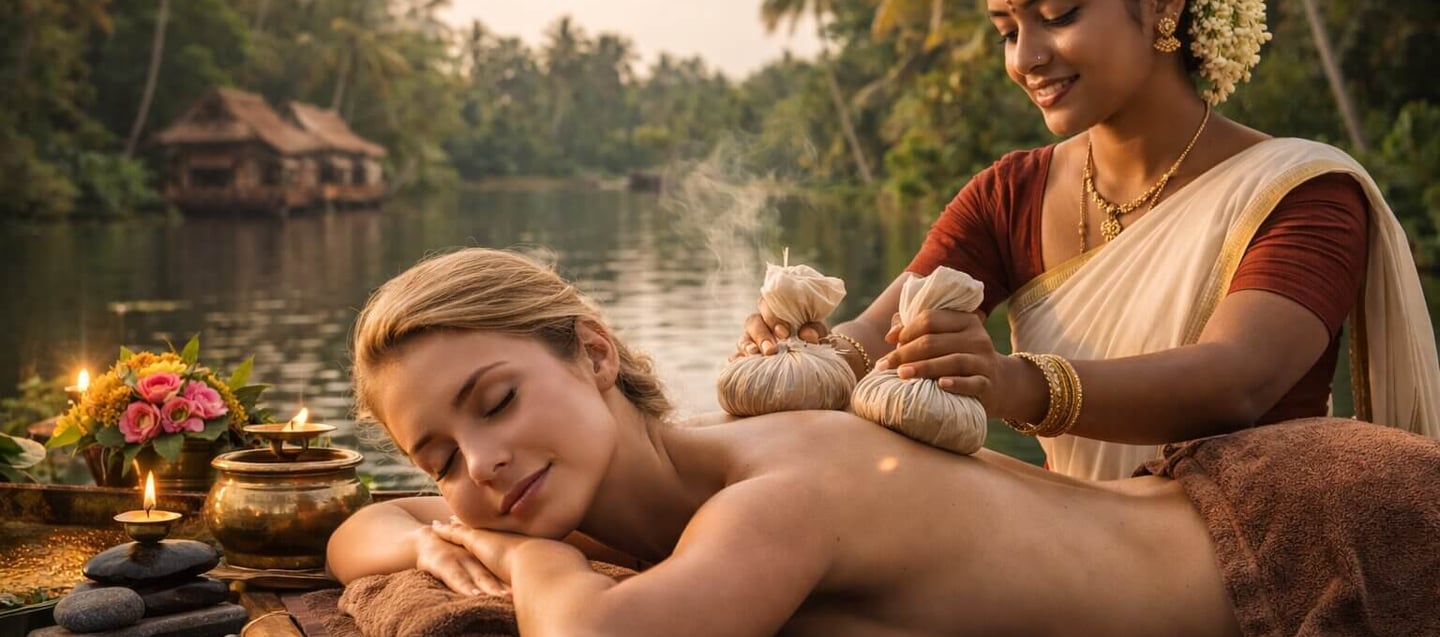
To understand why monsoon has become the centrepiece of serious Ayurvedic travel to Kerala, it helps to understand Karkidakam itself. In the traditional Malayalam calendar, Karkidakam is the final month of the year, typically falling between mid-July and mid-August, and it coincides with the peak of Kerala's southwest monsoon. Ayurvedic tradition classifies the year into six ritus, or seasons, and Varsha ritu, the rainy season, has long been regarded by vaidyas as the period in which the body is most receptive to deep purification.
The reasoning is both climatic and physiological. Ayurvedic texts describe the monsoon as a season in which the body's internal channels, or srotas, dilate under the influence of cool, humid air, while digestive fire, or agni, naturally slows. Practically, this means the skin absorbs medicated oils used in therapies such as Abhyanga and Pizhichil more readily, the cooler temperatures make prolonged steam and oil treatments more tolerable, and the body's reduced metabolic pace is considered better suited to intensive detoxification protocols such as Panchakarma than the heat and dryness of the summer months.
This is not purely traditional lore. Contemporary reviews in Ayurvedic and integrative medicine literature have pointed to elevated humidity accelerating the transdermal absorption of medicated oils, and practitioners across Kerala's Ayurvedic hospitals report that Panchakarma protocols conducted during monsoon frequently require lower doses of purgative herbs, since the climate itself has already begun loosening accumulated toxins, making the process both more effective and, for the guest, more comfortable than an equivalent summer programme.
The Karkidaka Chikitsa Tradition
Kerala's specific monsoon regimen, Karkidaka Chikitsa, has been practised for generations as a preventive and restorative programme timed precisely to this window. It typically combines Panchakarma's five classical therapies, Vamana, Virechana, Basti, Nasya, and Raktamokshana, with a monsoon-adapted diet built around warm, easily digestible foods, and a slower daily rhythm that discourages overexertion. Guests commonly report improved sleep, reduced joint discomfort, and a marked sense of mental clarity, outcomes that Kerala's Ayurvedic community attributes to the alignment between the season's natural effects on the body and the therapeutic goals of the treatment itself.
For international travellers, this translates into a case that goes well beyond scenery. A wellness journey to Kerala timed to Karkidakam is not simply a spa holiday relocated to a beautiful setting. It is participation in a therapeutic tradition that Kerala's own medical establishment considers most effective during precisely the weeks that international tour operators tend to steer travellers away from.
Where to Experience It
Kerala's Ayurvedic hospitality sector has built an entire seasonal infrastructure around Karkidakam, and the properties best equipped for it tend to be those with in-house physicians, dedicated pharmacies, and treatment protocols built for stays of two to three weeks rather than a handful of days. Backwater-facing retreats near Kumarakom and Kollam, plantation-set centres near Thrissur, and heritage Ayurvedic palaces further inland each offer a distinct register of the same underlying tradition, from clinical rigour to a softer, more resort-like immersion. The common thread across the strongest options is a licensed in-house pharmacy, resident vaidyas rather than visiting consultants, and a kitchen built specifically around the dosha-balanced diet that Karkidaka Chikitsa depends on.
For travellers coming from the United Kingdom, the United States, Canada, or Australia, the practical guidance from operators and physicians alike is consistent: book a minimum of fourteen nights, arrange the trip two to three months ahead to secure a preferred physician and room category, and expect the itinerary to prioritise stillness over sightseeing. This is a wellness journey built around depth rather than coverage, and it rewards travellers who arrive with that expectation already set.
The Western Ghats: Where the Rains Turn the Hills Into Something Else Entirely
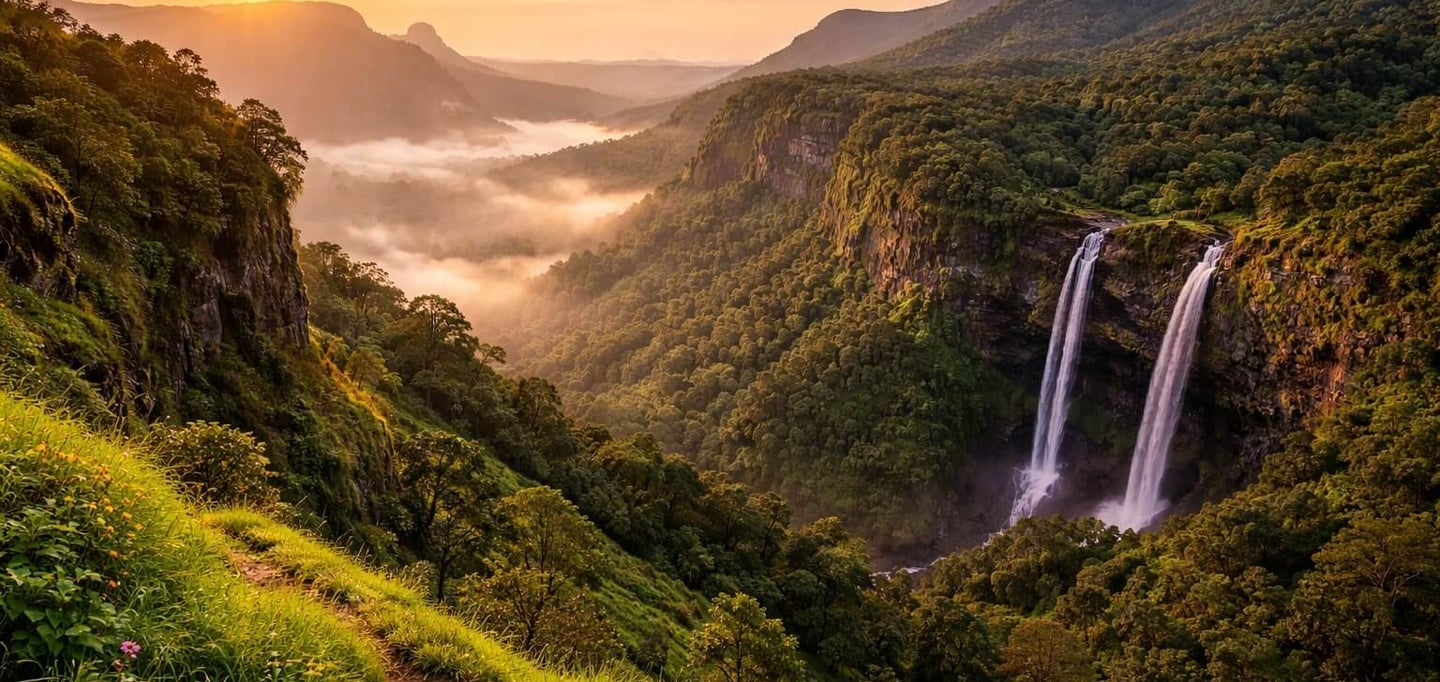
Beyond Kerala's wellness circuit, the monsoon transforms an entirely different stretch of India: the Western Ghats, the mountain range running down the country's western edge through Maharashtra, Karnataka, and Kerala. For most of the year, this range is a green backdrop. During monsoon, it becomes the destination itself. Waterfalls that are barely a trickle in April become full torrents by July. Hill stations across Coorg, Coonoor, and the Kasauli belt in the north turn a saturated emerald that photographs and, more importantly, feels entirely different from the dusty landscapes of India's dry season.
This shift has not gone unnoticed by India's own luxury hospitality sector. Properties built around slower, destination-led stays, rather than sightseeing-dense itineraries, have increasingly positioned themselves around exactly this seasonal window, marketing the monsoon specifically as a moment for guests to disconnect from routine amid natural surroundings rather than around a checklist of nearby attractions. Coorg's coffee estates take on a particular character during the rains, with plantation walks conducted under a canopy rather than open sun, and forest immersion stays leaning into the cooler, mist-heavy mornings that the dry season cannot offer.
For an international audience accustomed to associating rain with a ruined holiday, framing matters enormously here. A private plantation stay in Coorg during July is not a soggy compromise. It is closer to what a well-heeled Indian traveller increasingly seeks out deliberately: a quieter, more textured version of a landscape that during peak season is comparatively flat and overexposed. The same logic extends to newer wellness-adjacent circuits emerging in Coonoor, where small-estate tea tours built around the health properties of single-origin teas have started to draw a more curious, less crowd-dependent traveller.
The Himalayan Rejuvenation: Wellness Above the Clouds
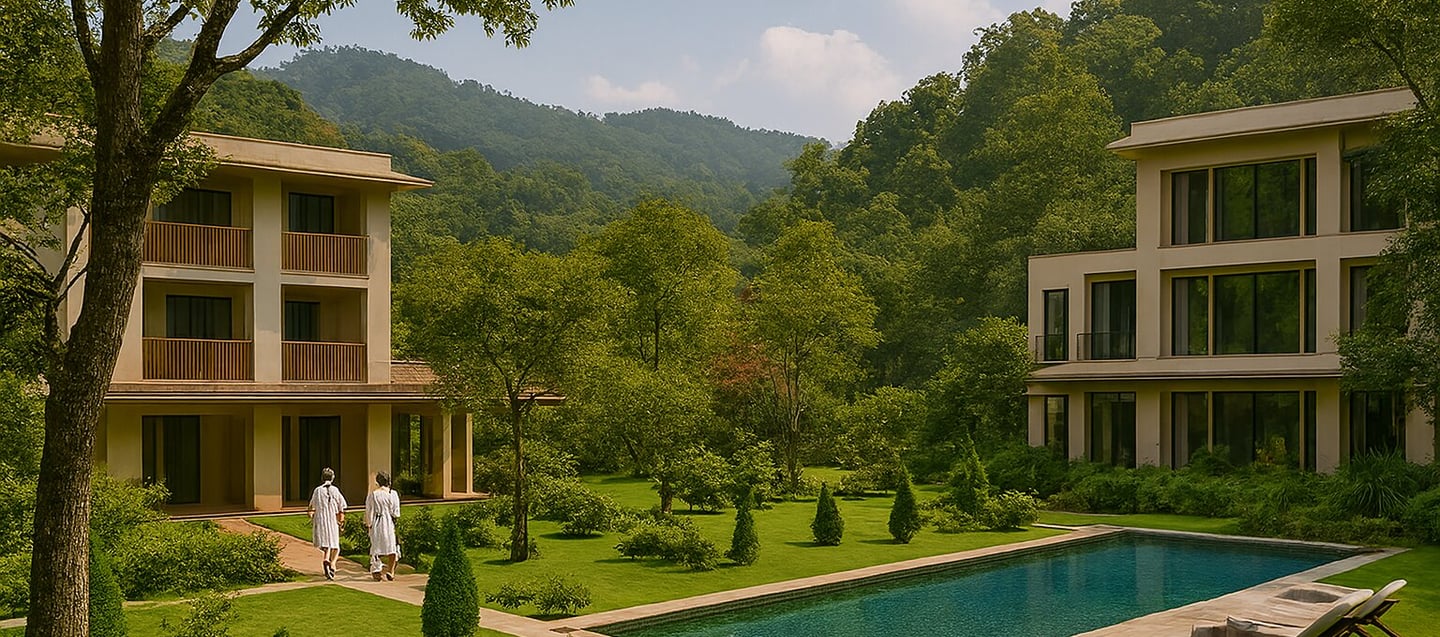
A third, quieter case for monsoon travel sits further north, in the lower reaches of the Himalayas. Towns such as Rishikesh have long built a reputation around yoga and meditation, but the monsoon months bring a specific atmospheric shift that many retreat operators consider genuinely additive to the experience, cooler air, cleared skies between showers, and a natural reduction in the tourist volume that can otherwise crowd riverside ashrams and meditation centres during the high season around Diwali and the winter months.
This is where India's broader 2026 travel narrative intersects directly with the monsoon case. Indian and international operators alike have noted a marked rise in what is being described industry-wide as the wellness-first traveller, someone who structures a trip around spa retreats, Ayurvedic treatment, and rejuvenation rather than treating wellness as an add-on to a sightseeing itinerary. Kerala remains the undisputed centre of this movement, but retreat towns in the Himalayan foothills are increasingly positioned as a complementary leg for travellers who want to pair Ayurvedic treatment in the south with meditation and sound healing in the north, a combination that plays naturally into longer-haul itineraries built for travellers from the UK, North America, and Australia who are already committing to a long flight and prefer to make the most of it.
The practical case for timing this leg to monsoon rather than around it is straightforward. Retreat towns that are difficult to book quietly in October are considerably easier to access in July, and the cooler, damp air that Himalayan hill towns take on during the rains suits the slower, more introspective pace that meditation-focused stays are designed around in the first place.
What a Monsoon Luxury Journey Through India Actually Looks Like
Put together, these three regional cases point toward a specific kind of itinerary, one built less around the sightseeing density of a classic Golden Triangle tour and more around depth in fewer places. A representative monsoon journey for an international traveller might open in Kerala with a two to three week Karkidakam Ayurveda programme at a licensed retreat near the backwaters, move to a private plantation stay in Coorg or the Nilgiris for a slower, immersive week among the coffee and tea estates, and close with a shorter stay in the Himalayan foothills focused on yoga and meditation before departure.
This structure suits a specific type of traveller rather than every traveller, and that distinction matters. It is not built for a first-time visitor to India who wants the Taj Mahal, Jaipur's City Palace, and a tiger safari in a single trip; that itinerary is better served by the dry season, when road conditions and wildlife visibility are both at their best. It is built instead for a returning traveller, or a traveller specifically seeking a wellness-led or nature-led journey, who is comfortable trading sightseeing volume for depth, and who is arriving with realistic expectations about rain rather than treating it as an inconvenience to be managed around.
This is also where a genuinely useful monsoon itinerary depends on local expertise rather than a generic template. Rainfall intensity varies enormously across India's geography and even within a single state, and the difference between a beautifully timed monsoon trip and a frustrating one usually comes down to which specific region, and which specific weeks, a traveller is booked into.
Transfers between these three legs also deserve more attention than a dry-season itinerary would require. Road conditions in the Western Ghats can shift quickly during heavy rain, and building a day of buffer between a hill-region stay and the next flight or transfer, rather than scheduling departures back to back, is standard practice among operators who run this itinerary regularly. The same applies to domestic flight connections into Kerala's smaller airports, where monsoon-related delays, while infrequent, are more common than during the dry season and are best planned around rather than assumed away.
Who This Season Suits and Who Should Wait
Honesty about limitations matters here as much as the case for the season itself. Monsoon travel to India is not well suited to travellers whose primary interest is classic heritage sightseeing in Rajasthan, where intense heat gives way to genuinely difficult road conditions during the peak rains, or to safari-focused travellers who want maximum wildlife visibility, since several national parks either close entirely or reduce vehicle access during the wettest weeks. Coastal Goa, similarly, becomes a genuinely different and often less comfortable proposition during peak monsoon than it is in the cooler months.
Where monsoon travel excels is precisely in the three regions already discussed: Kerala's Ayurvedic circuit, where the rains are the entire point rather than an obstacle; the Western Ghats hill regions, where the transformation in landscape is dramatic and genuinely photogenic; and the Himalayan foothill retreat towns, where cooler air and reduced crowds improve rather than detract from a meditation-focused stay. Within these three regions, the monsoon is not a season to work around. It is the reason to visit at all.
The clearest way to frame this for an international audience considering the trip is that monsoon travel in India rewards travellers with a specific purpose, wellness, nature immersion, or a slower, more contemplative pace, and is best avoided by travellers whose primary goal is comprehensive sightseeing across multiple regions in a single visit.
This is also a useful filter for a family or multi-generational group weighing the season. Where younger, activity-driven travellers may find the reduced outdoor mobility during peak rains restrictive, older travellers and those specifically seeking rest tend to find the enforced slower pace genuinely restorative rather than limiting. The growing multi-generational luxury segment, in particular, has begun to treat monsoon stays in Kerala and the Western Ghats as an opportunity for shared, low-intensity time together, built around communal meals, spa treatments, and unhurried conversation rather than a packed sightseeing schedule that rarely suits every generation in a family equally well.
Practical Intelligence for International Travellers Planning a Rainy Season Trip
When to Book
Karkidakam falls between mid-July and mid-August each year, and the properties best equipped for it, those with resident vaidyas and licensed in-house pharmacies, are typically booked two to three months in advance by returning wellness travellers, particularly from the UK, Germany, and North America. For a trip built around this specific window, booking by April or May for a July arrival is the realistic guidance most established Ayurvedic hospitals give international guests.
What to Expect Regionally
Kerala's monsoon arrives in two phases, the southwest monsoon from roughly June to August and a lighter northeast monsoon from October to November, and rainfall intensity is generally heavier in the state's northern districts than in the south, meaning first-time monsoon travellers are often better served starting around Kochi or Thrissur before considering the more intense rainfall further north. The Western Ghats hill regions follow a broadly similar pattern, with the heaviest rain concentrated in July and August before tapering through September.
Packing and Pacing
A monsoon itinerary is not one to over-schedule. Building in flexibility around transfers, particularly between hill regions, is standard practice, and travellers should expect and welcome a slower daily rhythm rather than treating any weather-related adjustment as a disruption. Light waterproof layers, breathable clothing suited to high humidity, and a realistic expectation of indoor time between showers all serve the trip better than an itinerary built to dry-season assumptions.
The Verdict: India's Quietest Luxury Window
The broader story of India's luxury travel sector in 2026 is one of maturation, a shift away from mass-market sightseeing and toward personalised, experience-led journeys, and monsoon travel sits squarely inside that shift rather than apart from it. It is, in effect, India's version of shoulder-season travel done properly: lower rates, sharply reduced crowds, and in the specific case of Kerala's Ayurvedic tradition, an experience that is not merely tolerable during the rains but is considered by the very physicians who practise it to be at its most effective precisely then.
For the international traveller weighing a first or a return trip to India, the monsoon case is ultimately not an argument against the country's more famous dry-season circuits. It is an argument for treating India as a destination with more than one correct season, and for recognising that some of its deepest and most distinctive experiences, a Karkidakam detox in Kerala, a plantation stay in the Western Ghats under a canopy of rain, a meditation retreat in a hushed Himalayan foothill town, are built specifically around the weeks that the rest of the travel industry tends to overlook.
That, more than any single itinerary, is the case for planning a luxury India journey around the rains, the rainy season that so much of the industry still treats as a problem to work around, rather than in spite of them.
This is precisely the kind of itinerary that rewards working with a specialist rather than a generalist. UK India Tourism builds each monsoon journey around verified, licensed Ayurvedic hospitals rather than resort spas repackaging treatments for tourists, sequences transfers with the region-by-region rainfall variance in mind rather than a fixed template, and works exclusively with properties experienced in hosting international guests through this specific season. For travellers in the UK, USA, Canada, Australia, and beyond considering a monsoon trip to India for the first time, that local judgement, knowing which weeks suit Kerala over the Western Ghats, which physicians are taking new guests, and which transfers need a buffer day, is the difference between a beautifully timed journey and a frustrating one.
Ready when you are
Let Us Bring Your India Dream to Life
UK India Tourism Company
UK Phone: +44 7345 191205
India Phone: +91 9958 480873
Email: sales@ukindiatourism.co.uk
Website: https://ukindiatourism.co.uk/
Luxury India Tour Specialists for UK, USA, Canada, Australia, Europe, Singapore, Japan and beyond
UK: +44 7345191205
UK India Tourism© 2026, all rights reserved
India: +91 9958480873
⭐⭐⭐⭐⭐ 4.9/5 | 2,600+ Travelers | 18 Years | 98% Recommend