UNESCO World Heritage Sites in India: Complete Guide
Discover all 45 UNESCO World Heritage Sites in India, from the Taj Mahal to the Western Ghats, with a complete travel guide for all international travellers.
Adarsh Gupta
8/6/202621 min read


UNESCO World Heritage Sites in India: The Complete Guide for International Travellers
India holds 45 UNESCO World Heritage Sites as of July 2026, more than almost every country outside of Italy, China and a small handful of others, and each one sits inside a landscape built for slow, considered travel rather than a checklist tour. For a first time visitor from the United Kingdom, the United States, Canada, Australia or Europe, that number can feel abstract until you see what it means on the ground. It means a single state such as Rajasthan holds enough listed heritage to fill three weeks on its own. It means a single morning in Delhi can carry you through three separate UNESCO sites before lunch. It means that the temples of Tamil Nadu, the desert forts of Rajasthan, the rock cut caves of Maharashtra and the mangrove wilderness of the Sundarbans are all technically part of the same trip, even though a single visitor rarely has the time to see more than a fraction of them in one journey.
This guide walks through every one of India's recognised sites, grouped by region, with the historical context, the travel logistics and the seasonal timing that matter to someone planning a trip from overseas rather than revising for a history exam. It is written for travellers who want to understand not just what a site is, but how it fits into a realistic itinerary, what time of year suits it best, and how it connects to the sites around it.
What Is a UNESCO World Heritage Site and Why It Matters for Your India Itinerary
A UNESCO World Heritage Site is a place, whether a monument, a city, a forest or a mountain range, that the United Nations Educational, Scientific and Cultural Organisation has judged to hold outstanding universal value to humanity. The designation exists under the World Heritage Convention of 1972, which India signed in November 1977, and it applies to places that meet at least one of ten defined criteria covering human creative genius, cultural interchange, testimony to a civilisation, architectural or technological achievement, traditional settlement patterns, superlative natural phenomena, evolutionary history, ecological processes or critical habitats for biodiversity.
For a traveller, the practical value of the list is quality assurance. A UNESCO listing means a site has been independently verified as significant, that a conservation framework exists around it, and that visitor infrastructure, however basic in some cases, has had international attention drawn to it. Building an India itinerary around these sites is a reliable way to guarantee substance in every stop, rather than relying on guesswork or generic top ten lists.
How a Site Earns UNESCO Recognition
Each country maintains a tentative list of properties it intends to nominate. India's tentative list currently runs to more than 60 sites. A formal nomination then goes to the International Council on Monuments and Sites for cultural properties or the International Union for Conservation of Nature for natural properties, both of which conduct independent technical evaluations covering authenticity, condition and the strength of the site's legal protection framework. The World Heritage Committee, made up of representative states, makes the final inscription decision at its annual session, and can also request further information, defer a decision, or decline a nomination outright if the evaluation raises concerns. The process typically takes years from tentative listing to inscription, which is why the list grows slowly and each addition carries real weight, both for the country nominating it and for the site itself, which then becomes subject to ongoing international monitoring of its conservation status.
India's UNESCO World Heritage Sites at a Glance
India's first four sites, Agra Fort, the Ajanta Caves, the Ellora Caves and the Taj Mahal, were all inscribed together in 1983, the same year India's involvement with the Convention began to bear results. Since then the list has grown steadily, with the most recent addition being the Ancient Buddhist Site of Sarnath near Varanasi, inscribed in July 2026 at the 48th session of the World Heritage Committee in Busan, South Korea.
Of the 45 sites, 37 are classed as cultural, covering monuments, cities, archaeological remains and living heritage such as functioning railways. Seven are classed as natural, covering national parks, wetlands and mountain ecosystems. One site, Khangchendzonga National Park in Sikkim, holds mixed status, recognised for both its natural biodiversity and its sacred cultural meaning to indigenous Sikkimese communities. This distribution places India sixth in the world for total UNESCO World Heritage Sites, and first in South Asia by a wide margin.
Geographically, the sites are spread across 18 states and union territories, from the Himalayan borderlands in the north to the tropical coastline of Tamil Nadu in the south, and from the Thar Desert forts of Rajasthan in the west to the burial mounds of Assam in the northeast. No single itinerary can cover all 45 in one trip, which is precisely why the regional breakdown below is built around realistic travel clusters rather than an alphabetical list.
The pace of new inscriptions has also picked up noticeably in recent years, with Santiniketan and the Sacred Ensembles of the Hoysala added in 2023, the Moidams in 2024, the Maratha Military Landscapes in 2025 and Sarnath in 2026. That means the list a traveller researches today is genuinely more current than the one available even eighteen months ago, and it is worth checking for updates before finalising an itinerary, particularly if a trip is being built around a specific regional cluster.
Cultural Heritage Sites of Delhi and the Golden Triangle
The Golden Triangle, connecting Delhi, Agra and Jaipur, is the most heritage dense travel circuit in India and the natural starting point for most first time visitors from overseas. It alone accounts for nine UNESCO listings within a radius that can comfortably be covered by road in under a week.
Humayun's Tomb, Delhi
Built in the 1560s for the Mughal emperor Humayun, this tomb was the first garden tomb on the Indian subcontinent and the architectural template that would eventually produce the Taj Mahal. Its red sandstone and white marble structure, set within a formal Persian charbagh garden, is quieter and less crowded than Delhi's other major sites, making it a good early morning stop.
Qutb Minar and Its Monuments, Delhi
The Qutb Minar is a 13th century minaret rising 73 metres, the tallest brick minaret in the world, built by Qutbuddin Aibak to mark the beginning of Muslim rule in Delhi. The surrounding complex includes the iron pillar of Delhi, a metallurgical curiosity that has resisted rust for over 1,600 years, and a scattering of tombs and mosque ruins that trace the earliest phase of Indo-Islamic architecture in India.
Red Fort Complex, Delhi
The Red Fort was the residence of Mughal emperors for nearly two centuries and remains the site of India's Independence Day address each year. Its red sandstone walls, audience halls and pavilions represent Mughal architecture at its artistic peak, built in the mid 17th century under Emperor Shah Jahan, the same ruler behind the Taj Mahal.
Taj Mahal, Agra
The Taj Mahal needs no introduction, and it remains the single most searched UNESCO site on earth, drawing well over a million monthly searches globally from travellers planning a visit. Built by Shah Jahan between 1631 and 1653 as a mausoleum for his wife Mumtaz Mahal, its white marble facade, inlaid with semi precious stones in intricate floral patterns, shifts in tone through the day, from soft pink at dawn to brilliant white at midday to golden at sunset. For visitors researching the practical side of a Taj Mahal trip, including timing, tickets and how to pair it with Agra Fort and Fatehpur Sikri, our dedicated Taj Mahal travel guide covers the full logistics in depth.
Agra Fort
A short distance from the Taj Mahal, Agra Fort is a walled Mughal palace city in red sandstone, begun under Emperor Akbar in the 16th century and expanded by successive emperors. It was here that Shah Jahan spent his final years under house arrest, reportedly gazing at the Taj Mahal from a marble balcony. Most visitors pair it with the Taj Mahal on the same day.
Fatehpur Sikri
Fatehpur Sikri was built by Emperor Akbar in the 1570s as his imperial capital, then abandoned within 15 years due to water shortages. The result is a remarkably intact ghost city of red sandstone palaces, courtyards and the Buland Darwaza gateway, one of the largest gateways in the world. It sits roughly 40 kilometres from Agra and is typically visited as a half day extension.
Ancient Buddhist Site of Sarnath
India's newest UNESCO site, inscribed in July 2026, Sarnath sits just outside Varanasi and marks the spot where Gautama Buddha delivered his first sermon after attaining enlightenment. The site includes the Dhamek Stupa, ancient monastery ruins and an archaeological museum housing the Lion Capital of Ashoka, now India's national emblem. For travellers combining a Varanasi visit with the Ganges ghats, Sarnath adds a significant Buddhist pilgrimage dimension to the trip.
Jantar Mantar, Jaipur
Built in the 1720s by Maharaja Jai Singh II, an astronomer king, the Jantar Mantar is a collection of 19 architectural astronomical instruments, including the world's largest stone sundial, accurate to within two seconds. It sits in the centre of Jaipur's old walled city, within easy walking distance of the City Palace.
Jaipur City
Jaipur itself was inscribed as a UNESCO site in 2019, recognised as an outstanding example of 18th century urban planning. Founded in 1727 by Jai Singh II, the city was laid out on a grid influenced by Vedic architectural principles, with wide avenues, planned bazaars and a colour scheme, the famous pink wash, that still defines the old city today.
Hill Forts of Rajasthan
This listing covers six forts across Rajasthan, including Amber Fort near Jaipur, Chittorgarh, Kumbhalgarh, Ranthambore Fort, Jaisalmer Fort and Gagron Fort, each demonstrating the military architecture of Rajput kingdoms between the 5th and 18th centuries. Most travellers encounter at least one or two of these as part of a wider Rajasthan circuit, and Amber Fort in particular is a standard Jaipur day trip.
Cultural Heritage Sites of Gujarat and Western India
Gujarat holds one of the densest concentrations of lesser known UNESCO sites in India, and increasingly features in longer luxury itineraries that move beyond the Golden Triangle.
Rani ki Vav, Patan
Rani ki Vav, or the Queen's Stepwell, was built in the 11th century and rediscovered largely intact after centuries buried under silt. Its seven levels descend through galleries carved with more than 500 sculptures, mostly depicting the ten incarnations of Vishnu. It appears on India's 100 rupee currency note and is widely regarded as the finest stepwell in the country.
Champaner-Pavagadh Archaeological Park
This site preserves a pre Mughal Islamic city built between the 8th and 14th centuries, layered around the sacred Hindu hilltop of Pavagadh. The combination of an unexcavated historic city, hilltop fort and active pilgrimage temple in one listing makes it one of the more archaeologically complex sites in India.
Historic City of Ahmedabad
Ahmedabad became the first city in India to receive a UNESCO World Heritage City designation, in 2017. Founded in the 15th century, its old quarter is defined by dense pols, traditional residential clusters, alongside mosques and tombs that blend Hindu and Islamic architectural traditions.
Dholavira: A Harappan City
Dholavira is one of the largest and best preserved cities of the Indus Valley Civilisation, dating between 3000 and 1500 BCE. Located in the remote Rann of Kutch, it reveals sophisticated water conservation systems, a layered urban plan and evidence of a civilisation that predates most of the sites elsewhere on this list by millennia.
The Architectural Work of Le Corbusier, Chandigarh
Chandigarh's Capitol Complex, designed by the Franco-Swiss architect Le Corbusier in the 1950s, forms part of a wider transnational UNESCO listing covering 17 Le Corbusier projects worldwide. The complex, including the High Court, Secretariat and Assembly buildings, represents a rare instance of a planned modernist capital city built from scratch after India's independence.
Cultural Heritage Sites of Maharashtra and Goa
Maharashtra holds some of India's most visited rock cut architecture, alongside colonial era heritage in Mumbai.
Ajanta Caves
Carved between the 2nd century BCE and the 6th century CE, the Ajanta Caves preserve the finest surviving examples of ancient Buddhist paintings and sculpture in India. The 30 rock cut caves, cut into a horseshoe shaped cliff above a river gorge, were abandoned and reclaimed by jungle for over a thousand years before their rediscovery in 1819.
Ellora Caves
A short distance from Ajanta, Ellora represents a different achievement entirely: 34 caves carved side by side representing Buddhist, Hindu and Jain traditions, built between the 6th and 10th centuries. Its centrepiece, the Kailasa Temple, was carved from a single rock downward, removing an estimated 200,000 tonnes of stone, and remains one of the most extraordinary feats of rock cut architecture anywhere in the world.
Elephanta Caves
Located on an island in Mumbai harbour, a short ferry ride from the Gateway of India, the Elephanta Caves house 6th century rock cut shrines dedicated to Shiva. The centrepiece is a monumental three faced sculpture of Shiva, among the finest examples of early medieval Indian sculpture.
Chhatrapati Shivaji Terminus, Mumbai
This working railway station, designed by Frederick William Stevens and completed in 1888, blends Victorian Gothic architecture with Indian traditional detailing. It remains one of the busiest railway stations in India today, making it a rare example of a UNESCO site that functions as everyday infrastructure rather than a museum piece.
Victorian Gothic and Art Deco Ensemble of Mumbai
Inscribed in 2018, this listing covers an ensemble of 19th century Gothic Revival buildings around Mumbai's Oval Maidan alongside a distinct cluster of Art Deco buildings along Marine Drive, together illustrating Mumbai's growth as a major port city under British rule and its subsequent modernist architectural wave.
Maratha Military Landscapes of India
India's most recent pre-Sarnath addition, inscribed in 2025, this listing covers 12 forts associated with the 17th and 18th century Maratha Empire, including Raigad, Rajgad, Pratapgad and Shivneri in Maharashtra along with Gingee Fort in Tamil Nadu. The forts demonstrate a distinct military architectural tradition built around hill and coastal defence rather than the palace forts of Rajasthan.
Churches and Convents of Goa
This listing covers a group of Portuguese colonial era churches and convents in Old Goa, including the Basilica of Bom Jesus, which holds the remains of St Francis Xavier. Built in Baroque and Manueline styles from the 16th century onward, they represent the spread of Christianity across Asia during the Portuguese colonial period.
Cultural Heritage Sites of Central India
Madhya Pradesh holds three of India's most significant cultural sites within a relatively compact geography.
Khajuraho Group of Monuments
Built between the 10th and 11th centuries by the Chandela dynasty, the Khajuraho temples are renowned worldwide for their intricate sculptural work, including scenes of daily life, deities and the erotic sculpture that has made the site famous internationally. Of the original 85 temples, 25 survive, spread across three enclosures.
Buddhist Monuments at Sanchi
Sanchi preserves the oldest stone structures still standing in India, dating to the 3rd century BCE under Emperor Ashoka. The Great Stupa, its four elaborately carved gateways depicting scenes from the life of Buddha, represents one of the most important surviving centres of early Buddhist art and architecture anywhere.
Rock Shelters of Bhimbetka
This site preserves prehistoric rock art dating back as far as 30,000 years, spread across hundreds of natural rock shelters in a forested sandstone outcrop. The paintings depict hunting scenes, dancing figures and animals, offering a rare direct window into some of the earliest evidence of human habitation on the subcontinent.
Cultural Heritage Sites of South India
South India's UNESCO sites span three states and cover roughly a thousand years of temple architecture under successive dynasties.
Group of Monuments at Hampi
Hampi was the capital of the Vijayanagara Empire, one of the largest Hindu empires in Indian history, and its ruins spread across a dramatic boulder strewn landscape on the banks of the Tungabhadra river. Temple complexes, royal enclosures, market streets and elephant stables survive across a site so large that most visitors need at least two full days to see it properly.
Group of Monuments at Pattadakal
Built in the 8th century by the Chalukya dynasty, Pattadakal represents a deliberate architectural experiment blending northern Nagara and southern Dravidian temple styles in the same complex, offering a rare side by side comparison of both traditions.
Sacred Ensembles of the Hoysala
Inscribed in 2023, this listing covers the Hoysala temples of Belur, Halebid and Somanathpura in Karnataka, built during the 12th and 13th centuries. Their star shaped platforms and densely carved friezes, depicting mythological scenes, dancers and animals in astonishing detail, represent a distinct architectural style found nowhere else in India.
Group of Monuments at Mahabalipuram
Built by the Pallava dynasty in the 7th and 8th centuries, Mahabalipuram is a port town covered in rock cut temples, cave sanctuaries and the famous Shore Temple, one of the oldest structural stone temples in South India, standing directly on the Bay of Bengal coastline.
Great Living Chola Temples
This listing covers three temples built by the Chola dynasty between the 11th and 12th centuries: the Brihadisvara Temple at Thanjavur, the Gangaikonda Cholapuram temple, and the Airavatesvara Temple at Darasuram. The Brihadisvara Temple's vimana tower, rising 66 metres, remained the tallest temple tower in India for centuries.
Kakatiya Rudreshwara Ramappa Temple
Built in the 13th century in present day Telangana, the Ramappa Temple is notable for its floating bricks, light enough to float on water, used in its dome construction, and for ornate sculptural work that continues to draw scholarly attention to Kakatiya dynasty engineering.
Cultural Heritage Sites of Eastern and Northeastern India
The eastern half of the country contributes fewer sites overall, but each carries considerable historical weight.
Sun Temple, Konark
Built in the 13th century in the form of a colossal stone chariot dedicated to the Sun God Surya, the Konark Sun Temple in Odisha is carved with 24 elaborately detailed stone wheels and drawn by a team of sculpted horses. Its scale and craftsmanship place it among the most architecturally ambitious temple projects in Indian history.
Archaeological Site of Nalanda Mahavihara
Nalanda was one of the world's first residential universities, a centre of Buddhist learning in Bihar that operated from the 5th century CE until its destruction in the 12th century. At its height it drew students and scholars from across Asia. The excavated ruins today reveal monasteries, temples and lecture halls across a site significant to the history of global education.
Santiniketan
Established by Nobel laureate Rabindranath Tagore in West Bengal, Santiniketan became a pioneering centre for education and the arts, blending Indian and international influences. Inscribed in 2023, it remains an active university campus today rather than a preserved ruin.
Moidams, the Mound Burial System of the Ahom Dynasty
Inscribed in 2024, the Moidams are 700 year old royal burial mounds of the Ahom dynasty in Assam, the first cultural UNESCO site recognised from India's northeast. They reflect a distinct funerary architectural tradition unlike anything found elsewhere on the subcontinent.
The Mountain Railways of India
Three separate hill railways, built between 1881 and 1908 under British colonial administration, share a single UNESCO listing as the Mountain Railways of India: the Darjeeling Himalayan Railway in West Bengal, the Nilgiri Mountain Railway in Tamil Nadu, and the Kalka Shimla Railway in Himachal Pradesh. All three remain fully operational today, carrying passengers on narrow gauge track through dramatic mountain terrain using engineering solutions that were considered remarkable for their era. For travellers, riding one of these lines offers a rare experience: a UNESCO World Heritage Site that is also simply a scenic train journey, with the Darjeeling toy train through tea estates and the Kalka Shimla line through pine covered Himalayan foothills being the two most commonly built into itineraries.
Natural Heritage Sites of India
India's seven natural UNESCO sites cover an extraordinary ecological range, from mangrove deltas to alpine meadows, and several rank among the best wildlife experiences in Asia.
Kaziranga National Park
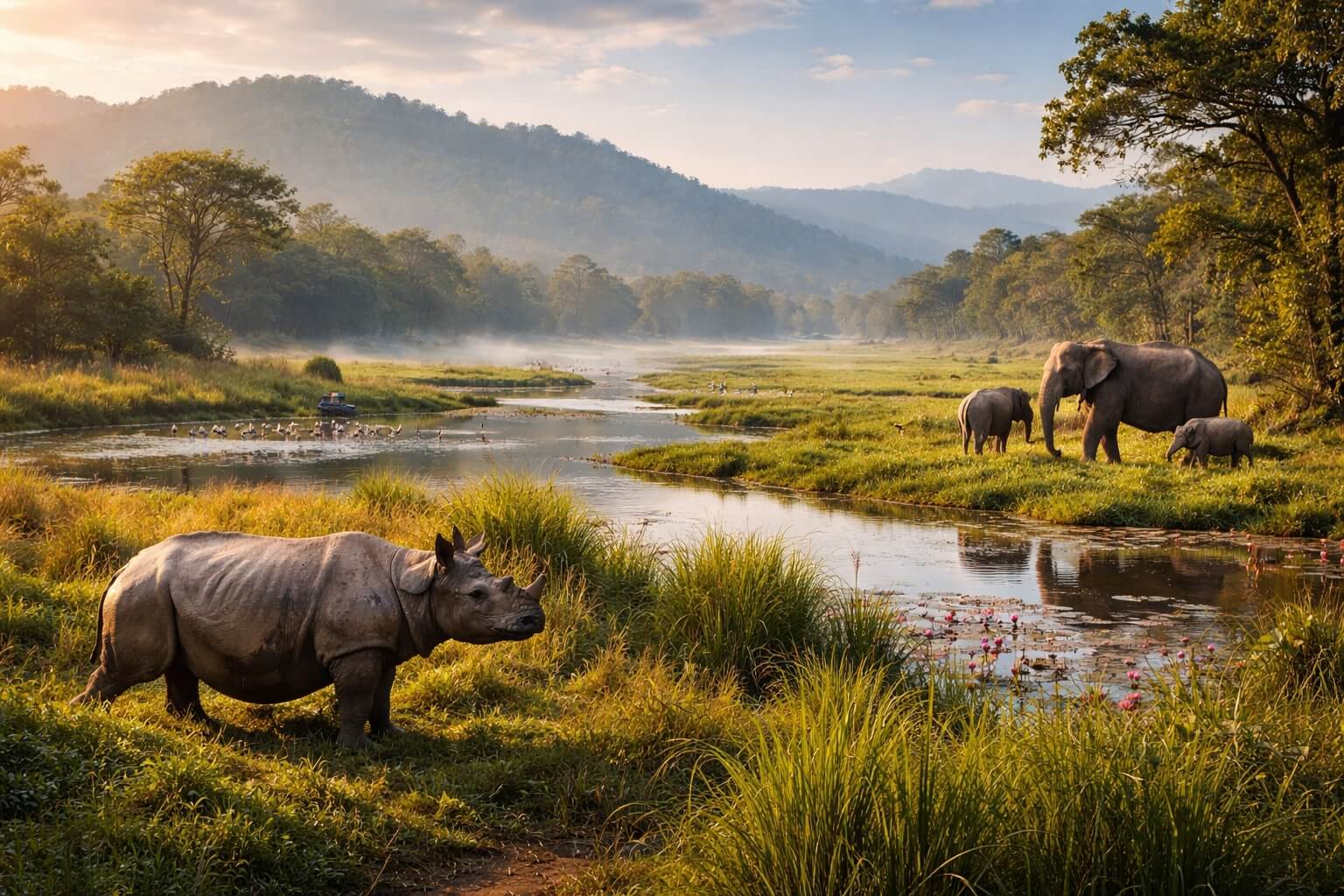
Kaziranga in Assam holds the world's largest population of the one horned rhinoceros, alongside significant populations of tigers, elephants and wild water buffalo. Jeep and elephant back safaris through its tall grasslands and wetlands make it one of India's premier wildlife destinations, best visited between November and April.
Manas Wildlife Sanctuary
Also in Assam, Manas sits along the foothills of the Himalayas and forms a critical tiger habitat and biodiversity corridor connecting into neighbouring Bhutan. It receives far fewer visitors than Kaziranga, making it a strong choice for travellers seeking a quieter wildlife experience.
Sundarbans National Park
The Sundarbans in West Bengal form the largest estuarine mangrove forest on earth, shared with neighbouring Bangladesh, and home to the elusive Bengal tiger in its only mangrove habitat anywhere in the world. Visits typically take place by boat through the tidal waterways, and the ecosystem is increasingly discussed in the context of rising sea levels and coastal conservation.
Keoladeo National Park
Formerly a royal hunting reserve, Keoladeo in Rajasthan, close enough to Agra and Jaipur to fold into a Golden Triangle itinerary, is a man made wetland that has become one of the most important bird habitats in Asia, hosting thousands of migratory waterbirds each winter, including rare Siberian cranes in past decades.
Nanda Devi and Valley of Flowers National Parks
This twin listing in Uttarakhand pairs the remote, rugged wilderness surrounding Nanda Devi, India's second highest peak, with the Valley of Flowers, an alpine meadow that bursts into a carpet of wildflowers each monsoon season. Together they protect some of the most biodiverse high altitude terrain in the Himalayas.
Western Ghats
Running parallel to India's western coastline through Kerala, Karnataka, Tamil Nadu and Maharashtra, the Western Ghats are older than the Himalayas and hold exceptional levels of biological endemism, meaning many species found here exist nowhere else on earth. The range underpins much of South India's tea and spice growing regions and increasingly features in eco-luxury travel itineraries.
Great Himalayan National Park
Located in Himachal Pradesh, this park protects a dramatic range of ecosystems across altitude, from forest to alpine meadow to permanent glacier, and supports species including the snow leopard and Himalayan tahr. It remains one of the least visited entries on this list, appealing to travellers who want serious trekking terrain over easy access.
India's Only Mixed Heritage Site
Khangchendzonga National Park
Khangchendzonga National Park in Sikkim holds the rare distinction of mixed UNESCO status, recognised in 2016 for both natural and cultural value. Named for Kangchenjunga, the third highest mountain on earth, the park is sacred to indigenous Sikkimese communities, who regard the mountain as a guardian deity, while its ecological range spans subtropical forest at lower elevations through to alpine and permanently glaciated zones near the peak. It is the only site in India where cultural belief and natural conservation are recognised together in a single listing.
UNESCO Sites on India's Tentative List
Beyond the 45 inscribed sites, India currently holds more than 60 properties on its UNESCO tentative list, the formal staging area a site must sit in before it can be nominated for full inscription. Several of these are already well known to travellers even without the UNESCO label. The Mahabodhi Temple Complex at Bodh Gaya, already inscribed since 2002, sits alongside newer tentative additions such as the Kanger Valley National Park in Chhattisgarh, a biodiversity hotspot known for limestone caves and dense forest, and the Mudumal Megalithic Menhirs in Telangana, Iron Age standing stones believed to mark ancient burial or ceremonial sites. Ashokan edict sites along the historic Mauryan trade routes, a series of Gupta era temples across North India, and the Bundela dynasty's palace fortresses in Madhya Pradesh and Uttar Pradesh round out recent additions to the list.
None of this is relevant only to policy watchers. For travellers who have already covered the major inscribed sites, the tentative list is a reliable source of the next generation of significant but still uncrowded destinations, often years ahead of when mainstream travel guides catch up.
How to Plan an India Itinerary Around UNESCO Heritage Sites
With 45 sites spread across a country the size of a continent, the sensible approach for most international travellers is to build a trip around one or two regional clusters rather than attempting to see a representative sample of everything.
The Golden Triangle Heritage Circuit
Delhi, Agra and Jaipur remain the most efficient introduction to Indian heritage anywhere in the country, delivering nine UNESCO sites, Humayun's Tomb, Qutb Minar, Red Fort, Taj Mahal, Agra Fort, Fatehpur Sikri, Jantar Mantar, Jaipur City and the Hill Forts of Rajasthan, on a route that can be comfortably driven in five to seven days. It remains the standard first time itinerary for a reason, and it pairs naturally with a wildlife extension to Ranthambore or Keoladeo National Park.
Heritage Trails Through Karnataka
Karnataka offers one of the densest and least crowded UNESCO clusters in India, combining Hampi, Pattadakal and the Sacred Ensembles of the Hoysala with the Western Ghats for travellers who want to add a natural heritage dimension. This route suits travellers who have already done a Golden Triangle trip and are looking for something with fewer other foreign visitors on the ground.
Wildlife and Natural Heritage Circuits
Assam pairs Kaziranga and Manas within a single state, offering two natural UNESCO listings alongside the Moidams cultural site, all achievable within a focused eight to ten day trip built around wildlife safaris rather than monuments. Uttarakhand and Himachal Pradesh offer a comparable Himalayan combination for travellers with a trekking or mountain interest, pairing Nanda Devi, the Valley of Flowers and the Great Himalayan National Park with the Kalka Shimla mountain railway.

Combining UNESCO Heritage with Luxury Travel in India
Heritage travel in India no longer means a trade off between historical depth and comfort. Many of the country's UNESCO sites now sit within reach of genuinely high end stays, from heritage palace hotels housed inside former royal residences in Rajasthan to boutique properties overlooking the Ganges near Sarnath and Varanasi, and eco luxury lodges positioned along the fringes of the Western Ghats and Kaziranga. A growing number of travellers are also choosing private aviation to link UNESCO clusters that would otherwise require long road transfers, flying between Delhi, Udaipur, Hampi or Jaipur in a fraction of the driving time, which matters considerably on a trip trying to balance the Golden Triangle with a second regional cluster in the same visit.
The sites themselves also benefit from private access options that are easy to overlook when planning independently. Early entry before public opening hours at the Taj Mahal, private guided access to sections of Hampi that see almost no foot traffic, and after hours visits arranged at select temple complexes all exist for travellers working with a specialist operator, and they change the character of a visit considerably compared with joining the general daytime crowds. This is the layer of planning where a tour operator based in India, working directly with site authorities and heritage properties, tends to add the most value beyond simply booking tickets.
Best Time to Visit India's UNESCO Sites
Timing varies significantly by region, and getting it right matters more in India than in most destinations given the range of climates involved. North India, covering Delhi, Agra, Rajasthan and the central sites at Khajuraho and Sanchi, is best visited between October and March, when daytime temperatures are manageable and skies are generally clear. The summer months from April to June bring intense heat across this entire belt, with Rajasthan regularly exceeding 40 degrees Celsius.
South India's temple sites, including Hampi, Mahabalipuram and the Chola temples, are more forgiving year round, though October to February remains the most comfortable window, avoiding both peak summer heat and the heaviest monsoon rains. The monsoon itself, generally running June to September depending on region, is worth serious consideration for travellers interested in the Western Ghats or the Valley of Flowers, both of which are at their most dramatic during or just after the rains, even though this period is traditionally treated as the off season by conventional itineraries.
Wildlife destinations follow their own calendar. Kaziranga closes entirely during the monsoon and reopens in November, running through until April. The Himalayan sites, including Nanda Devi, the Valley of Flowers and Khangchendzonga, are only accessible during a narrow window from late May to early October, when high altitude trails are clear of snow.
Practical Information for International Visitors
Entry Fees for Foreign Nationals
Most of India's major UNESCO monuments operate a dual pricing structure, with a significantly higher entry fee for foreign nationals than for Indian citizens, a system common across South Asia. At the Taj Mahal, Agra Fort, Fatehpur Sikri and comparable sites, foreign visitor fees typically run several times the domestic rate, though the fees remain modest by international museum and heritage site standards. Tickets for the most popular sites, particularly the Taj Mahal, are increasingly managed through timed online booking systems, and booking in advance is strongly recommended during the October to March peak season. Many sites also charge a separate, smaller fee for still photography and a higher one for video, and some inner sanctums or upper levels, such as the main mausoleum platform at the Taj Mahal, carry their own additional ticket on top of general entry.
Do You Need a Guide
A licensed guide is not compulsory at any UNESCO site in India, but for first time visitors it materially changes the experience at complex sites such as Hampi, Fatehpur Sikri and the Ellora Caves, where the historical layering is not obvious without context. For travellers arranging a trip through a specialist operator, private guiding is typically built into the itinerary rather than arranged separately on the ground, which also avoids the informal touting common at high traffic entrances.
Visa Requirements for UK, USA, Canada, Australia and European Travellers
Travellers from the UK, USA, Canada, Australia, France, Poland, Japan and Singapore are all eligible for India's e-Visa system, which covers tourist visits and can be applied for online in advance of travel. Processing typically takes a few business days, though applying at least two to three weeks before departure is advisable during peak season. Visa requirements and eligible nationalities are subject to periodic change, so confirming current rules directly with India's official e-Visa portal or a trusted travel operator ahead of booking flights is worthwhile.
Frequently Asked Questions
How many UNESCO World Heritage Sites are there in India?
India has 45 UNESCO World Heritage Sites as of July 2026, comprising 37 cultural sites, 7 natural sites and 1 mixed site, placing India sixth in the world by total number of listings.
Which is the most visited UNESCO site in India?
The Taj Mahal is by a wide margin the most visited and most searched UNESCO site in India, drawing well over a million monthly online searches from travellers worldwide and several million annual visitors in person.
Which was the first UNESCO World Heritage Site in India?
Agra Fort, the Ajanta Caves, the Ellora Caves and the Taj Mahal were all inscribed together in 1983, making them jointly India's first UNESCO World Heritage Sites.
Can international travellers visit all of India's UNESCO sites independently?
Most sites are open to independent travel and do not require special permits, though a small number of locations in border or restricted areas, particularly in the northeast and parts of Sikkim, may require additional permits that a specialist tour operator can typically arrange in advance.
How long does it take to see India's major UNESCO sites?
A focused Golden Triangle trip covering nine UNESCO sites across Delhi, Agra and Jaipur can be done in five to seven days. Seeing a genuinely representative cross section of India's cultural and natural heritage, spanning north, south, west and the Himalayas, realistically requires multiple trips or a longer three to four week journey.
Are India's UNESCO sites suitable for a honeymoon or anniversary trip?
Several sites lend themselves naturally to a romantic itinerary, most notably the Taj Mahal, built as a monument to love, alongside Udaipur's lake palaces near the Hill Forts of Rajasthan and the backwaters bordering the Western Ghats in Kerala. Many luxury operators build dedicated honeymoon itineraries around this combination of heritage sightseeing and private, scenic stays.
Is it possible to combine northern and southern UNESCO sites in a single trip?
It is possible but requires careful planning around India's size and internal flight connections. A common approach is to treat North India, covering the Golden Triangle and Rajasthan, and South India, covering Karnataka and Tamil Nadu, as two distinct legs of a longer three week trip connected by a short domestic flight, rather than attempting to move between them by road.
Plan Your UNESCO Heritage Journey with UK India Tourism
Forty five UNESCO sites across 18 states is not a itinerary anyone should attempt to improvise. UK India Tourism has spent years building journeys around exactly this kind of depth, from the Golden Triangle's nine listed sites through to the quieter Hoysala temple trail in Karnataka and the wildlife circuits of Assam, matched with the private guiding, timed entry planning and seasonal timing that make the difference between a rushed monument checklist and a genuinely considered heritage journey. To start planning a UNESCO focused trip to India, reach out to our team.
Ready when you are
Let Us Bring Your India Dream to Life
UK India Tourism Company
UK Phone: +44 7345 191205
India Phone: +91 9958 480873
Email: sales@ukindiatourism.co.uk
Luxury India Tour Specialists for UK, USA, Canada, Australia, Europe, Singapore, Japan and beyond
UK: +44 7345191205
UK India Tourism© 2026, all rights reserved
India: +91 9958480873
⭐⭐⭐⭐⭐ 4.9/5 | 2,600+ Travelers | 18 Years | 98% Recommend