Golden Triangle India - UK Travel Guide
Discover Delhi, Agra and Jaipur with our Expert Golden Triangle India Guide 2026 - for UK travellers. Tips, itinerary and visa help inside by UK India Tourism.
Adarsh Gupta
3/14/202612 min read
The Golden Triangle: India's Most Iconic Journey - A First-Timer's Guide from the UK
Charlotte from Manchester had never felt heat like it.
It was 6:47 am in the morning and the air outside Indira Gandhi International Airport already had weight — warm, spiced, alive. As her private car glided through the slowly waking streets of Delhi, a chai vendor balanced a tray of terracotta cups on his head, a saffron-robed sadhu crossed the road with the unhurried grace of someone to whom time meant nothing, and somewhere in the distance, the first call to prayer rose and unfurled over the city like slow smoke.
"I thought I was prepared," Charlotte told us three weeks later, still glowing. "I'd watched the documentaries, read the blogs, packed the guide books. But the moment India actually hits you , properly hits you, no preparation is enough. And that's the most wonderful thing about it."
Charlotte had just completed the Golden Triangle India tour — the journey through Delhi, Agra, and Jaipur that has been enchanting international travellers for decades. And for UK travellers making their first trip to India, there is no better starting point on earth.
This guide will take you through everything you need to know to plan, book, and absolutely love your own Golden Triangle adventure from the UK from the best time to visit and what to actually see in each city, to practical tips that will make your journey feel effortless.
Route
Delhi → Agra → Jaipur → Delhi (circular)
Total Distance
Approx. 720 km — comfortably covered by Private Car
Ideal Duration
7 to 10 days (7 days minimum; 10 days for a relaxed pace)
Best Time
October to March — cool, clear skies, ideal sightseeing weather
Flights from UK
Direct flights from London Heathrow to Delhi (approx. 8.5 hrs via Virgin Atlantic, British Airways, Air India)
India Visa
UK passport holders require an e-Visa — available online, typically approved within 72 hours
Budget Guide
Economy: from £600 pp · Mid-range: £1,200–£2,000 pp · Luxury: £3,000+ pp
Spoken English
Excellent across all hotels, major sites, and guided tours throughout the Golden Triangle
UK India Tourism
Expert planning, Private Car, Dedicated Representative & 24/7 support throughout — 18 years trusted
What Is the Golden Triangle India Tour?
The Golden Triangle is the name given to the triangular route connecting three of India's most celebrated cities: Delhi (the capital), Agra (home of the Taj Mahal), and Jaipur (Rajasthan's magnificent Pink City). On a map, these three cities form a near-perfect triangle across northern India, which is how the route earned its evocative name.
For UK travellers visiting India for the first time, the Golden Triangle India tour is the ultimate introduction. It packs extraordinary diversity into a manageable journey — Mughal history, Hindu architecture, royal Rajasthani culture, street food, wildlife, luxury palace hotels, and some of the most photographed monuments on earth — all without the logistical challenge of crossing vast distances.
Most visitors spend 2–3 nights in Delhi, one to two nights in Agra, and 2–3 nights in Jaipur before looping back to Delhi for their flight home. It is a rhythm that feels natural, unhurried, and deeply satisfying.
"The Golden Triangle doesn't just show you India — it initiates you into it. By the time you leave Jaipur, you will understand why every traveller who visits India immediately starts planning their return."
Delhi - Where India's 3,000-Year Story Begins
Delhi is not one city. It is at least eight cities stacked on top of each other across three millennia of history, and learning to read its layers is one of the great pleasures of the Golden Triangle India tour. From the ruins of ancient Hindu kingdoms to the grand avenues of the British Raj to the gleaming glass towers of modern India, Delhi is a place that refuses to be summarised.
For UK travellers, Delhi holds a particular resonance. The echoes of shared history — Lutyens' wide colonial boulevards, the sandstone sweep of Parliament House, the cricket grounds — sit in fascinating tension with the India that existed long before the British arrived, and the confident, extraordinary India that has emerged since.
Old Delhi: The Sensory Overload You Will Never Forget
Begin in Old Delhi, and begin early before the heat of the day and the fullness of the crowds. The heart of Old Delhi is Chandni Chowk, one of Asia's oldest and most atmospheric markets, where narrow lanes branch off in every direction like capillaries, each one devoted to a different trade: spices in one, silver in another, saris in the next, then wedding garlands, then street food, then electronics, then an impossibly good lassi shop that has occupied the same corner since 1884.
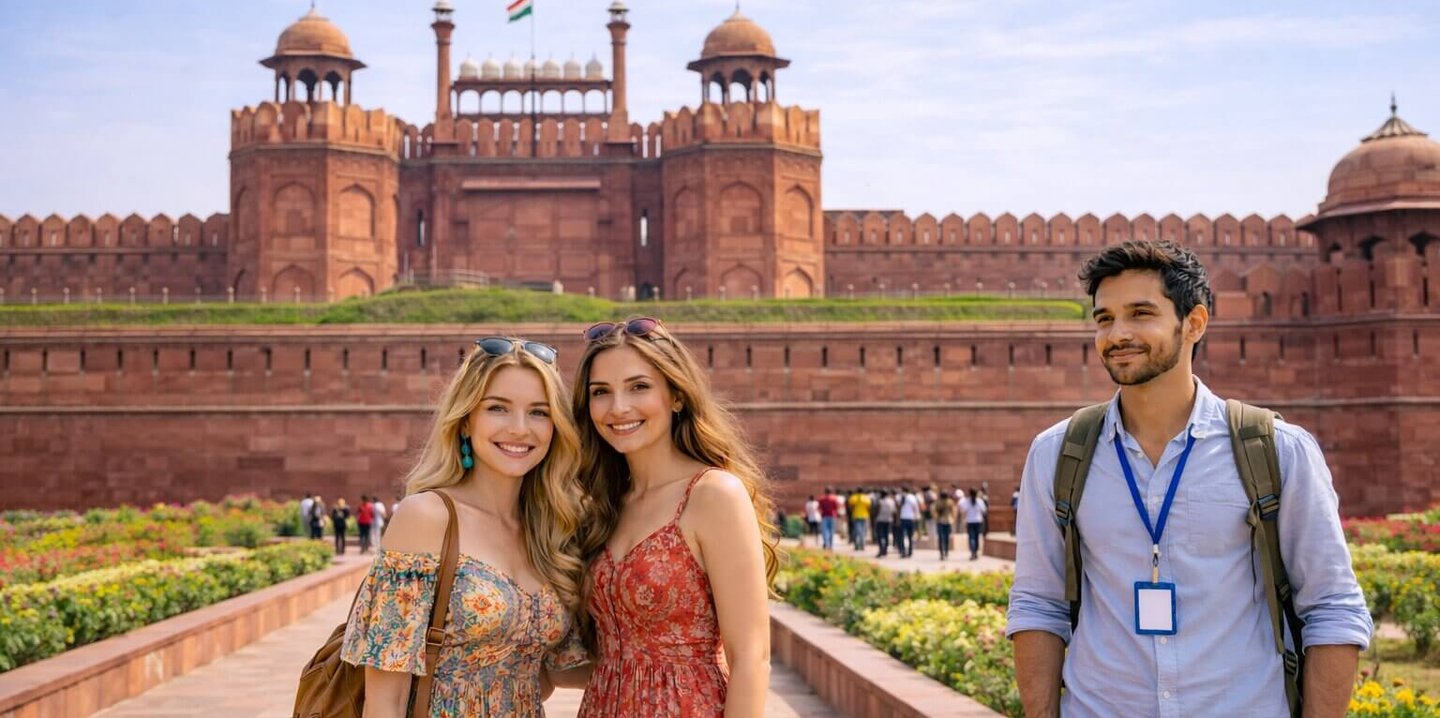
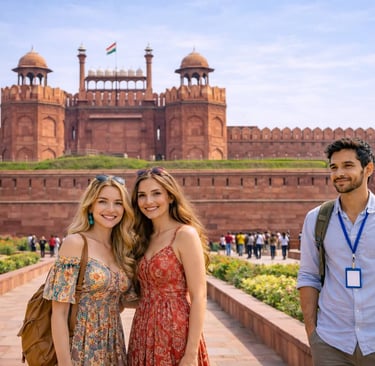
The Red Fort, Lal Qila - rises at the eastern end of Chandni Chowk in a blaze of red sandstone. Built by the Mughal Emperor Shah Jahan (the same man who built the Taj Mahal) in 1638, its walls are three kilometres long and up to 33 metres high. Standing at the Lahori Gate, you can feel the weight of empire, the point from which India's Prime Minister addresses the nation every Independence Day.
Nearby, the Jama Masjid - India's largest mosque, built between 1644 and 1656, is an experience of pure architectural awe. Its courtyard can hold 25,000 worshippers. On a Friday afternoon, when the faithful gather and the air fills with prayer, it becomes one of the most profoundly moving places in Asia.
For UK travellers who love food, Old Delhi is unmissable. A street food walk through Paranthe Wali Gali (the famous lane devoted entirely to stuffed flatbreads fried in clarified butter) is the kind of experience that turns people into lifelong lovers of Indian cuisine. Your dedicated guide will know exactly where the locals eat and exactly which stalls meet the highest hygiene standards, an important detail for international visitors.
New Delhi: Mughal Grandeur Meets British Geometry
South of the old city, New Delhi unfolds with the ordered confidence of an imperial capital. The Qutub Minar - a 73-metre tower of red sandstone and marble, begun in 1193 and a UNESCO World Heritage Site - is India's tallest minaret and one of its most remarkable engineering achievements. Stand at its base and crane your neck upward and you will understand why it has been captivating visitors for 800 years.
Humayun's Tomb, built in 1570, is the architectural forerunner of the Taj Mahal - the same four-fold garden design, the same white marble dome, the same hushed reverence and because it attracts fewer visitors than its more famous descendant, it often offers a more peaceful and contemplative experience.
Spend an evening on Connaught Place, Delhi's grand circular hub of restaurants, bars, and boutiques. Watch the city's young professionals settle in for the evening, smartphones in hand, effortlessly multilingual, utterly at ease with modernity. It is, for many UK visitors, a revelation about the India that news bulletins rarely show.
Agra - The City That Humbles Every Single Traveller
Agra is 200 kilometres south-east of Delhi, and the journey by private car, passing through the flat Gangetic plains, past mustard fields and road-side chai stalls and the occasional camel cart, is itself a beautiful transition between the energy of the capital and the romance of what awaits.
It is tempting to say that Agra exists solely because of the Taj Mahal. It does not, it has Agra Fort, the extraordinary Itmad-ud-Daulah (known as the 'Baby Taj'), the marble craftsmen whose inlay workshops line the city's back streets, and a food culture that gave India its most beloved sweet, the petha. But the Taj Mahal is the reason the world comes. And the Taj Mahal, when you finally stand before it, is worth every single kilometre.
The Taj Mahal: Why No Photograph Has Ever Done It Justice
Shah Jahan built the Taj Mahal between 1632 and 1653 as a mausoleum for his beloved wife Mumtaz Mahal, who died giving birth to their fourteenth child. He employed 20,000 artisans, sourced marble from Makrana in Rajasthan and precious stones from across Asia, and created what is, by almost universal agreement — the most beautiful building in the world.
The first thing that strikes you is not the Taj itself but the gateway, the Darwaza-i-Rauza - a vast red sandstone arch that frames the monument in a perfect rectangle of white. Through that arch, the Taj appears in miniature at first, then grows as you walk toward it until, at the reflecting pool, it fills your entire field of vision. The white marble seems to glow from within, changing colour with the light: pink in the early morning, blinding white at noon, gold at sunset, silver in the moonlight.
UK travellers who visit at sunrise will have the most magical experience. Arrive at the East Gate by 6:00 am, before the tour groups from the larger hotels have assembled, and for perhaps forty minutes the Taj Mahal belongs almost entirely to you. In the early light, with mist still rising from the Yamuna River behind it, the monument achieves an atmosphere that photographs - even the finest ones - can only approximate.
"I've stood before great cathedrals across Europe and felt moved. Nothing prepared me for the Taj Mahal. It doesn't look like something human beings built. It looks like something they dreamed." - James, London
Agra Fort: The Story Behind the Story
Just 2.5 kilometres from the Taj Mahal, Agra Fort is a UNESCO World Heritage Site that most visitors underestimate. Shah Jahan spent the final eight years of his life imprisoned here by his own son, in a chamber with a marble window from which, on a clear day, he could see the distant white dome of his greatest creation. The heartbreak and the beauty of that story are written into the stones of the fort itself.
The fort's inner palaces - the Khas Mahal, the Sheesh Mahal (Palace of Mirrors) with its intricate glass inlay work, and the Musamman Burj where Shah Jahan died - are among the finest examples of Mughal architecture anywhere in India. Allow at least two hours here.
Jaipur - The Pink City That Paints Your Heart
From Agra, the Golden Triangle route curves south-west toward Jaipur, the capital of Rajasthan and perhaps the most visually dramatic city in India. Jaipur earns its 'Pink City' nickname from the terracotta-rose colour of its old city walls and buildings - a tradition begun in 1876 when Maharaja Ram Singh ordered the city painted pink to welcome the Prince of Wales (the future King Edward VII). Over a century later, the colour remains, protected by law and maintained with enormous civic pride.
If Delhi is India's head and Agra its heart, Jaipur is its soul - flamboyant, proud, royal, and deeply, irresistibly alive. For UK travellers whose India experience has so far been Mughal (Delhi and Agra are essentially chapters in the same Mughal story), Jaipur introduces the Hindu Rajput tradition: the maharajas, the painted havelis, the camels, the turbans, the folk music drifting from courtyards at dusk.
Amber Fort: Rajasthan's Greatest Jewel
Eleven kilometres north of Jaipur, Amber Fort rises from a hilltop above the Maota Lake like a vision from a fairy tale. Built in 1592 by Raja Man Singh I and expanded over the following century, it is a masterpiece of Rajput and Mughal architectural fusion: sandstone battlements softened by white marble pavilions, mirrored halls that fragment a single candle flame into a thousand stars.
The Sheesh Mahal (Hall of Mirrors) inside Amber Fort is one of the wonders of Rajasthan. Every surface - walls, ceiling, arches - is covered in convex mirror tiles set in plasterwork of extraordinary delicacy. Light a match in here and the room ignites. UK visitors with an interest in history, architecture, or simply jaw-dropping beauty should allow a full morning.
The approach to the fort along the path followed by Maharajas and their armies through the Sun Gate and into the Jaleb Chowk - is ceremonial and grand. With a knowledgeable private guide beside you explaining the history, the symbolism, and the human stories that played out within these walls, the experience becomes genuinely unforgettable.
Hawa Mahal, City Palace & the Glorious Chaos of the Old Bazaars
Back in the city, the Hawa Mahal, the Palace of Winds - is one of India's most recognisable facades: a honeycomb of 953 latticed windows through which the royal ladies of the court could observe street life unseen. It was built in 1799 and its five-storey facade rises above Sirdeori Bazaar like a coral-coloured wave frozen mid-curl. It is one of the most photographed buildings in India and, in the golden light of late afternoon, one of the most beautiful.
City Palace, at the heart of the walled city, is still partly occupied by the Jaipur royal family, which lends it an intimacy that pure museums rarely have. Its collection of textiles, weapons, paintings, and royal artefacts is extraordinary, and the peacock-gate courtyard, each of its four gates decorated with a peacock representing a season - is among the most photographed spots in Rajasthan.
Save your last afternoon in Jaipur for the bazaars. Johari Bazaar for gemstones and jewellery (Jaipur is the world's largest gem-cutting centre). Bapu Bazaar for block-printed fabrics, mojari shoes, and blue pottery. And Nehru Bazaar for the kind of colourful, fragrant chaos that makes you forget that anything outside India's markets has ever existed.
Planning Your Golden Triangle Tour from the UK
The Best Time to Travel
For UK travellers, the ideal window for the Golden Triangle India tour is October through March. Temperatures during these months are comfortable - pleasantly warm rather than hot - and the skies are clear and blue. December and January are particularly popular (book early), as this is when India's North at its most golden and photogenic. The summer months (April–June) bring intense heat, and the monsoon (July–September) brings heavy rains, though the post-monsoon glow of October can be spectacularly beautiful.
How Long Should You Spend?
Seven days is the minimum to do the Golden Triangle justice without feeling rushed. Ten days is the sweet spot for UK travellers who want to absorb each city properly, with time for a day trip from Jaipur to Ranthambore National Park (tiger country) or from Agra to Fatehpur Sikri, the abandoned Mughal ghost city. Two weeks allows for a more relaxed pace and the addition of Udaipur or Varanasi - but that, as they say, is another story.
Getting There from the UK
Multiple airlines fly direct from London Heathrow to Indira Gandhi International Airport in Delhi, including British Airways, Virgin Atlantic, and Air India. Flight time is approximately 8.5 hours. From regional UK airports (Manchester, Birmingham, Edinburgh), connecting flights via Dubai, Doha, or Abu Dhabi typically add 2–4 hours to the journey. Business class on this route is excellent value compared to equivalent long-haul fares - worth considering for a journey of this kind.
India Visa for UK Travellers
UK passport holders must apply for an Indian e-Visa online before travelling. The process is entirely digital, typically takes 15–20 minutes to complete, and approval usually arrives within 48–72 hours. The Tourist e-Visa allows stays of up to 90 days and is available for a small fee. UK India Tourism provides step-by-step visa support for all clients - removing the paperwork anxiety entirely before you've even packed your bags.
PRO TIPS FOR UK TRAVELLERS TO THE GOLDEN TRIANGLE
Sunrise at the Taj Book your Taj Mahal visit for sunrise (East Gate opens at 6:00 am).
The monument in the early light is transcendent and the crowds are a fraction of what they will be by 9:00 am.
Currency Carry Indian Rupees for markets, rickshaws, and street food. Cards are accepted at most hotels and larger restaurants. Airport money changers are reliable; your hotel concierge can always assist.
What to Wear Modest, loose, breathable clothing is recommended throughout. Women should pack a light scarf (useful for temples, mosques, and covering in the sun). Comfortable walking shoes are essential.
Food Safety Stick to cooked food from reputable restaurants and street food recommended by your guide. Avoid tap water - bottled water is cheap and universally available. Your guide will always steer you right.
Get a Private Car The Golden Triangle is best explored with a private car and driver - not taxis or auto-rickshaws for inter-city travel. UK India Tourism provides clean, air-conditioned private cars with vetted, professional drivers for all journeys.
Photography Etiquette Always ask before photographing people, especially women. At religious sites, follow the instructions of your guide. The reward for respectful photography is often the most extraordinary portraits.
Remove Shoes At mosques, many temples, and some heritage sites, you will need to remove shoes. Wear slip-on footwear on days when you plan to visit religious monuments.
Why UK Travellers Choose UK India Tourism for the Golden Triangle
There is a specific kind of traveller who chooses UK India Tourism for their Golden Triangle India tour and it is not necessarily the most experienced traveller, or the most adventurous. It is, most often, the traveller who understands the difference between a trip that happens to them and a journey that is crafted for them.
UK India Tourism has been creating personalised India experiences for international visitors for 18 years. With over 2,600 travellers guided and a 4.9/5 satisfaction rating, the company has been built entirely on word of mouth and genuine relationships, not on aggressive marketing or volume bookings.
What makes the difference, according to almost every UK client, is the dedicated travel companion and representative who accompanies you throughout your journey. Not a tour guide who recites facts at monuments, but a trusted, qualified, friendly human presence who handles every logistical detail, translates every confusing moment, finds the perfect chai stall around the corner, and ensures that everything, from your airport arrival to your final hotel check-out, unfolds with grace and ease.
"I cannot imagine having done this trip without Rajiv beside us," wrote Sophie and Mark from Bristol, after their Golden Triangle tour in December 2024. "He didn't just show us India. He gave us access to it. That is an entirely different thing."
Every Golden Triangle India tour package from UK India Tourism includes a private car and driver, verified airport pickups, carefully selected accommodation (available across economy, mid-range, and luxury tiers) and support via both UK and India telephone lines. Visa assistance is available for all clients. Pricing is transparent, honest, and offers up to 25% better value than comparable operators - without a single compromise on quality.
Your Golden Triangle journey deserves more than a package tour. It deserves a trusted partner who has been crafting these experiences for 18 years, someone who is as excited about your trip as you are.
Get your personalised Golden Triangle India quote in 60 seconds.
No waiting. No email back-and-forth.
Just honest pricing and a team that treats every traveller from the UK like family.
🌐 ukindiatourism.co.uk · 📞 +44 7345191205
Useful Links:
UK: +44 7345191205
UK India Tourism© 2026, all rights reserved
India: +91 9958480873
⭐⭐⭐⭐⭐ 4.9/5 | 2,600+ Travelers | 18 Years | 98% Recommend