
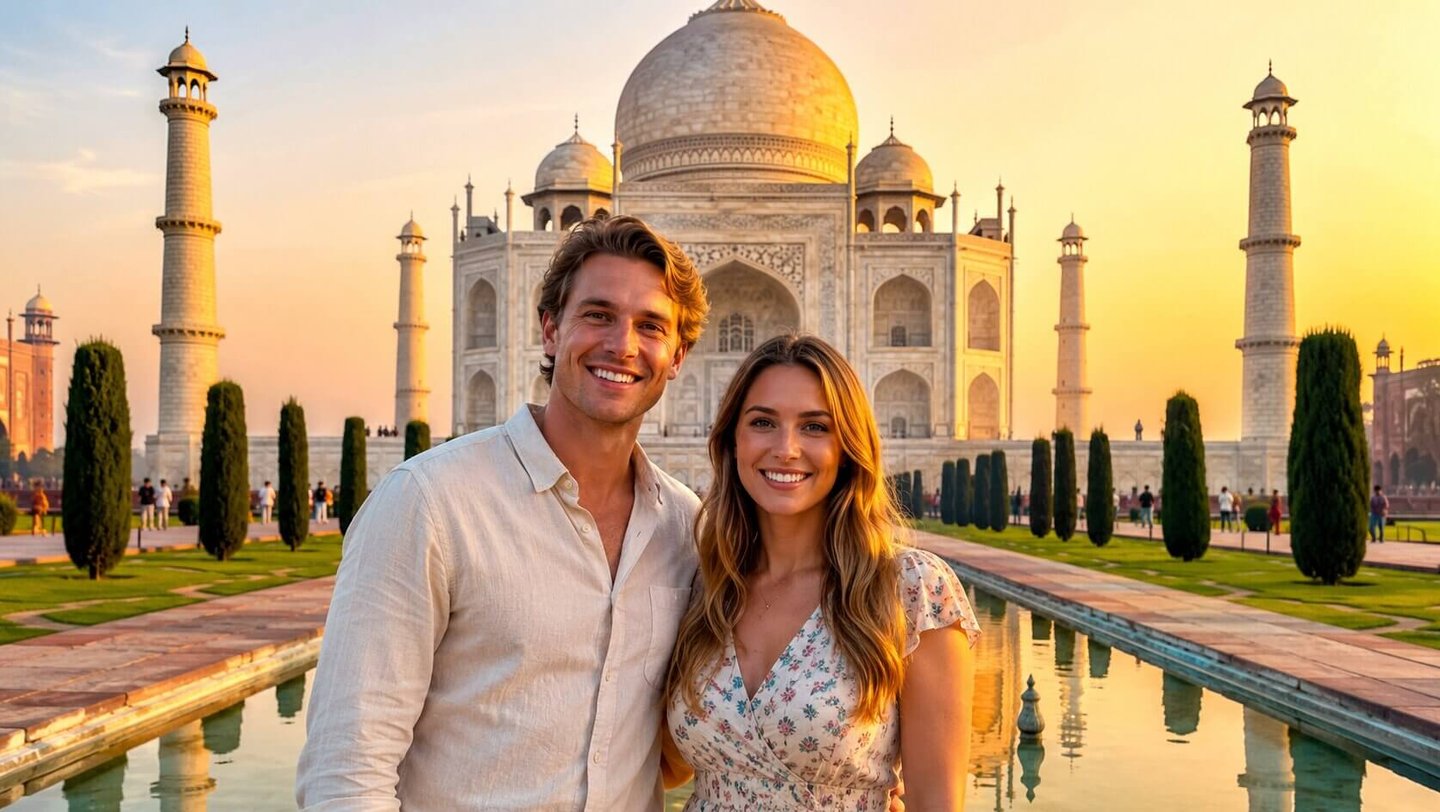

Taj Mahal India Tours from Australia
For Australian travellers seeking the depth and colour of India's greatest heritage landscape, UK India Tourism creates private luxury Taj Mahal tours from Australia that combine the world's most celebrated monument with the royal desert cities of Rajasthan and the wild heart of Bengal tiger country.
Australia to India: A Journey of Extraordinary Reward
Australia consistently ranks among India's top five international source markets, accounting for over five percent of all foreign tourist arrivals, a figure that reflects the close and growing ties between two nations separated by the Indian Ocean but connected by history, migration, sport, and a shared appetite for experiential travel. For Australian travellers, India offers a density of experience - historical, cultural, culinary, spiritual, and natural that is matched by very few destinations on earth. The Taj Mahal in Agra stands at the centre of that experience, the monument around which virtually every Australia-to-India itinerary is built.
UK India Tourism designs private, bespoke Taj Mahal India tours from Australia that treat the iconic mausoleum as a beginning rather than an end, a foundation for a journey that might extend through the royal Rajput cities of Jodhpur, Udaipur, and Jaisalmer; into the Bengal tiger reserves of Ranthambore; along the sacred ghats of Varanasi; or south to the tropical backwaters of Kerala. Whatever combination you choose, every UK India Tourism itinerary from Australia is private, personalised, and underpinned by the finest hotels, guides, and logistics in the country.
The Taj Mahal: The Most Beautiful Building on Earth
Few buildings in the history of human architecture have achieved what the Taj Mahal achieves, the combination of monumental scale, mathematical perfection, and emotional resonance that makes it not merely a great building but a universal symbol of love, loss, and human creative ambition. Commissioned in 1631 by the grief-stricken Mughal Emperor Shah Jahan following the death of his wife Mumtaz Mahal, the mausoleum complex was constructed over twenty-two years by more than twenty thousand artisans drawn from across the Mughal Empire and beyond. The chief architect, Ustad Ahmad Lahori, created a structure that satisfies the eye from every direction and at every scale of observation, magnificent in its overall silhouette, extraordinary in the precision of its symmetry, and astonishing in the detail of its decorative surface.
White Makrana marble from Rajasthan forms the central dome, the four subsidiary domed kiosks, and the four surrounding minarets, the last of these leaning very slightly outward from the plinth in a deliberate structural decision to ensure they would fall away from the mausoleum in the event of seismic movement. The surface of the marble is inlaid with semi-precious stones in the Persian pietra dura technique - lapis lazuli, carnelian, jasper, turquoise, malachite, and mother-of-pearl forming geometric, floral, and calligraphic patterns of extraordinary intricacy. The calligraphy panels framing the arched niches, designed by Amanat Khan Shirazi, quote verses from the Quran in a script that increases progressively in size as the panels ascend, creating an optical illusion of uniform scale from ground level.
The Taj Mahal complex encompasses the mausoleum, the great sandstone gateway (Darwaza-i-Rauza), a mosque, a mirror-image guest house, and the vast Mughal char bagh garden divided into four quadrants by water channels and elevated pathways. The reflecting pool at the garden's centre provides the most famous view of the mausoleum, the dome and its four minarets perfectly replicated in still water on calm mornings. Designated a UNESCO World Heritage Site in 1983 and voted one of the New Seven Wonders of the World in 2007, the Taj Mahal draws more than six million visitors annually, yet in the early morning, before the main crowds arrive, it is possible to experience the complex in something approaching the quiet it deserves.
Flights from Australia to the Taj Mahal
Australia is exceptionally well-connected to India by air, with non-stop services from several major Australian cities to Delhi making the Taj Mahal more accessible than many Australian travellers realise. Qantas and Air India operate direct services from Sydney and Melbourne to Delhi in approximately twelve to thirteen hours, while IndiGo operates direct services from Melbourne. From Perth, the journey time to Delhi is among the shortest from any major Australian city due to Perth's western position, approximately nine hours on direct services. Brisbane, Adelaide, and other Australian cities are well served by one-stop connections via Singapore, Kuala Lumpur, Dubai, or Bangkok, with total journey times of thirteen to sixteen hours.
All Australia-to-India flights arriving in Delhi land at Indira Gandhi International Airport, from where UK India Tourism arranges private transfer to your hotel. The Taj Mahal is three to three and a half hours from Delhi by private vehicle or eighty minutes by Gatimaan Express train. We schedule the Delhi-to-Agra journey to coincide with the early morning, ensuring that Australian guests who arrive on overnight flights from Australia can travel directly to Agra after a brief rest and arrive in time for an afternoon visit to Agra Fort and the Baby Taj, with the sunrise Taj Mahal visit the following morning.
Taj Mahal at Sunrise: The Experience That Defines India Travel
Every Australian client who has visited the Taj Mahal at sunrise with a UK India Tourism private guide has returned with the same testimony: nothing, not the photographs, not the films, not the accounts of previous travellers, prepares you for the reality of the experience. The monument in the first hour of daylight has a quality that is simultaneously monumental and intimate, the vast white dome hovering above its reflection in absolute stillness while the sky lightens around it. The private guide's knowledge adds a narrative layer that transforms what might otherwise be a purely visual experience into a deeply human story about love, grief, imperial ambition, and the extraordinary capacity of art to transcend the circumstances of its creation.
UK India Tourism arranges skip-the-line priority access to the Taj Mahal complex, meaning that Australian guests pass through ticketing and security quickly and are positioned at the finest vantage points before the main crowd. The private guide leads a comprehensive tour of the complex, the great gateway, the mausoleum exterior and interior, the mosque, the subsidiary garden areas, typically taking two to three hours. After the complex tour, we drive to Mehtab Bagh on the opposite bank of the Yamuna, where the entire Taj Mahal is visible across the river in a sweeping panorama that provides some of the finest Taj Mahal photography opportunities available anywhere. This is where the most celebrated sunrise and sunset images of the monument are made and it remains one of Agra's great under visited secrets.
For Australian clients staying two nights in Agra, which we recommend for the fullest experience, we arrange the sunset visit on the first afternoon, positioning guests at Mehtab Bagh or within the complex itself as the light shifts through amber to rose to deep crimson, and the sunrise visit on the following morning. This dual approach provides a complete experience of the monument across the full arc of a day's light, and it consistently produces the richest memories and the finest photographs of any Taj Mahal visit we arrange.
The Golden Triangle India Tour from Australia
The Golden Triangle — Delhi, Agra, and Jaipur, is the foundation of our Australia Taj Mahal tour programme and the most popular itinerary format among Australian clients. In five to nine days, this circuit delivers the full scope of North India's Mughal and Rajput heritage, and it provides an ideal first encounter with India for visitors who want both breadth and depth without overextending a first itinerary.
New Delhi: The Imperial Capital
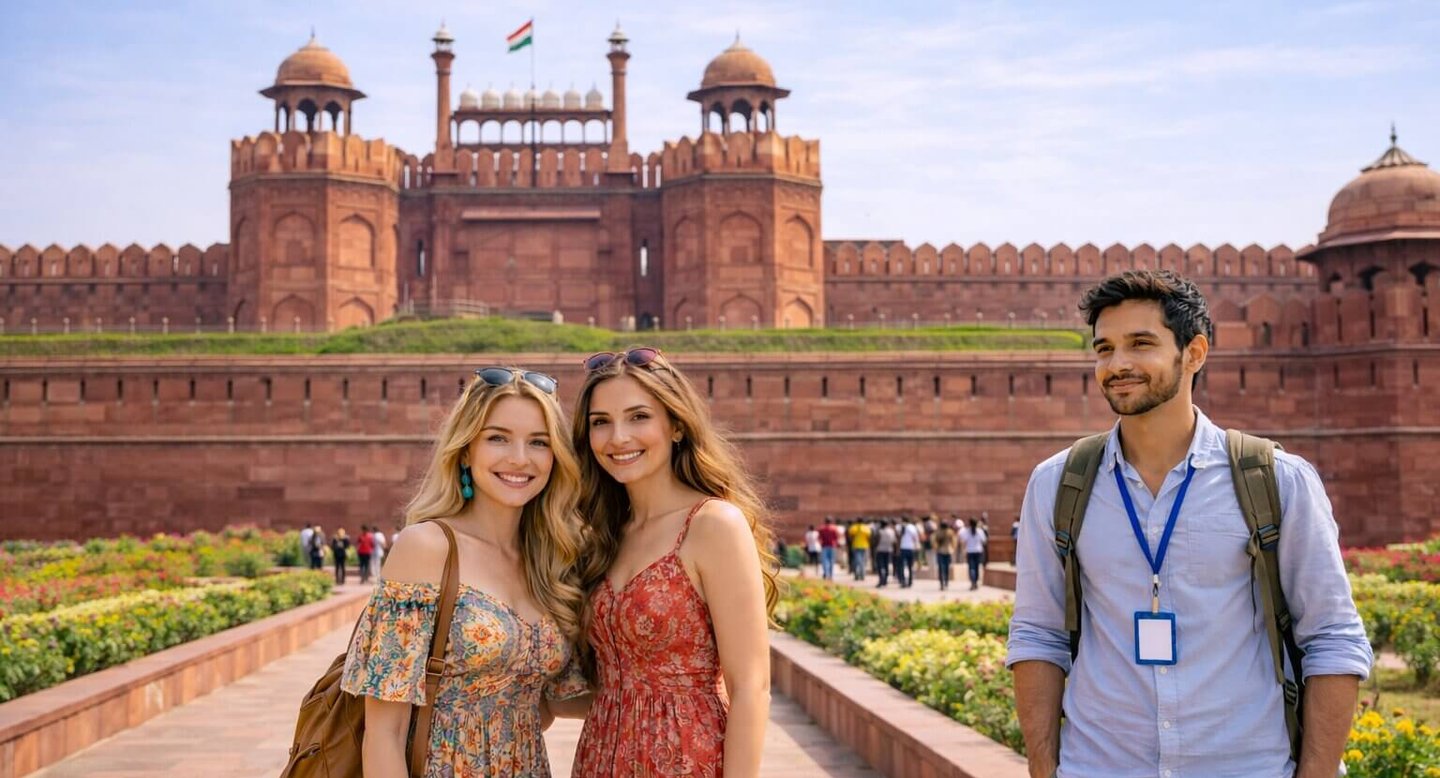
Delhi is a city that rewards a minimum of two full days with a private guide who understands its layered complexity. The Mughal quarter of Old Delhi, the Shahjahanabad of Shah Jahan, built in the 1640s — is one of the most densely atmospheric urban environments in Asia. The great Red Fort, with its Diwan-i-Am, Diwan-i-Khas, and Rang Mahal, was the centre of Mughal power for nearly two centuries; the Jama Masjid opposite it is the largest mosque in India, its courtyard capable of holding twenty-five thousand worshippers. A cycle-rickshaw journey through the lanes of Chandni Chowk immerses Australian visitors immediately in the sensory world of an Indian bazaar, the silver jewellery vendors, the spice merchants, the paratha shops that have been frying the same recipes since the Mughal era.
South of Old Delhi, the heritage circuit leads to Humayun's Tomb, the garden mausoleum completed in 1572 that directly anticipated the spatial and decorative principles later perfected at the Taj Mahal and the Qutab Minar complex, where the soaring thirteenth-century minaret stands alongside the earliest mosques of the Delhi Sultanate, built partly from the salvaged columns of Hindu and Jain temples. Lutyens' New Delhi, with its imperial axis of Rajpath, India Gate, and the Presidential Palace, provides a final, very different architectural perspective on a city that has been a capital of empires for more than a millennium.
Agra: Beyond the Taj Mahal
Agra was the heartland of the Mughal Empire at the height of its power under Akbar, Jahangir, and Shah Jahan, and its heritage circuit extends well beyond the mausoleum that has made it globally famous. Agra Fort, a UNESCO World Heritage Site built in red sandstone by Akbar from 1565 and expanded in white marble by Shah Jahan, contains some of the finest Mughal palace architecture in existence. Its halls tell the full arc of Mughal history, from Akbar's military consolidation to Shah Jahan's architectural refinement to Aurangzeb's cold pragmatism, and the view from the fort's ramparts across the Yamuna River to the distant white dome of the Taj Mahal, the view that sustained Shah Jahan in his final years of imprisonment, is one of the most emotionally resonant sightlines in India.
The Baby Taj, the Itimad-ud-Daulah, is a mausoleum of delicate proportions and extraordinary decorative richness built by Empress Nur Jahan for her father. It is the first Mughal structure to be constructed entirely in white marble and the first to use the pietra dura inlay technique that would later define the Taj Mahal. For Australian visitors with an architectural eye, the comparison between the Baby Taj's more intimate scale and the Taj Mahal's monumental ambition provides one of the most interesting formal contrasts in Agra's heritage landscape. Fatehpur Sikri, the ghost Mughal capital forty kilometres south-west of Agra, rounds out the Agra circuit with a complete, beautifully preserved red sandstone city that was the seat of the greatest empire of the sixteenth century and was abandoned within twenty years of its completion.
Jaipur: The Pink City
Jaipur is the city that most Australian visitors find most immediately captivating, its warm terracotta colour wash, its street markets dense with jewellery and textiles, its camel-drawn carts and auto-rickshaws and women in vivid Rajasthani ghagra-choli creating a visual spectacle that feels simultaneously ancient and vibrantly alive. The Amber Fort on its hilltop above Maota Lake is Jaipur's defining monument, a complex of Rajput palace architecture that incorporates Mughal design elements in a synthesis of extraordinary richness. The Sheesh Mahal (Hall of Mirrors), where a single candle flame is reflected ten thousand times across a ceiling encrusted with mirror fragments, is one of the most extraordinary interior spaces in Indian architecture.
The City Palace, Hawa Mahal, and Jantar Mantar complete Jaipur's central heritage circuit. The Jantar Mantar, a UNESCO-listed astronomical observatory of nineteen giant geometric instruments, is a particular favourite among Australian visitors for its combination of visual drama and scientific ingenuity. Jaipur's markets offer the finest selection of Rajasthani handicrafts in India: gemstone jewellery from the city's specialist gem-cutting quarter, hand-block-printed textiles in traditional Sanganer and Bagru designs, hand-knotted Rajasthani carpets, blue pottery, and lacquered wooden furniture.
Rajasthan Extension from Australia: The Desert Circuit
The most popular extension to the Australia Taj Mahal tour beyond the Golden Triangle is the Rajasthan desert circuit, which takes Australian guests deeper into the royal landscape of India's most visually spectacular state. From Jaipur, private vehicles carry guests through Pushkar (the sacred lake city set in a natural amphitheatre of the Aravalli hills, home to one of India's most important Brahma temples and the legendary Pushkar Camel Fair each November), Jodhpur (the Blue City of cobalt-painted houses dominated by the extraordinary Mehrangarh Fort, whose massive sandstone walls rise sheer from a rocky outcrop above the city), Udaipur (the Lake City of floating palaces, romantic rooftop restaurants, and the finest traditional crafts in Rajasthan), and Jaisalmer (the golden sandstone fortress city rising from the Thar Desert).
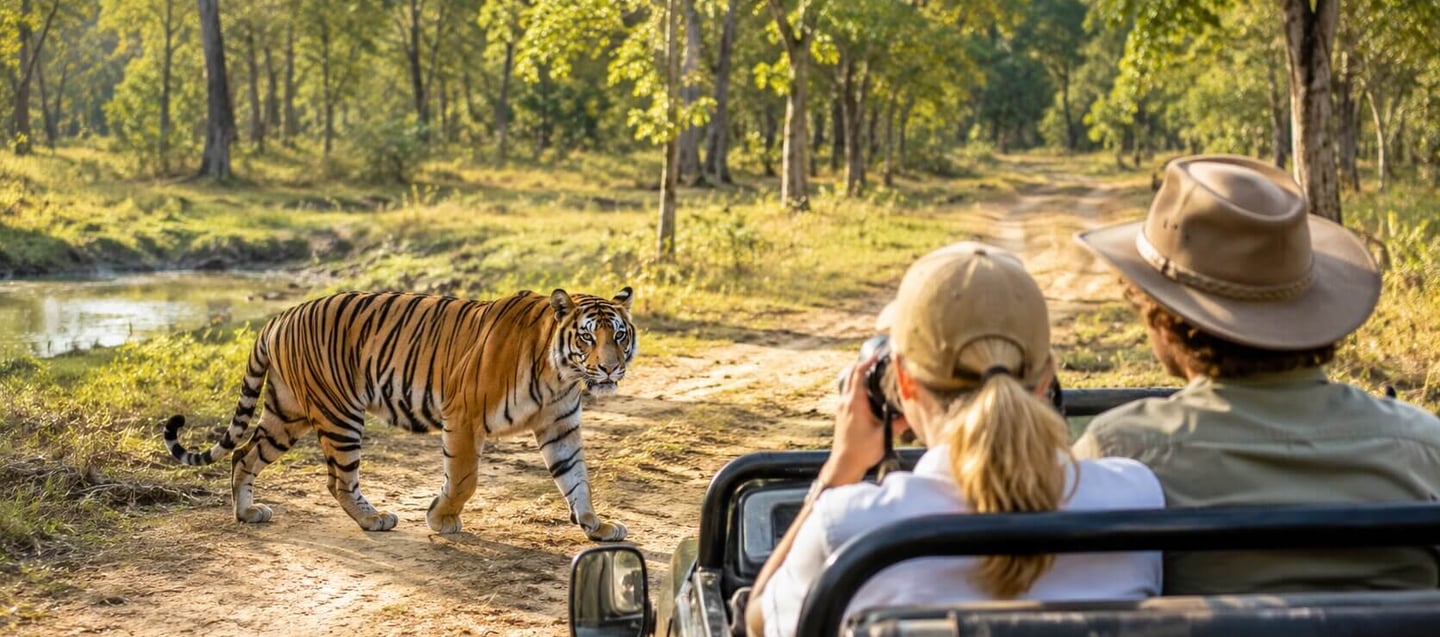
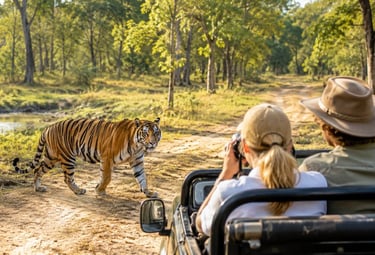
For Australian clients with an interest in wildlife, the Bengal tiger reserves of Ranthambore National Park provide one of the world's most rewarding wildlife safari experiences, readily combined with the Taj Mahal and Golden Triangle into a ten-to-fourteen day India tour package from Australia. Ranthambore's tigers are regularly seen on both morning and afternoon game drives, and the backdrop of a medieval Rajput fort rising above the forest makes for a landscape quite unlike any other safari destination in the world.
Sample Itineraries: Taj Mahal Tours from Australia
Golden Triangle Luxury — 8 Nights / 9 Days
• Day 1: Arrive New Delhi — private transfer, five-star hotel, welcome briefing
• Day 2: Old Delhi — Red Fort, Jama Masjid, Chandni Chowk spice market, Raj Ghat
• Day 3: New Delhi — Qutab Minar, Humayun's Tomb, India Gate, Lodi Garden
• Day 4: Delhi to Agra by Gatimaan Express — Agra Fort, Baby Taj, Mehtab Bagh sunset
• Day 5: Taj Mahal sunrise — full guided complex tour, Fatehpur Sikri afternoon visit
• Day 6: Agra to Jaipur — Abhaneri Chand Baori stepwell en route
• Day 7: Jaipur — Amber Fort, City Palace, Hawa Mahal, Jantar Mantar
• Day 8: Jaipur — Nahargarh Fort, local craft workshops, textile bazaars
• Day 9: Jaipur airport — depart for Australia
Taj Mahal with Rajasthan Desert Circuit — 14 Nights / 15 Days
• Days 1–6: As above (Delhi + Agra foundation)
• Day 7: Agra to Ranthambore — afternoon tiger safari
• Day 8: Morning tiger safari, drive to Jaipur
• Day 9–10: Jaipur full exploration
• Day 11: Jaipur to Jodhpur — Mehrangarh Fort, Blue City walk
• Day 12: Jodhpur to Udaipur — Kumbhalgarh Fort en route
• Day 13: Udaipur — City Palace, Lake Pichola boat ride, Jagdish Temple
• Day 14: Udaipur — Sajjangarh Monsoon Palace, local markets
• Day 15: Udaipur airport — depart for Australia
Luxury Hotels for Australian Taj Mahal Tours
UK India Tourism works exclusively with India's finest hotels, selected for quality, location and the authentic character that discerning Australian travellers appreciate. In Agra, the Oberoi Amarvilas - where every room offers a direct Taj Mahal view, is our first recommendation for Australian clients seeking the complete experience of waking to the mausoleum outside their window. The ITC Mughal and the Taj Hotel Agra provide alternative five-star options of the highest quality. In Delhi, The Leela Palace, The Imperial, The Lodhi, and Taj Mahal Hotel New Delhi represent our preferred portfolio. Across Rajasthan, we work with the iconic palace hotels: Rambagh Palace in Jaipur, RAAS Jodhpur, the Taj Lake Palace in Udaipur, and Suryagarh in Jaisalmer.
India e-Visa for Australian Passport Holders
Australian passport holders are eligible for the Indian e-Tourist Visa, applied for online without the need to post a passport or visit a consulate. The e-Visa is valid for sixty days from the date of arrival and covers tourism, heritage sightseeing, yoga retreats, and recreational visits. The application process is straightforward and typically returns approval within forty-eight to seventy-two hours. UK India Tourism provides detailed e-Visa application guidance as part of every booking, and we recommend applying at least two weeks before departure.
Best Time to Visit the Taj Mahal for Australian Travellers
The optimal season for Australian visitors to the Taj Mahal is October through March, coinciding with North India's cool, dry season. November and February are particularly outstanding months, clear skies, comfortable daytime temperatures, and excellent photography conditions at the monument. The Australian school holiday windows of December-January and July align well with India's travel calendar: December and January fall in India's peak cool season (book well in advance), while July falls in the monsoon season, which brings lush greenery, dramatic skies, and significantly reduced crowds to Agra and Rajasthan, an experience that appeals strongly to experienced travellers seeking India off the beaten path.
Begin Planning Your Taj Mahal India Tour from Australia
The Australia to India journey is long but it is one of the most rewarding journeys in the world of international travel. The UK India Tourism team is ready to design your perfect private Taj Mahal tour from Australia, drawing on deep expertise, genuine connections with the finest hotels and guides in the country, and an absolute commitment to the quality of every detail of your India experience. From a focused seven-day Golden Triangle tour to a comprehensive three-week India journey, we build every itinerary from scratch to match your interests, travel style, and ambitions for this extraordinary country.
Ready when you are
Let Us Bring Your India Dream to Life
UK India Tourism Company
UK Phone: +44 7345 191205
India Phone: +91 9958 480873
Email: sales@ukindiatourism.co.uk
Website: https://ukindiatourism.co.uk/
Luxury India Tour Specialists for UK, USA, Canada, Australia, Europe, Singapore, Japan and beyond
Australia to India is a journey worth making. Let UK India Tourism ensure that every moment of it exceeds your expectations.
UK: +44 7345191205
UK India Tourism© 2026, all rights reserved
India: +91 9958480873
⭐⭐⭐⭐⭐ 4.9/5 | 2,600+ Travelers | 18 Years | 98% Recommend