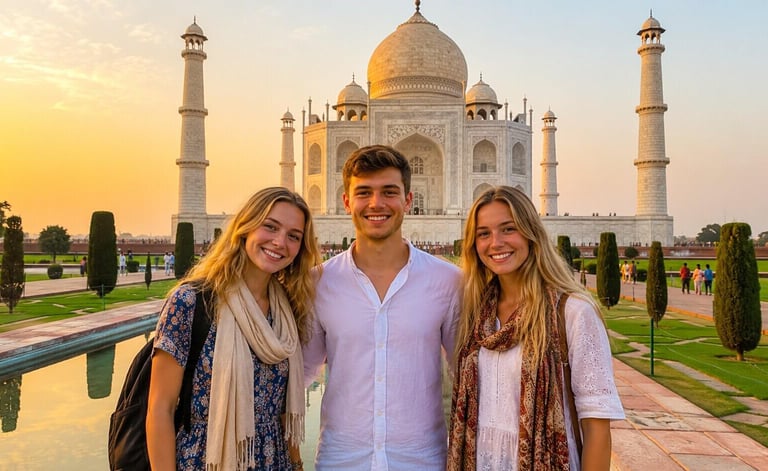
Taj Mahal India Tours from UK
For British travellers, India holds a place unlike any other destination, a land of profound historical connection, extraordinary architectural beauty, and a depth of cultural experience unmatched anywhere on earth. UK India Tourism brings the Taj Mahal and the full richness of India within comfortable reach of every discerning British traveller.
India's Greatest Wonder, Expertly Arranged for British Travellers
The United Kingdom is India's third largest international source market, accounting for more than ten percent of all foreign tourist arrivals, a figure that reflects both the historical ties between the two countries and the enduring fascination that India holds for British travellers of every background. British visitors have been making the journey to the Taj Mahal since the monument first entered European consciousness in the late eighteenth century, and the tradition of the India grand tour, anchored at Agra's iconic mausoleum, has never been more relevant or more accessible than it is today.
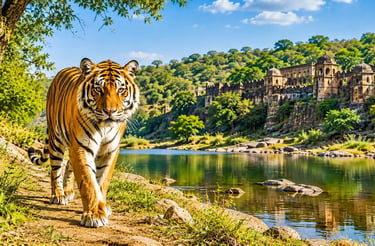
UK India Tourism is a luxury India travel specialist based in the United Kingdom, working exclusively with international travellers seeking private, bespoke India experiences of the highest quality. We design Taj Mahal India tours from the UK that combine the iconic Golden Triangle circuit with the royal cities of Rajasthan, the Bengal tiger reserves of central India, the ancient holy ghats of Varanasi, the hill stations of the Himalayas, and the tropical backwaters of Kerala. Whatever combination of India's extraordinary diversity appeals to you, we build every itinerary from scratch, in private, with the detail and imagination that this remarkable country deserves.
The Taj Mahal: Why It Still Takes the Breath Away
There is no preparing for the Taj Mahal. This is the unanimous testimony of every British traveller who has stood before it, and it is as true today as it was for the eighteenth-century visitors whose accounts of overwhelming awe constitute some of the finest travel writing in the English language.
Bishop Reginald Heber, visiting in 1825, was speechless.
Thomas Bacon, writing in 1835, called it 'absurd to attempt a description.'
Rudyard Kipling declared that the Taj Mahal was the only building in the world that entirely lived up to expectation.
The monument's power to astonish has not diminished in the centuries since its construction, if anything, the contrast between the noise and colour of the world outside its gates and the absolute, mathematical serenity within them makes the experience more intense for modern visitors than it was for those who approached it by elephant in the Mughal era.
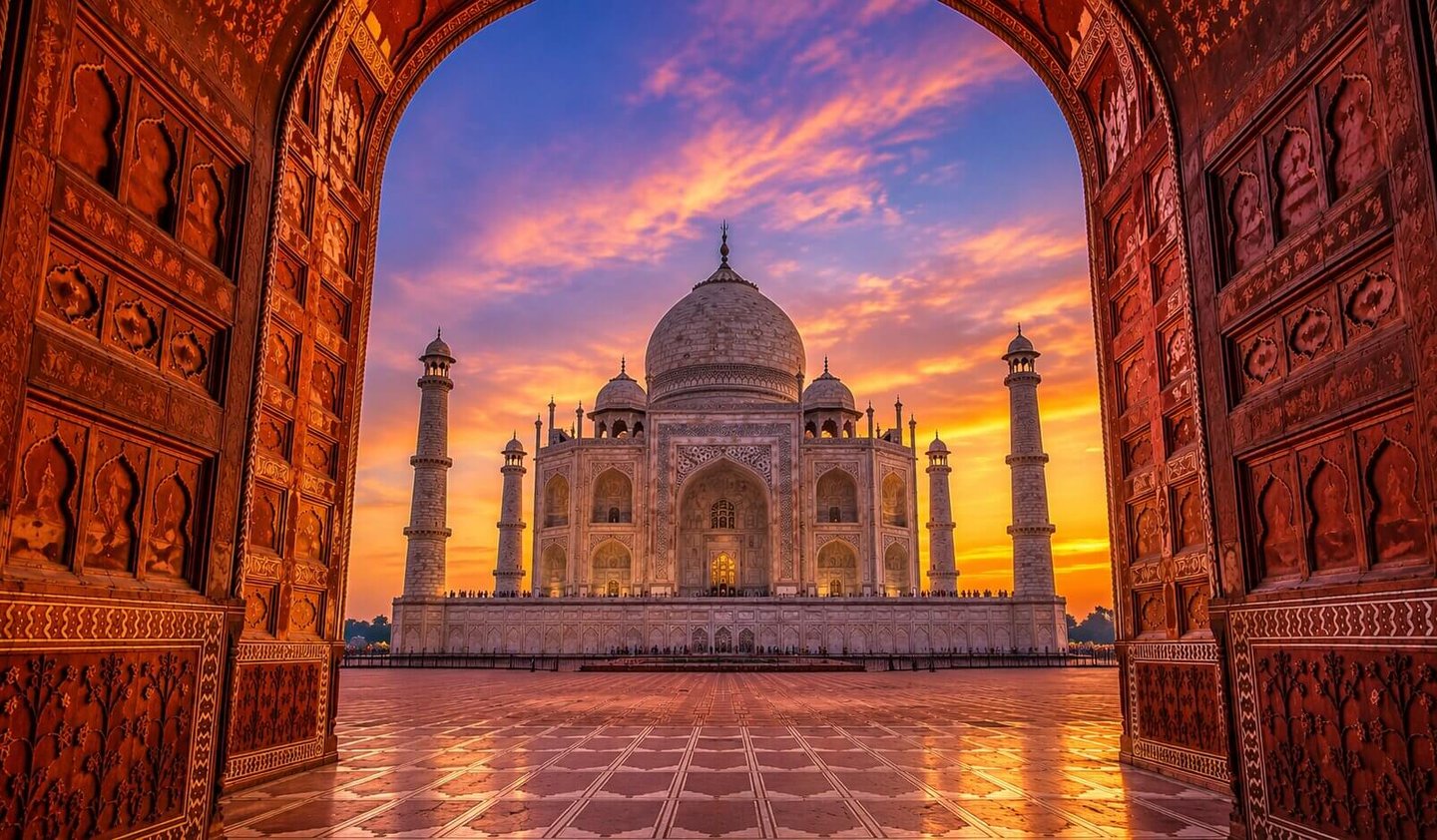
The Taj Mahal was built between 1632 and 1653 by the Mughal Emperor Shah Jahan as a mausoleum for his wife Mumtaz Mahal, who died in childbirth in 1631. It is constructed of white Makrana marble from Rajasthan, inlaid with semi-precious stones in the pietra dura technique, lapis lazuli, carnelian, jasper, jade, malachite, and mother-of-pearl forming geometric and floral patterns of extreme precision across the entire surface of the mausoleum. The central dome rises to a height of seventy-three metres, flanked by four subsidiary domed kiosks and four slender minarets that lean very slightly outward from the plinth. The complex encompasses the mausoleum, a great sandstone gateway, a mosque, a mirror-image guest house, and the formal Mughal char bagh gardens divided by water channels into four quadrants.
Designated a UNESCO World Heritage Site in 1983 and one of the New Seven Wonders of the World since 2007, the Taj Mahal attracts more than six million visitors annually, of whom more than six hundred thousand are international tourists.
For British visitors, it is the building that has defined India's image in the global imagination for more than two centuries and experiencing it in person, with a knowledgeable private guide and the time to absorb it properly, remains one of the great privileges of international travel.
Direct Flights from the UK to India: Your Gateway to the Taj Mahal
British travellers are exceptionally well served by direct flight connections from the UK to India. Non-stop services from London Heathrow to Indira Gandhi International Airport in Delhi operate daily with British Airways, Air India, and Virgin Atlantic in approximately eight to nine hours, one of the more comfortable long-haul journey times from the UK, making India considerably more accessible than destinations in Southeast Asia or South America. Regional departures from Manchester, Birmingham, Glasgow, and other UK cities connect conveniently via hub airports in Dubai, Abu Dhabi, Doha, Istanbul, and Amsterdam.
From Delhi airport, the Taj Mahal in Agra is eighty minutes away by Gatimaan Express, India's fastest train, offering a comfortable first introduction to Indian rail or three to three and a half hours by private air-conditioned vehicle along the Yamuna Expressway. We coordinate the Delhi-to-Agra connection to align with your flight arrival time and your preference for train versus vehicle travel, ensuring a seamless transition from the airport to Agra's heritage circuit without unnecessary waiting or logistics.
Taj Mahal at Sunrise: The Experience That Changes Everything
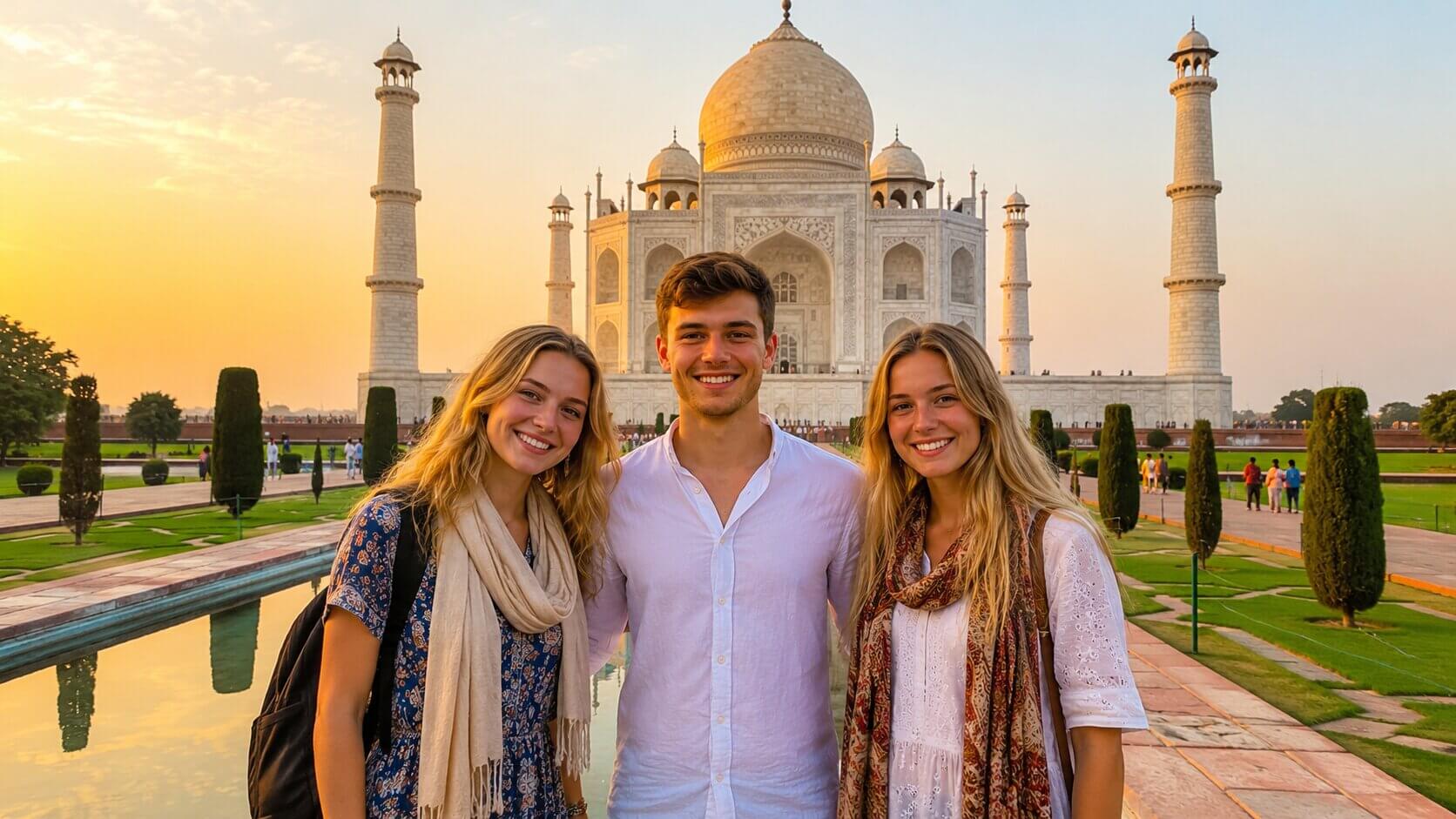
The single most important design decision in any Taj Mahal tour from the UK is the timing of the visit, and UK India Tourism always prioritises the sunrise experience for British clients. The Taj Mahal complex opens one hour before sunrise, typically between 5:30 and 6:30 AM depending on the season and the monument in the first hour of daylight has a quality that no other time of day replicates. The marble in the predawn light is luminous, almost spectral; as the sun rises across the Yamuna River, the surface shifts through silver to blush pink to pale gold to the brilliant, almost painful white of full morning. In this first hour, before the main crowds of domestic and international visitors arrive, the complex feels closer to the intimate, personal space Shah Jahan intended it to be.
UK India Tourism arranges skip-the-line priority access to the Taj Mahal, ensuring that British guests pass through ticketing and security quickly and efficiently. Your private guide, carefully selected for expertise, language fluency, and the ability to communicate the monument's full historical and artistic significance to a British audience, leads a comprehensive two-to-three-hour tour of the complex, covering the great gateway, the mausoleum exterior and interior, the mosque, the guest house, and the subsidiary garden areas. After the mausoleum tour, we take guests to Mehtab Bagh on the opposite bank of the Yamuna River, where the entire Taj Mahal complex is visible in a sweeping panoramic view that provides the most celebrated Taj Mahal photography opportunities in Agra.
For British visitors with time for a sunset visit as well which we arrange for all clients staying two nights in Agra, the monument in late afternoon light is warmer, more golden, and deeply beautiful in a different register from the sunrise. The long horizontal light of the late afternoon catches the surface of the marble and the edges of the inlay work with particular clarity, and as the day's crowds thin toward closing time, the complex takes on an atmosphere of quiet reflection that many British visitors find even more moving than the busy, brilliant morning. The Taj Mahal full moon viewing, available on the night of the full moon and the two adjacent evenings, excluding Ramadan, provides a third, extraordinary experience for British clients who time their visit accordingly.
The Golden Triangle India Tour from UK
The Golden Triangle - linking Delhi, Agra and Jaipur in a circuit of five to eight days, is the cornerstone of our UK Taj Mahal tour programme and the most consistently satisfying itinerary we design for British clients. In this circuit, three great cities of the Mughal and Rajput world reveal themselves in sequence, each with its own distinct architectural vocabulary, culinary tradition, and chapter of Indian history. Between them they contain more UNESCO World Heritage Sites than most entire countries, and they provide the full sweep of North India's heritage landscape with the efficiency and comfort that British travellers appreciate.
New Delhi: Seven Cities in One
Delhi is a city of extraordinary historical layering, it has served as the capital of a succession of empires over more than a millennium, and each of those empires has left its physical mark on the landscape. A private guide brings this complexity to life with a narrative fluency that transforms Delhi from an overwhelming megalopolis into an intelligible, endlessly fascinating place. Old Delhi, the Shahjahanabad built by Shah Jahan in the 1640s, retains the character of a seventeenth-century Mughal city in the dense lanes around the Red Fort and Jama Masjid. The Red Fort, built in red sandstone between 1638 and 1648, served as the main residence of the Mughal emperors until 1857 and contains some of the finest Mughal domestic architecture in existence, including the exquisite marble Rang Mahal and the Diwan-i-Khas where the Peacock Throne once stood. The Jama Masjid opposite, completed in 1656, is India's largest mosque and one of its most beautiful, its great red sandstone and marble courtyard capable of accommodating twenty-five thousand worshippers.
South Delhi's heritage circuit offers a very different perspective: the Qutab Minar complex, where the twelfth and thirteenth-century monuments of the Delhi Sultanate stand alongside a fourth-century iron pillar that has not rusted in sixteen hundred years; Humayun's Tomb, the 1572 garden mausoleum that served as the direct architectural prototype for the Taj Mahal; and the Lodi Garden, where the fifteenth-century tombs of the Lodi and Sayyid sultans sit in public parkland that is simultaneously one of Delhi's finest archaeological sites and most beloved green spaces. Lutyens' New Delhi, the imperial capital designed by Edwin Lutyens and Herbert Baker for the British Raj and inaugurated in 1931, provides a final, very particular chapter: the grand boulevard of Rajpath, the sandstone facades of Parliament and the Presidential Palace, and the triumphal arch of India Gate.
Agra: The Taj Mahal and the Mughal World
Agra was the capital of the Mughal Empire during the reigns of its three greatest emperors - Akbar, Jahangir, and Shah Jahan and the city's heritage circuit extends well beyond the mausoleum that has made it the most visited monument in India. Agra Fort, two kilometres from the Taj Mahal, is a UNESCO World Heritage Site in its own right: a vast citadel begun by Akbar in 1565 in red sandstone and progressively refined by his successors in marble, its successive courtyards containing some of the finest Mughal palace architecture in existence. The Diwan-i-Am (Hall of Public Audience) and the Diwan-i-Khas (Hall of Private Audience) establish the formal scale of Mughal imperial architecture, while the more intimate Khas Mahal and Musamman Burj, the octagonal marble pavilion from which Shah Jahan in his final imprisonment could see the distant dome of the Taj Mahal across the river, speak to the more personal dimensions of Mughal history.
The story of Shah Jahan's imprisonment by his son Aurangzeb, the emperor who built the world's most beautiful building spending his final years staring at it from behind bars, is one of the most powerful human narratives in Indian history, and it gives Agra Fort a depth of emotional resonance that British visitors particularly appreciate. The Baby Taj - the Itimad-ud-Daulah mausoleum built by Empress Nur Jahan for her father between 1622 and 1628, is the first Mughal building constructed entirely in white marble and the prototype for the pietra dura inlay technique later perfected at the Taj Mahal. Far less visited than the Taj Mahal and Agra Fort, it rewards the close attention of British visitors with an interest in architectural history.
Fatehpur Sikri, forty kilometres south-west of Agra, deserves extended time on any serious Taj Mahal tour from the UK. This complete Mughal city, built by Emperor Akbar in red sandstone between 1569 and 1585 and abandoned within two decades due to water scarcity, is one of the most perfectly preserved examples of Mughal urban planning in existence. The Buland Darwaza, the Gate of Magnificence, fifty-four metres high and the largest gateway in the Mughal world, announces the scale of Akbar's ambition. Within the city walls, the Panch Mahal, the Diwan-i-Khas with its singular central column, and the tomb of the Sufi saint Salim Chishti, enclosed in exquisite white marble screen-work, represent the full range of Mughal architectural ingenuity at its height.
Jaipur: The Pink City and the Rajput World
The journey from Agra to Jaipur through the Rajasthani countryside is one of the great road journeys of the Indian Subcontinent, a natural transition from the Mughal world of the Ganges plain to the Rajput world of the desert edge, the landscape shifting from irrigated flat land to the rocky, sun-baked terrain of the Aravalli hills as Jaipur approaches. The city itself, founded in 1727 by Maharaja Jai Singh II and planned according to ancient Vedic town-planning principles, is immediately distinctive: the old walled city is painted in warm terracotta-pink, and the broad planned avenues of Jai Singh's original grid give Jaipur an architectural coherence that contrasts with the organic density of Delhi and Agra.
The Amber Fort, Jaipur's defining monument, rises on a hillside above Maota Lake twelve kilometres north of the city. Approaching it along the lakeside road, with the fort's honey-coloured battlements reflected in the water and peacocks calling from the slopes above, provides one of the most immediately spectacular arrivals in Indian travel. Within the fort, the Ganesh Pol gate, painted in intricate frescoes and inlaid with mirror work, opens into the royal apartments, where the Sheesh Mahal (Hall of Mirrors) dazzles with a ceiling encrusted in thousands of mirror fragments that scatter a single candle flame into a thousand reflections. The Sukh Niwas (Hall of Pleasure), cooled by a water channel running through its marble floor, demonstrates the environmental ingenuity of Rajput architecture in the desert climate.
The City Palace at Jaipur's centre contains one of India's finest royal museums, with collections of Mughal and Rajput textiles, weapons, manuscripts, and miniature paintings housed in the magnificent Mubarak Mahal and Sileh Khana. The Hawa Mahal's extraordinary five-storey facade, nine hundred and fifty-three latticed sandstone windows from which the royal ladies could observe street life unseen, is Jaipur's most instantly recognisable image. The Jantar Mantar observatory, with its nineteen giant geometric instruments designed to measure time and track celestial bodies, is one of UNESCO's most unusual listed sites and a particular favourite among British visitors for its combination of visual drama and scientific ingenuity.
Luxury India Tours from UK: Extending Beyond the Golden Triangle
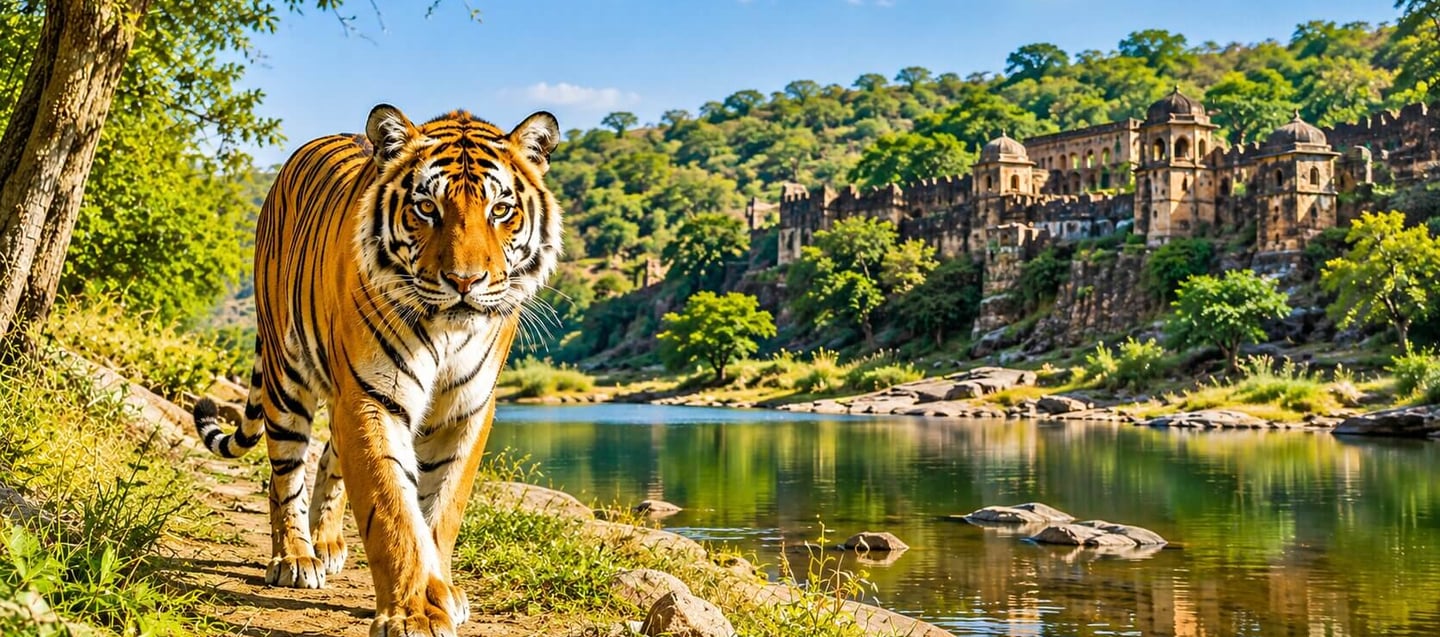
The Golden Triangle is a superb foundation but for British travellers with more than a week to devote to India, the possibilities for extending the Taj Mahal tour are extraordinary. The most popular extensions among our UK clients include the Rajasthan desert circuit, moving through the Blue City of Jodhpur, the Lake City of Udaipur, and the desert fortress of Jaisalmer; the India Tigers and Taj Mahal tour combining the Golden Triangle with a Bengal tiger safari in Ranthambore National Park; the Spiritual India extension adding Varanasi, the ancient holy city on the Ganges, for a profound encounter with Hindu religious tradition; and the South India extension combining the Taj Mahal and Rajasthan with the tropical backwaters of Kerala, the temple cities of Tamil Nadu, or the colonial heritage of Goa.
Many of our most enthusiastic UK clients return to India with us multiple times, each journey deepening their engagement with a country whose diversity and complexity reward repeated visits. We have British clients who have visited India six, eight, or ten times with UK India Tourism, each itinerary revealing a different face of this inexhaustible Subcontinent. The Taj Mahal remains the constant — the monument around which every India journey is anchored, whatever new territories it explores.
Sample Itineraries: Taj Mahal Tours from UK
Golden Triangle Classic - 8 Nights / 9 Days from UK
• Day 1: Depart UK — overnight flight to Delhi
• Day 2: Arrive New Delhi — private transfer, luxury hotel, Old Delhi evening walk
• Day 3: Delhi — Red Fort, Jama Masjid, Chandni Chowk, Qutab Minar, Raj Ghat
• Day 4: Delhi — Humayun's Tomb, Lodi Garden, India Gate, New Delhi architecture tour
• Day 5: Delhi to Agra by Gatimaan Express — Agra Fort, Baby Taj, Mehtab Bagh sunset
• Day 6: Taj Mahal sunrise — full guided complex tour, Fatehpur Sikri afternoon
• Day 7: Agra to Jaipur by private vehicle — Abhaneri Chand Baori stepwell en route
• Day 8: Jaipur — Amber Fort, City Palace, Hawa Mahal, Jantar Mantar
• Day 9: Jaipur at leisure, evening flight to UK
Taj Mahal with Rajasthan and Tigers - 14 Nights / 15 Days from UK
• Day 1: Depart UK — overnight flight
• Days 2–4: Delhi (3 full days — Old Delhi, New Delhi, Humayun's Tomb, Qutab)
• Day 5: Delhi to Agra — Agra Fort, Baby Taj, Mehtab Bagh
• Day 6: Taj Mahal sunrise — full complex, Fatehpur Sikri
• Day 7: Agra to Ranthambore — afternoon tiger game drive
• Day 8: Morning tiger safari, drive to Jaipur
• Days 9–10: Jaipur — Amber Fort, City Palace, markets
• Day 11: Jaipur to Jodhpur — Mehrangarh Fort, Blue City
• Day 12: Jodhpur to Udaipur — Kumbhalgarh en route
• Days 13–14: Udaipur — City Palace, Lake Pichola, Sajjangarh
• Day 15: Fly home to UK from Udaipur or Mumbai
Luxury Hotels on Our UK Taj Mahal Tours
UK India Tourism partners exclusively with India's finest hotel properties, selected for quality of accommodation, location, food, and the authentic sense of place that British travellers value. In Agra, the Oberoi Amarvilas, where every room commands an unobstructed view of the Taj Mahal, is the most celebrated hotel recommendation we make; it transforms the Taj Mahal experience from a day-visit into a twenty-four-hour immersion, with the mausoleum visible from the bath, the dining room, and the terrace. The ITC Mughal, set in twenty-three acres of Mughal-inspired gardens, and the Taj Hotel and Convention Centre Agra are our other preferred Agra properties.
In Delhi, The Leela Palace New Delhi and The Imperial on Janpath are our principal recommendations for British clients seeking the finest in capital city accommodation. The Imperial - a landmark of the Raj era inaugurated in 1936, set on Janpath boulevard in the heart of Lutyens' New Delhi, contains one of the finest private art collections of any hotel in Asia and provides British visitors with a particularly resonant sense of connection to India's colonial and post-colonial history. The Lodhi, a contemporary luxury property in South Delhi set in lush private gardens, provides a different aesthetic: quieter, greener, and closer to Humayun's Tomb and the Lodi Garden heritage circuit. Across Rajasthan, we work with the palace hotels of Rambagh Palace Jaipur, RAAS Jodhpur, the Taj Lake Palace Udaipur, and Suryagarh Jaisalmer.
India e-Visa for British Passport Holders
British passport holders apply for an Indian e-Tourist Visa online, without the need to post a passport or attend a consulate. The e-Visa is available for stays of up to sixty days from the date of first arrival and covers tourism, heritage sightseeing, yoga, and recreational visits. The application requires a valid British passport with at least six months of remaining validity, a recent passport photograph, and payment of the visa fee; approvals are typically returned within forty-eight to seventy-two hours. UK India Tourism provides comprehensive e-Visa guidance and a step-by-step application checklist as a standard part of every booking, and we recommend applying three to four weeks before departure to allow comfortable processing time.
Best Time to Visit the Taj Mahal from the UK
The optimal season for British visitors to the Taj Mahal is October through March, when northern India enjoys its cool, dry season and the Taj Mahal is at its most photogenic in clear, golden light. November through February offers the finest conditions for both sightseeing and photography, with daytime temperatures in the mid-twenties Celsius and cool evenings that make outdoor dining and evening walks in Jaipur or Old Delhi a particular pleasure. The Christmas and New Year period, when British schools are on holiday, is the most popular time for UK families to visit India, and demand for the finest hotels and private guides is extremely high; we strongly recommend booking six to nine months in advance for December and January travel.
February is an especially popular month for British honeymooners visiting the Taj Mahal - comfortably warm, brilliantly clear, and with the mausoleum surrounded by the winter garden at its most attractive. March brings the Festival of Holi, whose explosion of powdered colour and communal celebration transforms Rajasthan into one of the most visually spectacular events on the Indian calendar. October and September represent excellent shoulder-season options with fewer crowds, good value, and the deep green landscape that follows India's monsoon rains.
Talk to Our UK India Tourism Specialists
UK India Tourism is staffed by India specialists with deep, current, personal knowledge of the destinations they design itineraries for people who have visited the Taj Mahal at sunrise on many occasions, who know which suite at the Oberoi Amarvilas commands the finest view, who understand the difference between a great Agra guide and a merely competent one, and who bring that knowledge to every itinerary they craft. We work with a small number of clients at any one time, which means that every enquiry receives genuine, individual attention from a specialist who takes a personal interest in the quality of your India experience.
We work with British clients of all backgrounds - first-time India visitors seeking a definitive introduction to the country's greatest heritage sites; experienced India travellers seeking new itineraries and deeper encounters; families bringing children to see the Taj Mahal for the first time; honeymoon couples seeking the most romantic possible India journey; and solo travellers seeking the confidence and security of private, expertly supported travel in a complex country. Whatever your background, your interests, and your vision for India, UK India Tourism has the knowledge and the passion to make it real.
India is one of the great journeys of a lifetime. The Taj Mahal is its most unforgettable moment. Let UK India Tourism design your perfect private India tour from the UK and make the Taj Mahal everything you have always imagined it to be.
Ready when you are
Let Us Bring Your India Dream to Life
UK India Tourism Company
UK Phone: +44 7345 191205
India Phone: +91 9958 480873
Email: sales@ukindiatourism.co.uk
Luxury India Tour Specialists for UK, USA, Canada, Australia, Europe, Singapore, Japan and beyond
UK: +44 7345191205
UK India Tourism© 2026, all rights reserved
India: +91 9958480873
⭐⭐⭐⭐⭐ 4.9/5 | 2,600+ Travelers | 18 Years | 98% Recommend